
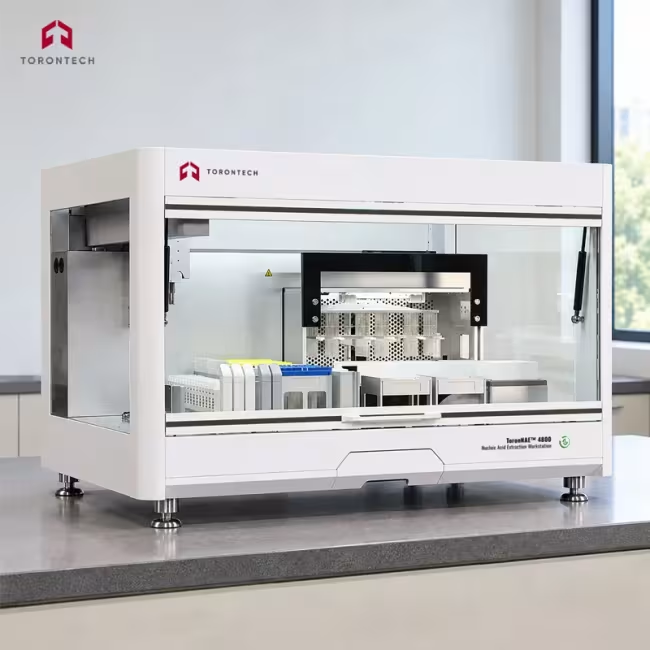
Nucleic Acid Extraction Workstation - ToronNAE™ 4800
ToronNAE™ 4800 High-Capacity Automated Nucleic Acid Extraction Workstation
The ToronNAE™ 4800 nucleic acid extraction workstation automates every step between the primary sample tube and a loaded PCR plate for up to 48 samples per run. Clinical, blood screening, and public health labs use it to remove manual pipetting from extraction and assay setup. A three-channel pipetting arm transfers samples and reagents, a magnetic bead module purifies the nucleic acid, and the same arm then dispenses PCR or qPCR reactions. The whole process runs without operator intervention once the deck is loaded.
Speed suits high-volume testing. The workstation pipettes 48 samples in about 13 minutes and completes extraction in 15 to 30 minutes, depending on the reagent kit. It processes 50 µL to 1000 µL per sample and elutes 40 µL to 200 µL. Operators can choose bottled reagents or prefilled cartridges, and single-sample consumables are supported for small batches. Purification and PCR setup can run in parallel to shorten turnaround time.
Contamination control runs throughout the enclosure. Air displacement pipetting and anti-drip technology keep liquid away from the pipetting channels, while a negative-pressure system with three HEPA filters traps aerosols. Separate UV lamps cover the extraction, pipetting, and waste areas. A built-in barcode reader tracks every sample and reagent through the run. A modular worktable accepts custom layouts and additional devices.
Nucleic Acid Extraction Workstation - ToronNAE™ 4800 Applications
The ToronNAE™ 4800 serves labs that need traceable, hands-off extraction and PCR setup at 48-sample scale. Its sample rack accepts primary tubes, test tubes, and centrifuge tubes for a broad range of specimen types.
- Clinical Molecular Diagnostics: automated extraction and PCR setup from swabs, blood, and saliva for infectious disease testing
- Blood Screening: nucleic acid testing of serum, plasma, and whole blood for transfusion-transmitted pathogens
- Public Health and Epidemic Response: high-volume pathogen testing during outbreaks, with barcode traceability for every sample
- Animal Husbandry and Veterinary Medicine: pathogen and genotyping workflows on animal tissues, blood, and swabs
- Food Safety Testing: extraction from microorganisms and cell culture fluids for foodborne pathogen and GMO assays
- Environmental Microbiology: nucleic acid recovery from soil and environmental microorganisms
- Forensic Laboratories: consistent DNA extraction from buccal swabs, blood, and tissue for identification work
- Pathology and Research Labs: DNA extraction from FFPE tissue and purification of PCR or enzyme reaction products
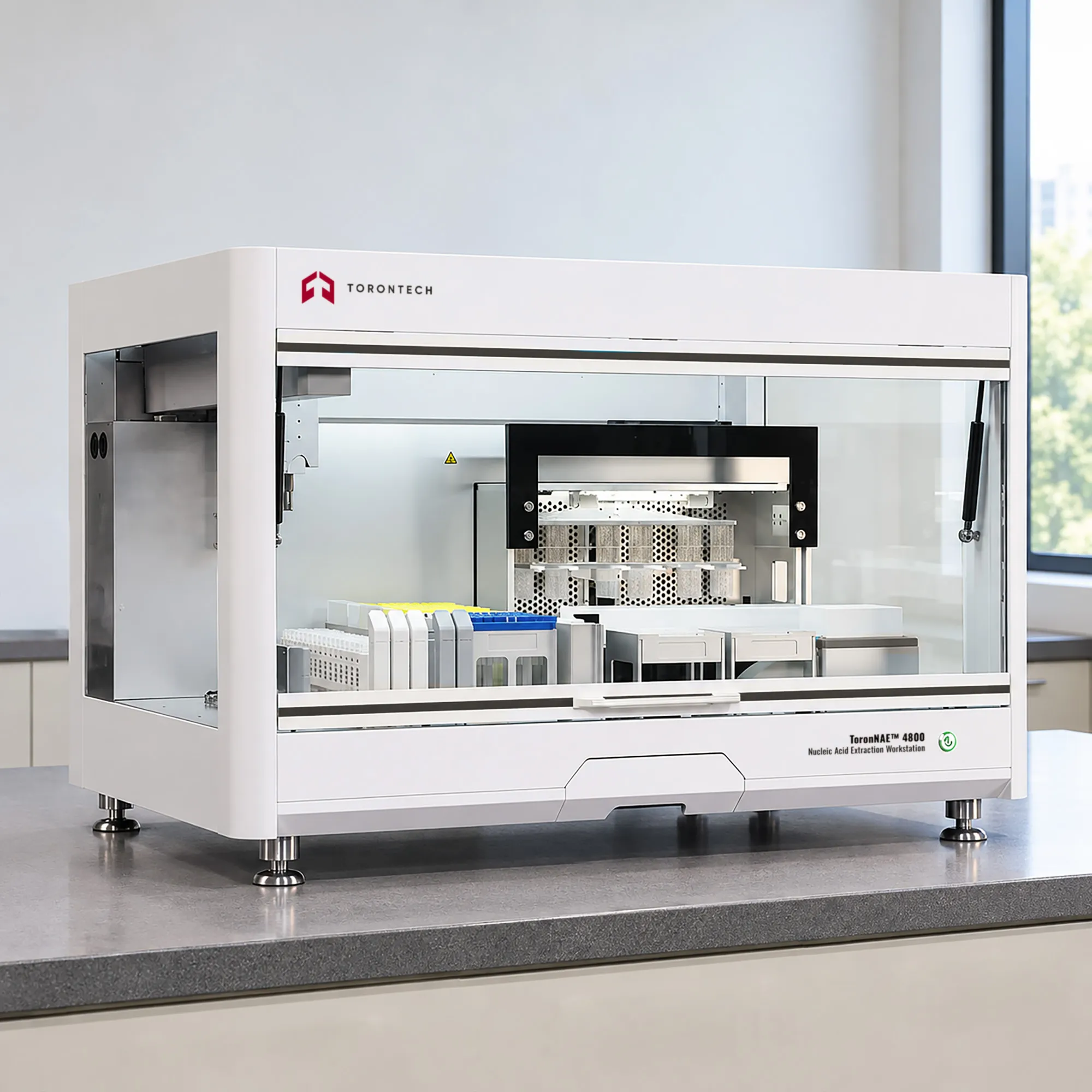
Nucleic Acid Extraction Workstation - ToronNAE™ 4800 Key Features
The ToronNAE™ 4800 combines liquid handling, magnetic bead extraction, and PCR setup on one modular deck. Each feature targets faster turnaround, full traceability, and lower contamination risk.
- Sample-to-PCR Automation: pipetting, lysis, washing, elution, and PCR or qPCR setup run in one workstation without manual transfers
- Fast 48-Sample Runs: about 13 minutes to pipette 48 samples and 15 to 30 minutes for extraction, depending on the kit
- Three-Channel Pipetting Arm: two 1000 µL channels and one 200 µL channel cover 1 µL to 1000 µL with CV as low as 0.4%
- Pressure-Based Liquid Detection: senses liquid level, tip clogs, and residual liquid on every aspiration
- Liquid-Specific Parameters: built-in liquid libraries and adjustable settings improve accuracy for each reagent type
- Parallel Purification and PCR Setup: runs extraction and reaction setup side by side to shorten turnaround time
- Barcode Traceability: automatic tube scanning and external USB scanner support track samples and reagents through the run
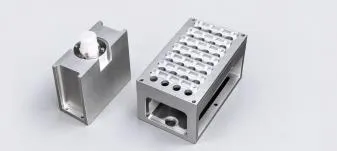
Vortex Magnetic Beads and PCR Reagent Block
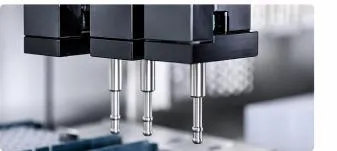
High-Precision Pipetting
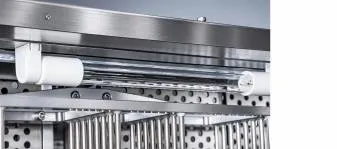
Effective Cross-Contamination Prevention
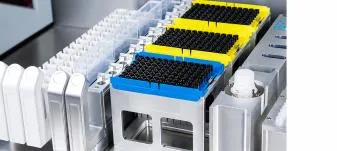
Fast & Flexible Experiment
- Flexible Sample Rack: 48-position rack accepts sample tubes, test tubes, and centrifuge tubes, including primary tubes
- Bottled or Prefilled Reagents: choose open bottled reagents or pre-packaged cartridges, with single-sample consumables supported
- Magnetic Bead Vortex: stable vortexing keeps bead stocks uniform for consistent binding across all samples
- Heated Extraction Area: built-in incubator heats lysis and elution steps up to 120 °C
- Optional Cooling Block: 0 °C to 105 °C block keeps PCR reagents cold, with customizable reagent block formats
- Air Displacement Pipetting and Anti-Drip Control: prevents liquid contact with channels and drip contamination across the deck
- Three-Zone UV and HEPA Protection: separate UV lamps for extraction, pipetting, and waste areas plus three HEPA filters under negative pressure
- Smart Waste Container: calculates tip fill level and expands storage space for used tips
- Graphical Software with Consumable Libraries: build complete protocols without complex programming using built-in carrier and liquid libraries
- Modular Worktable: customizable deck layouts and integration of additional devices as needs grow
Theory and Method
Magnetic bead extraction isolates nucleic acids on the surface of silica-coated paramagnetic particles. A lysis buffer with chaotropic salts breaks open cells and viral particles and strips proteins from DNA and RNA. Under these conditions, nucleic acids bind tightly to the bead surface. Wash buffers remove salts, proteins, and PCR inhibitors while the nucleic acids stay attached. A low-salt elution buffer, heated in the extraction area, then releases purified DNA or RNA into solution.
The ToronNAE™ 4800 links this chemistry to a liquid handler. The arm first reads each tube barcode and transfers samples and reagents into the extraction plate. Magnetic rods inside a disposable comb carry the beads through lysis, wash, and elution wells, while a heated incubator holds lysis and elution steps at up to 120 °C. A dedicated vortex keeps the bead stock evenly suspended for uniform dosing. Once elution finishes, the arm dispenses eluate and master mix into PCR plates or strips.
Air displacement pipetting keeps a cushion of air between the piston and the liquid, so samples never touch the pipetting channel. Pressure sensing on each channel detects the liquid surface, residual volume, and tip clogs during aspiration. Liquid-class parameters adjust speed, delay, and blowout for viscous or volatile reagents, which raises accuracy across reagent types. Anti-drip control holds liquid in the tip as the arm crosses the deck. Together these controls keep extraction uniformity at a CV of 5% or less.
Nucleic Acid Extraction Workstation - ToronNAE™ 4800 Technical Specifications
| Parameter | Specification |
|---|---|
| Function | Automatic sample pipetting, nucleic acid extraction, and PCR/qPCR setup |
| Extraction Method | Magnetic bead method, magnetic rod comb extraction |
| Samples per Run | 1 to 48 |
| Maximum Reaction System | 1 mL |
| Process Volume | 50 µL to 1000 µL |
| Elution Volume | 40 µL to 200 µL |
| Extraction Time | 15 to 30 min for 48 samples (reagent dependent) |
| Sample Pipetting Time | About 13 min for 48 samples |
| Extraction Uniformity | CV ≤ 5% |
| Single-Sample Consumables | Supported |
| Reagent Format | Bottled or prefilled cartridges |
| Pipetting Principle | Air displacement |
| Pipettors | Two 1000 µL pipettors and one 200 µL pipettor |
| Pipetting Range | 1 µL to 1000 µL |
| Liquid Detection | Pressure detection: liquid level, tip clogging, residual liquid |
| Tips | Dedicated tips and compatible third-party tips |
| Heating Temperature | Lysis and elution control: room temperature to 120 °C |
| Cooling Block | 0 °C to 105 °C (optional) |
| PCR Setup Capacity | 2 × 96-well PCR plates or 24 × 8-strip PCR tubes |
| Sample Rack | 48 positions for sample tubes, test tubes, and centrifuge tubes, with barcode scanner |
| Information Management | Automatic barcode scanning; external USB scanner support |
| UV Sterilization | Separate UV lamps for extraction area, pipetting area, and waste container area |
| Fan Filter | Three HEPA filters, negative pressure system |
| Instrument Port | USB |
| Voltage | 220 V, 8 A, 50/60 Hz (110V is also available) |
| Power Consumption | 30 W standby, 550 W maximum |
| Noise | ≤ 60 dB |
| Dimensions (W × D × H) | 1090 × 695 × 724 mm |
| Net Weight | 130 kg |
Pipetting Performance
| Parameter | 200 µL Pipettor | 1000 µL Pipettor |
|---|---|---|
| Pipetting Range | 1 µL to 200 µL | 5 µL to 1000 µL |
| Accuracy | 1 µL: ±12%; 20 µL: ±3%; 100 µL: ±1%; 200 µL: ±1% | 5 µL: ±5%; 100 µL: ±2%; 500 µL: ±1%; 1000 µL: ±1% |
| Precision (CV) | 1 µL: ≤ 8%; 20 µL: ≤ 1.5%; 100 µL: ≤ 0.8%; 200 µL: ≤ 0.5% | 5 µL: ≤ 2.5%; 100 µL: ≤ 1.25%; 500 µL: ≤ 0.4%; 1000 µL: ≤ 0.4% |
Deck Layout
| Area | Description |
|---|---|
| Pipetting Arm | 3-channel arm with two 1000 µL pipettors and one 200 µL pipettor |
| Sample Area | 48-position rack for sample tubes, test tubes, and centrifuge tubes, with barcode scanner |
| Reagent Area | Separate zones for extraction reagents and PCR reagents |
| Tip Area | Two 1000 µL and one 200 µL tip racks |
| Waste Area | Tip waste container with fill-level calculation |
| Magnetic Bead Vortex | Bead resuspension module |
| Nucleic Acid Extraction Area | 48-sample extraction with heating incubator up to 120 °C |
| PCR Setup Area | 2 × 96-well PCR plates or 24 × 8-strip PCR tubes |
Consumables
| Item | Description |
|---|---|
| 96 Deep-Well Plate | 2.2 mL plate for extraction reagents |
| Magnetic Rod Comb | Disposable comb that covers the magnetic rods |
| 5 mL Sample Tube | Tube for sample loading |
| 1.5 mL and 7 mL Centrifuge Tubes | Tubes for samples and reagents |
| 15 mL Wide-Mouth Bottle | Bottle for bulk reagents |
| 100 mL Reservoir | Reservoir for high-volume reagents |
| 200 µL and 1000 µL Tips | Boxed tips for the pipetting arm |