
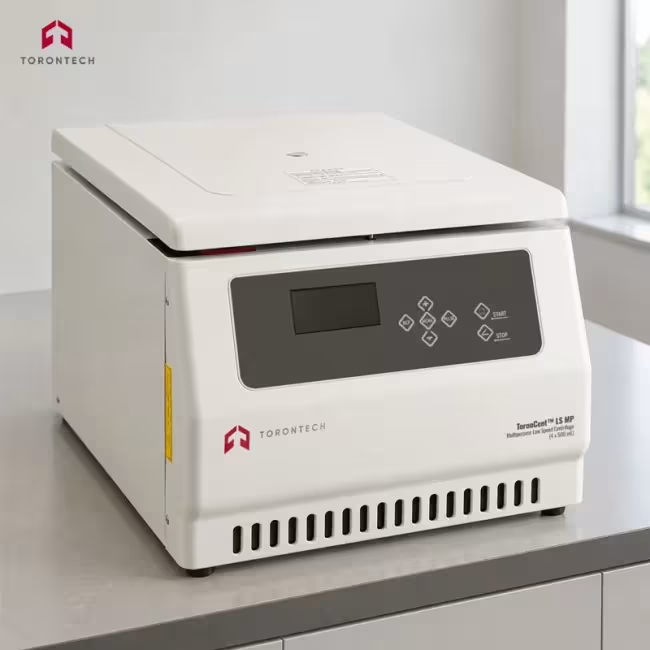
Multipurpose Low Speed Centrifuge (4 x 500 mL) - ToronCent™ LS MP
ToronCent™ LS MP multipurpose low speed centrifuge holds 4 x 500 mL and reaches 5,500 rpm and 5,310 x g. Clinical research groups and cell culture laboratories use it for routine separations that span several tube formats rather than one fixed workload. Five rotors cover 15 mL angle work, 100 mL and 200 mL swing loads, 500 mL buckets, and 96-well plates. The instrument occupies a 470 mm wide footprint and weighs 50 kg.
Rotor choice sets the working envelope. A 12 x 15 mL angle rotor delivers the top speed and 5,310 x g for pelleting small volumes. A 4 x 100 mL swing rotor runs at 5,000 rpm and 4,390 x g, and a 4 x 200 mL version reaches 4,200 rpm. The 4 x 500 mL swing rotor accepts round, rectangular, and microplate buckets, with adapters covering 1.5 mL microtubes up to 250 mL bottles. A dedicated microplate rotor spins two stacks of 96-well plates.
A microprocessor controller calculates RCF automatically, so operators enter either speed or g-force without converting by hand. The unit stores 25 user-defined programs for repeat methods. Nine acceleration and ten deceleration profiles let the operator slow the ramp enough to keep separated layers from remixing. Self-diagnostic monitoring covers the door interlock, over-speed conditions, motor temperature, operator error, and communication faults.
Multipurpose Low Speed Centrifuge (4 x 500 mL) - ToronCent™ LS MP Applications
The ToronCent™ LS MP fits laboratories running mixed sample formats on a single instrument rather than dedicating one machine per workflow.
- Clinical Research Laboratories: routine serum and plasma separation with up to 124 vacuum blood collection tubes loaded per run
- Urinalysis: sediment concentration in 10 mL and 15 mL tubes ahead of microscopic examination, using gentle deceleration to leave the sediment button intact
- Cell Washing and Blood Banking: repeated wash and resuspension cycles across 32 x 15 mL tubes carried in the 4 x 200 mL swing rotor
- Cell Culture: harvesting suspension cultures in 250 mL and 500 mL containers without splitting the batch across multiple spins
- Microplate and Bead Assays: spin-down of 96-well and deep-well plates for ELISA, magnetic bead, and filtration protocols
- Molecular Biology: recovery of nucleic acid and protein precipitates in 1.5 mL microtubes and 15 mL conical tubes
- Cytology and Histology Sample Preparation: concentration of dilute cell suspensions ahead of slide preparation
- Pharmaceutical and Chemical Quality Control: clarification of suspensions and emulsions before instrumental analysis
- Environmental and Food Testing: sediment recovery and clarification of large volume aqueous samples
Standards
No test method or safety standard appears in the source documentation for the ToronCent™ LS MP, so this page states no compliance claim. The self-diagnostic set covering door interlock, over-speed, motor temperature, and communication faults operates as protective design rather than certified conformity to a published standard. Laboratories that require documented centrifuge safety, electromagnetic compatibility, or regional market access approval should request the certificates ahead of ordering. Torontech supplies the documentation the manufacturer holds on request.
Multipurpose Low Speed Centrifuge (4 x 500 mL) - ToronCent™ LS MP Key Features
The rotor range, program memory, and ramp control target laboratories that switch between sample types several times a day.
- Five-Rotor Range: covers 12 x 15 mL angle work, 4 x 100 mL and 4 x 200 mL swing loads, 4 x 500 mL buckets, and 96-well plates on one drive
- 5,310 x g Maximum: reaches a g-force ceiling wide enough to absorb clarification work that would otherwise call for a second instrument
- Automatic RCF Calculation: converts between rpm and x g so protocols written in either unit run without hand conversion
- 25 Stored Programs: recalls routine methods on demand, removing repeat setup for high frequency assays
- Nine Acceleration and Ten Deceleration Profiles: match ramp rates to sample fragility and keep settled layers from remixing during slow-down
- DC Brushless Motor: runs without carbon brushes, leaving no carbon dust in the chamber and no brush replacement over the service life
- Microprocessor Speed Control: holds set speed within ±10 rpm across the full range
- Door Interlock Monitoring: blocks the run when the lid is not secured and reports interlock faults to the operator
- Over-Speed Protection: stops the run if the rotor exceeds its rated speed, protecting the lower rated swing and microplate rotors
- Motor Overheat Detection: shuts the drive down ahead of thermal damage, which matters during back-to-back batches
- Misoperation and Communication Fault Alerts: catch entry errors and internal signal faults and report them rather than failing silently
- Wide Adapter Range: covers 1.5 mL microtubes up to 250 mL bottles, including conical, round, self-standing, and vacuum blood collection formats
- Interchangeable Bucket Types: round, rectangular, and microplate buckets all fit the same 4 x 500 mL swing rotor
- Compact 470 mm Footprint: fits a standard bench run at 50 kg without dedicated floor space
- Noise at or Below 65 dB(A): keeps a shared laboratory workable through long runs
Theory and Method
Centrifugation accelerates sedimentation by spinning a sample so that radial acceleration stands in for gravity. Relative centrifugal force depends on the rotating radius and the square of the speed, which is why one drive produces 5,310 x g on a compact angle rotor and 2,200 x g on a microplate rotor. Particles settle at a rate governed by their size, the density gap against the medium, and its viscosity. Larger and denser material clears first, leaving a supernatant the operator can draw off.
Rotor geometry decides how the pellet forms. The fixed angle rotor holds tubes at a set tilt, so particles travel a short path to the tube wall and slide down into a sloped pellet, which speeds up routine clarification. Swing-out buckets rotate to horizontal under load, sending sediment straight down the tube axis into a flat pellet that resists disturbance during decanting. The microplate rotor applies the same swing principle to well plates, driving liquid and beads to the well bottom.
Deceleration matters as much as speed for delicate separations. A hard stop drags the rotor against the settled layer and can resuspend a soft pellet or blur a boundary that just formed. Ten deceleration profiles let the operator pick a gentle coast for urine sediment and cell washing work, or a fast brake for robust pellets when throughput matters more. Nine acceleration profiles do the same at the start of the run, easing the sample up to speed instead of shocking it.
Multipurpose Low Speed Centrifuge (4 x 500 mL) - ToronCent™ LS MP Technical Specifications
| Parameter | Specification |
|---|---|
| Maximum Speed | 5,500 rpm |
| Maximum RCF | 5,310 x g |
| Maximum Capacity | 4 x 500 mL |
| Speed Accuracy | ±10 rpm |
| Time Setting Range | 1 min to 99 min 59 s |
| Program Memory | 25 user-defined programs |
| Acceleration Profiles | 9 |
| Deceleration Profiles | 10 |
| Motor | DC brushless |
| Control | Microprocessor, automatic RCF calculation |
| Noise Level | ≤65 dB(A) |
| Voltage | AC 220 V ±22 V, 50/60 Hz (110V is also available) |
| Power Consumption | 750 W |
| Dimensions (W x D x H) | 470 x 560 x 380 mm |
| Packing Dimensions (W x D x H) | 547 x 727 x 422 mm |
| Net Weight | 50 kg |
Rotor Range
| Rotor | Type | Maximum Capacity | Maximum Speed | Maximum RCF |
|---|---|---|---|---|
| Rotor 1 | Fixed angle | 12 x 15 mL | 5,500 rpm | 5,310 x g |
| Rotor 2 | Swing-out (buckets ordered separately) | 4 x 500 mL | 4,000 rpm | 3,040 x g |
| Rotor 3 | Microplate | 2 x 2 x 96-well | 4,000 rpm | 2,200 x g |
| Rotor 4 | Swing-out | 4 x 100 mL | 5,000 rpm | 4,390 x g |
| Rotor 5 | Swing-out | 4 x 200 mL | 4,200 rpm | 3,100 x g |
Bucket and Adapter Options
| Rotor | Bucket or Bracket | Adapter Capacities |
|---|---|---|
| Rotor 1 | Not applicable | Direct tube loading, 12 x 15 mL |
| Rotor 2 | Round bucket | 4 x 1 x 250 mL; 4 x 2 x 100 mL; 4 x 4 x 50 mL (conical/round); 4 x 7 x 20 mL; 4 x 9 x 15 mL (conical/round); 4 x 11 x 15 mL conical (cap ≤21.5 mm); 4 x 14 x 10 mL; 4 x 19 x 5/7 mL vacuum blood collection; 4 x 36 x 1.5 mL |
| Rotor 2 | Rectangular bucket | 4 x 1 x 250 mL; 4 x 3 x 100 mL; 4 x 6 x 50 mL (conical/round); 4 x 12 x 15 mL (conical/round); 4 x 20 x 10 mL; 4 x 31 x 5/7 mL vacuum blood collection; 4 x 56 x 1.5 mL |
| Rotor 2 | Microplate bucket | 4 x 1 x 96 deep-well plate; 4 x 2 x 96 microplate |
| Rotor 3 | Microplate bucket | 2 x 2 x 96-well |
| Rotor 4 | Bracket, 4 x 100 mL | 4 x 50 mL; 4 x 50 mL (conical); 4 x 30 mL; 4 x 20 mL; 4 x 15 mL; 4 x 15 mL (conical); 4 x 3 x 5 mL vacuum tube; 4 x 2 x 10 mL; 4 x 4 accretion tubes; 4 x 3 x 1.5 mL |
| Rotor 5 | Bracket, 4 x 2 x 100 mL | 4 x 2 x 50 mL; 4 x 2 x 50 mL (conical); 4 x 2 x 30 mL; 4 x 2 x 20 mL; 4 x 2 x 15 mL; 4 x 2 x 15 mL (conical); 4 x 6 x 5 mL vacuum tube; 4 x 4 x 10 mL; 4 x 8 accretion tubes; 4 x 3 x 1.5 mL |
| Rotor 5 | Bracket, 4 x 8 x 15 mL | 5 mL; 7 mL; 10 mL |
| Rotor 5 | Bracket, 4 x 2 x 50 mL | Custom configurations available on request |
Custom bracket and adapter configurations are available across the swing-out rotor range.