
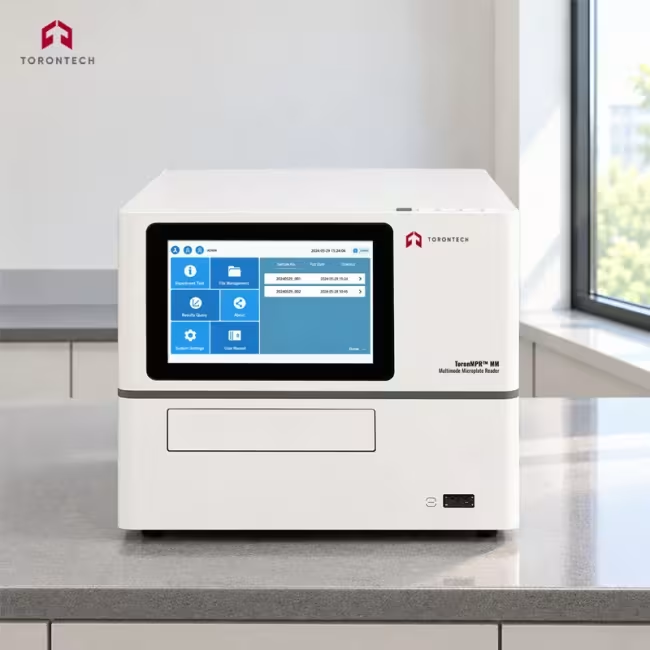
Multimode Microplate Reader - ToronMPR™ MM
ToronMPR™ MM Series Multimode Microplate Reader for Absorbance, Fluorescence and Luminescence
The ToronMPR™ MM multimode microplate reader combines absorbance, fluorescence, and luminescence detection in one benchtop instrument, with time-resolved fluorescence and fluorescence polarization on higher models. Drug discovery groups, biotech R&D labs, and university core facilities use it to run ELISA, reporter gene, cell viability, and binding assays on a single platform. Three models cover different needs. The ToronMPR™ MM3 handles absorbance, fluorescence, and luminescence. The MM4 adds time-resolved fluorescence, and the MM5 adds fluorescence polarization.
Absorbance uses a monochromator that selects any wavelength between 200 nm and 1000 nm, so no filters are needed for absorbance assays. Fluorescence uses filter-based optics with a xenon lamp and a photomultiplier tube (PMT) for high sensitivity. Filter modules slide out for quick changes, and the reader identifies each module by scanning its code. The reader accepts 6-well through 384-well plates, PCR plates, and microvolume plates. Optional dual injectors support flash luminescence and calcium flux assays.
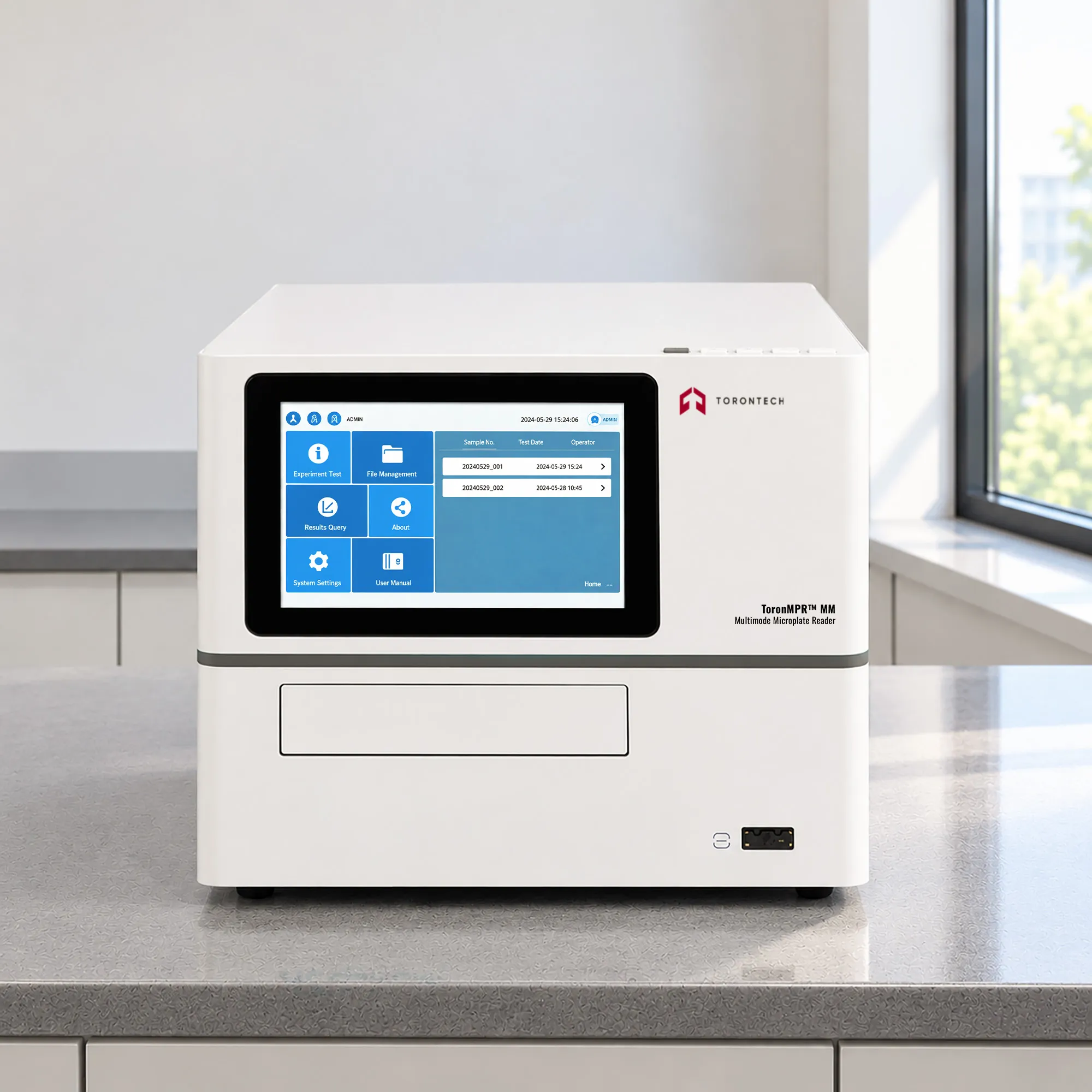
A 10-inch touchscreen with an adjustable viewing angle runs every function without a PC. Built-in software covers plate layout, standard curves, kinetics, spectral scanning, and custom algorithms. Four user permission levels keep each researcher's data secure. Programs and standard curves can be shared as QR codes and imported by scanning. Results upload directly to a network server by FTP, and the universal 100 V to 240 V AC input suits North American labs.
Multimode Microplate Reader - ToronMPR™ MM Applications
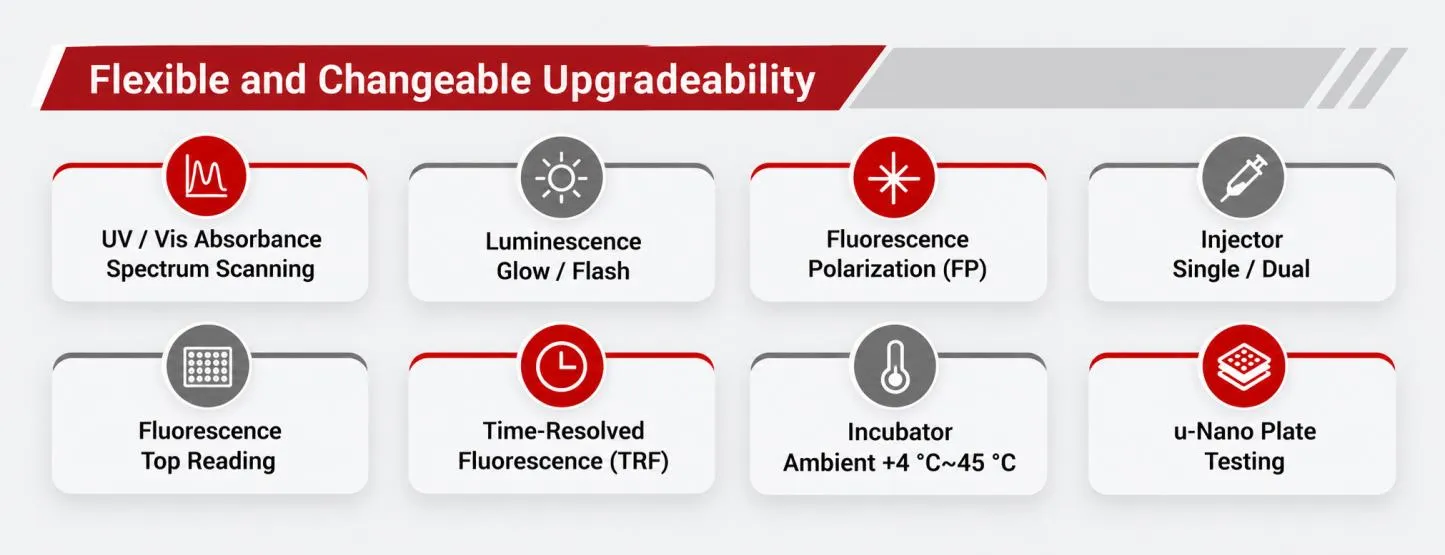
The ToronMPR™ MM serves labs that need several detection technologies but want one instrument and one software platform. Its upgradeable design lets labs start with core modes and add accessories as assays expand.
- Drug Discovery and Screening: compound screening with fluorescence, luminescence, TR-FRET, and FP assay formats in 96-well and 384-well plates
- Reporter Gene Assays: firefly and dual luciferase luminescence measurements with optional injectors for flash kinetics
- Cell Viability and Cytotoxicity: ATP luminescence, resazurin fluorescence, and MTT or CCK-8 absorbance assays
- ELISA and Immunoassays: colorimetric, fluorescent, and time-resolved fluorescence immunoassays for hormones, viral markers, and cytokines
- Nucleic Acid and Protein Quantification: fluorescent dye assays and microvolume absorbance using 2 µL to 4 µL samples
- Molecular Interaction Studies: fluorescence polarization for receptor-ligand binding, kinase activity, and protein-DNA interaction (MM5)
- Calcium Flux and Signaling: rapid injection and kinetic reading of intracellular calcium responses
- Enzyme Kinetics: temperature-controlled absorbance and fluorescence kinetics with spectral scanning
- Microbial and Cell Growth: OD readings with incubation and three shaking modes for growth curves

Fluorescence
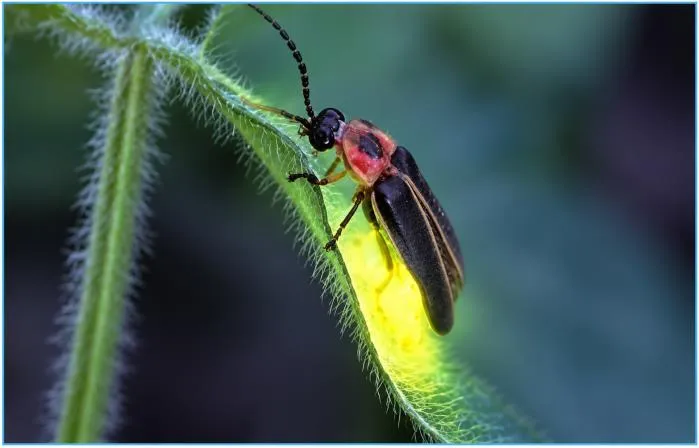
Luminescene
Multimode Microplate Reader - ToronMPR™ MM Key Features
The ToronMPR™ MM combines monochromator absorbance, filter-based fluorescence, and PMT luminescence in a modular, upgradeable reader. Each feature targets assay flexibility, sensitivity, and easy data sharing.
- Three Upgradeable Models: ToronMPR™ MM3 (ABS, FL, LUM), ToronMPR™ MM4 (adds TRF), and ToronMPR™ MM5 (adds FP) match capability to budget and assay needs
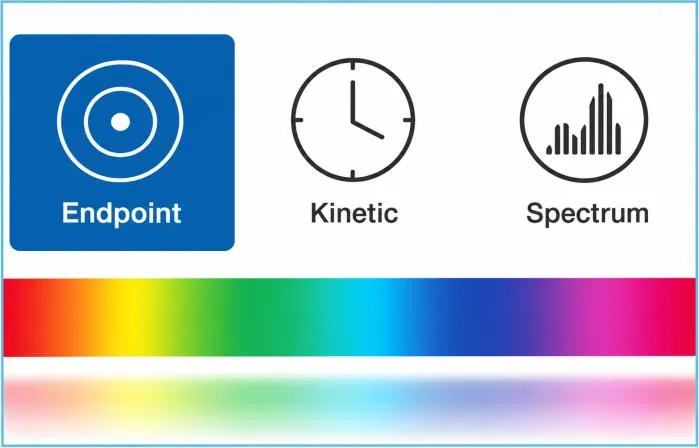
- 200 nm to 1000 nm Absorbance Monochromator: select any wavelength in 1 nm steps and scan a full spectrum in under 15 seconds
UV/Vis Absorbance
Time-Resolved Fluorescence (TRF)
- High-Sensitivity Fluorescence: xenon excitation and PMT detection reach 1 pM detection limits with six logs of linear range
- Low-Light Luminescence: detects down to 15 amol/well of ATP with crosstalk of 0.005% or less
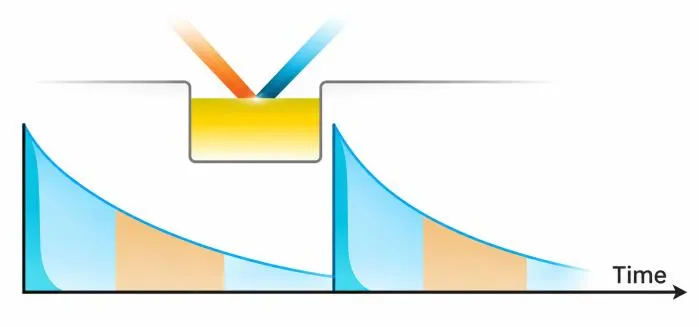
- Time-Resolved Fluorescence (ToronMPR™ MM4, ToronMPR™ MM5): lanthanide-based TRF and TR-FRET with detection down to 0.02 pM
Fluorescence Polarization (FP)
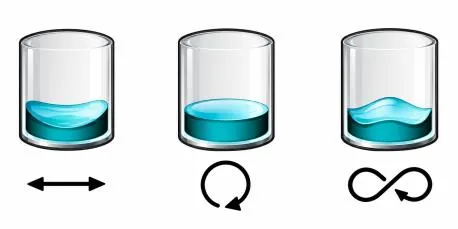
Multiple Shaking Modes
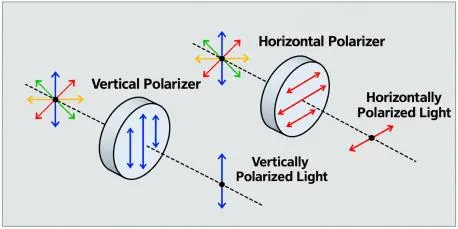
- Fluorescence Polarization (ToronMPR™ MM5): measures binding events with SD of 5 mP or less
- Modular Code-Read Filters: slide-out filter modules with code recognition shorten changeover and prevent setup errors
- Broad Plate Compatibility: 6-well to 384-well plates, 96 and 384 PCR plates, and 16- or 96-sample microvolume plates
- Optional Dual Injectors: 5 µL to 1000 µL dispensing at 125 µL/s to 500 µL/s for flash luminescence and calcium flux
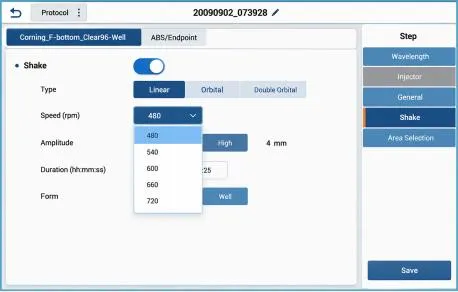
- Three Shaking Modes: linear, circular, and double circular shaking with adjustable strength and speed
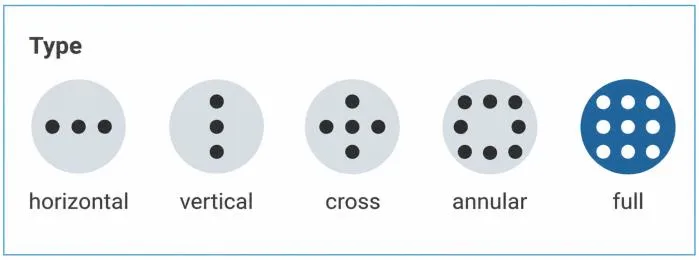
Well Scanning Function
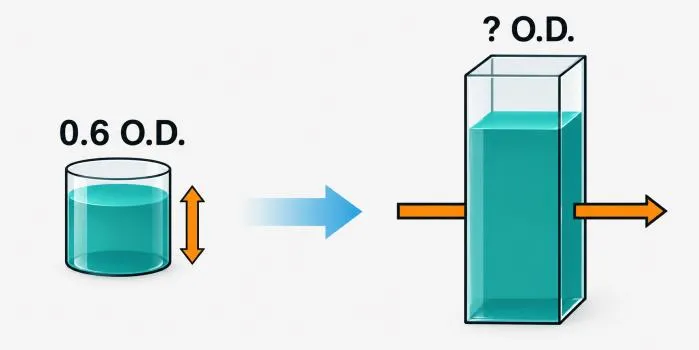
Optical Pathlength Correction
- PID Incubation up to 45 °C: ±0.5 °C accuracy at 37 °C with top-to-bottom temperature control to reduce edge effects
- Well Scanning: up to 900 measurement points per well for uneven cell monolayers
- Pathlength Correction: converts absorbance at any fill volume to a 1 cm equivalent
- Standalone 10-Inch Touchscreen: adjustable viewing angle, built-in analysis, and no PC required
- Four User Permission Levels: separate accounts and passwords protect experiment data
- QR Code Sharing and FTP Upload: share programs and standard curves by QR code and send reports to a network server
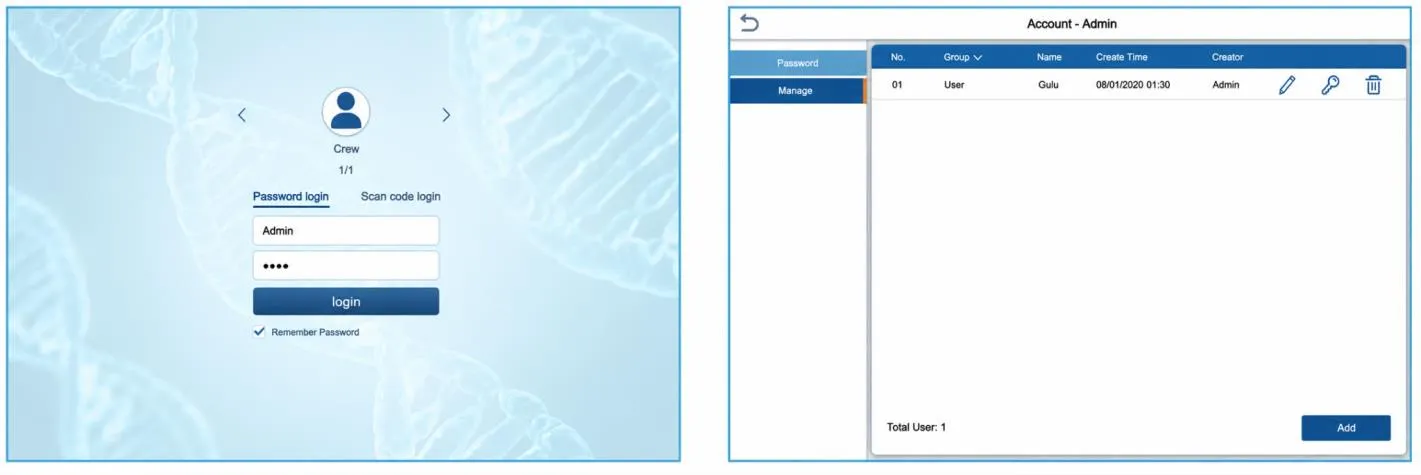
User Authority Classification
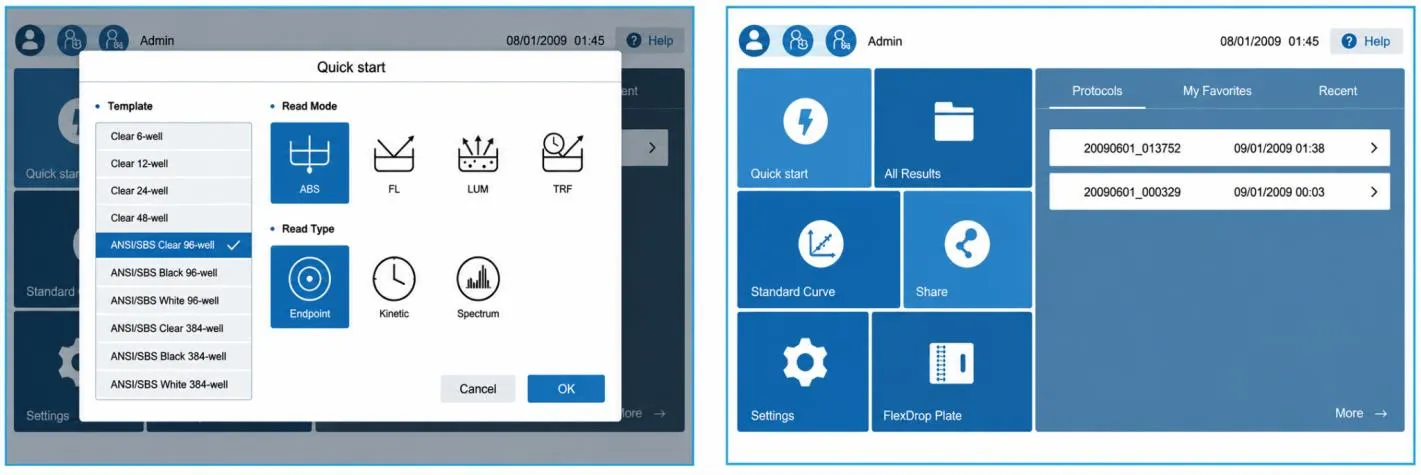
Intuitive Interface Display
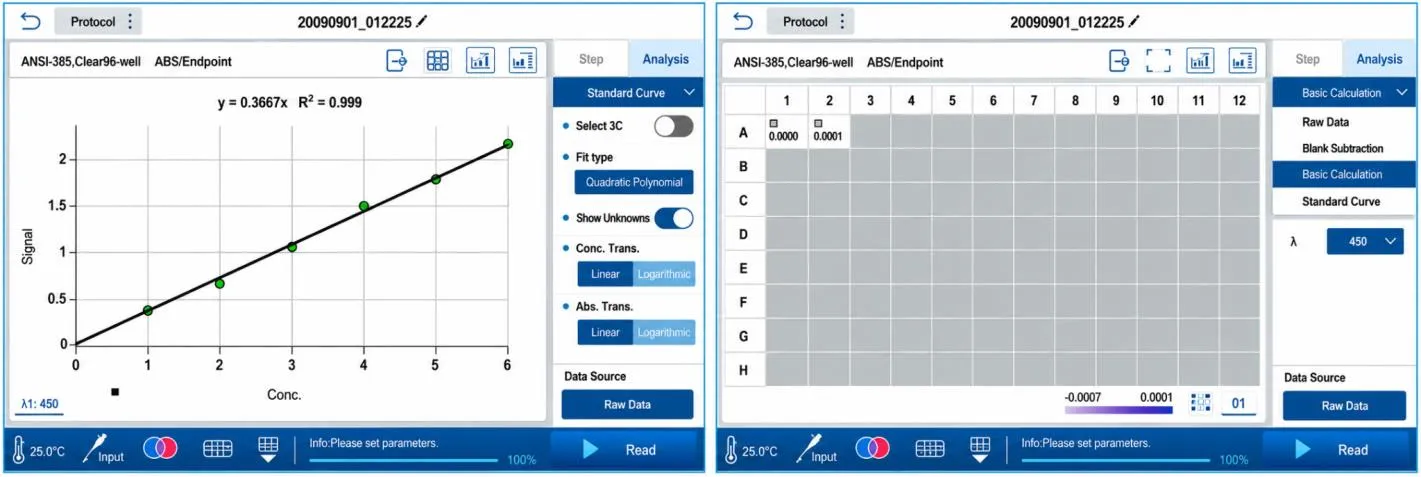
Powerful Data Analysis and Process
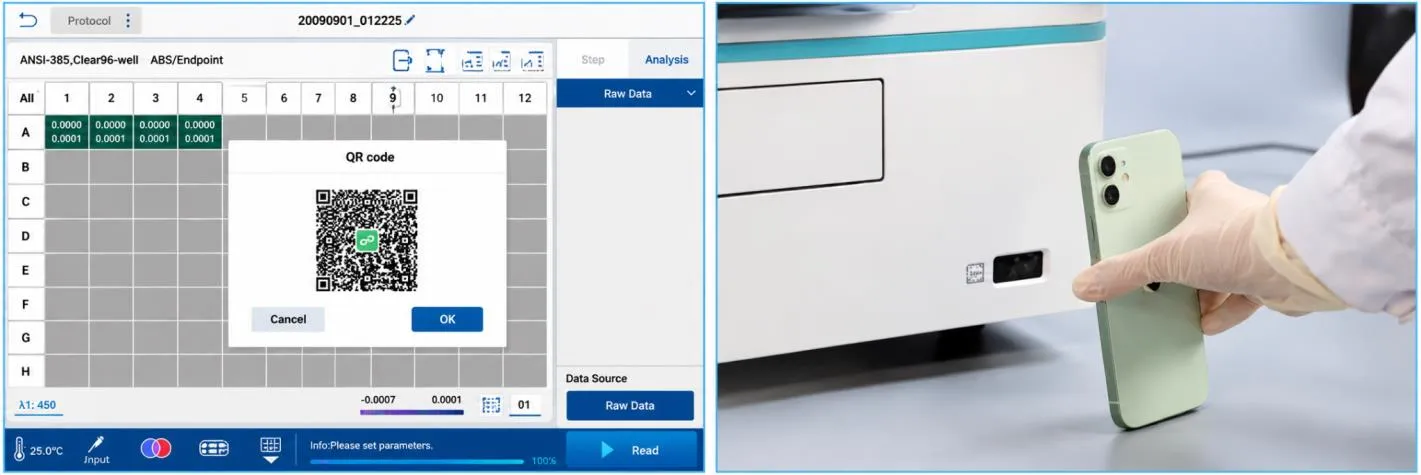
Liberalized User Communication
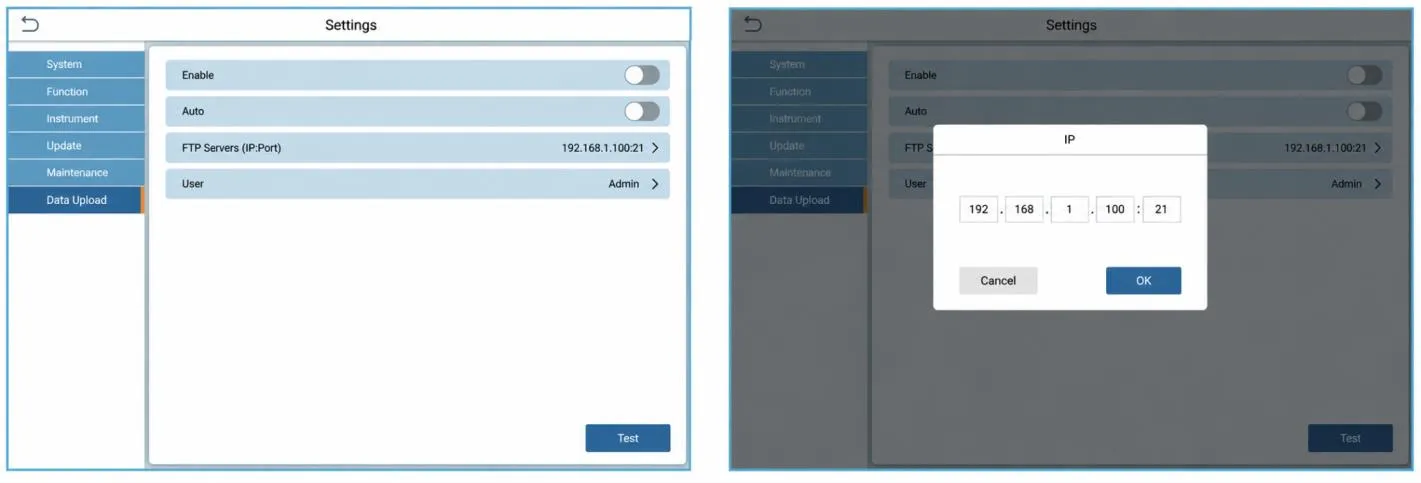
FTP (File Transfer Protocol)
Theory and Method
Each detection mode measures light in a different way. Absorbance measures how much light a sample removes at a set wavelength, following the Beer-Lambert law. Fluorescence excites a dye at one wavelength and measures the longer-wavelength light it emits. Luminescence needs no excitation light at all, because a chemical or enzymatic reaction such as luciferase oxidizing luciferin produces the light. A PMT amplifies these weak emission signals, giving a linear dynamic range of six logs or more.
Time-resolved fluorescence uses lanthanide labels such as europium, which keep emitting light long after the excitation flash ends. The reader waits a few microseconds before measuring, so short-lived background fluorescence and scattered light fade first. This delay raises the signal-to-noise ratio and lowers the detection limit to 0.02 pM. TR-FRET extends the method to measure energy transfer between two labels that bind close together, which signals a molecular interaction.
Fluorescence polarization excites the sample with polarized light and compares emission in parallel and perpendicular planes. Small labeled molecules tumble quickly and scramble the polarization, while a labeled molecule bound to a large protein tumbles slowly and keeps it. The resulting change in millipolarization (mP) reports binding without any wash step. The incubation chamber uses PID control and a slight top-to-bottom temperature difference to limit condensation and edge effects. Well scanning at up to 900 points per well averages out uneven cell layers.
Multimode Microplate Reader - ToronMPR™ MM Technical Specifications
Detection Modes by Model
| Detection Mode | ToronMPR™ MM3 | ToronMPR™ MM4 | ToronMPR™ MM5 |
|---|---|---|---|
| Absorbance (ABS) | Yes | Yes | Yes |
| Fluorescence (FL) | Yes | Yes | Yes |
| FRET | Yes | Yes | Yes |
| Luminescence (LUM) | Yes | Yes | Yes |
| Time-Resolved Fluorescence (TRF) | No | Yes | Yes |
| Fluorescence Polarization (FP) | No | No | Yes |
Absorbance
| Parameter | Specification |
|---|---|
| Light Source | Xenon flash lamp, rated for 10^9 flashes |
| Wavelength Range | 200 nm to 1000 nm, 1 nm step |
| Wavelength Accuracy | 2 nm |
| Wavelength Repeatability (SD) | 0.2 nm |
| Bandwidth (FWHM) | < 2.5 nm |
| Detector | 2 × photodiode |
| Measuring Range | 0 OD to 4 OD |
| Resolution | 0.0001 OD |
| Accuracy at 450 nm (Precision Mode) | ±(1.0% + 0.003 OD) for 0.0 to 2.0 OD; ±2% for 2.0 to 3.0 OD |
| Repeatability at 450 nm | Fast mode: CV < 1.0% or SD < 0.003; accurate mode: CV < 0.5% or SD < 0.003 (0.0 to 3.0 OD) |
| Linearity at 450 nm | R² ≥ 0.999 (0.0 OD to 3.0 OD) |
| Stray Light | 0.1% at 220 nm |
| Spectral Scan Time | < 15 s (200 nm to 1000 nm, 1 nm step) |
| 96-Well Read Time | Fast mode < 15 s |
Fluorescence
| Parameter | Specification |
|---|---|
| Reading Mode | Top reading |
| Excitation Source | Xenon lamp |
| Detector | PMT |
| Wavelength Range | Excitation 200 nm to 1000 nm; emission 270 nm to 850 nm |
| Standard Filters (EX/EM) | 485/530 nm, 523/564 nm, 624/692 nm (other wavelengths available) |
| Linear Dynamic Range | ≥ 6 logs |
| Detection Limit | 1 pM (optimized conditions) |
Luminescence
| Parameter | Specification |
|---|---|
| Detector | PMT |
| Wavelength Range | 200 nm to 850 nm |
| Filter | LUM cut-off filter |
| Detection Limit | ≤ 15 amol/well (96-well white plate, flash ATP) |
| Linear Dynamic Range | ≥ 6 logs |
| Crosstalk | ≤ 0.005% |
Time-Resolved Fluorescence (ToronMPR™ MM4 and MM5)
| Parameter | Specification |
|---|---|
| Standard Filter (EX/EM) | 365/612 nm |
| Detection Limit | 0.02 pM (optimized conditions) |
Fluorescence Polarization (ToronMPR™ MM5)
| Parameter | Specification |
|---|---|
| Wavelength Range | 300 nm to 850 nm |
| Standard Filter (EX/EM) | 485/530 nm polarizer filter |
| Detection Limit | SD ≤ 5 mP (1 nM sodium fluorescein) |
General Specifications
| Parameter | Specification |
|---|---|
| Read Types | Endpoint, kinetics, spectral scanning, well scanning |
| Plate Formats | 6, 12, 24, 48, 96, 384-well; 96 and 384 PCR plates; 16- and 96-sample microvolume plates |
| Well Scanning | Up to 900 points per well |
| Pathlength Correction | Converts to 1 cm equivalent |
| Shaking Modes | Linear, circular, double circular (strength and speed adjustable) |
| Incubation Temperature | RT + 4 °C to 45 °C, PID control |
| Temperature Accuracy | ±0.5 °C at 37 °C |
| Display | 10-inch touchscreen, adjustable viewing angle |
| Operation | Touchscreen (Android) or PC (Windows 10 and later, 64-bit) |
| User Management | Four permission levels with individual accounts |
| Data Capacity | 10 GB |
| Data Transfer | FTP upload to PC server; QR code program sharing |
| Ports | 2 × USB-A, 1 × USB-B, 1 × Ethernet, RS-232 (injector) |
| Voltage | AC 100 V to 240 V, 50/60 Hz |
| Dimensions (W × D × H) | 420 × 550 × 386 mm |
| Weight | 33 kg |
Optional Injector
| Parameter | Specification |
|---|---|
| Supported Plates | 6-well to 384-well |
| Number of Injectors | 1 or 2 |
| Dispensing Volume | 5 µL to 1000 µL, 1 µL increment |
| Injection Speed | 125 µL/s to 500 µL/s |
| Accuracy | ±1 µL at 5 µL to 50 µL; ±2% at 51 µL to 1000 µL |
| Waste Collection | 25 mL |
| Overflow Protection | Software liquid injection protection |
Accessories
| Item | Description |
|---|---|
| Fluorescence Filter Modules | 485/530 nm, 523/564 nm, and 624/692 nm standard sets; custom wavelengths available |
| LUM Cut-Off Filter | Luminescence filter module |
| TRF Filter Module | 365/612 nm filter for MM4 and MM5 |
| FP Polarizer Filter Module | 485/530 nm polarizer filter for MM5 |
| Automatic Injector Module | Single or dual injector for flash luminescence and calcium flux |
| 16-Sample Microvolume Plate | Reads 1 to 16 samples of 2 µL to 4 µL |
| 96-Sample Microvolume Plate | Reads up to 96 samples of 2 µL to 4 µL |
| Absorbance Validation Plate | Optical performance plate for IQ, OQ, and routine checks |
| Luminescence Standardization Plate | Verifies luminescence function |
| PC Analysis Software | Advanced analysis and report generation on Windows |