
Mobile OES
Mobile OES – ToronOES™ M
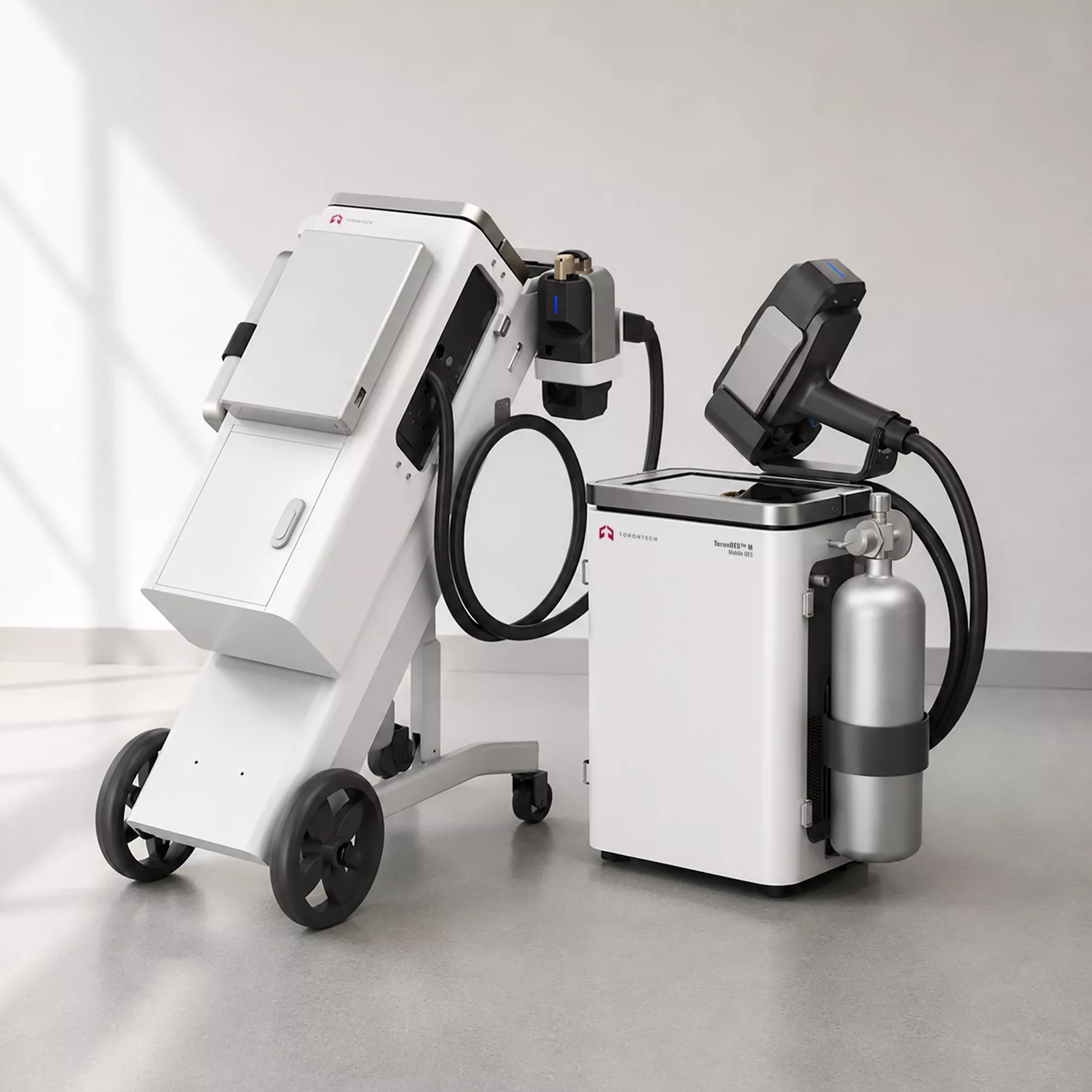
ToronOES™ M is a mobile spark optical emission spectrometer (Spark OES) engineered for fast and reliable on-site metal analysis. Designed for field mobility and shop-floor durability, the system enables accurate alloy chemistry verification when components are too large or impractical to bring into a laboratory. It combines a portable spectrometer unit, an excitation gun, and a trolley-based setup for field-ready operation.
Built on a Paschen–Runge optical platform with digital plasma spark technology, QualiOES™ M delivers stable multi-element analysis for steels, stainless steels, aluminum alloys, and other common industrial metals.
Mobile OES – ToronOES™ M Application
- Incoming material verification and PMI: OES helps confirm alloy grade before cutting, machining, or welding starts. This reduces wrong-material errors when heat numbers or tags are missing. Sorting and verification features support faster receiving decisions.
- Fabrication, welding QA, and maintenance inspection: Large structures, installed parts, and field components can be tested without moving them to a lab. OES results help confirm chemistry before repairs, joining, or component replacement. This fits pipelines, tanks, structural steel, and heavy equipment.
- Foundry and production spot checks: OES can support chemistry confirmation during production runs and changeovers. Quick feedback helps reduce rework tied to off-spec composition. It also supports audit-style verification and supplier dispute resolution.
- Outdoor and remote testing: Battery operation supports locations with limited AC power access. Mobile form factor and trolley mobility support field use. The brochure also claims suitability for high-altitude and outdoor environments.
Mobile OES – ToronOES™ M Key Features
- Mobile OES setup designed for large, fixed, or heavy parts in the field
- Battery-powered operation intended to support many excitations per charge
- Paschen–Runge optical structure derived from fixed laboratory spectrometers, with ruggedized mounting for portability
- Argon-flushed UV capability for elements such as C, P, S, B, Sn, and As in steel
- HEPS high-energy pre-spark approach described to improve discharge stability
- Fast analysis cycle stated at about 20 seconds per detection
- ARM-based processing described for fast data synchronization and processing
- USB and network interfaces for data transfer and printer connection
- ICAL logic described to reduce recalibration tied to location and temperature changes
- APF software described to identify unknown grades faster
- ACP software streamlines calibration, enabling rapid transitions between different specimens.
- Expandable method programs described to add bases/elements through software updates instead of hardware changes
Complete Set
ToronOES™ M typically ships as a mobile kit designed for field deployment:
- Main OES unit: the spectrometer body with optics, spark control, and onboard computing
- Excitation gun: handheld spark head used to excite the sample surface
- Trolley: rolling platform to support safe operation, storage, and transport
- Battery pack: powers the system when AC power is unavailable
- Software + analytical programs: analysis, alloy ID, verification, pass/fail sorting
- Argon connection kit: gas pipeline, connectors, and pressure regulator
- Calibration reference sample: supports standardization checks
- Documentation package: manual, certificates, and acceptance paperwork
- Tools and consumables: maintenance items for routine upkeep
Theory and Method
OES works by creating a controlled spark on the metal surface. The spark excites atoms and ions, producing light at wavelengths tied to each element. The optical system disperses the emitted light across detectors. Software converts signal intensity into concentration using calibration curves and method settings.
ToronOES™ M uses an argon-flushed UV optical path for low-wavelength lines. The excitation gun works as a mobile spark stand, so you can test large parts with stable positioning. Results can be stored, compared, and exported for inspection records.
Mobile OES – ToronOES™ M Technical Specification
Optical System
| Specification | ToronOES™ M |
|---|---|
| Optical structure | Paschen–Runge |
| Rowland circle diameter | ≥ 300 mm |
| Wavelength range | 170–670 nm |
| Grating ruling | 3600 lines/mm |
| Dispersion | 1.2 nm/mm |
| Detector | Multiple CCD linear arrays |
| Optical chamber temperature | 34°C ± 0.1°C |
| Grating | Carl Zeiss grating (listed) |
Excitation Source and UV Capability
| Specification | ToronOES™ M |
|---|---|
| Spark source | Full-digital plasma spark source |
| Frequency | 100–1000 Hz |
| Current | 1–400 A |
| Pre-spark | HEPS high-energy pre-spark |
| UV usable range | 174–196 nm |
| UV argon-flush capability | Supports C, P, S, Sn, As, B and more |
| Sample stage | Open stage for large samples |
| Excitation aperture | ≤ 10 mm |
Computing, Display, and Software
| Specification | ToronOES™ M |
|---|---|
| Computer | Mobile CPU, 2 GB RAM, 128 GB SSD |
| Operating system | Windows 10 |
| Display | 10.4-inch TFT |
| Software functions | Diagnostics, regression, ACP calibration, chemical analysis, alloy ID, alloy verification, APF, recalibration, pass/fail sorting and display |
Electrical, Size, and Weight
| Specification | ToronOES™ M |
|---|---|
| Input power | 90–230 V, 50/60 Hz |
| Power consumption | 300 W (sparking), 100 W (standby) |
| Fuse | 16 A slow-blow |
| Total dimensions | 125 × 27 × 48 cm |
| Main unit dimensions | 31 × 21 × 48 cm |
| Weight | Main unit 18.5 kg; trolley 38.5 kg |
| Battery operation | Supported |
Installation Requirements
| Specification | ToronOES™ M |
|---|---|
| Voltage | AC 100–240 V, single-phase, 3-wire, 50/60 Hz, 16 A |
| Argon purity | 99.999% |
| Argon outlet pressure | ≥ 0.5 MPa |
| Environment | 0–35°C, 20–80% RH non-condensing, avoid strong airflow and direct sunlight |
| Sample preparation | Surface must be ground to clean metallic finish prior to analysis. |
Configuration List
- OES main unit
- Excitation gun
- Wireless mouse
- Wireless keyboard
- Trolley
- Battery
- Analytical programs
- Standard calibration sample
- Gas pipeline and connector
- Argon pressure regulator and connector
- Power cord
- User manual
- Software
- Qualification certificate
- Packing list
- Tools and consumable spares list
- Warranty card
- Installation, acceptance, and delivery sheet