

Micro Twin-Screw Compounder - ToronMTC™ 40
ToronMTC™ 40 Micro Twin-Screw Compounder brings melt compounding down to batch sizes as small as 10 ml. Two pairs of conical twin screws sit in an inverted, staggered layout, so melt recirculates through the mixing chamber for as long as a formulation requires. Screw speed adjusts independently, which suits highly filled compounds and high-viscosity melts. Laboratories working with scarce or costly synthetic materials can screen formulations without committing kilogram quantities.
A split mixing chamber opens flat through 180 degrees for direct access to both screw pairs, and the screws release quickly for cleaning between runs. Barrel and screws carry low-wear, chemically resistant treatment that holds the original screw geometry across years of service. Torque, melt pressure, and barrel temperature stream to a Delta touch-screen controller throughout each cycle. A 1,050 mm footprint fits a standard lab bench or a fume hood.
Compound development groups in plastics, composites, and pharmaceutical laboratories apply the MTC-40 to masterbatch trials, filler dispersion studies, and reactive extrusion at gram scale. Material discharged from the unit carries forward into micro injection molding or filament work for downstream property testing. The compounder ships with manual feeding as standard, and an automatic feeder is available as an option. Torontech supports the unit with screw sets, spare chamber seals, and application guidance for new formulations.
Micro Twin-Screw Compounder - ToronMTC™ 40 Applications
The ToronMTC™ 40 serves research groups that need production-relevant mixing conditions from a few grams of material.
- Polymer Compound Development: screens resin, additive, and filler combinations at gram scale before committing to pilot-line trials
- Nanocomposite Research: disperses carbon nanotubes, graphene, and nanoclays into thermoplastic matrices under controlled residence time
- Masterbatch and Color Trials: produces small-batch masterbatch samples for pigment loading, dispersion, and color-match checks
- Highly Filled Compounds: mixes calcium carbonate, talc, glass fiber, and metal powder loadings that stall conventional lab mixers
- Biopolymer and Bioplastic R&D: processes PLA, PHA, and starch-based blends whose narrow thermal window and material cost favor small batches
- Pharmaceutical Hot-Melt Extrusion: blends active ingredients with polymer carriers for solubility and dispersion studies
- Reactive Extrusion Studies: holds melt in circulation so grafting, chain extension, and crosslinking reactions run to a defined time
- Recycled Resin Evaluation: tests compatibilizer and stabilizer packages on limited quantities of post-consumer or post-industrial material
- Adhesive and Sealant Formulation: compounds hot-melt systems where each trial batch would otherwise consume expensive tackifiers and polymers
- Academic Teaching Laboratories: gives undergraduate polymer courses hands-on extrusion practice at low material cost
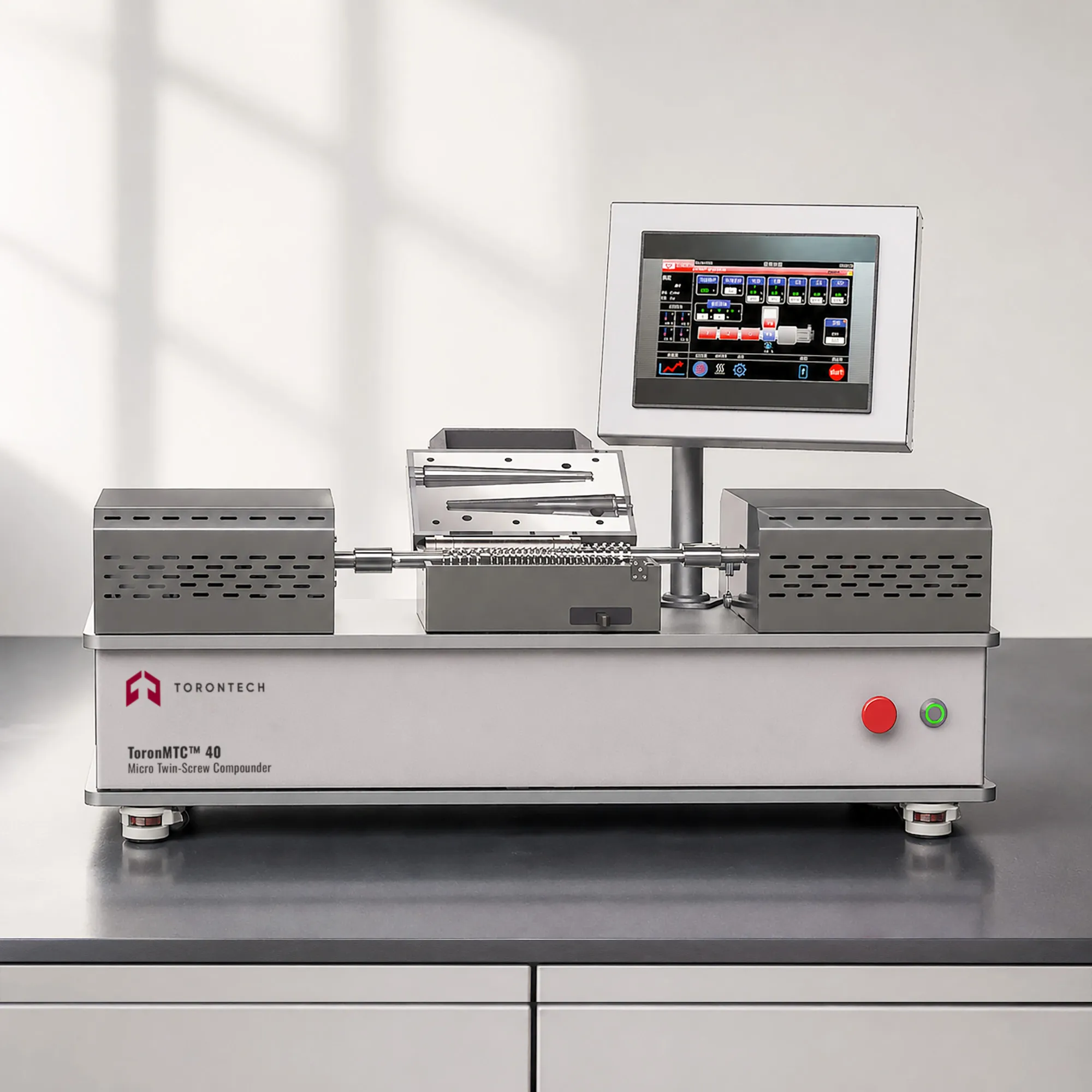
Micro Twin-Screw Compounder - ToronMTC™ 40 Key Features
Every feature of the ToronMTC™ 40 targets the same goal: production-relevant compounding data from the smallest practical sample.
- Dual Conical Twin-Screw Sets: inverted, staggered arrangement returns melt through the chamber for an unlimited number of mixing cycles
- 10 ml Minimum Batch Volume: allows formulation work on newly synthesized or high-cost materials available only in small quantities
- 40 g Charge per Cycle: provides enough compounded output for specimen molding and downstream property testing
- Independent Screw Speed Adjustment: 1 to 120 rpm on each screw set for tuning shear input to the formulation
- 400°C Barrel Capability: covers commodity resins through high-temperature engineering thermoplastics
- ±0.5°C Temperature Control: keeps melt viscosity stable so repeat trials produce comparable torque and dispersion results
- Direct-Connected Torque Measurement: 0 to 50 N·m electronic transducer tracks melt resistance in real time without belt or gear losses
- 180° Split Mixing Chamber: hinged, leak-free barrel opens flat for melt observation, sampling, and fast cleanout
- Quick-Release Conical Screws: two screw pairs come out by hand for cleaning or changeover between formulations
- Wear and Chemical Resistant Surfaces: treated screws and chamber hold their original geometry through abrasive and corrosive compounds
- Delta Touch-Screen Control: single-screen operation for temperature zones, speed, cycle timing, and process readouts
- Multi-Channel Data Acquisition: logs torque, pressure, and barrel temperature together for full process traceability
- Manual or Automatic Feeding: hand charging as standard, with an optional automatic feeder for continuous small-volume extrusion
- Low Material and Energy Consumption: 400 W draw and gram-scale batches keep the cost per trial well below pilot-line work
- High Run-to-Run Repeatability: stable screw geometry and tight thermal control support reproducible formulation comparisons
- Bench and Fume Hood Installation: 338 mm depth and self-contained construction suit crowded laboratories and ventilated enclosures
Theory and Method
Conical twin-screw geometry drives the mixing action. Each screw tapers from a 25 mm root to a 10 mm tip, so the free channel volume shrinks steadily toward the discharge end. That taper compresses the melt, builds discharge pressure without a long barrel, and holds total working volume to a few milliliters. Fully intermeshing screws sweep material from one flight into the other, splitting and recombining the melt stream to distribute additives while the narrow gaps apply the shear needed to break down agglomerates.
Residence time in a conventional extruder depends on barrel length. The MTC-40 removes that constraint by pairing two conical twin-screw sets in opposed, staggered positions, so material leaving one set enters the other and returns to the mixing chamber. Melt therefore circulates for an unlimited number of passes, which produces the effect of a very long length-to-diameter ratio inside a benchtop frame. Operators set mixing intensity by cycle time and screw speed instead of by machine geometry.
Torque measurement converts the mixing process into usable data. A direct-connected transducer reads the resistance the melt exerts against the screw shafts across a 0 to 50 N·m range. Torque climbs as solids compact, falls as the polymer melts, and settles once dispersion approaches steady state, giving a live indication of both melt viscosity and mixing progress. Temperature control within ±0.5°C keeps shear-thinning behavior consistent, so torque traces from repeat runs remain directly comparable.
Micro Twin-Screw Compounder - ToronMTC™ 40 Technical Specifications
| Parameter | Specification |
|---|---|
| Screw Diameter | Ø10 mm (small end) / Ø25 mm (large end) |
| Screw Configuration | Two sets of conical twin screws, inverted staggered layout |
| Screw Speed | 1 to 120 rpm |
| Torque Measurement | Electronic direct-connected transducer, 0 to 50 N·m |
| Maximum Temperature | 400°C |
| Temperature Control Accuracy | ±0.5°C |
| Minimum Batch Volume | 10 ml |
| Material Volume per Cycle | 40 g |
| Feeding Mode | Manual standard, automatic optional |
| Barrel | Split type, 180° flat-opening leak-free mixing chamber |
| Control System | Delta touch-screen HMI |
| Data Acquisition | Torque, pressure, barrel temperature |
| Voltage | 220 V, 50 Hz, 400 W (110V is also available) |
| Overall Dimensions | 1,050 × 338 × 730 mm |
| Net Weight | 96 kg |