

Micro Separator
Micro Separator – ToronMS™ 100
A Micro Separator is used to rate how well aviation fuel releases entrained or emulsified water when it passes through a coalescing medium. Micro Separator – ToronMS™ 100 is positioned for measuring the water separation index and fuel cleanliness, with an optical detection system, a built-in guided test program, and a typical analysis cycle of 5 to 10 minutes.
Micro Separator – ToronMS™ 100 is designed for aviation fuel quality checks where water separation behavior matters during storage, transfer, and use. The instrument measures the water separation index and cleanliness of aviation fuels and evaluates how easily water separates as the fuel passes through a coalescing medium. The measuring range is listed as 50 to 100, with 1-point resolution.
This type of instrument is commonly associated with portable separometer-style testing. ASTM D3948 covers portable separometer testing for aviation turbine fuels, while ASTM D8073 covers water separation index determination with a small-scale water separation instrument and reports results as WSI.
Micro Separator – ToronMS™ 100 Application
- Aviation turbine fuel quality control: This instrument is suited to routine checks on aviation fuels where water separation performance must be verified before the fuel is accepted for use. A stronger water separation result indicates that the fuel is less affected by surfactant contamination and is better able to release water through coalescing media.
- Fuel cleanliness assessment: The tester measures both water separation index and cleanliness of aviation fuels. This makes it useful for identifying whether the fuel may contain contamination that could interfere with downstream filtration and water removal performance.
- Fuel handling and distribution monitoring: Water separation testing is useful during production, transfer, storage, and point-of-use handling because surfactants or contaminants can be introduced anywhere along the fuel supply chain. ASTM D3948 notes that the method can detect surface-active substances added to or picked up by the fuel during handling, which is why this type of test is often used in fuel logistics programs.
- Field and laboratory fuel inspection: Portable separometer-style methods are intended for both field and laboratory use. ASTM D3948 and ASTM D7224 both describe rapid portable means for rating a fuel’s ability to release entrained or emulsified water, which supports both lab confirmation and on-site screening.
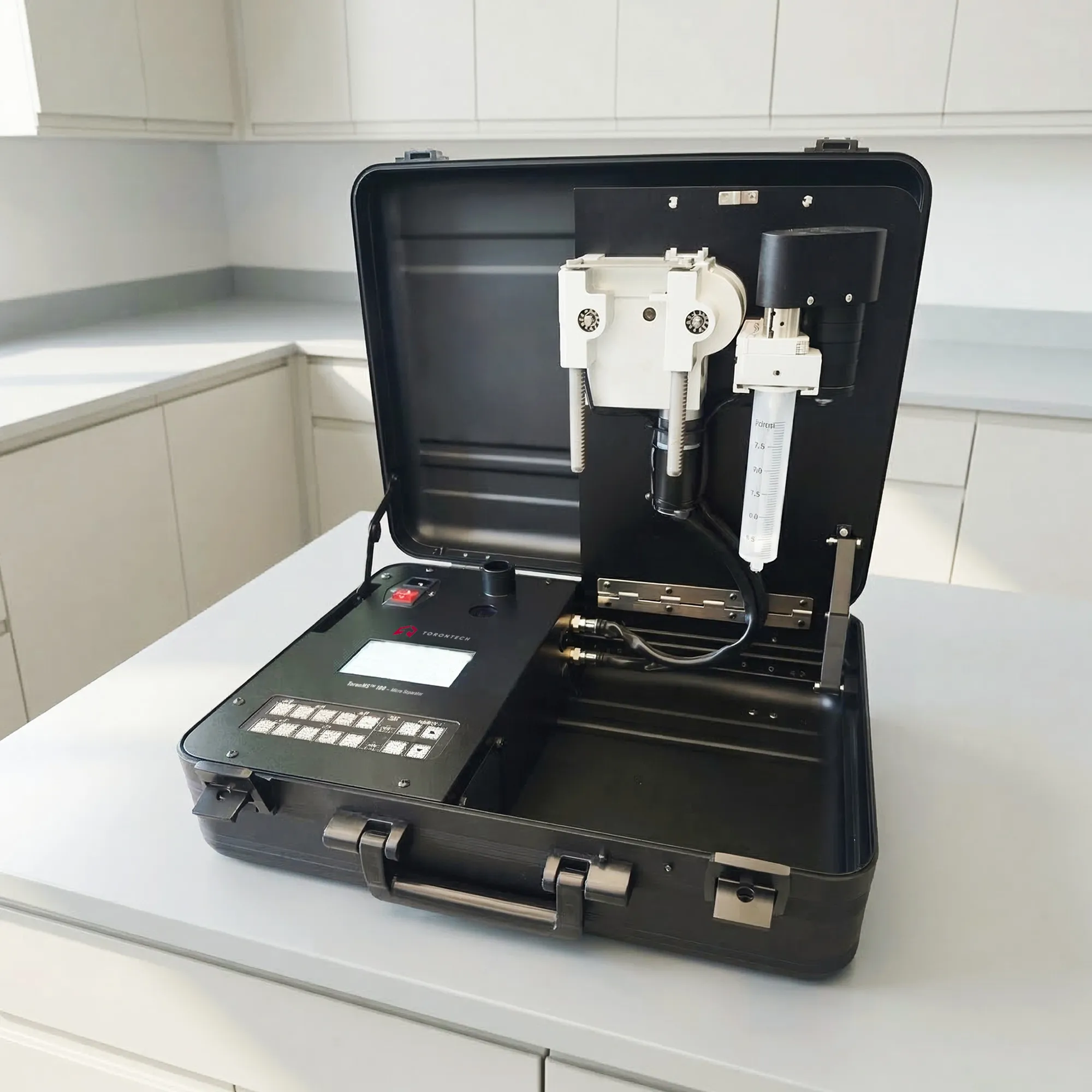
Micro Separator – ToronMS™ 100 Key Feature
- Optical detection system for water separation index testing in aviation fuel workflows.
- Measuring range of 50 to 100 with 1-point resolution for straightforward WSI-style interpretation.
- Typical analysis cycle of 5 to 10 minutes, which supports relatively fast screening in field or lab use.
- High-speed motor stirring system rated at 25,000 ± 1,000 rpm for sample preparation during the test sequence.
- Dual power flexibility with AC supply and built-in battery operation. The built-in high-capacity battery supports up to 40 tests at maximum, which is useful for mobile work.
- Built-in standard test program with automatic step prompts to simplify operation and reduce training burden.
- Reusable coalescers and straight-neck bottles to lower routine operating cost.
- Corrosion-resistant keyboard design to reduce the risk of oil-liquid contamination during use.
Theory and Method
The instrument uses optical detection to determine the water separation result after fuel passes through a coalescing medium. In portable separometer-style methods, the fuel/water mixture is passed through coalescing material and the effluent is evaluated by light transmission to determine how much uncoalesced water remains. Higher ratings indicate that water is more easily coalesced and that the fuel is relatively free of surfactant materials.
This type of result is important because surfactants and certain contaminants can reduce the performance of filter separators in aviation fuel systems. ASTM D3948 specifically describes the method as a way to measure the presence of surfactants in aviation turbine fuels and to assess their effect on water separation behavior.
Micro Separator – ToronMS™ 100 Technical Specification
| Item | Micro Separator – ToronMS™ 100 |
|---|---|
| Measuring principle | Optical detection |
| Measuring range | 50–100 |
| Resolution | 1 |
| Analysis cycle | 5 min to 10 min |
| Motor stirring speed | 25,000 ± 1,000 rpm |
| Power supply | AC power and battery power |
| Battery capability | Built-in high-capacity battery, supports up to 40 tests at maximum |
| Weight | 11.2 kg |