
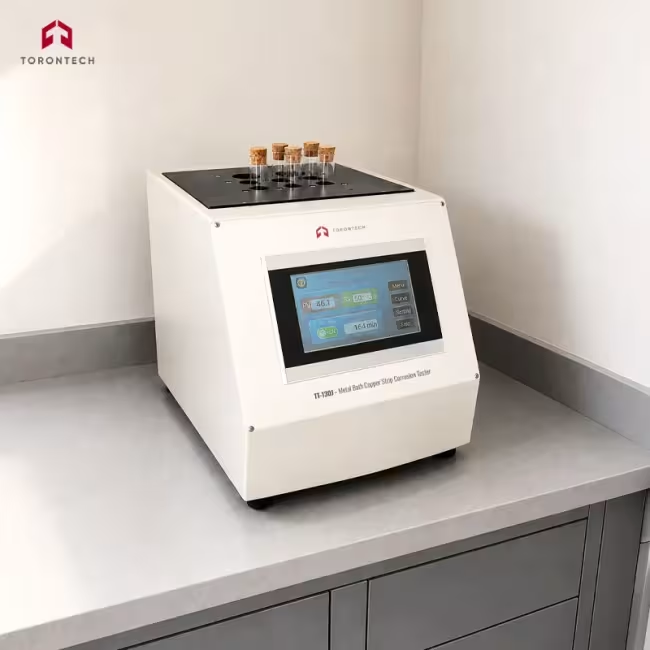
Metal Bath Copper Strip Corrosion Tester
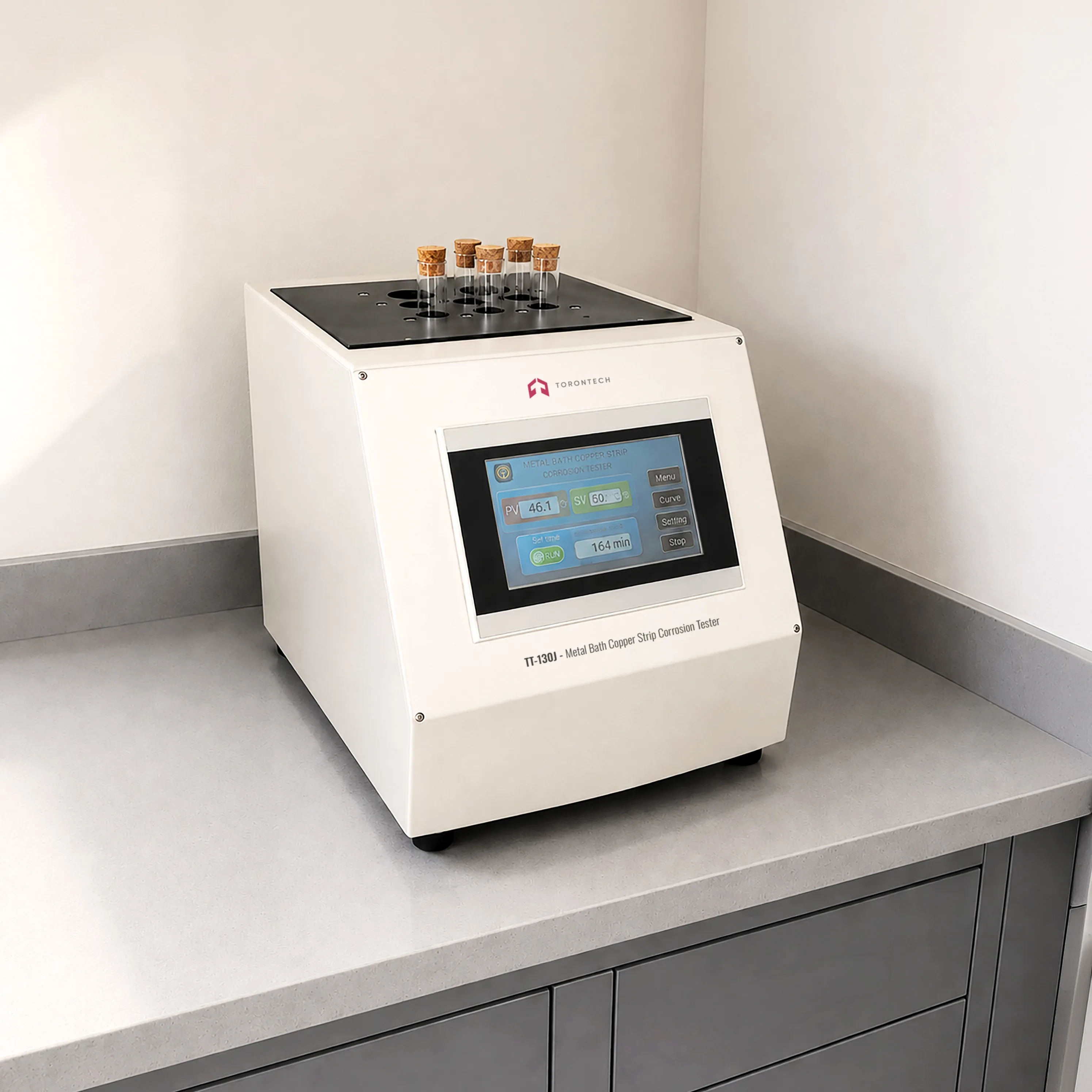
Metal Bath Copper Strip Corrosion Tester - TT-130J
TT-130J Metal Bath Copper Strip Corrosion Tester is a precision, desktop-format petroleum testing instrument designed to determine the corrosiveness to copper of a wide range of petroleum products and hydrocarbon-based fuels, in full compliance with ASTM D130 — the internationally recognized standard test method for corrosiveness to copper from petroleum products by the copper strip test. The TT-130J is the reference copper strip corrosion tester for petroleum quality control laboratories, fuel testing operations, lubricant manufacturing, and transportation industry testing across the world.
The copper strip corrosion test is a direct indicator of the active sulfur and corrosive compound content of petroleum products. Sulfur species present in fuels and lubricating oils — including mercaptans, elemental sulfur, hydrogen sulfide, and reactive sulfur compounds — react with the polished copper strip surface under controlled temperature conditions, producing characteristic discoloration and tarnishing that is rated against the ASTM Copper Strip Corrosion Standard Color Chart. The TT-130J metal bath copper strip corrosion tester delivers the precisely controlled, uniform temperature environment required for consistent, reproducible corrosion rating results across all eight test stations simultaneously.
The TT-130J features an integrally cast aluminum metal bath with matched-power electric heating elements that maintain identical thermal conditions at every test position — eliminating the temperature non-uniformity and vapor generation problems associated with open oil bath designs. A 7-inch color touch screen provides complete instrument control including real-time temperature curve display, timer management with audible alarm, and access to the five preset test temperature points (40°C, 50°C, 100°C, 120°C, and 150°C) defined by ASTM D130, ISO 2160, and ASTM D4814 for the full range of petroleum product copper strip corrosion test protocols.
With a compact footprint, a PID intelligent temperature control system accurate to ±0.1°C, an electronic timer programmable from 0 to 99 hours, and an anodized aluminum metal bath that provides long-term corrosion resistance and service life, the TT-130J is the preferred metal bath copper strip corrosion tester for North American petroleum testing laboratories, fuel terminals, refineries, and lubricant blending facilities.
ASTM D130 | 8 | ±0.1°C | 150°C | 0–99 h |
|---|---|---|---|---|
PRIMARY STANDARD | TEST STATIONS | TEMP. ACCURACY | MAX. TEMP. | TIMER RANGE |
Metal Bath Copper Strip Corrosion Tester - TT-130J Applications
The TT-130J copper strip corrosion tester is used to evaluate the corrosive sulfur content of the following petroleum products and hydrocarbon materials, as specified in ASTM D130, ISO 2160, and related product standards:
- Aviation Gasoline: Determines the copper strip corrosion classification of aviation gasoline (avgas) per ASTM D910 and ASTM D130, verifying that active sulfur compounds are within the limits required for compatibility with copper, brass, and bronze components in aircraft fuel systems and engines.
- Aviation Turbine Fuel (Jet Fuel): Tests the corrosiveness to copper of aviation turbine fuels (Jet-A, Jet-A1, JP-8) per ASTM D1655, ASTM D130, and DEF STAN 91-091 requirements, confirming freedom from corrosive sulfur species that could damage aircraft fuel system components and elastomers.
- Automotive Gasoline: Evaluates the copper strip corrosion rating of motor gasoline including regular, premium, and ethanol-blended gasolines per ASTM D4814 and ASTM D130, ensuring that the corrosive sulfur specification (Class 1, ASTM D130 copper strip corrosion rating) is met at point-of-blending, terminal, and distribution quality control check points.
- Diesel Fuel & Distillate Fuel Oil: Measures the copper strip corrosion characteristics of diesel fuels and heating oils per ASTM D975 and ASTM D130, supporting the corrosiveness specification requirements of North American diesel fuel quality standards for on-road, off-road, and home heating applications.
- Kerosene & Stoddard Solvent: Tests kerosene and petroleum cleaning solvents for copper strip corrosion per ASTM D3699 and ASTM D484, confirming compatibility with copper-containing household fixtures, industrial equipment, and solvent delivery systems.
- Lubricating Oil: Determines the corrosiveness to copper of lubricating oils per ASTM D130 and ISO 2160, qualifying finished lubricants for use in engines, gear systems, hydraulic circuits, and other applications where copper alloy bearings, bushings, and thrust washers are present.
- Grease & Specialty Products: Evaluates the copper corrosion characteristics of lubricating greases and specialty petroleum products for confirmation of inhibitor system effectiveness and active sulfur content, supporting product quality acceptance and in-service oil analysis programs.
- Natural Gasoline & Hydrocarbons: Tests natural gasoline and other liquid hydrocarbons with Reid vapor pressure not exceeding 124 kPa (18 psi / 930 mmHg) at 37.8°C per ASTM D130, covering the full scope of petroleum products addressed by the copper strip corrosion test method.
Compliant Standards
The TT-130J metal bath copper strip corrosion tester is designed and validated in accordance with the following internationally recognized test standards for copper strip corrosion testing of petroleum products.
- ASTM D130: Standard Test Method for Corrosiveness to Copper from Petroleum Products by Copper Strip Test. The primary standard implemented by the TT-130J copper strip corrosion tester. Defines the test procedure, copper strip preparation, temperature and time combinations (40°C for 3h, 50°C for 3h, 100°C for 3h, 120°C for 3h/16h, and 150°C for up to 3h), and the four-class copper strip corrosion rating scale using the ASTM Copper Strip Corrosion Standard Color Chart. Applicable to the full range of petroleum liquids.
- ISO 2160: Petroleum products and related materials — Corrosiveness to copper — Copper strip test. The international counterpart to ASTM D130, specifying equivalent test conditions and rating criteria for the copper strip corrosion method. Used for petroleum product qualification under international and European product standards. The TT-130J metal bath fully satisfies the temperature uniformity requirements of ISO 2160.
- ASTM D4814: Standard Specification for Automotive Spark-Ignition Engine Fuel. References the copper strip corrosion test (ASTM D130) as a mandatory specification requirement for automotive gasoline, requiring a maximum rating of Class 1 at 50°C for 3 hours. The TT-130J copper strip corrosion tester provides the standard test conditions required for ASTM D4814 compliance testing.
- ASTM D1655: Standard Specification for Aviation Turbine Fuels (Jet-A, Jet-A1). Requires ASTM D130 copper strip corrosion testing at 100°C for 2 hours with a maximum Class 1 rating for aviation turbine fuel qualification. The 100°C preset temperature on the TT-130J directly supports this test requirement.
- ASTM D910: Standard Specification for Aviation Gasolines. Mandates ASTM D130 copper strip corrosion testing as part of the avgas quality specification, requiring a maximum Class 1 rating at 100°C.
- ASTM D975: Standard Specification for Diesel Fuel Oils. References ASTM D130 copper strip corrosion testing as a diesel fuel specification requirement, with the copper strip corrosion test confirming the absence of corrosive sulfur species in finished diesel fuel.
- ASTM D3699: Standard Specification for Kerosine. Includes ASTM D130 copper strip corrosion testing as a product specification requirement, confirming compatibility of kerosene with copper-containing fixtures and equipment.
- ISO/IEC 17025: General requirements for the competence of testing and calibration laboratories. Provides the quality management framework applicable to accredited petroleum testing programs where copper strip corrosion test results generated by the TT-130J are used in third-party product certification and compliance testing reports.
Metal Bath Copper Strip Corrosion Tester - TT-130J Key Features
- 8-Station Metal Bath — Simultaneous Multi-Sample Testing: The TT-130J accommodates up to 8 samples simultaneously in its integrally cast aluminum metal bath — 6 standard test tube wells and 2 pressure bomb wells — enabling a full batch of copper strip corrosion tests to be completed in a single heating cycle. Each well can also be used independently for single-sample testing, providing complete flexibility for laboratory workflows of any throughput level.
- Integrally Cast Aluminum Metal Bath Design: The metal bath block is machined from a single casting of high-quality aluminum alloy, providing excellent thermal conductivity and the uniform temperature distribution required for consistent copper strip corrosion test results across all 8 positions. The anodized surface finish delivers long-term corrosion resistance against petroleum sample contamination and simplifies post-test cleanup.
- Matched-Power Heating Elements — Equal Temperature at Every Well: All test stations in the TT-130J metal bath are heated by a matched-power electric heating system that delivers equal wattage per unit area at every position. This design eliminates the temperature gradients inherent in oil bath systems, ensuring that each copper strip corrosion test — whether run at a single station or all eight simultaneously — experiences the same precisely controlled thermal environment.
- PID Intelligent Temperature Control (±0.1°C): The PID intelligent temperature controller continuously adjusts heating output based on real-time metal bath temperature feedback, eliminating overshoot and temperature oscillation. The result is stable, accurate temperature control to within ±0.1°C at the test position — a critical requirement for reproducible copper strip corrosion test ratings across different laboratories, operators, and test days.
- 7-Inch Touch Screen — Real-Time Temperature Curve Display: The 7-inch color touch screen provides the complete instrument interface in a single, intuitive display. Operators monitor the live metal bath temperature (PV), set the target temperature (SV from five preset points), manage the countdown timer, view the real-time temperature trend curve, and access system settings — all from the touch screen without any external computer connection.
- Five Preset ASTM/ISO Test Temperature Points: The TT-130J provides five factory-preset temperature set points — 40°C, 50°C, 100°C, 120°C, and 150°C — covering the complete range of test temperatures specified by ASTM D130, ISO 2160, ASTM D4814, ASTM D1655, ASTM D910, and ASTM D975 for different petroleum product types. One-touch temperature selection eliminates manual temperature entry and reduces the risk of operator-entry errors.
- Flexible Electronic Timer (0–99 Hours): The built-in electronic timer is programmable in seconds, minutes, and hours over a total range of 0 to 99 hours, 59 minutes, covering both the standard 3-hour copper strip corrosion test durations and the extended 16-hour or 24-hour test protocols specified for selected petroleum products. An audible buzzer alarm notifies the operator immediately when the set test duration has elapsed.
- Metal Bath vs. Oil Bath — Fume-Free, Clean Operation: The TT-130J’s solid aluminum metal bath eliminates the petroleum vapor generation, oil level monitoring, contamination disposal, and housekeeping challenges associated with traditional open liquid oil bath copper strip corrosion testers. The metal bath design provides a cleaner, safer laboratory environment, eliminates fire hazard from flammable oil baths, and avoids the odor and occupational exposure concerns associated with heated petroleum bath oils.
- High-Quality Stainless Steel Test Bombs: The included stainless steel pressure test bombs are fabricated from high-grade corrosion-resistant and heat-resistant stainless steel, providing safe, reliable, and reusable test vessels for petroleum products requiring sealed, pressure-rated containment during the copper strip corrosion test at elevated temperatures. The manual strip holder accessory facilitates convenient copper strip handling and placement.
- PT100 High-Precision Temperature Sensor: The TT-130J employs a platinum resistance temperature sensor (PT100) as its primary temperature measurement element, providing fast thermal response, high accuracy, and long-term stability. The instrument supports periodic temperature calibration via a built-in five-point correction system accessible through the Function Settings menu, ensuring traceable temperature accuracy throughout the instrument’s service life.
Theory & Test Method
The copper strip corrosion test is based on the fundamental chemical reactivity between active sulfur compounds present in petroleum products and the metallic copper surface. Petroleum fuels, lubricating oils, and related hydrocarbon products may contain a variety of sulfur species arising from crude oil processing, blending, or additive use. These sulfur compounds range from relatively inert forms (such as thiophenes and sulfides in adequately hydrotreated products) to highly reactive active sulfur species — including elemental sulfur, hydrogen sulfide, mercaptans (thiols), and polysulfides — that react aggressively with copper and copper alloys at elevated temperatures.
The corrosion mechanism involves two primary reaction pathways. First, direct chemical attack: reactive sulfur species react with the copper surface to form copper sulfide (Cu₂S, CuS) and copper mercaptide compounds, producing the characteristic dark gray, black, or multicolored tarnish observed on the tested copper strip. Second, oxidative corrosion acceleration: dissolved oxygen and acidic species in the petroleum sample can accelerate the copper sulfide formation reaction and contribute to additional surface tarnishing. Both mechanisms are active during the metal bath heating cycle of the copper strip corrosion test.
The ASTM D130 test procedure employs a freshly polished, reagent-grade copper strip of standardized dimensions (approximately 12.5 × 1.5 × 75 mm) as the test coupon. The surface of the copper strip is prepared by sequential abrasion with 240, 400, and 600-grit sandpaper, followed by solvent cleaning with absolute ethanol, to produce a bright, contaminant-free surface that is maximally reactive with corrosive sulfur compounds in the test sample. The prepared copper strip is immersed in a specified volume of the petroleum product sample in a sealed glass test tube or stainless steel pressure bomb, which is then placed in the TT-130J’s metal bath at the temperature prescribed by the applicable product standard.
After the specified test period, the copper strip is removed, washed with absolute ethanol to remove adhering sample, and immediately compared with the ASTM Copper Strip Corrosion Standard Color Chart under standard lighting conditions. The degree of tarnishing and discoloration is classified into one of four corrosion rating categories:
- Class 1 — Slight Tarnish: Fresh copper color, slight orange discoloration, or faint straw color. Indicates low or no active sulfur content. Acceptable for most petroleum product specifications.
- Class 2 — Moderate Tarnish: Dark orange, claret, or lavender tarnish. Indicates moderate active sulfur levels. May or may not meet product specifications depending on the standard.
- Class 3 — Dark Tarnish: Multicolored tarnish (magenta, dark blue-purple). Indicates significant active sulfur content. Typically fails petroleum product specifications.
- Class 4 — Corrosion: Transparent black, graphite black, or jet black copper strip. Indicates high active sulfur content and significant copper corrosion. Always fails petroleum product specifications.
The TT-130J’s integrally cast aluminum metal bath delivers the critical requirement of this test: uniform, stable temperature at every test position throughout the full test duration. Unlike open oil baths — which generate vapors, require oil level management, and exhibit temperature gradients between positions — the TT-130J metal bath uses matched-power electric heating elements embedded in the solid aluminum block to maintain equal temperature at all 8 test wells simultaneously, with a bath accuracy of ±0.1°C. This thermal uniformity is essential for between-position and between-laboratory reproducibility of copper strip corrosion test results, and is a key advantage of the metal bath copper strip corrosion tester design over liquid bath alternatives.
Test Procedure Overview
- Copper Strip Preparation — Polish the copper strip sequentially with 240, 400, and 600-grit sandpaper to produce a bright, uniform surface. Clean with absolute ethanol and degreasing cotton immediately before use. Handle with forceps only — do not contact the polished surface with bare hands.
- Sample Loading — Place the prepared copper strip into a clean glass test tube or stainless steel test bomb. Add the specified volume of petroleum sample (approximately 30 mL for test tube, or as specified by the applicable standard), completely immersing the copper strip. Seal the test tube or bomb.
- Temperature Selection & Pre-Heat — Select the required test temperature on the TT-130J touch screen (40°C, 50°C, 100°C, 120°C, or 150°C per the applicable product standard). Press Heating to bring the metal bath to the set point. Wait for temperature stabilization before loading samples.
- Sample Immersion & Timing — Place the loaded test tube or test bomb into one of the 8 metal bath wells. Set the test timer per the standard (typically 3 hours for most petroleum products). Press Timer to begin the countdown. The TT-130J’s real-time temperature curve confirms bath stability throughout the test.
- Endpoint & Strip Removal — On timer alarm, immediately remove the test tube or bomb from the metal bath. Remove the copper strip using forceps and wash with absolute ethanol to remove adhering sample.
- Corrosion Rating — Under standard lighting, compare the copper strip’s discoloration against the ASTM Copper Strip Corrosion Standard Color Chart. Assign the ASTM Class rating (1 through 4) based on the closest matching color standard.
- Result Recording & Compliance Assessment — Record the corrosion class rating and sub-rating. Compare the result against the maximum permissible corrosion rating specified in the applicable product standard (e.g., ASTM D4814, ASTM D1655) to determine pass/fail compliance.
Metal Bath Copper Strip Corrosion Tester - TT-130J Technical Specifications
| TEST CONFIGURATION | |
| Number of Test Stations | 8 total (2 pressure bomb wells + 6 test tube wells) |
| Metal Bath Material | Integrally cast aluminum alloy (CNC machined), anodized surface finish |
| Test Bomb Material | High-grade stainless steel (corrosion and heat resistant) |
| Housing | Electrostatic spray-coated steel, wall thickness ≥ 1.2 mm |
| Strip Holder | Manual copper strip holder included |
| TEMPERATURE SYSTEM | |
| Temperature Control Range | Ambient – 150°C |
| Temperature Control Accuracy | ±0.1°C |
| Temperature Control Mode | PID intelligent digital display controller |
| Temperature Display | 7-inch LCD touch screen (PV / SV display with real-time curve) |
| Preset Test Temperatures | 40°C, 50°C, 100°C, 120°C, 150°C (ASTM D130 / ISO 2160 test points) |
| Temperature Sensor | High-precision PT100 platinum resistance sensor |
| Temperature Calibration | Built-in 5-point correction via Function Settings menu |
| TIMER SYSTEM | |
| Timer Range | 0 – 99 hours, 59 minutes (arbitrarily settable) |
| Timer Units | Seconds, minutes, hours (selectable) |
| Alarm | Audible buzzer alarm at timer completion |
| ELECTRICAL | |
| Rated Voltage | AC 220 V ± 10%, 50 Hz (110V is also available) |
| Heating Power | 1,000 W (product brochure) / 1,500 W (operation manual) |
| Heating Method | Electric resistance heating, uniform distribution |
| ENVIRONMENTAL REQUIREMENTS | |
| Ambient Temperature | 5°C – 35°C (operation manual) / 0°C – 40°C (product sheet) |
| Relative Humidity | ≤ 85% (non-condensing) |
| Atmospheric Pressure | 86 kPa – 106 kPa |
| Environment | No strong electromagnetic interference, good ventilation, no corrosive gases, no direct sunlight |
| PHYSICAL | |
| Dimensions (L × W × H) | 500 mm × 350 mm × 450 mm |
| Net Weight | 25 kg |
| APPLICABLE STANDARDS | |
| Primary Standard | ASTM D130 — Standard Test Method for Corrosiveness to Copper from Petroleum Products by Copper Strip Test |
| Additional Standards | ISO 2160; ASTM D4814; ASTM D1655; ASTM D910; ASTM D975; ASTM D3699 |
The TT-130J Metal Bath Copper Strip Corrosion Tester delivers ASTM D130 and ISO 2160 compliant copper strip corrosion testing across eight simultaneous test positions, with PID-controlled metal bath precision, a 7-inch touch screen interface, and fume-free, clean operation for petroleum testing laboratories.
TT-130J | Metal Bath Copper Strip Corrosion Tester | ASTM D130 / ISO 2160 | ToronTech