Medical Waste Autoclave with Shredder
Medical Waste Autoclave with Shredder - ToronMW™ AS
On-Site Hospital Waste Sterilization and Volume Reduction
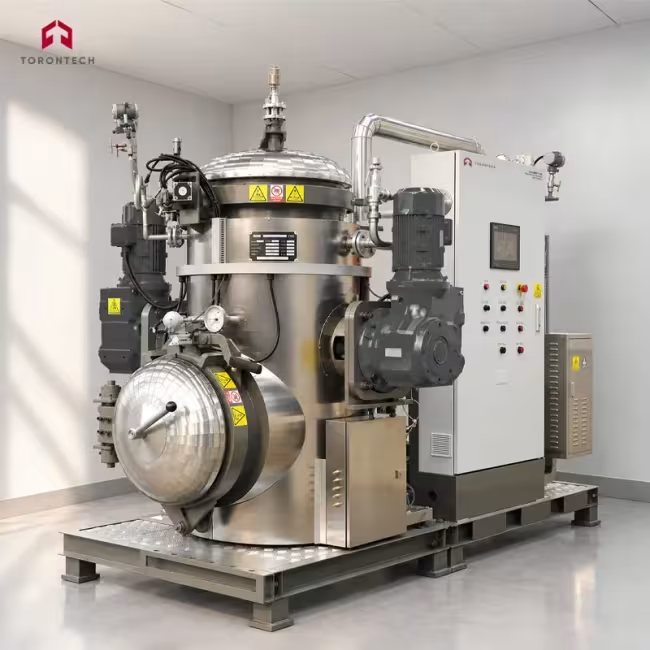
The ToronMW™ AS medical waste autoclave with shredder treats infectious waste at the point of generation, combining mechanical size reduction and saturated steam sterilization inside one sealed vessel. Hospitals, clinics, laboratories, and central treatment plants use the system to convert regulated medical waste into unrecognizable, non-infectious material suitable for ordinary municipal disposal. Waste loads into the upper chamber, passes through a low-speed shredder, and drops into the lower chamber for steam treatment. Treated output leaves the machine dry, unrecognizable, and non-infectious.
A single automated cycle handles loading, shredding, sterilization, condensation, vacuum drying, and discharge without operator contact with untreated waste. The closed-vessel design keeps aerosols, odors, and condensate contained throughout the process. Volume reduction reaches 60 to 80 percent, which lowers hauling frequency, transport cost, and the liability that comes with moving untreated infectious waste off site. Each cycle records its own temperature and pressure data for regulatory reporting.
The ToronMW™ AS range covers seven capacities, spanning 100 L through 2,500 L per cycle, so the same treatment method scales across a small clinic and a municipal treatment facility. Smaller units arrive with an integrated electric steam generator and water purification package, making them suitable for sites without a central steam supply. Larger units connect to existing plant steam. The process uses no chemicals, produces no radiation, and generates no secondary hazardous liquid or solid waste stream.
Medical Waste Autoclave with Shredder - ToronMW™ AS Applications
The ToronMW™ AS serves any facility that generates regulated medical waste and needs a compliant treatment route that does not depend on incineration or third-party transport.
- Hospitals and Medical Centers: on-site treatment of sharps, dressings, cultures, and isolation waste, removing the need to store untreated infectious material between collections
- Outpatient Clinics and Dialysis Centers: batch treatment of dialyzers, tubing, and contaminated disposables in a footprint that fits a utility room
- Clinical and Diagnostic Laboratories: sterilization of culture plates, specimen containers, and biological samples before disposal as ordinary waste
- Pharmaceutical and Biotechnology Facilities: treatment of contaminated production consumables, filter media, and laboratory waste under a documented cycle
- Central Medical Waste Treatment Plants: high-throughput processing of waste collected across a region, with capacities reaching 2,500 L per cycle
- Veterinary Hospitals and Animal Research Facilities: treatment of animal bedding, tissue, and contaminated consumables that require both sterilization and size reduction
- Blood Banks and Plasma Collection Centers: disposal of expired units, collection sets, and contaminated packaging
- Long-Term Care and Isolation Facilities: containment of outbreak-related waste on site, limiting transport of infectious material through public areas
- Field Hospitals and Emergency Response Units: containerized treatment where municipal waste infrastructure is unavailable or overloaded
Standards
Medical waste treatment equipment is judged mainly on demonstrated microbial inactivation rather than on a single product-safety standard, and the ToronMW™ AS is designed to align with the inactivation criteria used by North American regulators to approve alternative treatment technologies.
- STAATT Level IV - State and Territorial Association on Alternative Treatment Technologies, microbial inactivation criteria for alternative medical waste treatment (validated inactivation reported at ≥ 8 Log₁₀)
Approval of any alternative treatment technology remains a state, provincial, or municipal decision in North America, and the specific validation protocol, biological indicator, and recordkeeping requirements vary by jurisdiction. Site-specific validation with the accepted biological indicator should be arranged with the local regulator before commissioning.
Medical Waste Autoclave with Shredder - ToronMW™ AS Key Features
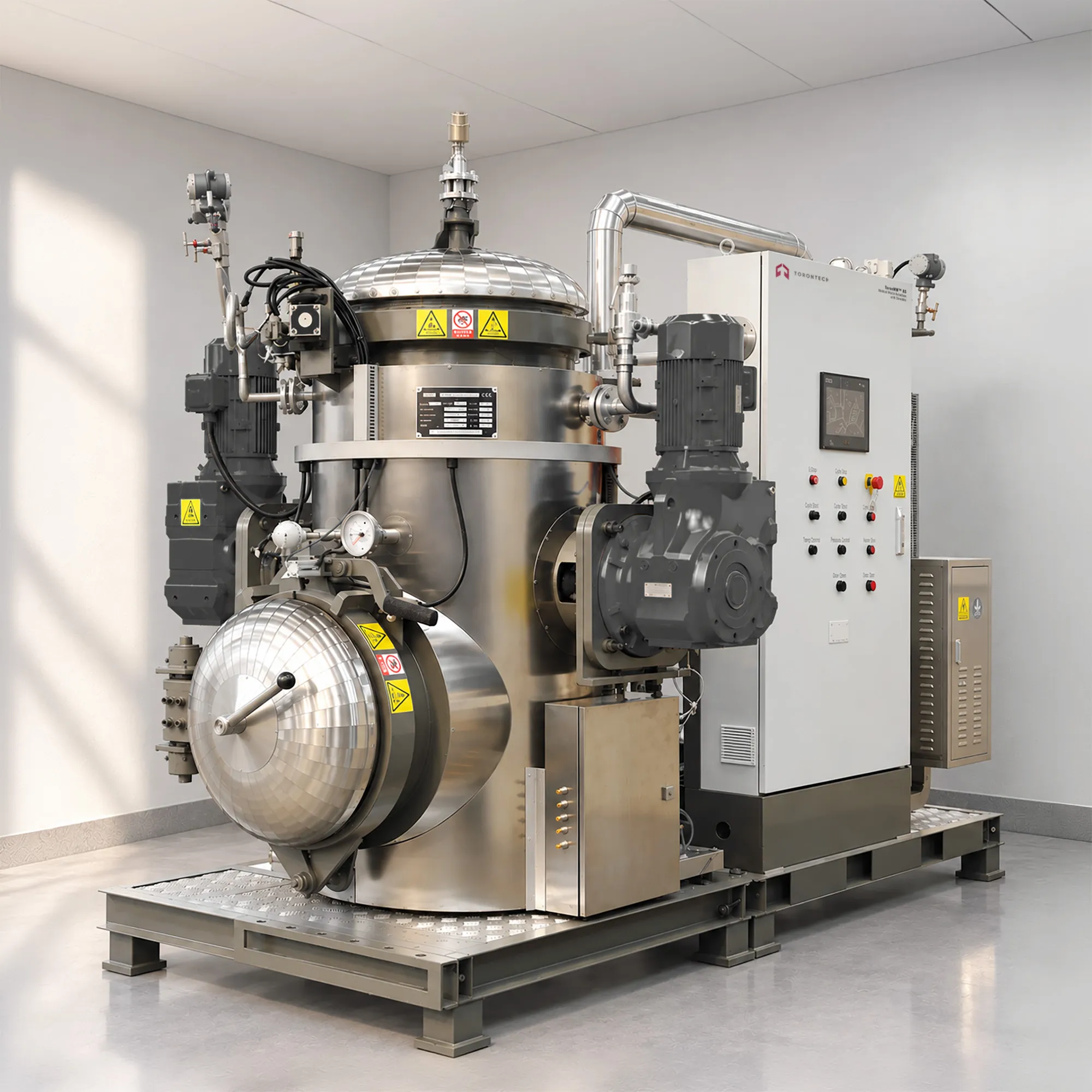
The ToronMW™ AS combines a heavy-duty shredder, a corrosion-resistant pressure vessel, and full cycle automation in a single machine.
- Low-Speed High-Torque Twin-Shaft Shredder: cuts through dense mixed waste, glass, and plastics without the stalling and wear typical of high-speed blender-style shredders
- Automatic Jam Detection and Reversing: the drive senses resistance and alternates direction, clearing bridged material and returning it for a second pass instead of halting the cycle
- Anti-Bridging Push Feeder: a positive pushing mechanism keeps waste moving into the cutting chamber, preventing the arching that stalls gravity-fed shredders
- In-Wall Self-Cleaning Surfaces: resists attack from the high chloride-ion content of medical waste condensate, extending vessel life in an aggressive service environment
- Single Closed Vessel Treatment: shredding, sterilization, and drying all occur inside one sealed chamber, so untreated waste never transfers between machines or contacts an operator
- Fully Automatic Cycle Control: the sequence runs unattended from loading through discharge, reducing labor input and removing operator judgment from process compliance
- Integrated Water Purification: conditions feed water on board, so sites without softening expertise or treated water supply can still run the machine
- Remote Monitoring and Fault Diagnosis: cycle data and alarm conditions are available remotely for support response and uptime tracking
- Sealed Odor and Emission Control: no hazardous gas or malodorous steam vents during the cycle, keeping the installation viable inside occupied buildings
- No Secondary Waste Stream: the process creates no hazardous liquid effluent or residue requiring separate disposal
- Chemical-Free and Radiation-Free Process: steam is the only treatment agent, avoiding chemical inventory, worker exposure controls, and disinfectant procurement
- 60 to 80 Percent Volume Reduction: shredding compacts the treated fraction, cutting container use, storage space, and hauling frequency
- Heavy-Duty Construction: built for continuous multi-shift duty with a low failure rate across long service intervals
- Integrated Steam Generation on Compact Models: the 100 L and 200 L units include an electric steam generator, removing any dependence on plant steam
Theory and Method
Saturated steam sterilization works through the latent heat released when steam condenses on a cooler surface. A gram of saturated steam gives up roughly 2,200 joules as it turns back into water, and that energy transfers directly into the waste it touches. Moist heat then denatures structural proteins and hydrolyzes nucleic acids inside microbial cells, destroying vegetative bacteria, fungi, viruses, mycobacteria, and bacterial spores. Dry heat needs far higher temperatures and much longer holds to achieve the same result.
The relationship between saturated steam pressure and temperature is fixed. Holding the vessel at 0.2 to 0.3 MPa drives the steam temperature to 134°C to 138°C, well above the 121°C baseline used for routine autoclaving, which shortens the hold time needed for a given log reduction. Trapped air is the main obstacle, since air pockets conduct heat poorly and prevent steam from reaching waste surfaces. The vessel therefore evacuates air before the steam charge and again after the hold.
Shredding before sterilization is what separates this design from a conventional autoclave. Intact waste bags trap air, resist steam penetration, and leave cold spots at the center of the load. Reducing the waste to loose fragments opens every surface to direct steam contact, collapses void spaces, and lets the load reach temperature uniformly. Size reduction also renders sharps and identifiable clinical items unrecognizable, which most jurisdictions require before treated waste can enter the municipal stream.
Treatment Cycle Sequence
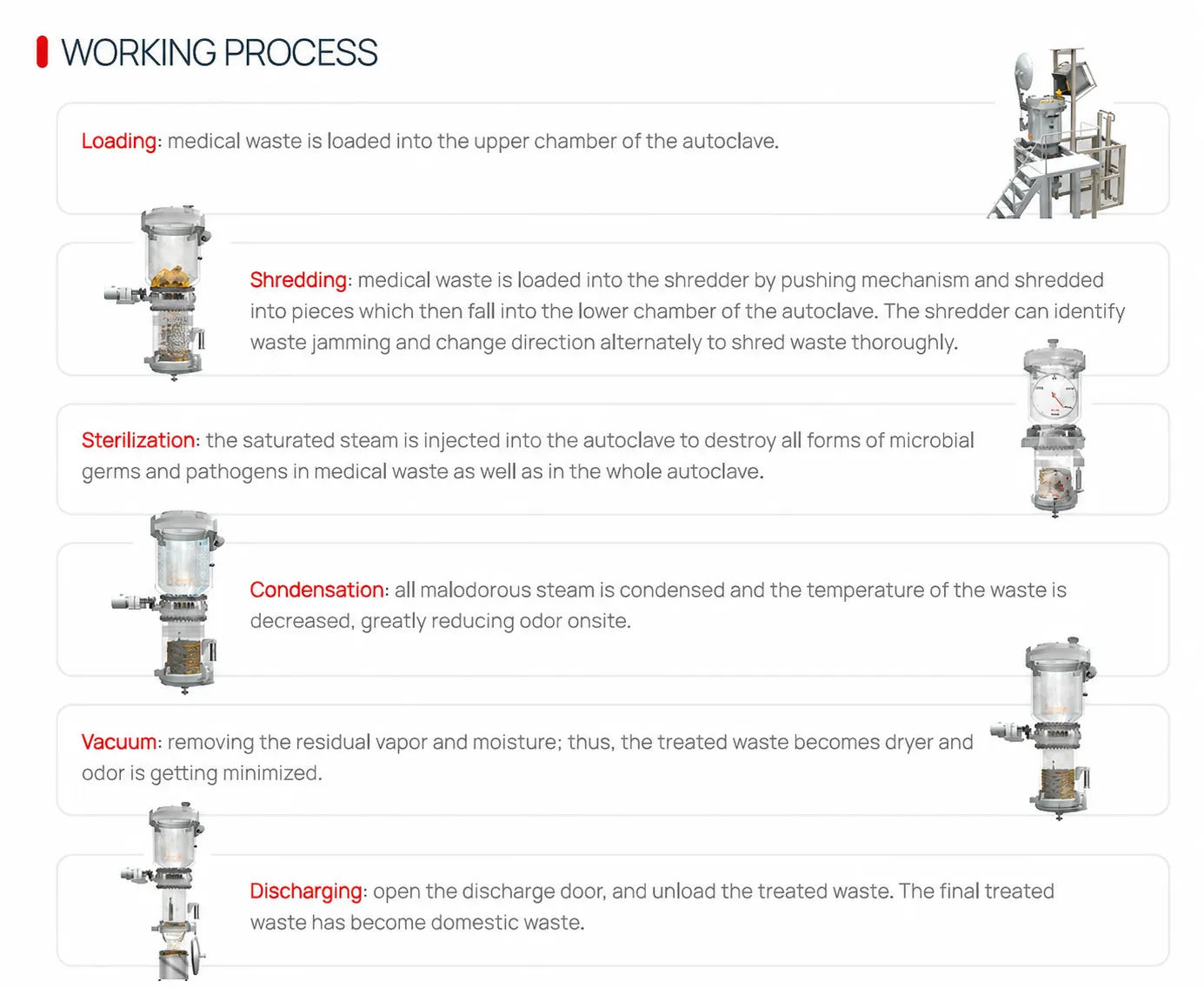
- Loading: waste is charged into the upper chamber and the vessel seals
- Shredding: a pushing mechanism feeds waste into the twin-shaft shredder, which reduces it to fragments that fall into the lower chamber; the drive detects jamming and reverses direction to clear and re-cut the load
- Sterilization: saturated steam floods the lower chamber, holding 134°C to 138°C at 0.2 to 0.3 MPa to inactivate microbial contamination in both the waste and the vessel interior
- Condensation: residual steam condenses and the waste temperature drops, which collapses the odor load before the vessel opens
- Vacuum: the pump strips residual vapor and moisture, leaving the treated fraction dry and low in odor
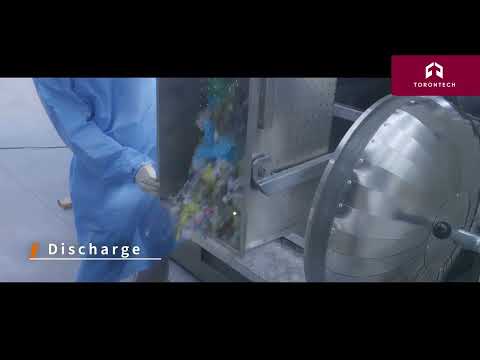
- Discharging: the discharge door opens and the treated material, now classified as ordinary waste in most jurisdictions, is unloaded
Medical Waste Autoclave with Shredder - ToronMW™ AS Technical Specifications
Process Performance
| Parameter | Specification |
|---|---|
| Sterilization Temperature | 134°C to 138°C |
| Sterilization Pressure | 0.2 to 0.3 MPa |
| Microbial Inactivation | STAATT Level IV, ≥ 8 Log₁₀ |
| Volume Reduction | 60% to 80% |
| Treatment Agent | Saturated steam (chemical-free, radiation-free) |
| Shredder Type | Twin-shaft, low speed, high torque, auto-reversing |
| Process Stages | Load, shred, sterilize, condense, vacuum, discharge |
| Control | Fully automatic, remote monitoring and fault diagnosis |
Model Range
| Parameter | ToronMW™ AS-100 | ToronMW™ AS-200 | ToronMW™ AS-300 | ToronMW™ AS-500 | ToronMW™ AS-750 | ToronMW™ AS-1000 | ToronMW™ AS-2500 |
|---|---|---|---|---|---|---|---|
| Treatment Capacity (L/cycle) | 100 | 200 | 300 | 500 | 750 | 1,000 | 2,500 |
| Cycle Time* (min) | 30 | 30 | 30 | 35 | 35 | 40 | 45 |
| Disposal Weight** (kg/h) | 20 | 40 | 60 | 90 | 120 | 150 | 330 |
| Dimensions L×W×H (m) | 3.0 × 1.6 × 2.1 | 3.3 × 1.7 × 2.2 | 3.9 × 3.1 × 3.1 | 4.6 × 3.0 × 3.9 | 5.0 × 3.0 × 4.6 | 5.0 × 5.0 × 5.7 | 6.8 × 5.3 × 7.1 |
| Net Weight (ton) | 2.4 | 3.0 | 3.5 | 4.0 | 4.3 | 8.5 | Available on request |
| Rated Power*** (kW) | 30 | 40 | 14 | 15 | 16 | 22 | 40 |
* Cycle time varies with sterilization temperature and local regulatory requirements.
** Disposal weight is calculated at a waste density of 0.1 kg/L. Actual density varies with waste composition and local segregation practice.
*** The AS-100 and AS-200 include an electric steam generator and water purification system, which accounts for their higher rated power. Larger models draw steam from the plant supply.
Standard Configuration
| Item | Description |
|---|---|
| Pressure Vessel | Dual-chamber design with corrosion-resistant in-wall self-cleaning surfaces |
| Shredding Unit | Built-in twin-shaft shredder with auto-reversing drive and push feeder |
| Steam Supply | Electric steam generator on AS-100 and AS-200; plant steam connection on AS-300 and above |
| Water Treatment | Integrated water purification system, no external softening required |
| Vacuum System | Vacuum pump for pre-sterilization air removal and post-cycle drying |
| Control System | Automatic PLC cycle control with operator interface |
| Remote Support | Remote monitoring and fault diagnosis interface |
| Documentation | Cycle temperature and pressure records for regulatory reporting |