
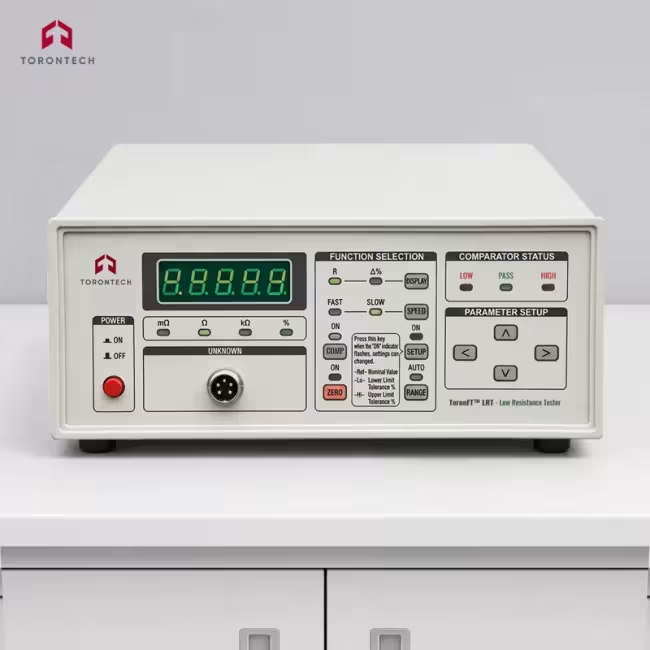
Low Resistance Tester
Low Resistance Tester — ToronFT™ LRT
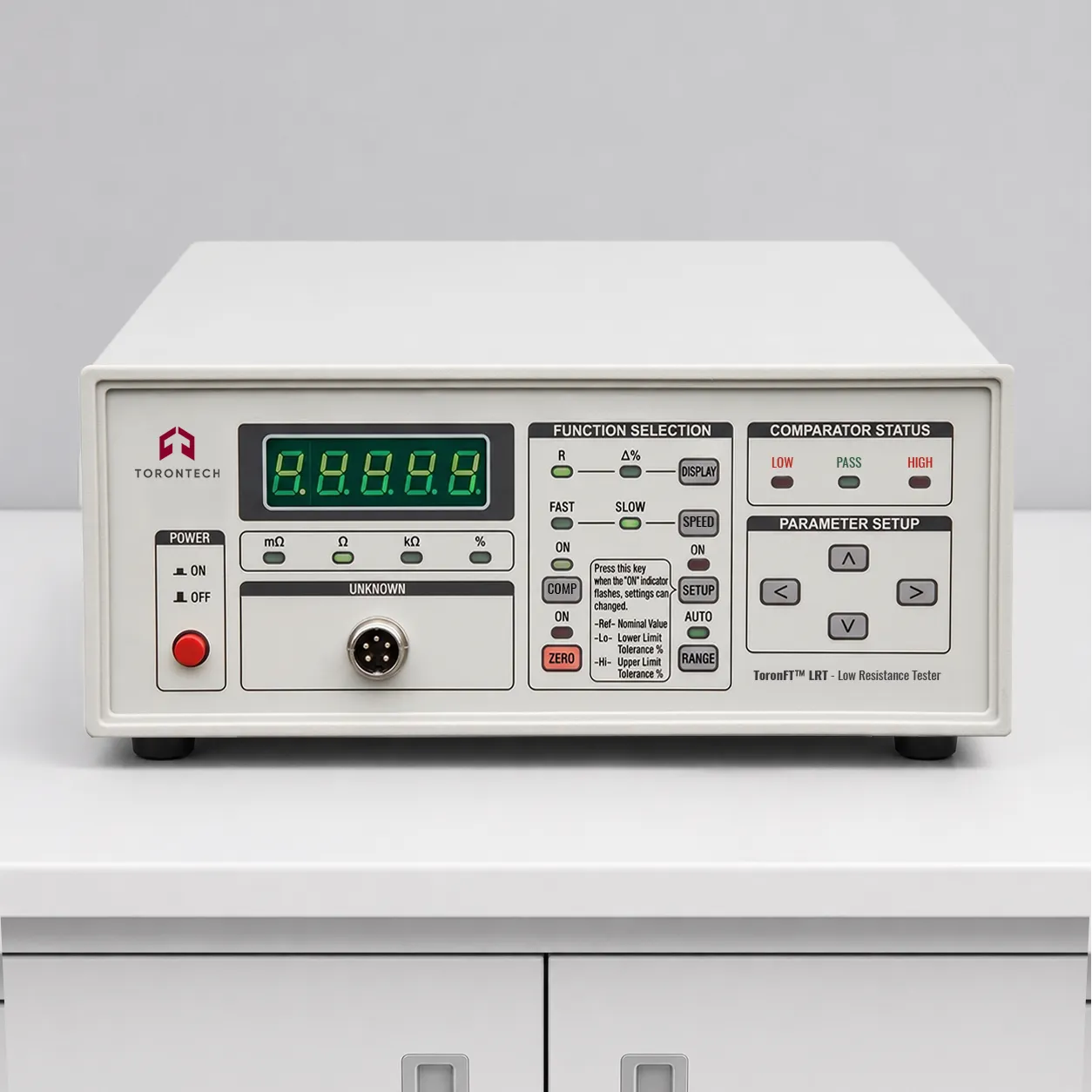
ToronFT™ LRT Low Resistance Tester is a precision DC resistance measurement instrument designed for the accurate measurement of low-resistance values in electrical cables and conductors with wire diameters of 1.0 mm and above. With a resistance measurement range of 0.001 mΩ to 20 kΩ, a measurement accuracy of 0.05% + 2 Counts, and a test current range of 1 mA to 1 A, the ToronFT™ LRT delivers the measurement precision and dynamic range required for cable quality assurance, incoming material inspection, and conductor resistance characterization programs.
The ToronFT™ LRT Low Resistance Tester incorporates a five-terminal Kelvin measurement configuration (two voltage terminals, two current terminals, and one shielding terminal) combined with an intelligent sorting function that provides real-time pass/fail judgment (upper overshoot, qualified, lower overshoot) with an audible qualified signal, enabling high-speed production-line screening without manual result interpretation.
Low Resistance Tester — ToronFT™ LRT Applications
- Wire and cable manufacturers: DC resistance testing and quality control for conductors with diameters ≥ 1.0 mm
- Electrical component manufacturers: low resistance measurement of contacts, connectors, bus bars, and bonding straps
- Quality assurance and incoming inspection departments: batch sampling and production-line screening for conductor resistance compliance
- Cable certification and testing laboratories: conductor resistance measurement per IEC 60228 and related international standards
- Fire protection equipment manufacturers: resistance verification of cable conductors used in fire detection and suppression systems
- Electrical maintenance and field service: low-resistance measurement of installed cable runs and grounding connections
Standards
The ToronFT™ LRT supports low resistance testing in compliance with internationally recognized electrical and cable standards, including:
- IEC 60228: Conductors of insulated cables (conductor resistance requirements)
- ASTM B193: Standard test method for resistivity of electrical conductor materials
- UL 44: Standard for thermoset-insulated wires and cables (conductor resistance reference)
- IEC 61010-1: Safety requirements for electrical equipment for measurement, control, and laboratory use
- ASTM B3: Standard specification for soft or annealed copper wire (resistance reference)
Low Resistance Tester — ToronFT™ LRT Key Features
- Suitable for DC resistance testing of electrical cables with conductor diameters ≥ 1.0 mm — covering standard wire and cable conductor sizes
- Wide resistance measurement range: 0.001 mΩ to 20 kΩ — from micro-ohm conductor resistance to kilohm insulation resistance checks
- Measurement accuracy: 0.05% + 2 Counts — high-precision, traceable resistance data
- Test current range: 1 mA to 1 A — selectable to match specimen requirements and minimize self-heating
- Five-terminal Kelvin measurement configuration: 2 voltage terminals, 2 current terminals, 1 shielding terminal — eliminates lead and contact resistance errors
- Intelligent real-time sorting: upper overshoot, qualified, and lower overshoot categories — with audible qualified signal for production-line screening
- High-speed real-time judgment — enabling rapid, non-interpretive production screening without manual result reading
- Compact bench-top instrument for efficient integration into production quality control and laboratory measurement stations
Theory and Method
The ToronFT™ LRT uses the four-terminal (Kelvin) resistance measurement method to eliminate the effect of lead and contact resistance from the measurement result. In the four-terminal configuration, current is sourced through the two current terminals while voltage is measured across the specimen using the two separate voltage terminals — ensuring that the measured voltage drop reflects only the resistance of the specimen, not the resistance of the measurement leads or contact interfaces.
The additional shielding terminal minimizes interference from external electromagnetic fields and reduces leakage current errors in low-resistance measurements, further improving measurement accuracy at the 0.001 mΩ level. The test current (1 mA to 1 A, selectable) is applied by precision current sources calibrated to deliver stable, accurate DC current throughout the measurement, and the resulting voltage drop is measured by a high-resolution analog-to-digital converter. The sorting function compares the measured resistance to user-defined upper and lower limits in real time, triggering the appropriate sorted output (upper overshoot, qualified, or lower overshoot) and sounding the qualified signal when the measured value falls within the acceptance window.
Low Resistance Tester — ToronFT™ LRT Technical Specifications
| Parameter | Specification |
|---|---|
| Model | ToronFT™ LRT |
| Applicable Conductor Diameter | ≥ 1.0 mm (DC resistance measurement) |
| Resistance Measurement Range | 0.001 mΩ – 20 kΩ |
| Measurement Accuracy | 0.05% + 2 Counts |
| Test Current Range | 1 mA – 1 A |
| Terminal Configuration | 5-terminal: 2 voltage, 2 current, 1 shielding (Kelvin method) |
| Sorting Categories | Upper overshoot / Qualified / Lower overshoot |
| Qualified Signal | Audible sound (real-time) |