

Linear Reciprocating Tribometer - ToronLRT™ 02
Linear Reciprocating Tribometer - Reciprocating Wear Tester - ToronLRT™ 02
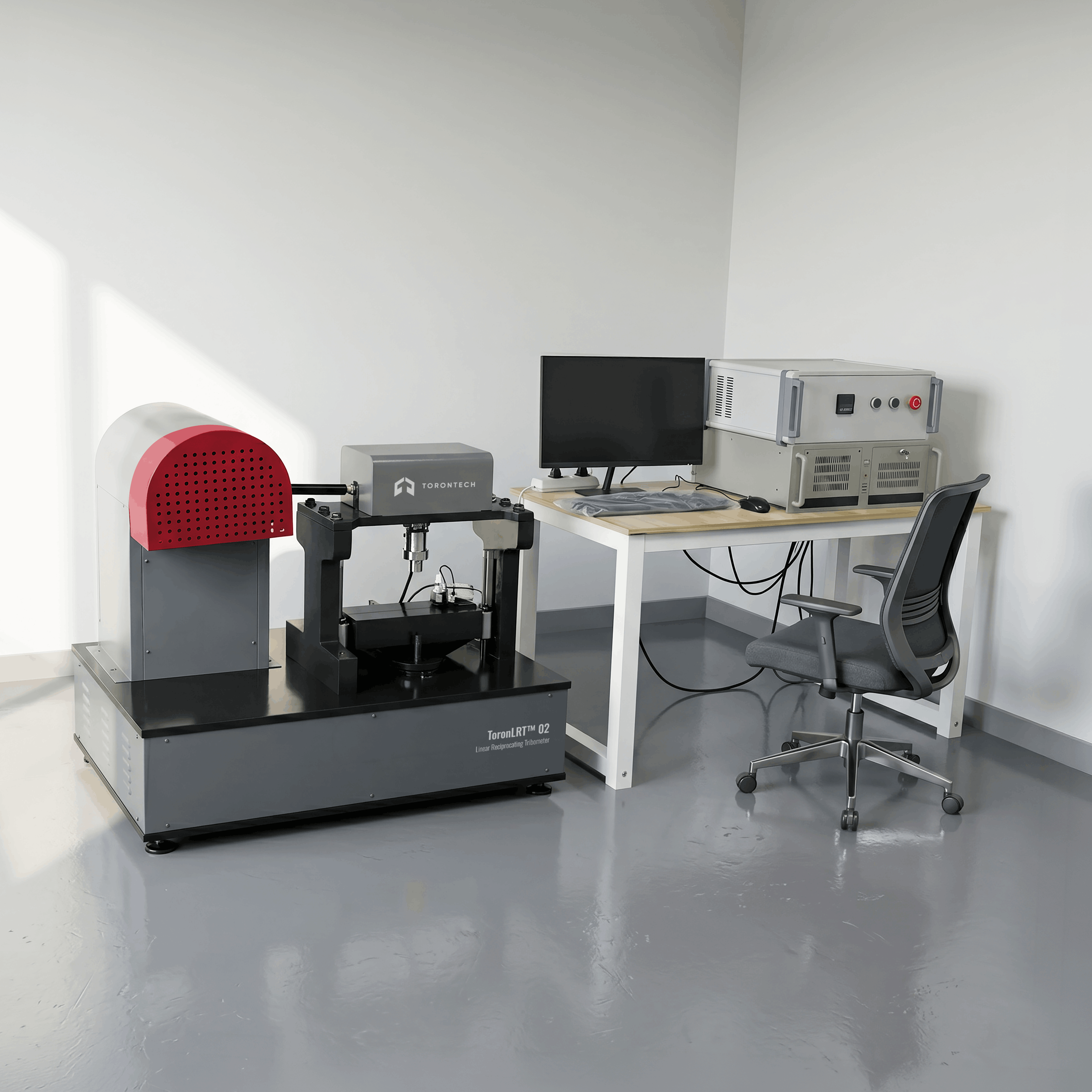
The ToronLRT™ 02 linear reciprocating tribometer tests friction force, coefficient of friction, and wear for materials, surface coatings, and lubricants under controlled reciprocating sliding contact. Built for research laboratories and quality-control departments in materials science, automotive, aerospace, and surface engineering, it generates tribological data under realistic contact conditions matched to ASTM G133. The instrument supports ball-on-flat, pin-on-flat, and cylinder-on-flat configurations and applies loads to 200 N through an automated loading system. An industrial PC with dedicated software manages each test from setup through report generation.
Testing frequency adjusts steplessly from zero to 20 Hz across a maximum stroke of 40 mm, giving operators precise control over contact cycle rate and wear track length. An optional 30 Hz configuration is available for higher-frequency applications. Both dry friction and oil-lubricated test conditions are supported, and the optional high-temperature module extends the test zone to 600°C for evaluating materials and lubricants at elevated service temperatures. Test duration spans from one second to 9,999 hours, covering rapid friction screening through long-duration endurance wear runs.
All test parameters display simultaneously in real time throughout each run: normal load, friction force, friction coefficient, reciprocating frequency, stroke position, elapsed time, and temperature. The control software stores data continuously, plots parameter-versus-time curves automatically, and generates formatted test reports at completion. Configurable threshold limits trigger automatic alarms or machine stop when any parameter exceeds preset bounds. This protection supports unattended test runs without manual monitoring.
Linear Reciprocating Tribometer - ToronLRT™ 02 Applications
The ToronLRT™ 02 suits research and quality-control laboratories that require standardized, repeatable friction and wear data across diverse material types and contact configurations.
- Surface Coating Tribology: tests friction and wear resistance of PVD, DLC, CVD, and thermal spray coatings under standardized ball-on-flat or pin-on-flat reciprocating contact to validate coating performance before deployment
- Lubricant Screening and Development: evaluates friction-reducing effectiveness of industrial oils and greases under reciprocating high-frequency contact conditions, supporting both qualification and formulation work
- Materials Comparison and Selection: measures friction coefficient and wear rate of metals, ceramics, polymers, and composites to inform material selection decisions in design and engineering
- Automotive Powertrain Tribology: replicates sliding contact conditions at valve trains, piston ring-liner pairs, and cam-follower interfaces to screen material and lubricant combinations at operating conditions
- Aerospace Surface Treatment Qualification: verifies friction and wear performance of specialty surface treatments and alloys under oscillating contact at representative loads and cycle rates
- Bearing Material Evaluation: assesses friction and wear behavior of plain bearing material pairs under contact geometries and load levels representative of service conditions
- Mechanical Seal Development: evaluates friction behavior of seal face materials under reciprocating sliding contact to support seal design and material selection
- Biomedical Coating Research: characterizes tribological performance of orthopedic coating materials and substrate pairs under controlled sliding contact conditions
Standards
The ToronLRT™ 02 supports friction and wear testing in accordance with internationally recognized tribology standards. The following standards define the test methods and measurement practices applicable to this instrument's reciprocating contact configuration and output parameters:
- ASTM G133 - Standard Test Method for Linearly Reciprocating Ball-on-Flat Sliding Wear
- ASTM G115 - Standard Guide for Measuring and Reporting Friction Coefficients
- ASTM G40 - Standard Terminology Relating to Wear and Erosion
- ASTM D5707 - Standard Test Method for Measuring Friction and Wear Properties of Lubricating Grease Using a High-Frequency, Linear-Oscillation (SRV) Test Machine
- DIN 51834-1 - Testing of Lubricants: Tribological Test in the Translatory Oscillation Apparatus, Part 1: General Working Principles
Linear Reciprocating Tribometer - ToronLRT™ 02 Key Features
The ToronLRT™ 02 combines automated loading, three selectable contact geometries, and full-featured data acquisition to give tribology laboratories a single instrument for standardized ASTM G133 friction and wear testing.
- Motorized Load Application to 200 N: automated vertical loading axis holds contact force constant throughout each test, eliminating manual load variation between operators and runs
- Stepless Frequency Control to 20 Hz: adjusts continuously from zero to 20 Hz (30 Hz with optional upgrade) without discrete steps, allowing precise frequency matching to any test protocol
- Three Contact Pair Geometries: ball-on-flat, pin-on-flat, and cylinder-on-flat configurations are all supported, covering point contact, circular contact, and line contact test setups in one instrument
- 40 mm Maximum Stroke: accommodates test configurations from short micro-oscillation tracks to longer ASTM G133 wear tracks, with stroke length set before each test run
- Dry and Lubricated Test Modes: test chamber supports dry friction and oil-lubricated conditions without instrument modification, expanding applicability from unlubricated wear screening to full lubricant evaluation
- Optional High-Temperature Module to 600°C: extends the test zone for service-temperature characterization of coatings and lubricants without a separate elevated-temperature instrument
- Real-Time Seven-Parameter Display: normal load, friction force, friction coefficient, frequency, stroke position, elapsed time, and temperature display simultaneously throughout each test for continuous test visibility
- Automated Parameter Logging and Reporting: control software logs all parameters continuously, generates parameter-versus-time curves automatically, and produces formatted test reports at completion
- Test Duration to 9,999 Hours: configurable time range covers short friction screening and long-cycle endurance wear tests on the same platform
Theory and Method
A linear reciprocating tribometer measures friction coefficient from the direct ratio of frictional and normal forces at the contact interface. A stationary upper specimen presses against a flat lower specimen under a prescribed normal load, and the flat translates back and forth in a straight line. A load cell measures the resulting friction force continuously, and the control system computes μ = F/N at each stroke point. The three selectable contact pair geometries control the initial Hertzian contact stress and simulate different real-world contact configurations.
The linear reciprocating geometry introduces a tribological event that rotating configurations cannot reproduce: the velocity reversal at each stroke end. As the lower flat changes direction, sliding velocity passes momentarily through zero before increasing in the opposite direction. This zero-velocity event disrupts hydrodynamic lubrication in wet tests and concentrates fatigue stress at the contact edges in both wet and dry conditions. Many practical mechanical components, including valve trains, oscillating bearings, and reciprocating seals, operate under exactly these conditions.
The ToronLRT™ 02 applies load through a motorized vertical axis with 25 mm of travel, holding contact force constant throughout the test regardless of surface changes at the wear site. Ball-on-flat creates a point contact for high initial Hertzian pressure; pin-on-flat creates a circular contact at lower pressure; cylinder-on-flat distributes load along a line. The optional high-temperature module heats the test zone to 600°C for service-temperature testing of coatings and lubricants. All force signals feed into the real-time friction coefficient calculation logged continuously by the control software.
Linear Reciprocating Tribometer - ToronLRT™ 02 Technical Specifications
| Parameter | Specification |
|---|---|
| Max Reciprocating Frequency | 20 Hz, stepless adjustment |
| Optional Max Frequency | 30 Hz |
| Max Stroke Length | 40 mm |
| Max Friction Force | 100 N |
| Max Normal Load | 200 N |
| Contact Pair Configurations | Ball-on-flat, pin-on-flat, cylinder-on-flat |
| Upper Specimen Vertical Travel | 25 mm |
| Test Time Range | 1 s to 9,999 h |
| Control System | Industrial PC with dedicated test software |
| Displayed Parameters | Test force, friction force, friction coefficient, frequency, elapsed time, temperature |
| High-Temperature Module (Optional) | Ambient to 600°C |