
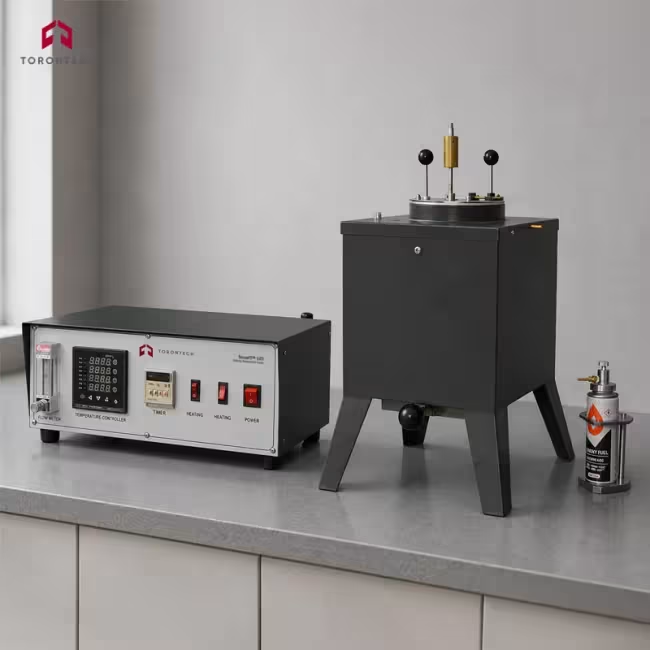
Lighting Temperature Tester
Lighting Temperature Tester – ToronFT™ LiTT
ToronFT™ LiTT Lighting Temperature Tester is a precision laboratory instrument designed for testing the flash-ignition temperature (FIT) and spontaneous-ignition temperature (SIT) of plastic materials using the hot air furnace method. This testing method is one of the primary approaches for evaluating the fire performance of plastics — determining the lowest temperatures at which plastic materials will ignite under defined conditions of heat exposure, either when a small flame is applied (flash-ignition) or without any external ignition source (spontaneous-ignition).
The ToronFT™ LiTT determines three key thermal ignition parameters of plastics: Flash-Ignition Temperature (FIT), Spontaneous-Ignition Temperature (SIT), and the temperature of smoldering combustion — a condition where no flame is present in the solid phase but the burning area is accompanied by luminescence. It complies with ISO 871 and ASTM D1929 — the principal international standards for determining the ignition temperature of plastics.
Lighting Temperature Tester – ToronFT™ LiTT Applications
The ToronFT™ LiTT is applicable for flash-ignition and spontaneous-ignition temperature testing of the following plastic and polymeric material categories:
- Engineering plastics and commodity polymers requiring FIT and SIT data for fire hazard assessment and material selection
- Plastic components and assemblies for electrical and electronic equipment requiring flash-ignition and spontaneous-ignition temperature characterization
- Building and construction plastic materials — including insulation foams, pipe systems, and cladding — for fire performance evaluation
- Packaging materials, films, and plastic containers requiring flash-ignition temperature data for fire and explosion hazard classification
- Automotive interior plastic materials for FIT and SIT fire hazard characterization
- Research and development of new polymer formulations — using FIT and SIT data to evaluate and optimize thermal ignition resistance of plastic materials
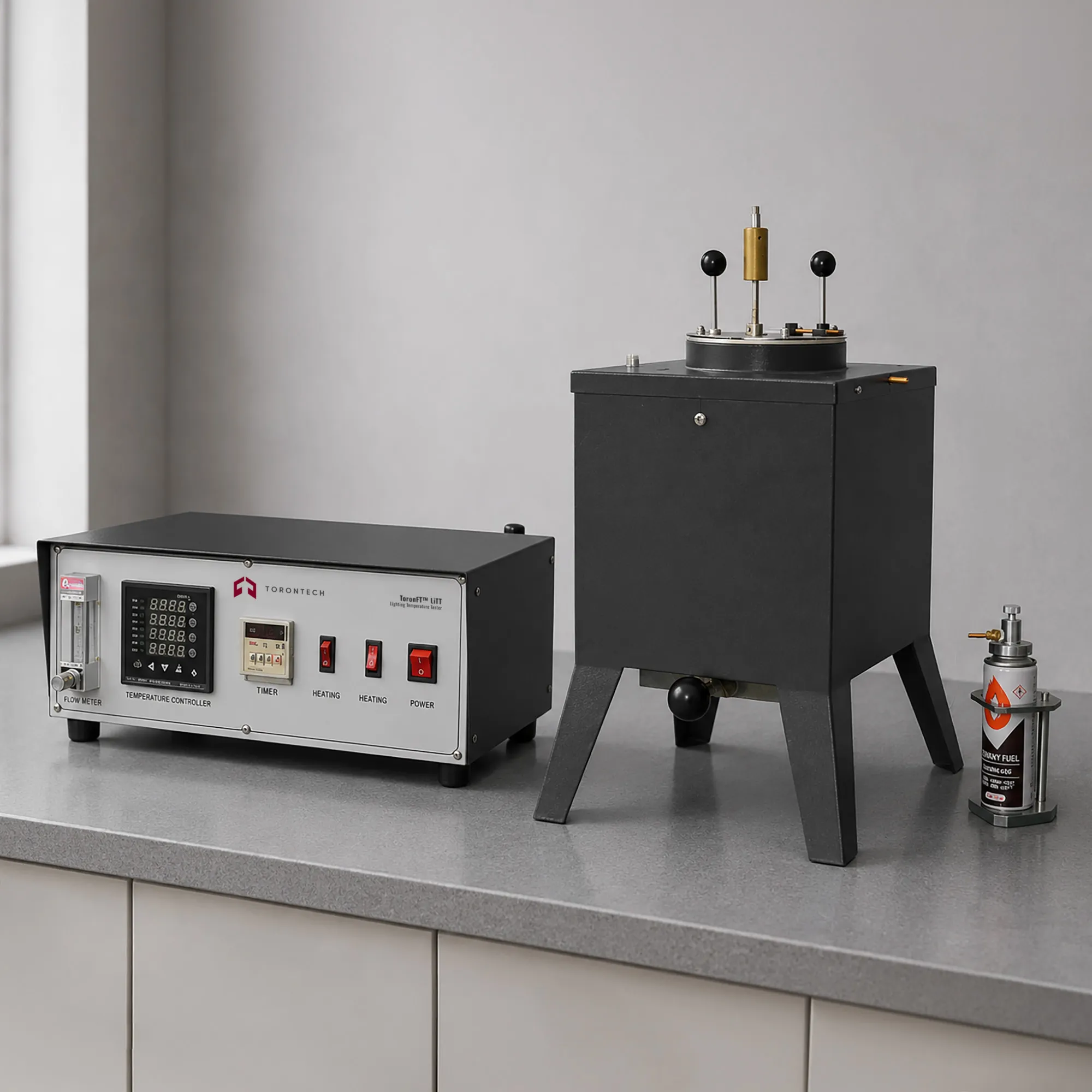
Standards
The ToronFT™ LiTT is designed to comply with the following international standards for plastic flash-ignition and spontaneous-ignition temperature testing:
- ISO 871 — Plastics: Determination of ignition temperature using a hot-air furnace
- ASTM D1929 — Standard Test Method for Determining Ignition Temperature of Plastics
- IEC 60695-1-10 — Fire hazard testing: Guidance for assessing the fire hazard of electrotechnical products
Lighting Temperature Tester – ToronFT™ LiTT Key Features
- Complete hot air furnace-based lighting temperature tester for simultaneous determination of Flash-Ignition Temperature (FIT), Spontaneous-Ignition Temperature (SIT), and smoldering combustion temperature of plastic materials per ISO 871 and ASTM D1929
- Precisely controlled hot air furnace environment provides stable, reproducible temperature conditions for accurate flash-ignition and spontaneous-ignition temperature determination across a wide range of plastic material types
- Small pilot flame applied at the furnace upper opening for FIT determination — detecting flash-ignition of escaping combustible gases at the threshold ignition temperature with high sensitivity
- Spontaneous-ignition temperature (SIT) determined under identical hot air furnace conditions but without pilot flame — identifying the auto-ignition threshold of plastic thermal decomposition gases
- Smoldering combustion detection capability — identifies the temperature at which slow, flameless luminescent combustion occurs in the solid plastic phase — capturing the complete thermal ignition behavior spectrum of the test material
- Complies with ISO 871 and ASTM D1929, providing internationally recognized flash-ignition and spontaneous-ignition temperature test results for plastics accepted by fire safety authorities and certification bodies in North America and globally
Theory and Method
Flash-ignition temperature (FIT) and spontaneous-ignition temperature (SIT) testing expose plastic specimens to a hot air furnace at progressively increasing temperatures to identify the critical temperatures at which thermal decomposition gases ignite. At the flash-ignition temperature, sufficient flammable gas is generated from the heated plastic to ignite momentarily when a small pilot flame is applied to the escaping gas at the furnace opening. At the spontaneous-ignition temperature, the concentration of evolved flammable gas is sufficient for auto-ignition without any external flame source.
In the ToronFT™ LiTT, the plastic specimen is placed in the heating chamber of the hot air furnace and heated at the specified rate. A small flame is applied to the upper opening of the furnace to detect the FIT — the lowest temperature at which ignition of escaping gas is observed. The SIT is determined by the same method but without applying a pilot flame — the temperature at which auto-ignition occurs is recorded. Smoldering combustion is also identified — characterized by luminescence without open flame in the solid plastic material phase. The instrument complies with ISO 871 and ASTM D1929 test requirements.
Lighting Temperature Tester – ToronFT™ LiTT Technical Specifications
| Component / Parameter | Specification Details |
|---|---|
| General Information | |
| Product Name | Lighting Temperature Tester — ToronFT™ LiTT |
| Test Method | Hot air furnace method |
| Applicable Materials | Plastics (all types) |
| Compliance Standards | ISO 871; ASTM D1929 |
| Test Capabilities & Parameters | |
| Parameters Determined | Flash-Ignition Temperature (FIT); Spontaneous-Ignition Temperature (SIT); Smoldering combustion temperature |
| Parameter Definitions | • FIT: Lowest temperature at which sufficient flammable gas is ignited by a small applied flame • SIT: Lowest temperature at which self-ignition occurs without an external flame source • Smoldering Combustion: No flame in solid phase; burning area is accompanied by luminescence |
| Furnace & Heating System | |
| Furnace Tube (Outer) | Ceramic tube; Inner Diameter: 100±5 mm; Length: 240±20 mm; Temperature Resistance: ≥750℃ |
| Inner Tube | Inner Diameter: 75±2 mm; Length: 240±20 mm; Temperature Resistance: ≥750℃ |
| Heating Element | 1.3±0.1 mm metal alloy heating wire evenly wound 50 turns around the furnace tube; features an outer jacket made of refractory material |
| Heating Power & Control | Power: 2.6 kW; Heating is automatically controlled |
| Ignition System | |
| Ignition Device | Copper tube with an inner diameter of 2.0 mm (uses Butane ignition) |
| Ignition Placement | Horizontally placed 5±1 mm above the surface of the round cover, located at the center of the open round cover |
| Flame Height | Adjusted to 20±2 mm |
| Temperature Control & Sensors | |
| Temperature Controller | PID program control; simultaneously displays three temperatures with a display accuracy of ±0.5℃ |
| Temperature Stability | The reference temperature T3 is adjusted automatically until the air temperature T2 stabilizes at the set initial temperature value |
| Thermocouple | 0.5 mm diameter K-type thermocouple (Temperature error: ±2.5℃, conforming to Class 2 of GB/T16839.2-1997) |
| Airflow & Timing System | |
| Airflow Regulation | 1 to 10 L/min (controlled via a rotor flow meter and air regulating valve) |
| Timer | Settable from 0 to 99.00 (min/s); Accuracy: 1 s/h |
| Dimensions, Weight & Materials | |
| Overall Equipment Dimensions | 700 mm × 450 mm × 700 mm (L × W × H) |
| Test Furnace Dimensions | 250 mm × 250 mm × 700 mm |
| Equipment Weight | 20 kg |
| Construction Materials | • Casing: Painted finish for an elegant appearance • Sample Container: Stainless steel |
For more information, pricing, or to request a quotation, please contact ToronFT. Specifications are subject to change without prior notice.