
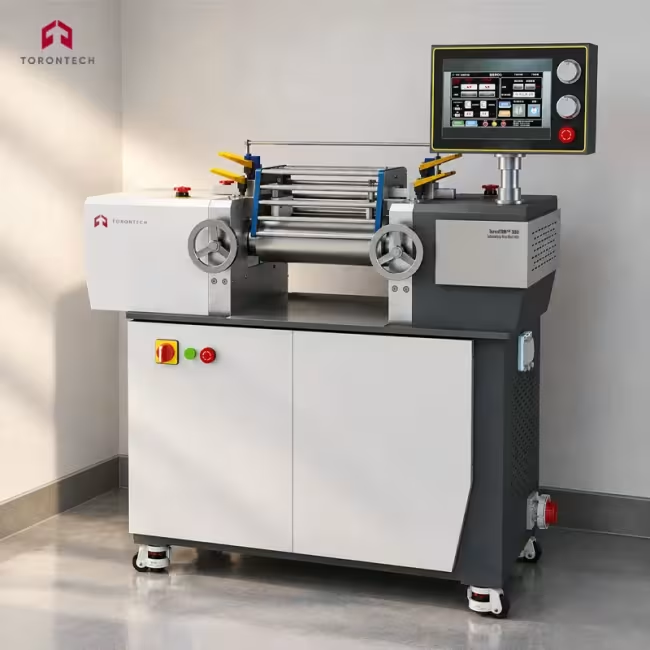
Laboratory Two-Roll Mill - ToronTRM™ 300
ToronTRM™ 300 Laboratory Two-Roll Mill prepares small-batch polymer compounds for research, quality control, and teaching work. Two mirror chrome-plated rolls counter-rotate across an adjustable nip, working rubber and thermoplastic stock into a uniform sheet. Each roll runs on its own servo drive across a 0 to 60 rpm range, so the friction ratio becomes a setting rather than a fixed property of a gear train. Compounders can therefore approach production mixing conditions using a sample of a few hundred grams.
Electric heating built into dedicated roll molds takes surface temperature from ambient to 300°C, and the roll construction distributes that heat evenly along the working face. Natural or water cooling brings temperature back down between runs and holds shear-sensitive stock below its degradation point. Roll separation adjusts anywhere from closed contact to 10 mm, giving control over both shear intensity and finished sheet thickness. A PLC touch-screen panel handles heating, roll speed, and run timing from one interface.
Safety hardware on the TRM 300 addresses the hazard particular to open mills, which is the nip itself. A pull-rod trip line, a panel emergency stop, and a knee-operated reverse door each stop or reverse the rolls from the operator position. A protective enclosure version covers laboratories that require a fully guarded machine, and a three-dimensional safety guard is available as an option. Rubber compounders, masterbatch developers, and university polymer programs apply the mill to mixing, mastication, and sheet preparation alike.
Laboratory Two-Roll Mill - ToronTRM™ 300 Applications
The ToronTRM™ 300 covers compounding and sheet-preparation work at sample scale, ahead of any commitment to an internal mixer or production line.
- Rubber Compound Development: masticates natural and synthetic rubbers, then works in fillers, accelerators, and curatives to build trial recipes
- Filler Dispersion Studies: disperses carbon black, silica, calcium carbonate, and clay at loadings that demand high shear at the nip
- Masterbatch and Pigment Trials: mixes and evaluates color concentrates for dispersion quality, gloss, and shade consistency
- Additive Screening: incorporates plasticizers, stabilizers, flame retardants, and coupling agents for property comparison
- Thermoplastic Blending: combines resins and compatibilizers into homogeneous sheet for downstream molding or testing
- Test Specimen Sheet Preparation: produces sheet of controlled thickness for cutting tensile, tear, hardness, and abrasion specimens
- Recycled Polymer Evaluation: reworks reclaimed rubber and plastic with virgin stock to gauge processability and property retention
- Sample Reclaim and Reprocessing: converts trial batches and off-cuts back into workable sheet for repeat testing
- Thermoset and Silicone Work: mixes silicone rubber and other reactive systems under controlled temperature to avoid premature cure
- University Teaching Laboratories: shows students mastication, banding, and cut-and-fold mixing with guarded operation
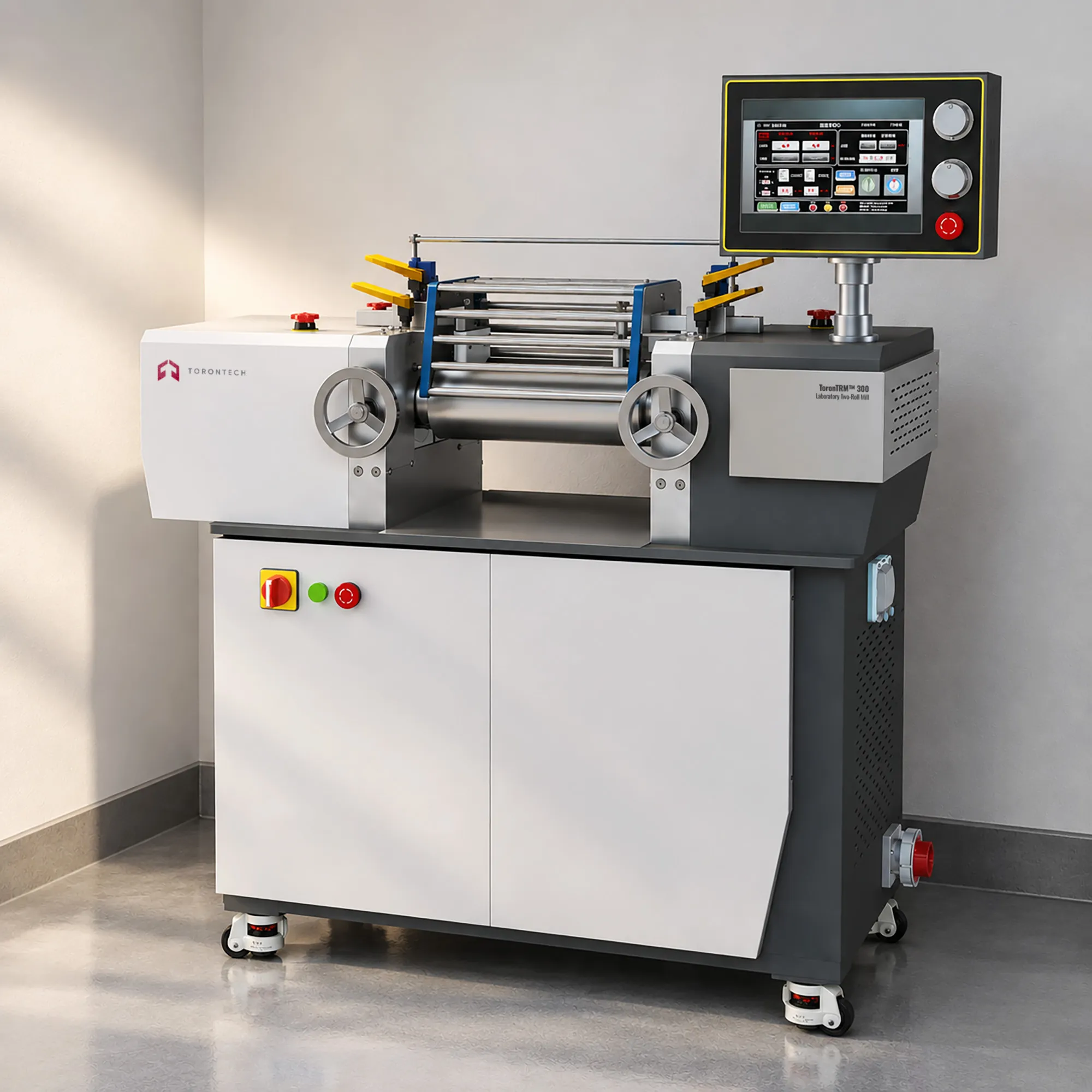
Laboratory Two-Roll Mill - ToronTRM™ 300 Key Features
The feature set on the ToronTRM™ 300 centers on controllable shear, even roll temperature, and operator protection at the nip.
- Independent Servo Roll Drives: 0 to 60 rpm on each roll separately, so friction ratio becomes an adjustable mixing parameter
- Mirror Chrome-Plated Roll Surfaces: smooth, polished faces release the sheet cleanly and resist buildup between materials
- HRC60 Hardened Roll Bodies: precision-ground SKD-series chromium-molybdenum tool steel holds roll geometry and surface finish under repeated high-shear work
- Adjustable Nip, 0 to 10 mm: sets shear intensity and finished sheet thickness for each stage of a mixing procedure
- Roll Temperature to 300°C: dedicated electric heating molds cover rubber, thermoplastic, and higher-temperature compound work, with the range customizable on request
- Uniform Heat Distribution: even surface temperature along the roll face keeps mixing conditions consistent across the full sheet width
- Natural or Water Cooling: removes shear-generated heat to protect curative packages and shear-sensitive polymers
- PLC Touch-Screen Control: single panel for temperature, roll speed, and timing, with repeatable parameter settings between operators
- Pull-Rod Emergency Trip: a full-width trip line stops the rolls from anywhere along the operator side
- Knee-Operated Reverse Door: hands-free roll reversal for the moment when an operator's hands are occupied at the nip
- Panel Emergency Stop: a second, independent stop path for immediate shutdown
- Protective Enclosure Version: a fully guarded machine variant for laboratories with stricter machine-safety requirements
- Optional Three-Dimensional Safety Guard: added barrier protection around the nip and roll ends
- Ø120 or Ø150 mm Roll Options: two roll diameters share the same 350 mm face length to match batch size and available bench space
- Mobile Base: castors allow the mill to be repositioned within a laboratory
- Dual-Voltage Mains Compatibility: 380 V and 220 V, ±10%, at 50 or 60 Hz on a 3.5 kW drive
Theory and Method
Mixing on an open mill happens inside the nip. Two rolls turning toward each other drag material into a narrowing gap, where pressure and shear stress rise sharply over a short path. The rolls turn at different surface speeds, so material in the nip shears between one faster face and one slower face. That speed difference, the friction ratio, sets the shear work each pass delivers, and independent servo drives let an operator dial it to the compound.
Shear at the nip does two separate jobs. Dispersive mixing breaks filler agglomerates apart, because the stress transmitted through the surrounding polymer exceeds the cohesive strength holding the aggregate together. Distributive mixing spreads those broken-down particles through the bulk, helped by the operator cutting the banded sheet off the slow roll and folding it back into the nip. The same shear masticates raw rubber, scissioning long molecular chains so the stock softens, loses elasticity, and accepts powdered ingredients.
Temperature governs whether that mechanical work produces a good compound or a ruined one. Roll surface temperature sets stock viscosity, which decides how much stress reaches the filler agglomerates: soft stock transmits too little, stiff stock overheats. Uniform temperature across the roll face keeps shear conditions equal along the whole sheet. Water cooling removes the heat shear itself generates, which matters for compounds carrying curatives that react well below 300°C.
Laboratory Two-Roll Mill - ToronTRM™ 300 Technical Specifications
| Parameter | Specification |
|---|---|
| Roll Size | Ø120 mm or Ø150 mm × 350 mm face length |
| Roll Material | SKD-series chromium-molybdenum tool steel, mirror chrome-plated, HRC60, precision ground |
| Roll Speed | 0 to 60 rpm, each roll independently servo regulated |
| Roll Spacing (Nip) | 0 to 10 mm, adjustable |
| Temperature Range | Ambient to 300°C (customizable) |
| Heating Mode | Electric |
| Cooling Mode | Natural or water cooling |
| Control Mode | PLC with touch screen |
| Safety Protection | Pull-rod emergency stop, emergency stop button, knee-operated reverse safety door |
| Voltage | AC 380 V / 220 V, ±10%, 50/60 Hz |
| Main Unit Power Rating | 3.5 kW |
Configuration Options
| Item | Description |
|---|---|
| Standard Type | Open-frame mill with pull-rod stop, emergency stop button, and knee reverse door |
| Protective Type | Enclosed variant with full guarding around the roll assembly |
| Three-Dimensional Safety Guard | Optional added barrier around the nip and roll ends |
| Roll Diameter | Ø120 mm or Ø150 mm, both with 350 mm face length |
| Temperature Range | Ambient to 300°C standard, customizable on request |