
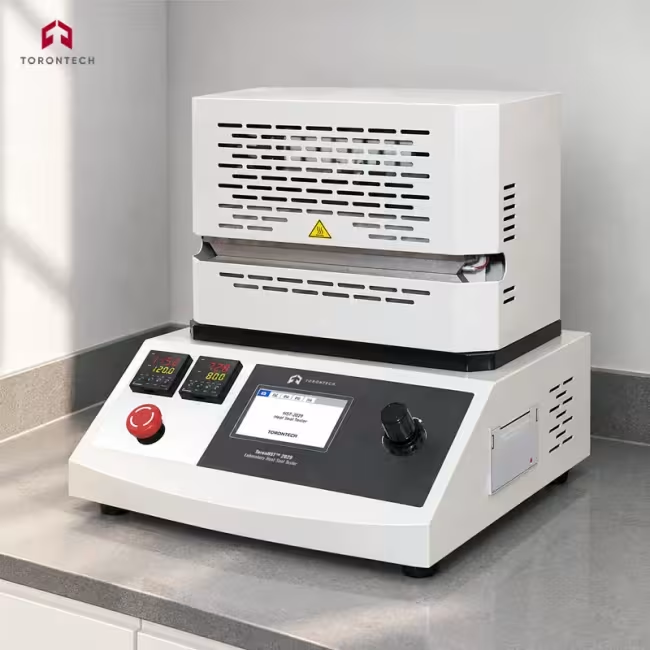
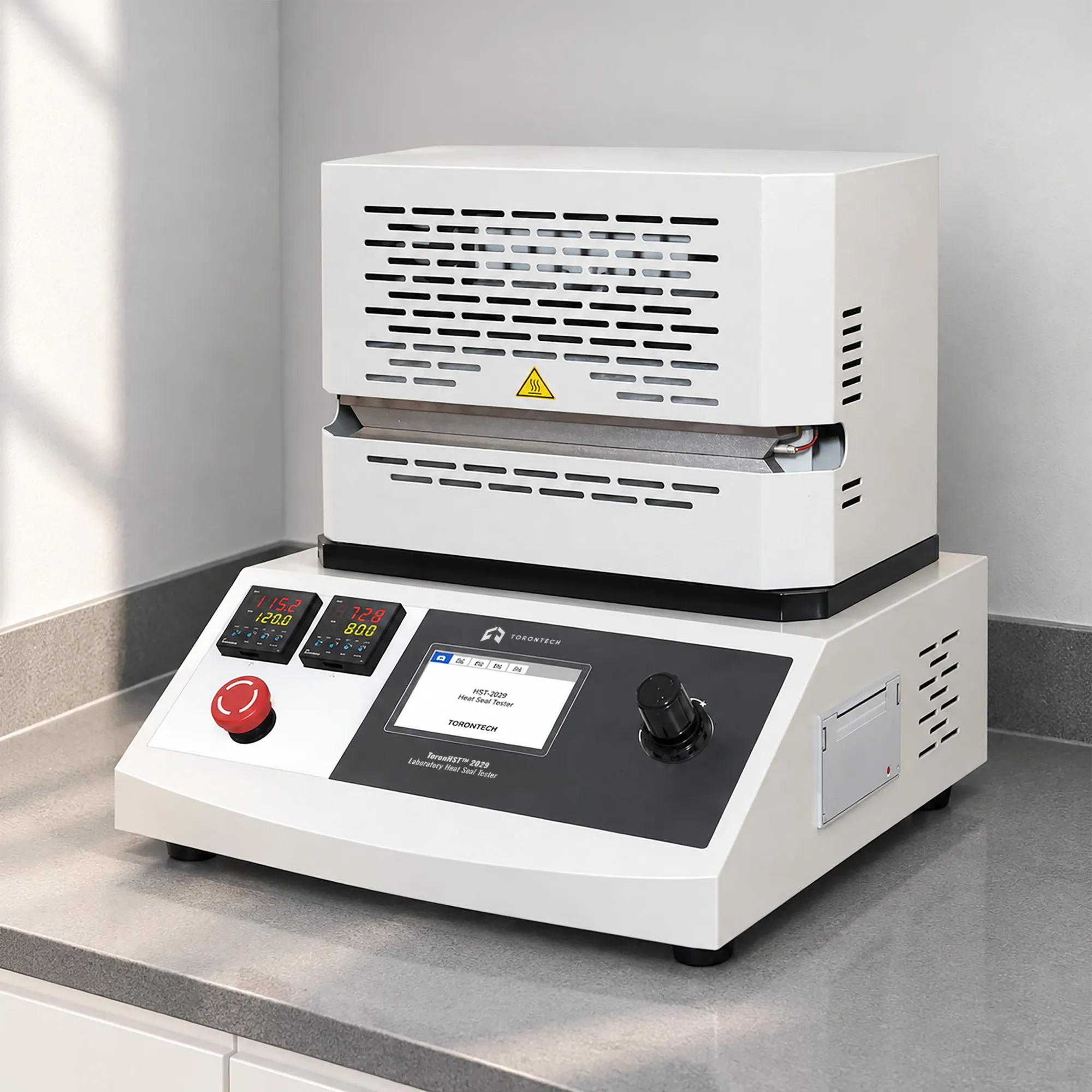
Laboratory Heat Seal Tester
Laboratory Heat Seal Tester - ToronHST™ 2029
Heat Sealer with Independent Dual-Jaw Temperature Control
The ToronHST™ 2029 is a laboratory heat seal tester that makes heat seals under controlled temperature, pressure, and dwell time to determine the heat sealability of films. Two heated jaws with independent temperature control press the film for a set time, so a lab can find the sealing conditions that give a sound seal. It serves food, pharmaceutical, and flexible-packaging labs.
The ToronHST™ 2029 seals over a room-temperature to 300°C range with ±0.2°C accuracy, a 0.03 to 0.6 MPa pressure range, and a dwell time of 0.1 to 999.9 seconds. Independent upper and lower jaw temperatures suit laminates and asymmetric structures. A touchscreen sets each parameter, and a micro-printer records the settings.
Safety features include an emergency stop, over-temperature and over-pressure protection, and a burn-guard design, and the unit runs silently with no cooling fan. The ToronHST™ 2029 (Heat Sealer with Independent Dual-Jaw Temperature Control) prepares sealed specimens whose strength can then be evaluated on a tensile tester. Foot-pedal operation speeds repeated sealing.
Laboratory Heat Seal Tester - ToronHST™ 2029 Applications
The ToronHST™ 2029 sets and reproduces sealing conditions wherever heat sealability drives packaging performance.
- Heat Sealability Studies: finds the temperature, pressure, and time that give a sound seal on a film.
- Sealing Window Development: maps how sealing settings affect the seal to define the sealing window.
- Seal Sample Preparation: makes consistent sealed specimens for later strength testing on a tensile tester.
- Laminates and Coextrusions: seals asymmetric structures with independent upper and lower jaw temperatures.
- Food and Pharmaceutical Packaging: sets sealing conditions for food and drug packaging films.
- Sealant and Film Development: qualifies new films and sealant layers for sealing performance.
- Process Setup and Transfer: builds a repeatable sealing recipe to transfer to production lines.
- Quality Control: verifies sealing behavior against specification batch to batch.
Standards
The ToronHST™ 2029 is designed to align with the internationally recognized practice for making heat seals to evaluate heat sealability.
- ASTM F2029 - Standard Practice for Making Heat Seals for Determination of Heat Sealability of Flexible Webs as Measured by Seal Strength
Sealing conditions depend on the film and the application, so the temperature, pressure, and dwell time can be set to a laboratory's chosen protocol.
Laboratory Heat Seal Tester - ToronHST™ 2029 Key Features
The ToronHST™ 2029 pairs independent dual-jaw temperature control with precise pressure and time settings.
- Independent Dual Jaws: two heated jaws with separate temperature control suit asymmetric and laminate structures.
- Sealing Temperature to 300°C: a wide temperature range with ±0.2°C accuracy covers most sealant films.
- Adjustable Pressure: a 0.03 to 0.6 MPa sealing pressure range, set easily for the material.
- Precise Dwell Time: a dwell time of 0.1 to 999.9 seconds, set on the touchscreen.
- Touchscreen Control: temperature, pressure, and time are set on a color TFT touchscreen.
- Built-In Micro-Printer: prints the sealing parameters for each run.
- Safety Design: an emergency stop, over-temperature and over-pressure protection, and a burn guard protect the operator.
- Quiet Operation: the sealer runs silently with no cooling fan.
- Foot-Pedal Operation: a foot pedal frees the operator's hands during sealing.
- RS232 Communication: a serial port connects the instrument to a PC.
- Laboratory Data Management Integration: optional lab data management software centralizes records.
Theory and Method
The heat sealability of a film depends on three settings: the sealing temperature, the pressure applied, and the dwell time the film spends under the hot jaws. A heat seal tester makes seals under precisely controlled combinations of these settings, so a lab can find the conditions that give a sound seal.
The instrument presses the film between two heated jaws for a set dwell time at a set pressure, then releases it. Independent control of the upper and lower jaw temperatures lets the sealer match asymmetric structures, where one side needs more heat than the other. Repeating the seal across a grid of temperature, pressure, and time settings maps how each affects the seal.
The sealed specimens are then evaluated, often by peeling them on a tensile tester, to find the setting that gives the target seal strength. Finding this sealing window matters because too little heat leaves a weak seal, while too much can burn or distort the film. The result is a repeatable recipe for sealing that film on a packaging line.
Laboratory Heat Seal Tester - ToronHST™ 2029 Technical Specifications
| Parameter | Specification |
|---|---|
| Heat Temperature | Room temperature +6 to 300°C |
| Temperature Accuracy | ±0.2°C |
| Heat Pressure | 0.03 to 0.6 MPa (standard) |
| Dwell Time | 0.1 to 999.9 s |
| Heat Jaw Surface | 265 mm × 12 mm (standard) |
| Heat Jaws | 2, independently controlled |
| Gas Source Pressure | 0.05 to 1.1 MPa (user-supplied) |
| Gas Source Interface | Ø6 mm |
| Dimensions | 536 mm (L) × 335 mm (W) × 413 mm (H) |
| Voltage | AC 220 V, 50 Hz (110V is also available) |
| Net Weight | 33 kg |
Standard Delivery
| Item | Description |
|---|---|
| Main Unit | Dual-jaw laboratory heat sealer with touchscreen |
| Micro-Printer | Built-in printer for sealing parameters |
| Foot Pedal | Foot-pedal control for hands-free sealing |
| Sample Feeding Rod | Guides the film into the jaws |
Optional Accessories
| Item | Description |
|---|---|
| Communication Cable | Connects the instrument to a PC |
| Laboratory Data Management System | Centralized data management and reporting software |