

Laboratory Grinder - Laboratory Mill ToronGrind™ 100
ToronGrind™ 100 laboratory grinder gives R&D teams, color matchers, and QC labs a fast way to turn small samples of plastic, rubber, and other materials into fine, uniform powder. A dual-mode design lets the operator switch between a disc mill for coarse and medium grinding and a hammer mill for ultrafine powder, so one benchtop unit covers a wide range of size-reduction tasks. The system handles multi-category and multi-color materials, which makes it well suited to masterbatch color matching and short-run sampling where quick changeovers matter.
Doubling as a laboratory mill and a laboratory grinding mill, the ToronGrind™ 100 processes batches from 5 to 500 grams, the right scale for multi-sample experimentation without committing production-size material. A patented water-cooling system holds the grinding chamber at low temperature, so heat-sensitive resins, pharmaceuticals, and food materials keep their properties through the grind. Screw feeding with adjustable dosing delivers repeatable results, giving labs powder with uniform particle size distribution and predictable D50 values run after run.
Laboratory Grinder - Laboratory Mill ToronGrind™ 100 Applications
The ToronGrind™ 100 laboratory grinder serves research, formulation, and quality-inspection work across several industries that depend on consistent sample powder.
- Masterbatch and Color Matching: grinds PP, PE, ABS, and other resins into fine powder for fast color development and blend-uniformity checks, with D50 control in the 0.1 to 2 mm range
- Engineering Plastics R&D: prepares uniform powder for testing while preventing thermal degradation that would skew mechanical-property data
- Pharmaceutical and Nutraceutical R&D: GMP-grade, food-grade stainless contact parts and cryogenic grinding suit herbal extracts and tablet materials while preserving active ingredients
- Food Technology and Additives: contamination-free grinding of sugars and flavors, with an optional inert-gas option for oxidation-sensitive products
- Rubber and Adhesives: a dedicated elastomer blade with anti-caking treatment handles vulcanized rubber and high-viscosity samples for rapid preparation
- Quality Inspection Institutions: a standard sieve module with selectable mesh sizes supports particle-size testing to recognized methods in routine lab work
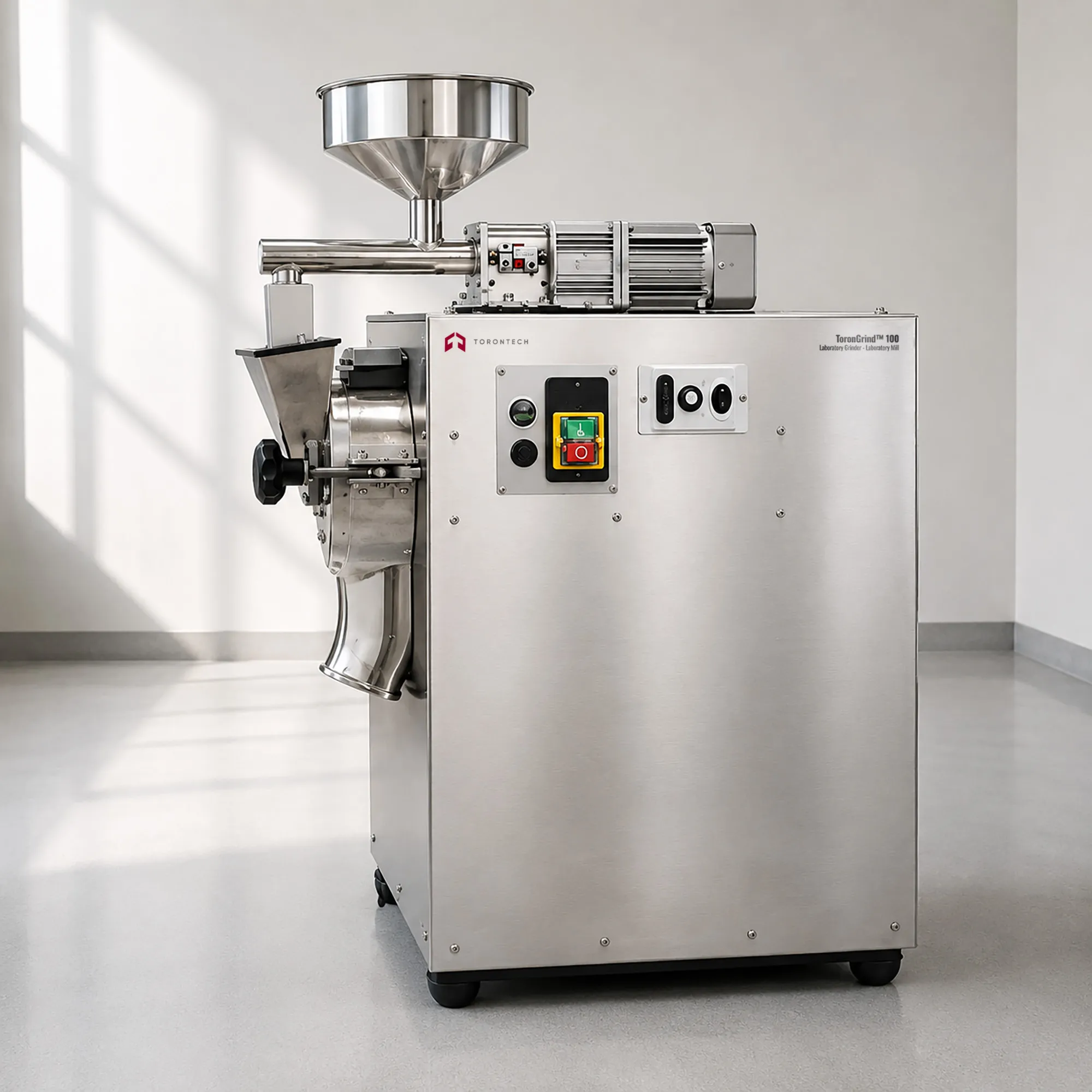
Laboratory Grinder - Laboratory Mill ToronGrind™ 100 Key Features
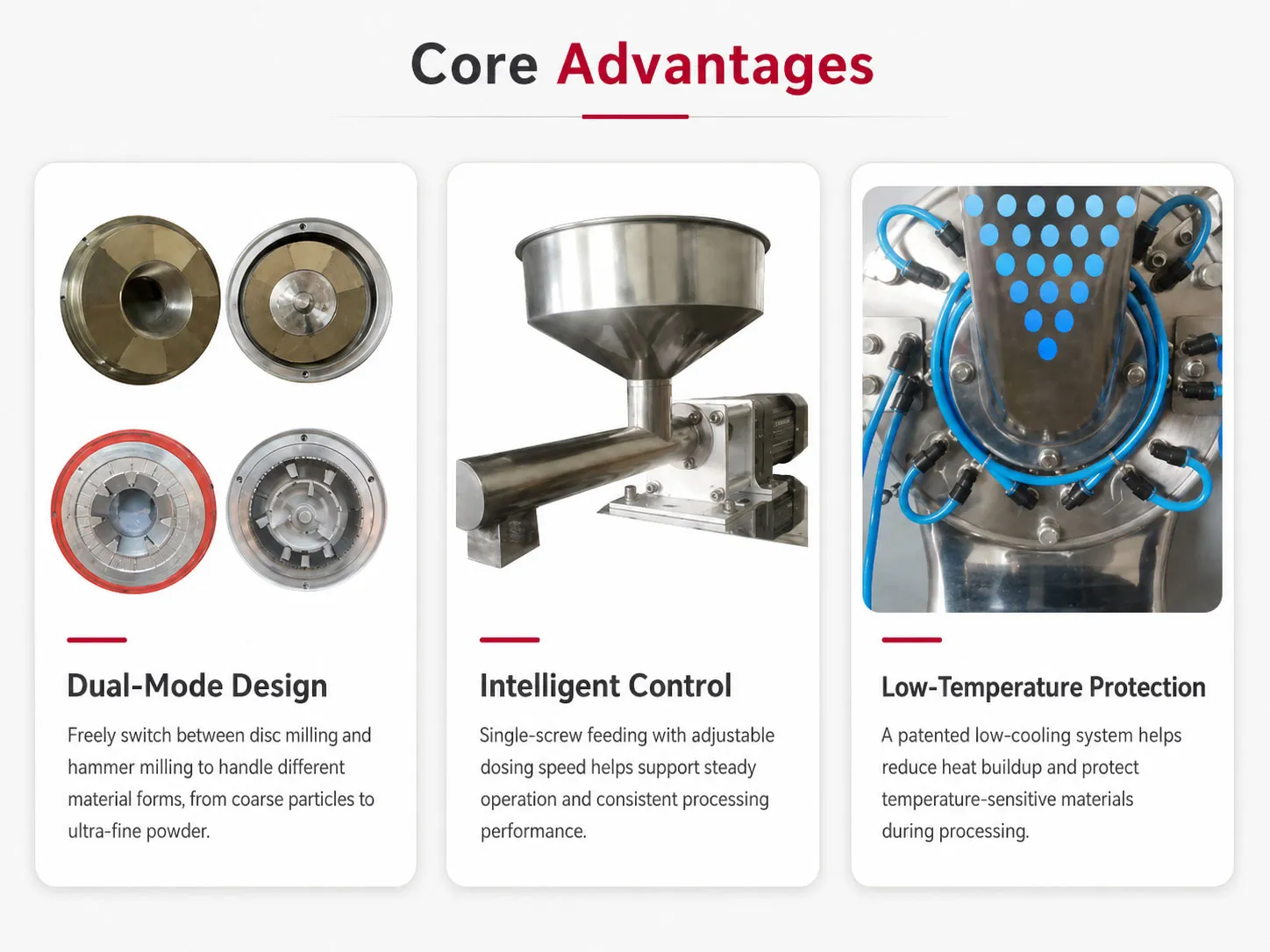
The ToronGrind™ 100 combines mode flexibility, temperature control, and repeatable feeding in a compact benchtop format.
- Dual-Mode Disc and Hammer Mill: a single unit switches between coarse-to-medium disc grinding and ultrafine hammer-mill grinding by swapping modules, covering varied material requirements
- Screw Feeding with Adjustable Dosing: controlled, even feed delivers ±1% repeatability for consistent sample-to-sample results
- Patented Water-Cooling System: keeps the grinding zone at low temperature to protect heat-sensitive resins, pharmaceuticals, and food materials from thermal degradation
- Ultrafine Powder Capability: produces powder down to roughly 100 micrometers (up to 140 mesh) with uniform particle size distribution
- D50 Particle Size Control: tunes output to a target median size from 0.1 to 2 mm for predictable downstream behavior
- Multi-Category and Multi-Color Handling: fast changeover supports color matching and mixed-material sampling
- Cryogenic Grinding Ready: chills brittle and heat-sensitive feedstock for clean reduction of herbal extracts, elastomers, and tablet materials
- GMP and Food-Grade Contact Parts: stainless steel construction suits pharmaceutical, nutraceutical, and food applications
- Dedicated Elastomer Blade: anti-caking treatment handles vulcanized rubber and high-viscosity samples
- Optional Inert-Gas Protection: shields oxidation-sensitive food and additive samples during grinding
- Standard Sieve Module: optional mesh sizes from 10 to 200 support particle-size classification to ASTM and IEC requirements
- Small-Batch Capacity: processes 5 to 500 grams per run for multi-sample experimentation
Theory and Method
The ToronGrind™ 100 reduces particle size through two distinct mechanisms, selected by switching grinding modules. In disc-mill mode, a screw feeder meters material into the chamber, where a toothed rotating disc works against a fixed disc. The narrow gap between the discs shears and abrades the feed by attrition, producing coarse to medium powder at a moderate 3,200 rpm. This mode favors controlled D50 output and generates less heat, which protects the structure of softer thermoplastics.
In hammer-mill mode, high-speed rotating blades spinning at 5,000 rpm strike the material repeatedly and throw it against the chamber wall and a screen. Impact and the screen aperture together govern fineness, letting the mill reach ultrafine powder down to roughly 100 micrometers and 140 mesh. Because impact grinding is more aggressive, this mode pairs naturally with the cooling system to keep fine work from overheating the sample.
Heat control is what allows the mill to process sensitive materials. Friction and impact generate heat that can soften thermoplastics, cake elastomers, or degrade pharmaceutical and food compounds. A water-cooled jacket draws this heat away so grinding stays near low temperature, preserving material properties and keeping powder free-flowing. Adjustable screw dosing holds the feed rate steady, which stabilizes residence time in the chamber and delivers the ±1% repeatability labs need for comparable results.
Laboratory Grinder - Laboratory Mill ToronGrind™ 100 Technical Specifications
| Parameter | Disc Mill Mode | Hammer Mill Mode |
|---|---|---|
| Grinding Chamber Diameter | 180 mm | 200 mm |
| Voltage | 220 V, 1-phase, 50 Hz (110V is also available) | 220 V, 1-phase, 50 Hz (110V is also available) |
| Grinding Motor Power | 4 kW | 4 kW |
| Screw Feeding Motor Power | 60 W | 60 W |
| Water-Cooling Pump Power | 25 W | 25 W |
| Grinding Motor Speed | 3,200 rpm | 5,000 rpm |
| Input Material Size | < 4 mm | < 4 mm |
| Fineness | 5 to 80 mesh | 5 to 140 mesh |
| Production Capacity | 1 to 20 kg/h | 1 to 50 kg/h |
| Weight | 85 kg | 83 kg |
| Dimensions (L × W × H) | 65 × 31 × 85 cm | 65 × 31 × 85 cm |
Optional Accessories
| Accessory | Description |
|---|---|
| Standard sieve module | Selectable mesh sizes from 10 to 200 for particle-size classification |
| Cryogenic grinding kit | Chills feedstock for heat-sensitive and elastomeric materials |
| Inert-gas protection | Blankets the chamber to protect oxidation-sensitive food and additives |
| Dedicated elastomer blade | Anti-caking blade design for rubber and high-viscosity samples |