
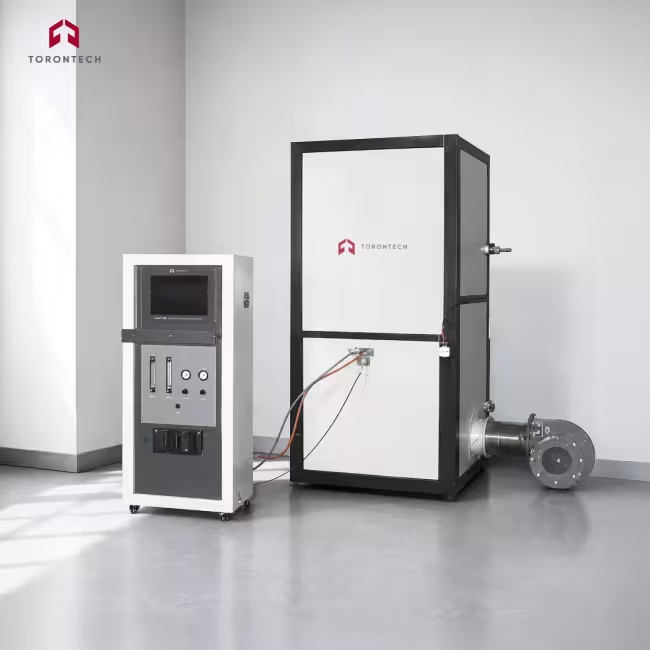
Insulation Material Smoldering Tester
Insulation Material Smoldering Tester – ToronFT™ IMS
ToronFT™ IMS Insulation Material Smoldering Tester is a precision high-temperature furnace instrument designed for testing and evaluating the smoldering performance of organic exterior wall insulation materials. Smoldering — the slow, flameless combustion of a material — is a critical and often overlooked fire hazard in building insulation systems. Materials that exhibit sustained smoldering behavior can remain a hidden fire risk long after apparent fire extinguishment, threatening building structural integrity and occupant safety.
The ToronFT™ IMS features a robust three-layer laboratory structure with 1.2 mm steel outer shell, 100 mm high-temperature insulation cotton middle layer, and 20 mm high-temperature-resistant inner layer, combined with a 7.5 kW resistance heating furnace and a PID-controlled natural air ventilation system providing precise temperature regulation from ambient up to 500°C. It is designed to support compliance with international insulation material smoldering performance test requirements.
Insulation Material Smoldering Tester – ToronFT™ IMS Applications
The ToronFT™ IMS is applicable for smoldering performance testing of the following insulation materials and building products:
- Organic exterior wall insulation materials: including expanded polystyrene (EPS), extruded polystyrene (XPS), and polyurethane (PU) foam boards — for smoldering performance characterization
- Mineral wool and glass wool insulation products for smoldering resistance evaluation
- Composite insulation systems and insulation boards used in external thermal insulation composite systems (ETICS/EIFS) for smoldering performance qualification
- Insulation materials for residential building energy-saving retrofits requiring smoldering performance compliance
- New insulation material formulations during product development and smoldering resistance optimization
- Research and development testing of fire-retardant treated insulation materials for smoldering performance improvement
Standards
The ToronFT™ IMS is designed to support compliance with the following international standards for insulation material fire performance and smoldering testing:
- ISO 9705: Fire tests: Full-scale room test for surface products
- ISO 11925-2: Reaction to fire tests: Ignitability of products subjected to direct impingement of flame
- EN 13501-1: Fire classification of construction products and building elements: Classification using test data from reaction to fire tests
- ASTM E970: Standard Test Method for Critical Radiant Flux of Exposed Attic Floor Insulation Using a Radiant Heat Energy Source
Insulation Material Smoldering Tester – ToronFT™ IMS Key Features
- Three-layer furnace chamber construction provides outstanding thermal insulation and temperature stability for accurate insulation material smoldering performance testing: 1.2 mm electrostatic high-temperature baking paint steel outer shell; 100 mm high-temperature insulation cotton middle layer; 20 mm thick high-temperature-resistant inner layer
- High-power 7.5 kW resistance heating furnace delivers rapid, reliable heating and sustained temperature holding for smoldering performance tests at temperatures up to 500°C
- PID program-controlled natural air ventilation and constant-temperature system provides precise, stable temperature regulation — maintaining the target smoldering test temperature with minimal fluctuation throughout extended test sequences
- Wide, arbitrarily settable temperature range from ambient (RT) to 500°C accommodates the full range of smoldering performance test conditions required for different insulation material types and standards
- Controlled heating rate of 0.5°C/min enables reproducible, gradual temperature ramp-up to the target smoldering test temperature — preventing thermal shock to insulation specimens
- Robust, thermally efficient chamber design minimizes heat loss and external surface temperatures, improving operator safety and energy efficiency during extended smoldering performance test sequences
- Suitable for a broad range of organic and inorganic exterior wall insulation materials, supporting smoldering performance qualification for building energy efficiency retrofit and new construction applications
Theory and Method
Smoldering performance testing of insulation materials evaluates the propensity of the material to sustain slow, exothermic, flameless oxidation when exposed to a heat source at elevated temperatures. Unlike flaming combustion, smoldering can persist at temperatures far below the material's ignition temperature, making it particularly hazardous in insulation applications where heat can accumulate over extended periods.
In the ToronFT™ IMS, the insulation material specimen is placed inside the three-layer insulated furnace chamber and subjected to a controlled temperature profile using the 7.5 kW resistance heating furnace. The PID program-controlled natural air ventilation system maintains stable temperature conditions throughout the smoldering test, with temperature settable from ambient (RT) up to 500°C at a defined heating rate of 0.5°C/min. The three-layer chamber construction — 1.2 mm electrostatic high-temperature painted steel outer shell, 100 mm high-temperature insulation cotton middle layer, and 20 mm thick high-temperature-resistant inner layer — ensures excellent thermal uniformity and stability for accurate smoldering performance characterization of insulation materials.
Insulation Material Smoldering Tester – ToronFT™ IMS Technical Specifications
| Parameter | Specification |
|---|---|
| Model | ToronFT™ IMS |
| Product Name | Insulation Material Smoldering Tester — ToronFT™ IMS |
| Laboratory Structure | Three-layer: 1.2 mm electrostatic high-temp. paint steel outer shell; 100 mm high-temp. insulation cotton; 20 mm high-temp.-resistant inner layer |
| Heating Device | Resistance heating furnace |
| Heating Power | 7.5 kW |
| Temperature Control | Natural air ventilation; PID program constant temperature |
| Temperature Range | RT (ambient) to 500°C (arbitrarily settable) |
| Heating Rate | 0.5°C/min |
| Compliance Standards | ISO 11925-2; EN 13501-1 |