
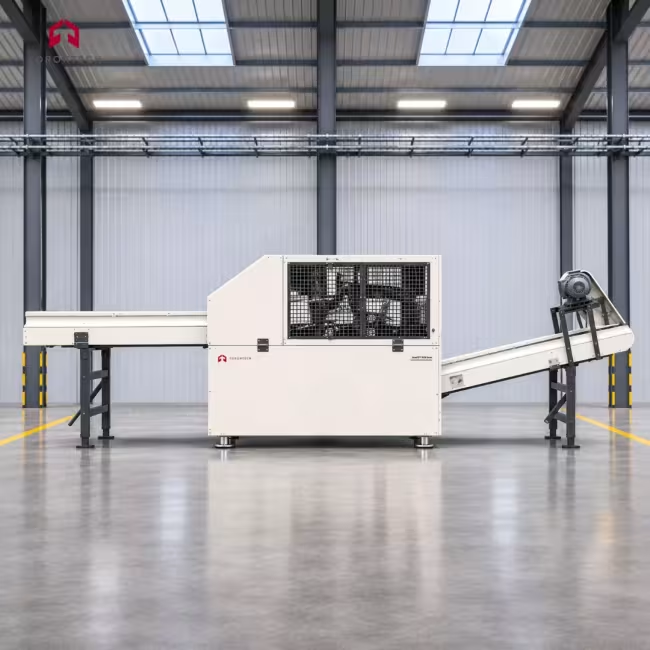
Industrial Rag Cutting Machine
Industrial Rag Cutting Machine - ToronPR™ RCM Series
Industrial Rag and Textile Waste Cutting Machine for Cloth, Fiber and Non-Woven
The rag cutting machine chops waste cloth, worn clothing, yarn, fiber, and non-woven fabric into uniform short pieces ready for opening, recycling, or reuse. Textile recyclers, fiber reclaimers, and nonwoven producers use it to replace slow manual cutting at the front of a recycling line. The ToronPR™ RCM feeds material on a conveyor into a rotary knife drum that cuts against fixed knives at an adjustable length. Five models cover output of 100 kg/h through 2,000 kg/h.
Textile waste is long, tangled, and flexible, which makes it hard to process in shredders built for rigid plastic. This machine meters material flat on a belt and cuts it in clean, repeated passes, so pieces come out a consistent size. Uniform cut length helps downstream openers and garnetting machines loosen the fibers evenly. Operators set the cut length to match the next process in the line.
The same machine handles leather, plastic film, paper, and label stock alongside textiles. An optional magnetic separator can be added to pull ferrous metal such as buttons, zippers, and staples out before it reaches the knives. The machine is easy to relocate, runs steadily, and needs only simple routine maintenance. Torontech matches each model to the material, cut length, and throughput a plant needs.
Industrial Rag Cutting Machine - ToronPR™ RCM Series Applications
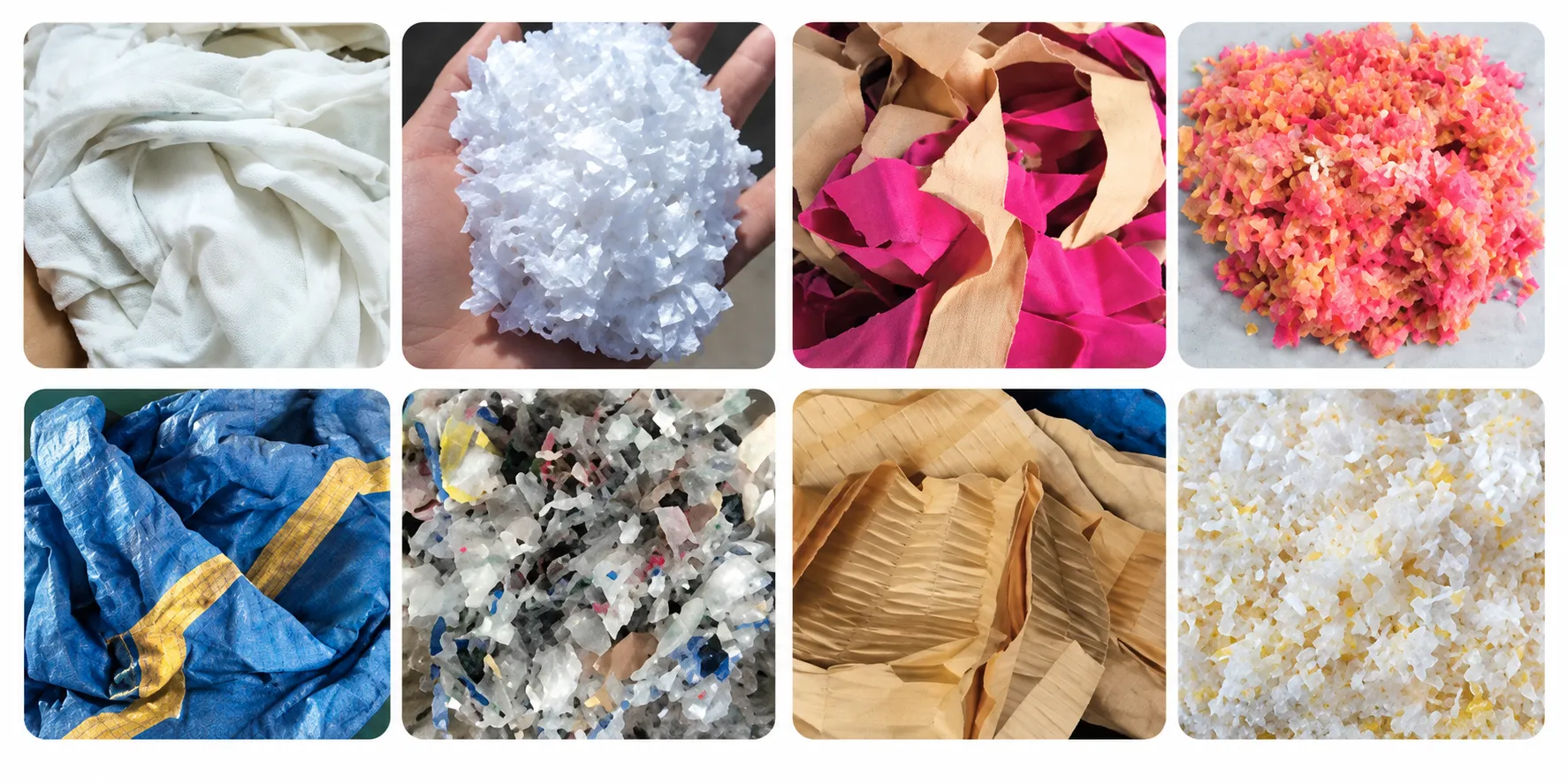
This industrial rag cutter suits operations that process soft, flexible, or fibrous waste into short, uniform pieces.
- Textile Recycling: cutting post-consumer clothing and household textiles before fiber opening and reclaiming
- Garment Manufacturing Waste: reducing cutting-room scraps, offcuts, and selvage into recyclable pieces
- Spinning Mill Waste: chopping waste cotton yarn, sliver, and thread for fiber recovery
- Nonwoven Production: cutting nonwoven trim, rejects, and edge waste for reprocessing
- Fiber Waste Cutting Machine: preparing chemical fiber, linen, and cotton wool waste for opening and carding
- Wiping Rag Production: cutting used textiles into consistent sizes for industrial wipers
- Mixed Soft Waste: processing leather offcuts, plastic film, paper, and label stock on sites with several soft waste streams
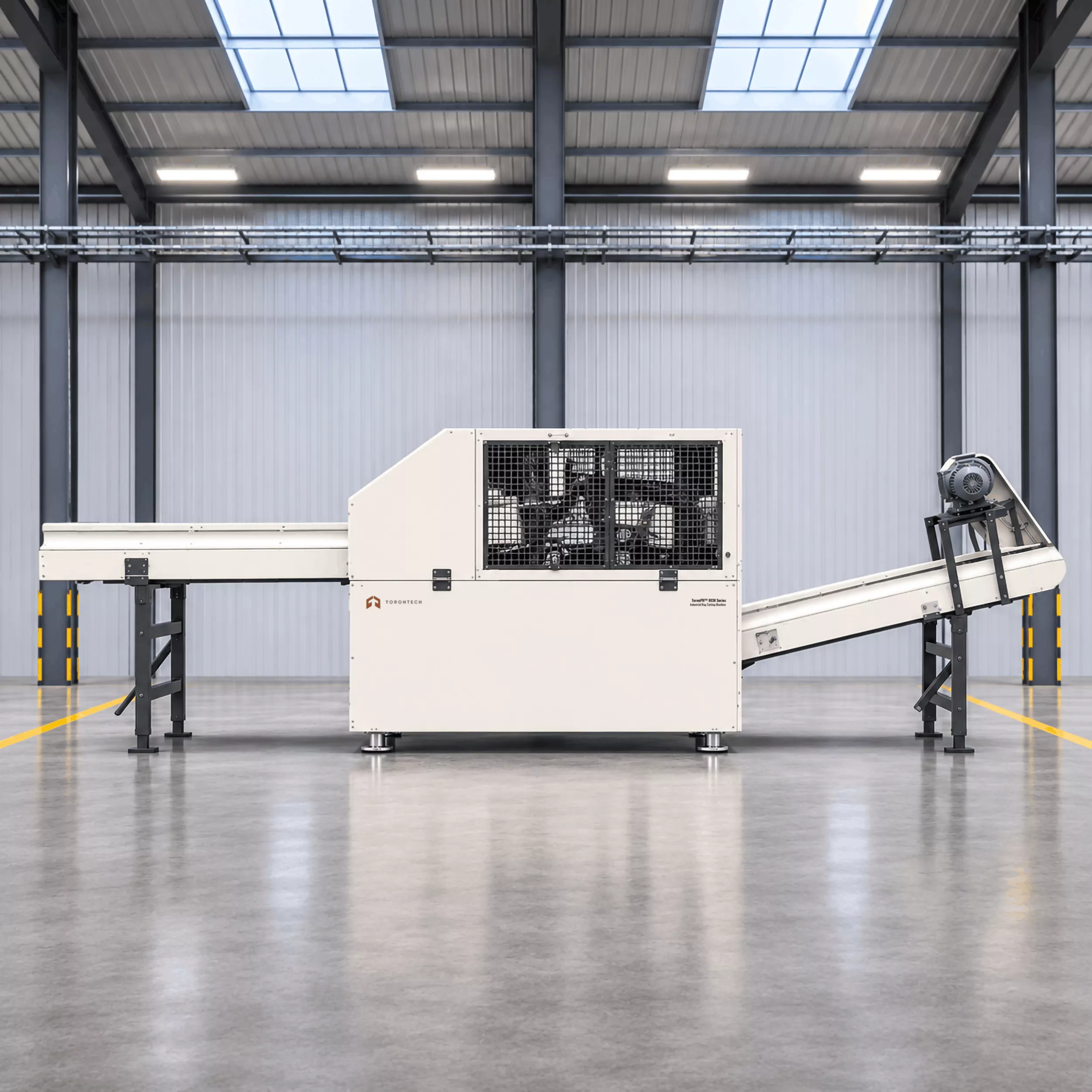
Industrial Rag Cutting Machine - ToronPR™ RCM Series Key Features
The machine combines conveyor feeding and rotary shear cutting for consistent, high-volume processing of textile and soft waste.
- Adjustable Cut Length: operators set the cut length to suit downstream opening, garnetting, or reuse
- Uniform Piece Size: steady conveyor feeding and repeated knife passes produce consistent cut pieces
- Rotary Knife Drum: blades shear material cleanly against fixed knives instead of tearing it
- Input and Output Conveyors: belt conveyors feed material in flat and carry cut pieces away
- Optional Magnetic Separator: removes ferrous metal such as zippers and buttons to protect the blades
- Wide Material Range: cuts cloth, clothing, yarn, cotton wool, chemical fiber, linen, leather, film, paper, labels, and nonwoven fabric
- Precision-Machined Construction: quality materials and precision machining support stable, reliable operation
- Easy Relocation and Maintenance: the machine moves easily within a plant and needs only simple routine care
- Reduced Manual Labor: replaces hand cutting and loosening at the start of the recycling line
- Five Capacity Options: models span 100 kg/h through 2,000 kg/h
Theory and Method
Rag cutting relies on a rotary shear. A horizontal knife drum carries several blades along its length and spins past fixed knives mounted in the housing. Each time a rotating blade passes a fixed knife, it shears through any material lying across the cutting edge. Clean shear cuts slice textile fibers instead of tearing them, which keeps fiber length more consistent for reuse.
Controlled feeding sets the cut length. The input conveyor carries material flat toward the knives at a steady rate set by its drive reducer. Between one blade pass and the next, the conveyor advances a fixed distance, and that distance becomes the length of each piece. Changing the relationship between feed speed and knife speed changes the cut length, so one machine can produce several sizes.
Soft material behaves differently from rigid plastic under a cutter. Fabric and fiber stretch and wrap instead of breaking, so they need a clean, close cut against a fixed edge. Feeding the material flat and under control keeps it presented squarely to the knives. An output conveyor then carries cut pieces away for opening, baling, or further processing.
Industrial Rag Cutting Machine - ToronPR™ RCM Series Technical Specifications
| Parameter | ToronPR™ RCM 800 | ToronPR™ RCM 1200 | ToronPR™ RCM 1600 | ToronPR™ RCM 2400 | ToronPR™ RCM 3200 |
|---|---|---|---|---|---|
| Output | 100-150 kg/h | 250-350 kg/h | 450-650 kg/h | 800-1,000 kg/h | 2,000 kg/h |
| Cutting Motor Power | 7.5 kW | 15 kW | 18.5 kW | 2 × 22 kW | 2 × 45 kW |
| Conveyor Motor Power | 1.5 kW | 2.2 kW | 3 kW | 4 kW | 5.5 kW |
| Conveyor Reducer Ratio | 55:1 | 55:1 | 55:1 | 55:1 | 23:1 |
| Cutting Motor Pulley Diameter | 140 mm | 160 mm | 180 mm | 180 mm | 220 mm |
| Rotary Knife Drum (Dia. × Length) | 300 × 400 mm | 400 × 600 mm | 500 × 800 mm | 600 × 1,200 mm | 1,000 × 1,600 mm |
| Rotary Blades | 8 pcs | 8 pcs | 8 pcs | 8 pcs | 32 pcs |
| Stationary Knives | 2 pcs | 2 pcs | 2 pcs | 2 pcs | 4 pcs |
| Input Conveyor (L × W) | 1,400 × 330 mm | 3,000 × 520 mm | 3,000 × 720 mm | 3,000 × 1,100 mm | 4,000 × 1,500 mm |
| Output Conveyor (L × W) | 1,400 × 330 mm | 3,000 × 520 mm | 3,000 × 720 mm | 3,000 × 1,100 mm | 4,000 × 1,500 mm |
| Overall Dimensions (L × W × H) | 3,100 × 1,000 × 1,100 mm | 6,250 × 1,450 × 1,570 mm | 6,340 × 1,650 × 1,630 mm | 6,363 × 2,043 × 1,770 mm | 10,000 × 3,300 × 2,400 mm |
Parameters are for reference only and may change according to the final configuration.
Common Specifications and Options
| Item | Description |
|---|---|
| Cutting Principle | Rotary knife drum against stationary knives |
| Feeding | Belt conveyor with geared drive |
| Cut Length | Adjustable |
| Optional Equipment | Magnetic separator for ferrous metal removal |
| Suitable Materials | Waste cloth, waste cotton yarn, worn clothing, cotton wool, chemical fiber, linen, leather, plastic film, paper, labels, nonwoven fabric |