
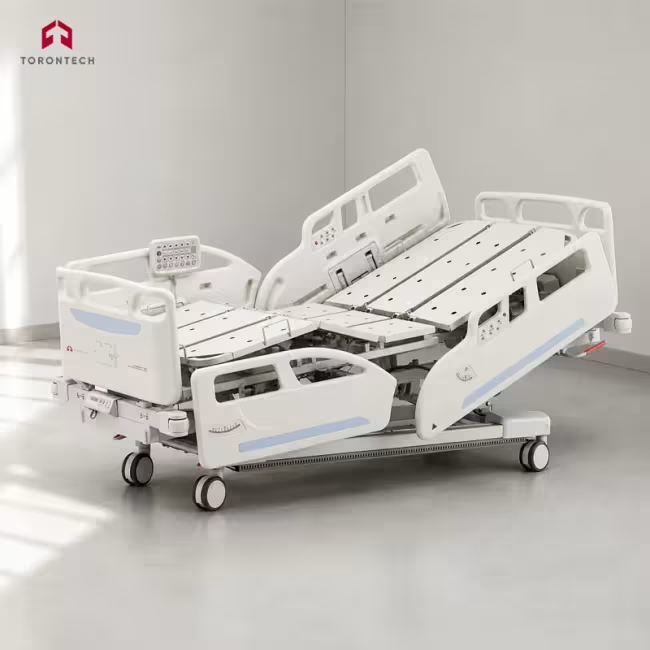
ICU/CCU Bed (Lateral-Tilt Model) - ToronCare™ 1073
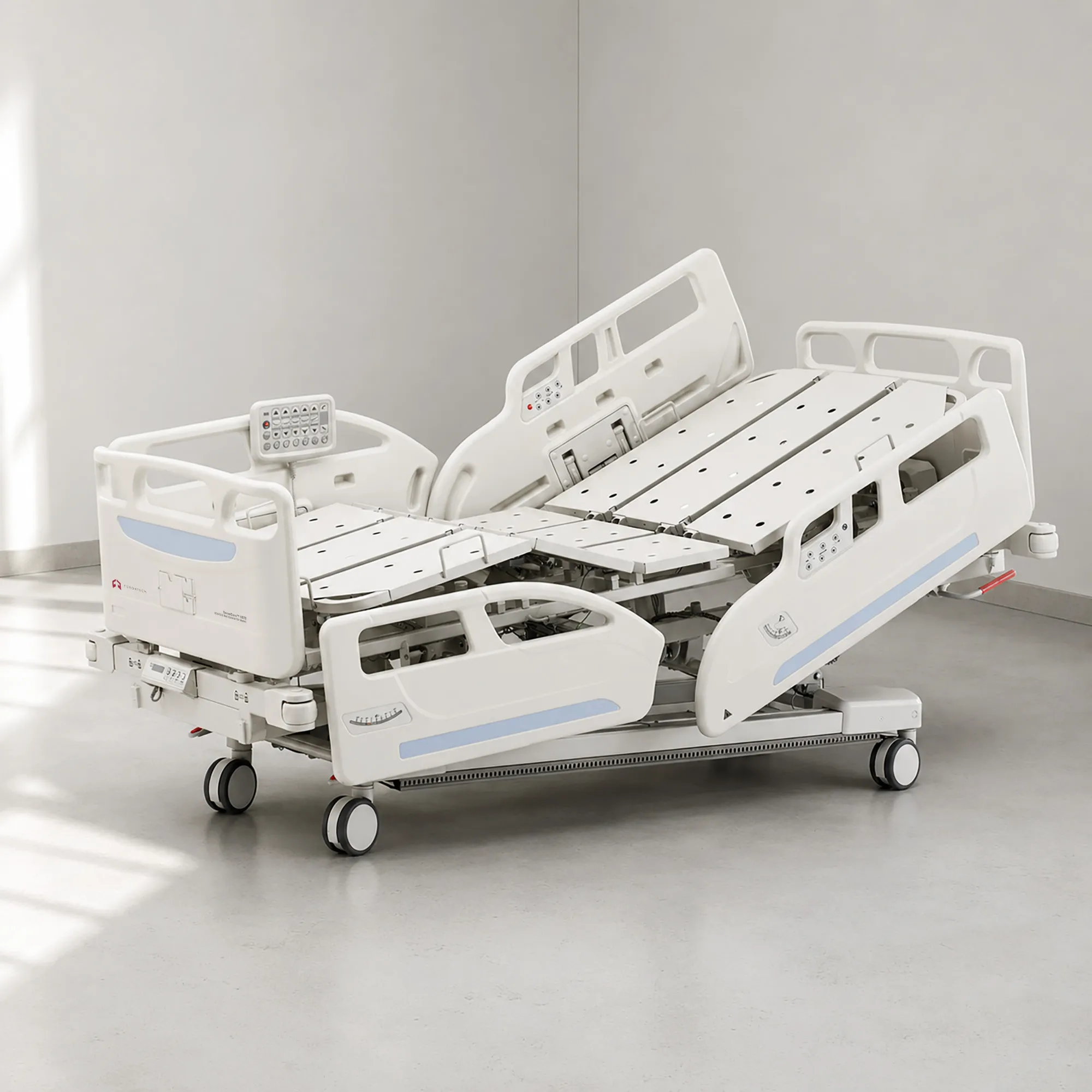
ToronCare™ 1073 is a lateral tilt hospital bed that rotates the mattress platform up to 30 degrees side to side, shifting patient weight off bony prominences and assisting staff with turning and repositioning. Powered lateral rotation reduces the manual effort of moving immobile patients, which supports pressure-injury prevention programs and lowers the handling load on nursing teams. Alongside the lateral function, the bed delivers backrest articulation to 70 degrees, thigh rest elevation, full-height travel from 540 to 835 mm, and Trendelenburg and reverse Trendelenburg tilt. A 240 kg safe working load and an integrated weight scales system round out a bed built for active critical care.
The ToronCare™ 1073 keeps clinical workflows fast. One-button presets move the patient into a cardiac chair position or a bed-exit position, an auto-contour function bends the knees as the backrest rises to prevent sliding, and both electric and mechanical CPR drop the backrest flat for resuscitation. Dual control panels and a corded handheld remote give nurses and patients separate access to the powered functions, and a side-rail angle indicator shows backrest and tilt angles at a glance.
Manufactured to European medical device norms and rated IP54 against water spray and dust, this lateral tilt ICU bed suits intensive care units, pulmonary and wound-care wards, and long-term acute care facilities where frequent repositioning and continuous supervision shape patient care. A central braking system and protective corner bumpers support safe transport through busy corridors.
ICU/CCU Bed (Lateral-Tilt Model) - ToronCare™ 1073 Applications
The ToronCare™ 1073 fits acute and long-term care settings where repositioning, pressure management, and caregiver safety are daily priorities. Powered lateral tilt extends its usefulness well beyond standard articulation.
- Intensive Care Units (ICU): lateral rotation turns ventilated and sedated patients with minimal manual handling, supporting pressure care and respiratory positioning.
- Pressure Injury and Wound Care: scheduled side-to-side tilting offloads the sacrum and hips to lower the risk of pressure ulcers in immobile patients.
- Pulmonary and Respiratory Wards: lateral positioning assists secretion drainage and helps distribute ventilation across the lungs.
- Bariatric and Heavy-Patient Handling: powered turning moves larger patients within the 240 kg load rating while reducing strain on caregivers.
- Long-Term Acute and Geriatric Care: regular repositioning of bedbound patients supports skin integrity and comfort over extended stays.
- Post-Surgical and Recovery Units: controlled tilt, height, and backrest settings aid positioning and monitoring after procedures.
- Cardiac Care Units (CCU): the one-button cardiac chair position raises the patient upright to ease breathing and support recovery.
Standards
The ToronCare™ 1073 is designed and produced to internationally recognized standards for medical electrical equipment, medical beds, and the weighing function of the integrated scale.
- ISO 13485 - Medical Devices: Quality Management Systems, Requirements for Regulatory Purposes
ICU/CCU Bed (Lateral-Tilt Model) - ToronCare™ 1073 Key Features
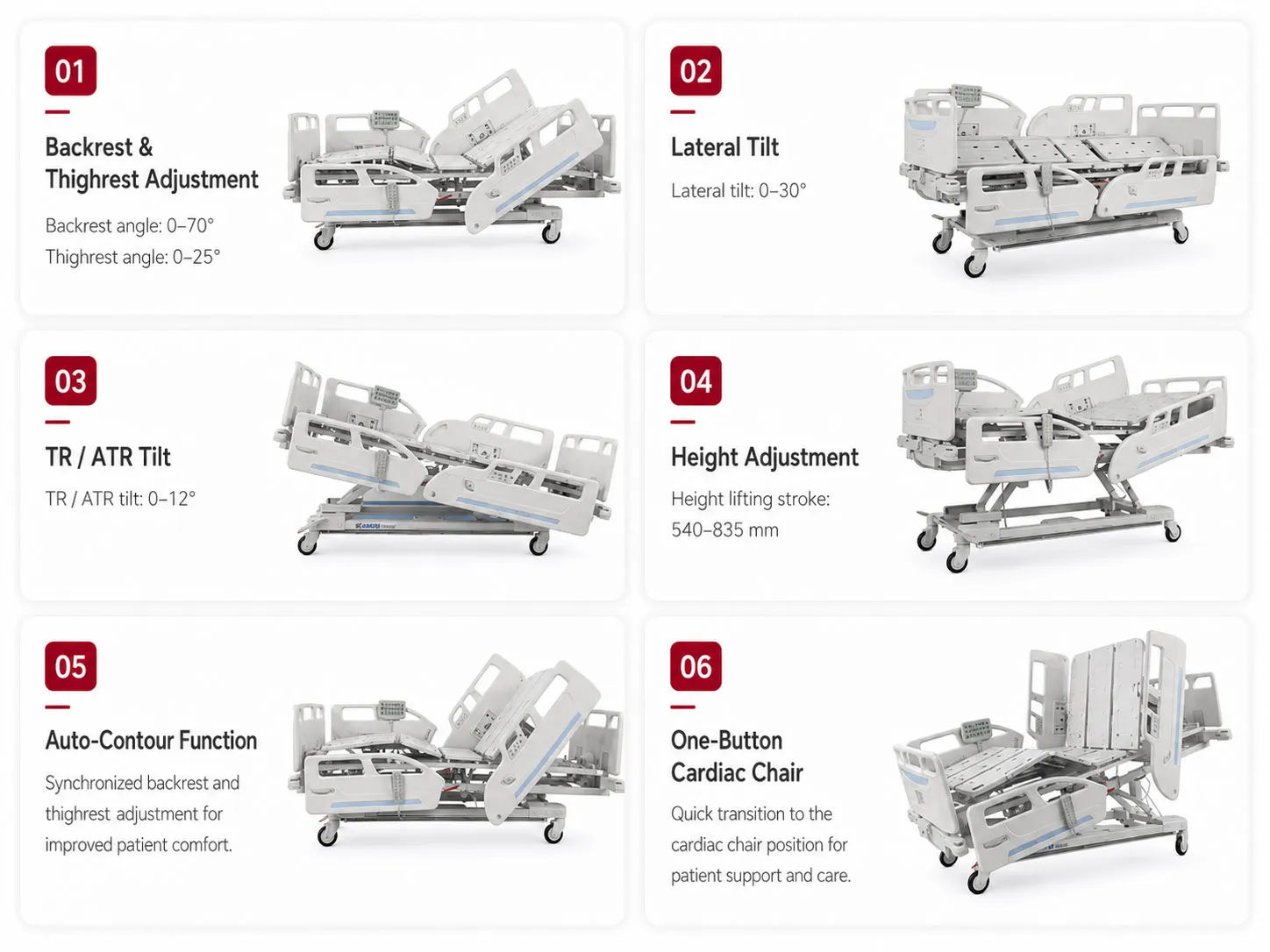
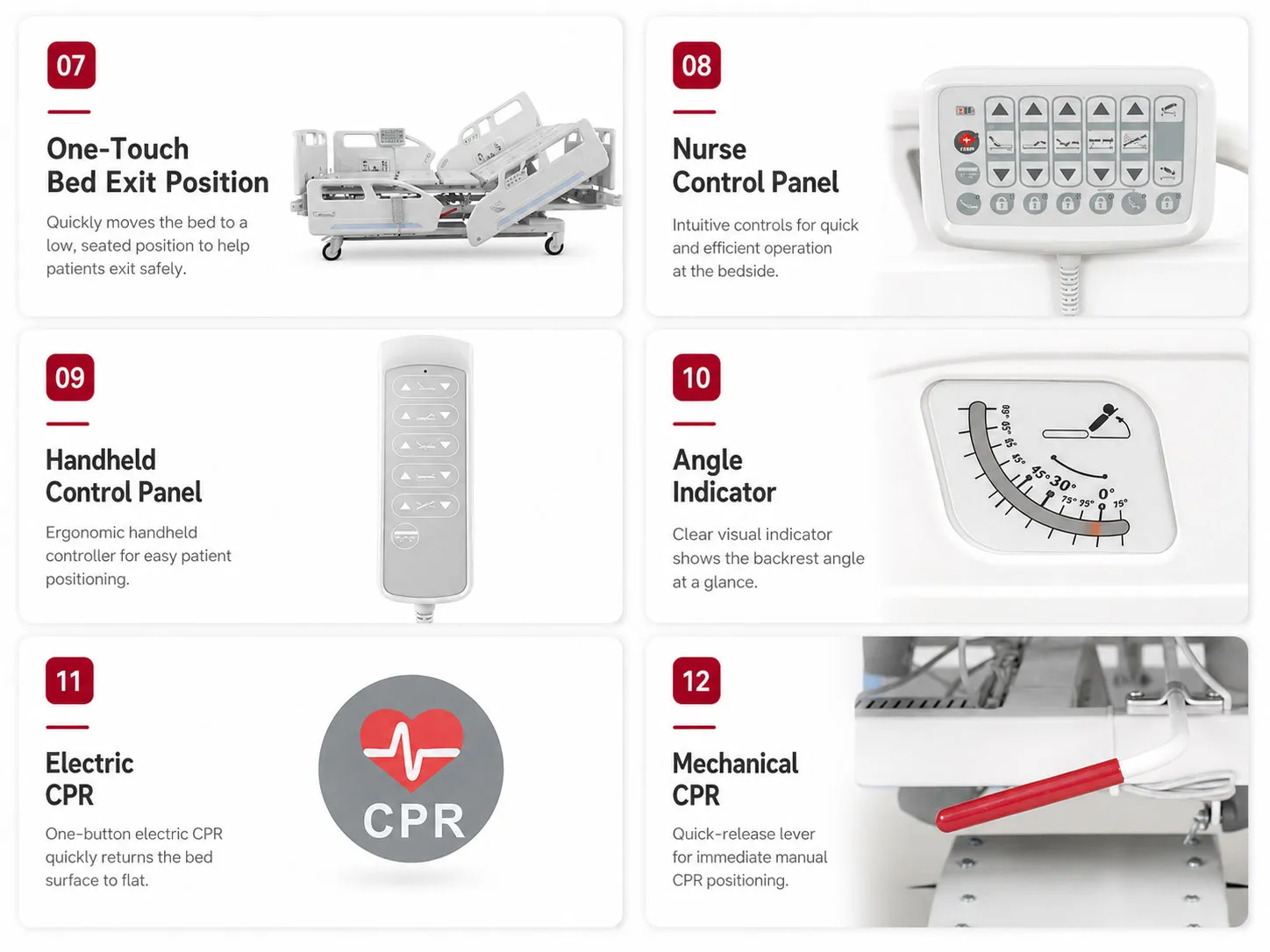
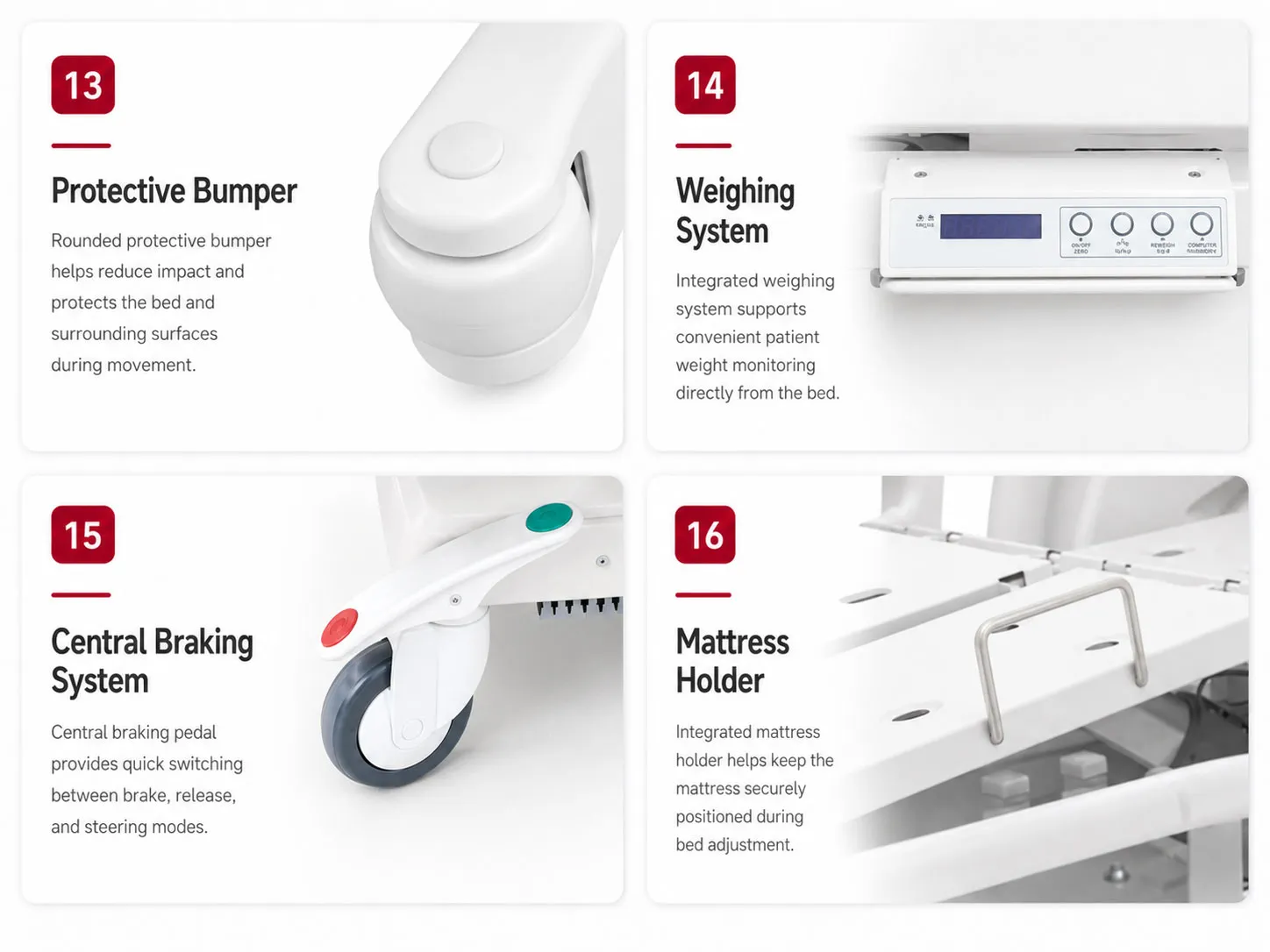
The ToronCare™ 1073 combines powered lateral tilt with full electric articulation, an integrated scale, and emergency-ready controls.
- Lateral Tilt to 30°: powered side-to-side rotation offloads pressure points and turns immobile patients with less manual effort.
- Backrest to 70° and Thigh Rest to 25°: a wide articulation range supports positioning for comfort, feeding, and clinical access.
- Trendelenburg and Reverse Trendelenburg: head-down and foot-down tilt to 12 degrees assists circulation management and procedures.
- One-Button Cardiac Chair Position: a single command seats the patient upright to support breathing and cardiac recovery.
- One-Button Bed-Exit Position: a preset lowers and configures the bed to help mobile patients leave safely.
- Auto-Contour Function: synchronized backrest and leg motion bends the knees as the head rises to reduce patient sliding.
- Electric and Mechanical CPR: a damped quick-release drops the backrest flat with one hand, working with or without mains power.
- Integrated Weight Scales System: load cells capture patient weight on the bed, removing the need to transfer patients to a separate scale.
- Full-Height Travel (540 to 835 mm): a low minimum height aids patient transfers and fall prevention, while a high setting eases bedside care.
- Nurse Control Panel: a central panel covers all powered functions and position presets for staff operation.
- Handheld Control Panel: a corded remote gives the patient direct access to core functions.
- Side-Rail Angle Indicator: a mechanical gauge displays backrest angle and platform tilt at a glance.
- Protective Corner Bumpers: bumpers absorb impacts and guide the bed past obstacles during transport.
- Central Braking System: a single pedal controls braking and steering across all castors.
- Mattress Holders: retainers keep the mattress aligned on the platform during tilt and articulation.
- Grounded Class I Design with IP54 Rating: a protective-earth electrical design and IP54 sealing support safe operation around cleaning fluids and dust.
Theory and Method
Lateral tilt rotates the mattress platform about the bed's long axis, the line running from head to foot, raising one side while lowering the other by up to 30 degrees. Tilt actuators pivot the platform relative to the base frame, and as the surface angles over, gravity shifts the patient's weight toward the lowered side. That weight transfer offloads the sacrum, hips, and shoulder against which a still patient would otherwise press, so alternating the tilt at intervals redistributes pressure and helps prevent skin breakdown. The same motion swings the patient toward a nurse standing at the bedside, turning a two-person manual lift into a guided, powered movement that reduces caregiver injury.
Patient positioning relies on electromechanical actuation. Each linear actuator turns a lead screw that drives a nut along a push rod, converting motor rotation into linear travel that pivots a frame section. Dedicated actuators set the backrest to 70 degrees and the thigh rest to 25 degrees, while the height columns produce Trendelenburg and reverse Trendelenburg of up to 12 degrees by tilting the platform along its length rather than across it. The auto-contour function links the backrest and thigh rest so raising the head end also bends the knees, which keeps the patient from sliding toward the foot of the bed.
The integrated weight scales system reads patient weight through load cells set between the platform and the frame. A strain gauge in each cell changes resistance as the load deflects its sensing element, and the controller sums the cell outputs into a single weight value on the panel. For emergencies, a damped quick-release decouples the backrest actuator and lets the section fall flat smoothly with one hand, working both electrically and mechanically so staff can deliver CPR even during a power loss.
ICU/CCU Bed (Lateral-Tilt Model) - ToronCare™ 1073 Technical Specifications
| Parameter | Specification |
|---|---|
| External Dimensions | L2215 × W1050 × H540 to 835 mm (±10 mm) |
| Height Lifting Stroke | 540 to 835 mm |
| Side Rail Height (above mattress platform) | 370 mm (±10 mm) |
| Backrest Lift | 0 to 70° |
| Thigh Rest Lift | 0 to 25° |
| Lateral Tilt | 0 to 30° |
| Trendelenburg / Reverse Trendelenburg (TR/ATR) | 0 to 12° |
| Safe Working Load | 240 kg (≈529 lb) |
| Integrated Weight Scales System | Yes (load-cell based) |
| Voltage | 100 to 240 VAC, 50/60 Hz, 4000 mA |
| Maximum Input | 960 VA |
| Ingress Protection | IP54 |
| Equipment Safety Classification | Class I |
| Applied Part Type | Type B |
| Braking | Central braking system |
Standard Functions and Components
| Item | Description |
|---|---|
| Lateral tilt | Powered side-to-side rotation, 0 to 30° |
| Backrest lift | Powered, 0 to 70° |
| Thigh rest lift | Powered, 0 to 25° |
| TR / ATR tilt | Trendelenburg and reverse Trendelenburg, 0 to 12° |
| Height adjustment | Powered, 540 to 835 mm stroke |
| Auto-contour | Synchronized backrest and thigh rest motion |
| One-button cardiac chair position | Upright seated preset |
| One-button bed-exit position | Egress-assist preset |
| Nurse control panel | Full-function staff control |
| Handheld control panel | Corded patient remote |
| Angle indicator | Side-rail backrest and tilt gauge |
| Electric CPR | Powered backrest flat-release |
| Mechanical CPR | Manual damped backrest flat-release |
| Weight scales system | Integrated patient weighing |
| Protective bumper | Corner impact protection |
| Central braking system | Single-pedal brake and steer |
| Mattress holder | Mattress retention during tilt |