
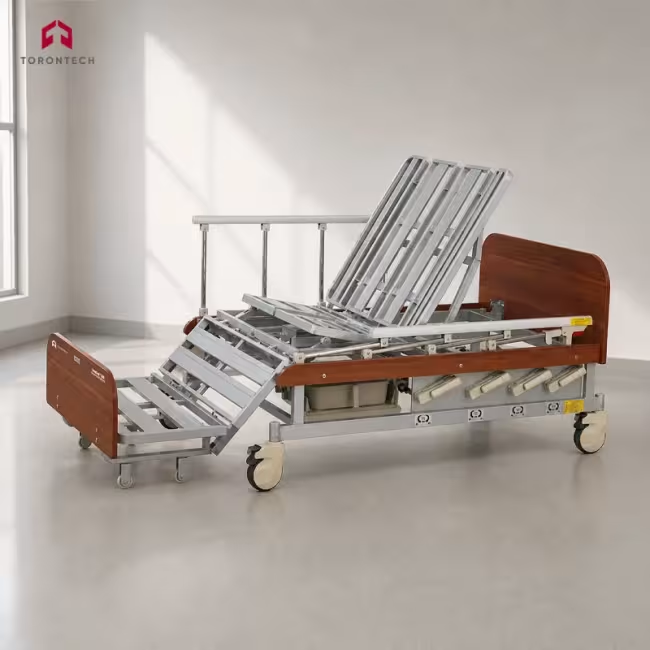
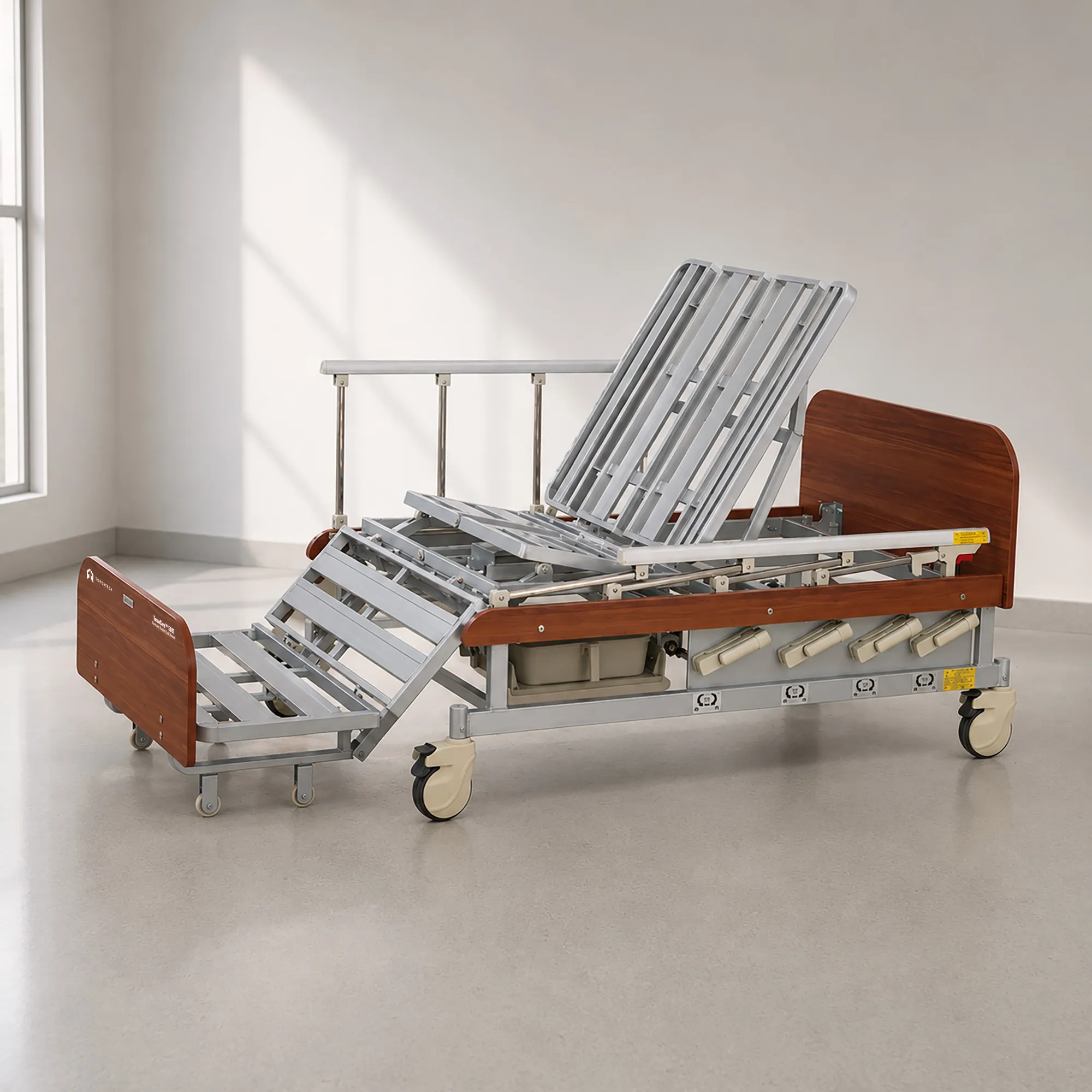
Homecare Hospital Bed (Manual)
Homecare Hospital Bed (Manual) - ToronCare™ 5081
ToronCare™ 5081 is a manual homecare hospital bed built for families and caregivers managing long-term, post-surgical, or geriatric care at home. It brings several nursing functions together in one hand-cranked frame: lateral turning, a seated chair position, leg elevation, a built-in toilet opening, and a bed-side hair-washing station. Every adjustment runs on manual cranks and lead screws, so the bed needs no electricity and stays usable during power outages.
As a manual homecare bed, the ToronCare™ 5081 gives budget-conscious households hospital-grade positioning without the cost or complexity of a powered frame. The crank-driven backrest raises to 70° for upright rest, while the leg section articulates to support circulation and comfort. Foldable aluminum alloy side rails mounted on stainless steel posts guard against falls and drop down quickly for transfers. Wooden head and foot boards finished in water-based paint give the bed a residential look that fits a home bedroom.
With a 170 kg (375 lb) capacity and durability-tested castors, the bed handles daily repositioning and room-to-room movement. The ToronCare™ 5081 suits home care, nursing homes, and long-term care facilities that need dependable homecare hospital beds for bedridden and reduced-mobility patients.
Homecare Hospital Bed (Manual) - ToronCare™ 5081 Applications
The ToronCare™ 5081 serves patients who spend extended periods in bed and the caregivers who support them, making it one of the more versatile homecare beds for both home and facility settings.
- Home-Based Long-Term Care: gives families a multi-function nursing bed for relatives recovering from illness or living with chronic conditions, reducing the need for a care facility.
- Post-Surgical and Rehabilitation Recovery: backrest and leg adjustments help patients rest, sit up, and reposition while recovering from surgery or injury.
- Elderly and Geriatric Care: low-effort cranks and fall-prevention rails support aging patients with limited mobility who need help changing position.
- Stroke and Neurological Recovery: lateral turning and the chair position assist patients who cannot reposition themselves, lowering the risk of complications from prolonged bed rest.
- Palliative and Hospice Care: in-bed toileting and hair washing keep patients comfortable and dignified while minimizing painful transfers.
- Nursing Homes and Long-Term Care Facilities: a manual, low-maintenance frame keeps acquisition and upkeep costs down across multiple beds.
- Bedridden and Pressure-Prone Patients: scheduled side-to-side turning offloads bony pressure points to help prevent bedsores.
- Power-Limited or Off-Grid Homes: fully manual operation keeps the bed functional where reliable electricity is not available.
Standards
The ToronCare™ 5081 is designed to align with the international standards that govern adult medical bed safety, mechanical strength, and entrapment prevention. The product line also carries CE, FDA, ANVISA, and ISO certification marks per the manufacturer, covering medical device quality and market access.
- IEC 80601-2-52:2026 - Medical Electrical Equipment, Part 2-52: Particular Requirements for the Basic Safety and Essential Performance of Medical Beds for Adults (the current revision, which explicitly covers both electrical and manual beds)
- IEC 60601-2-52 - Medical Electrical Equipment, Part 2-52: Particular Requirements for the Basic Safety and Essential Performance of Medical Beds
- EN 60601-2-52 - European Harmonized Standard for the Safety and Essential Performance of Medical Beds
- ISO 13485 - Medical Devices: Quality Management Systems for Regulatory Purposes
Homecare Hospital Bed (Manual) - ToronCare™ 5081 Key Features
The ToronCare™ 5081 packs a full set of nursing functions into a manual frame, with each feature aimed at lowering caregiver effort and keeping the patient comfortable.
- Lateral Turning Up to 45° Each Side: repositions the patient from side to side to offload pressure points, helping to prevent bedsores while sparing caregivers the strain of manual log-rolling.
- Cardiac Chair Position with Table Board: folds the deck into a seated posture with a 12° anti-slide seat tilt and a fold-out table, supporting independent eating, reading, and upright recovery while easing back and cardiopulmonary load.
- Crank-Adjustable Backrest and Leg Sections: manual cranks raise the backrest to 70° and articulate the leg section across a wide range, letting caregivers fine-tune posture without electricity.
- Built-In Manual Toilet Opening: a hand-cranked, lead-screw-driven commode aperture lets caregivers manage toileting in place, avoiding difficult lifts and transfers to a bathroom.
- Integrated Hair-Washing Station: a removable mattress segment pairs with a fitted shampoo basin so hair can be washed in bed, keeping the patient clean without a trip to a sink.
- Leg Elevation for Circulation: raises the lower limbs while the patient lies flat to encourage venous return and reduce fluid pooling in the legs.
- Foldable Aluminum Alloy Side Rails: lightweight rails on stainless steel posts lock upright to guard against falls and fold down with one hand for easy transfers.
- Residential Wooden Head and Foot Boards: finished with water-based, low-emission paint for a warm, home-like appearance rather than a clinical look.
- Four Durability-Tested Castors: four swivel casters validated over 50 km of continuous travel and more than 30,000 obstacle crossings for stable, long-lasting movement around the home.
Theory and Method
Pressure ulcers form when sustained pressure on bony areas such as the hips, sacrum, and heels compresses blood vessels and cuts off circulation to the skin. Without periodic relief, the starved tissue breaks down. Clinical practice calls for repositioning a bedridden patient about every two hours to restore blood flow. The ToronCare™ 5081 mechanizes this routine: turning a crank tilts the mattress platform up to 45° to either side, rolling the patient onto fresh tissue without a caregiver having to log-roll the body.
Each adjustable section moves through a hand crank coupled to a lead screw. As the operator turns the crank, the screw thread converts low-effort rotary motion into high linear force, much like a car jack. This mechanical advantage lets a single caregiver raise a loaded deck section against the weight of the patient. Because the lead screw is self-locking, the section holds its position once the crank stops, with no motors or batteries to fail.
Body position changes the workload on the heart, lungs, and circulation. Raising the backrest toward 70° opens the chest for easier breathing and supports digestion, while elevating the legs encourages venous blood to return from the lower limbs and reduces swelling. The chair position carries this further by folding the deck into a seated posture for meals or therapy, and a 12° seat tilt uses gravity to hold the patient in place and limit forward sliding.
Homecare Hospital Bed (Manual) - ToronCare™ 5081 Technical Specifications
| Parameter | Specification |
|---|---|
| Overall Dimensions (side rails raised) | 2000 × 960 × 455 mm (78.7 × 37.8 × 17.9 in) |
| Bed Platform Height | 455 mm (17.9 in) |
| Maximum Backrest Angle | ≥ 70° |
| Leg / Thigh Section Range | -45° to +45° |
| Lateral Turning Angle | Up to 45° left and right |
| Safe Working Load | 170 kg (375 lb) |
| Operating Temperature | 5°C to 40°C (41°F to 104°F) |
| Relative Humidity | ≤ 85% |
| Side Rail Material | Aluminum alloy rails on stainless steel posts |
| Head and Foot Boards | Wood with water-based paint finish |
| Castors | Four swivel casters |
| Operation | Manual hand crank, lead-screw drive |
Optional Accessories
| Accessory | Description |
|---|---|
| Rollover Pad | Positioning pad that assists side-to-side turning and helps hold the patient on their side |
| Shampoo Basin | Fitted basin used with the bed's hair-washing function for in-bed shampooing |
Companion Products
| Product | Description |
|---|---|
| Bedside Cabinet | Wooden bedside storage cabinet that pairs with the bed for patient belongings and supplies |
| Patient Lift | Mobile patient lift for transferring the patient between the bed and a chair or wheelchair |