
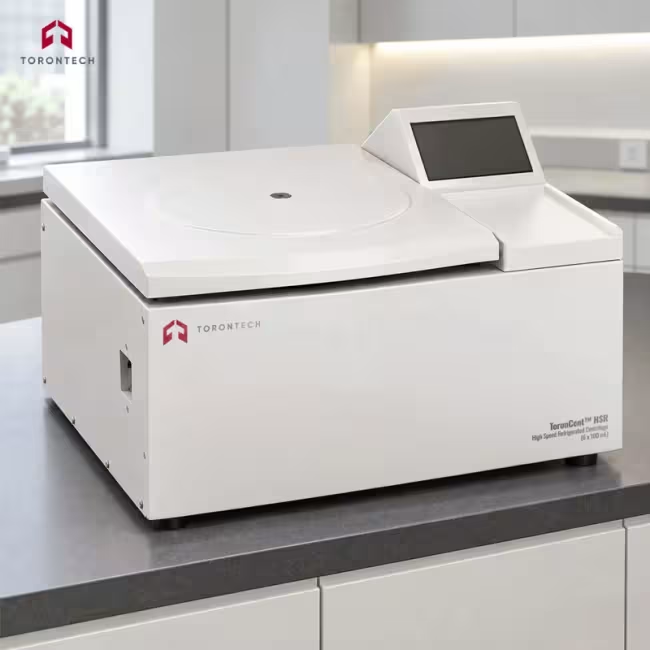
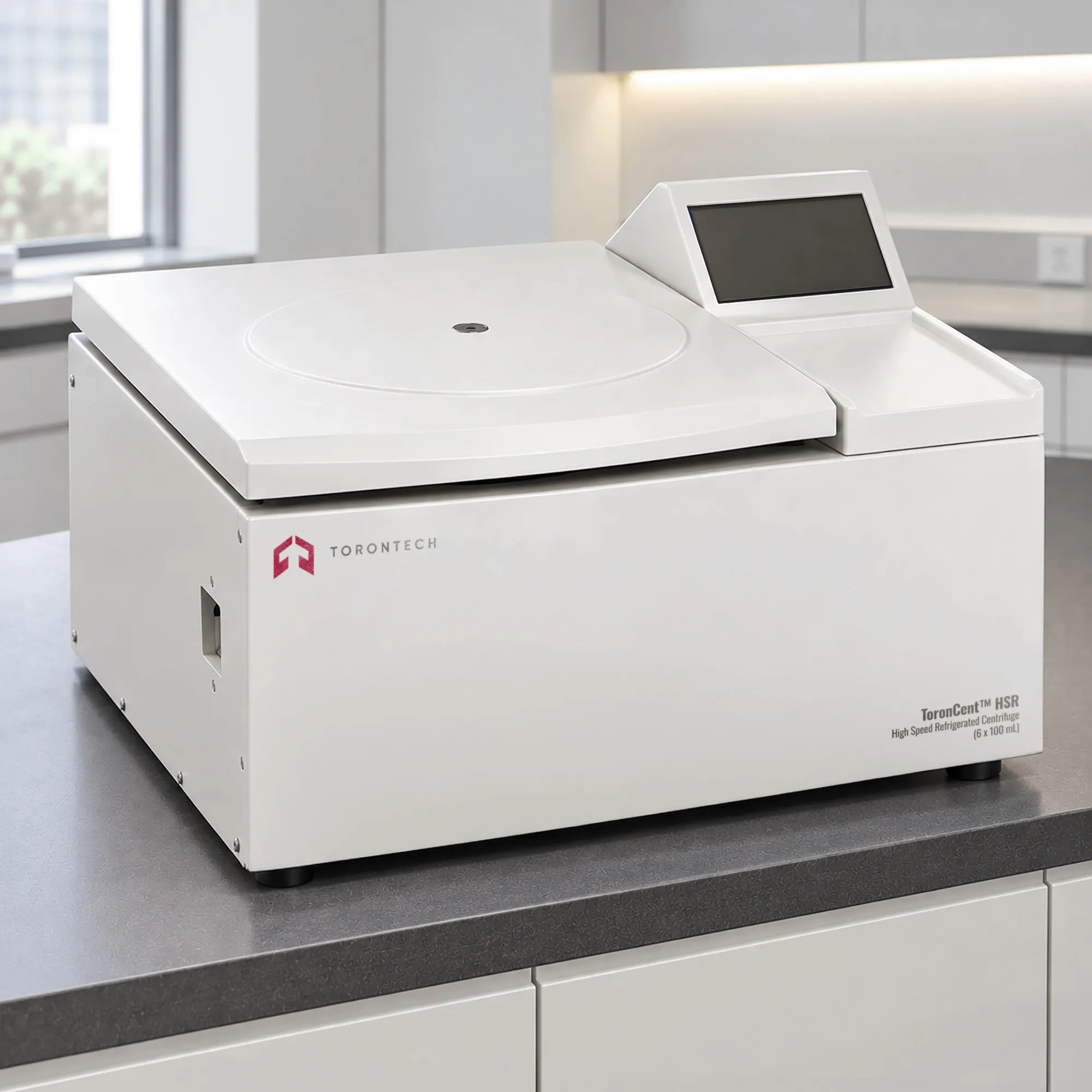
High Speed Refrigerated Centrifuge (6 x 100 mL)
High Speed Refrigerated Centrifuge (6 x 100 mL) - ToronCent™ HSR
ToronCent HSR high speed refrigerated centrifuge separates dense biological and chemical samples at speeds up to 25,000 rpm while holding the chamber between -20°C and 40°C. Molecular biology labs, protein purification groups, and clinical laboratories use it to pellet cells, precipitate nucleic acids, and clarify lysates without thermal degradation. The benchtop footprint fits standard lab casework at 710 x 600 x 480 mm. A 7-inch touchscreen handles setup, monitoring, and program recall from one display.
Ten interchangeable angle rotors cover the working range, from 48 x 1.5 mL microtube carriers to the 6 x 100 mL bottle rotor named in the model designation. Each rotor seats directly on the drive shaft without screws or tools, so a technician can switch formats between runs in seconds. Maximum relative centrifugal force reaches 50,560 x g with the 24-place high speed rotor. The refrigeration circuit uses non-CFC R404a refrigerant.
Rotor choice sets the actual ceiling for any given run, since speed and capacity trade against each other across the range. The 6 x 100 mL rotor spins to 13,500 rpm and 21,800 x g, while the 12 x 1.5/2.2 mL rotor reaches the full 25,000 rpm. Onboard storage holds months of run records and fault logs alongside hundreds of user-defined programs, which gives QC teams a traceable history for audit review. Operators recall a stored method by sample ID rather than re-entering parameters.
High Speed Refrigerated Centrifuge (6 x 100 mL) - ToronCent™ HSR Applications
The ToronCent HSR serves laboratories that need high g-force separation with tight temperature control across biological, clinical, and chemical sample types.
- Molecular Biology and Genomics: pellets nucleic acid precipitates, clears lysates before column purification, and concentrates plasmid preparations at speeds microcentrifuges cannot reach
- Protein Purification and Enzymology: separates soluble protein from cell debris and collects ammonium sulfate precipitates while the chamber stays near 4°C to preserve enzyme activity
- Clinical and Diagnostic Laboratories: prepares serum, plasma, and buffy coat fractions for assay work, and pellets stool or urine sediment for microscopy
- Cell Biology and Culture Work: harvests bacterial, yeast, and mammalian cell suspensions with the 6 x 100 mL rotor for larger culture volumes
- Pharmaceutical and Biotechnology Quality Control: clarifies formulation samples, separates suspended actives, and supports stability testing under controlled temperature
- Microbiology and Virology: concentrates viral particles, bacterial spores, and subcellular fractions using the high speed microtube rotors
- Environmental and Food Analysis: separates particulates from water, soil extracts, and sample slurries ahead of chromatographic or spectroscopic measurement
- Academic and Core Research Facilities: shared-instrument settings benefit from stored methods, sample ID recall, and user access control across many operators
- Nanoparticle and Colloid Research: fractionates fine suspensions where sedimentation demands sustained force above 40,000 x g
Standards
Torontech supplies the ToronCent HSR with the manufacturer's conformity documentation and calibration records. Supplier literature for this model does not cite specific international test standards, so laboratories operating under accredited quality programs should request the declaration of conformity at the time of order and qualify the unit under their own equipment verification procedure.
High Speed Refrigerated Centrifuge (6 x 100 mL) - ToronCent™ HSR Key Features
The feature set targets three things technical buyers ask about: repeatable methods, sample protection, and safe operation at high rotational energy.
- Tool-Free Rotor Exchange: rotors drop onto the drive shaft without screws or fixing hardware, so switching tube formats takes seconds and removes a common source of mounting error
- 7-Inch HD Touchscreen: shows setup values and live run parameters on a single screen, so operators track speed, RCF, temperature, and remaining time without cycling through menus
- Ten Acceleration and Eleven Deceleration Rates: fine ramp control prevents resuspension of soft pellets and secondary emulsification of layered samples
- Five-Step Gradient Separation: one program runs up to five speed and time stages in sequence, which supports density gradient work without operator intervention between steps
- Multi-Layer Protection System: rotor identification, imbalance detection, lid interlock, overtemperature cutout, and overspeed limiting stop a run before a fault becomes a hazard
- Extended Data Storage: months of run records and fault logs stay on the instrument, giving QC and audit teams a retrievable history of every cycle
- Hundreds of Programmable Methods: named and annotated programs recall by sample ID, which standardizes technique across shifts and operators
- User Access Management: account-level permissions stop stored programs from being altered or deleted by unauthorized staff
- Delayed Start Scheduling: a booked start time means the chamber pre-chills and the separation finishes as the analyst arrives
- Non-CFC Refrigeration: the R404a compressor holds -20°C to 40°C within ±1°C without ozone-depleting refrigerant
- Ten Rotor Options: angle rotors from 48 x 1.5 mL to 6 x 100 mL cover microtube, conical, and bottle formats on one drive
- Real-Time Curve Display: speed and temperature plot against elapsed time, documenting actual run conditions rather than setpoints alone
- Bilingual Interface: the display switches between English and Chinese for multilingual laboratory teams
- Low Acoustic Output: noise stays at or below 62 dB(A), which suits open-plan labs and shared benches
Theory and Method
Centrifugal separation accelerates gravitational sedimentation. A particle suspended in fluid settles at a rate governed by its size, its density difference from the surrounding medium, and the medium's viscosity. Spinning the sample multiplies the effective gravitational field, so particles that would take days to settle on the bench pellet in minutes. Relative centrifugal force expresses that multiplier: RCF = 1.118 × 10⁻⁵ × r × N², where r is the rotor radius in centimeters and N is speed in rpm.
Radius carries as much weight as speed in that relationship, which explains why two rotors turning at the same rpm deliver different g-forces. The ToronCent HSR reports both values so operators can reproduce a published protocol stated in x g rather than converting by hand. All ten rotors use fixed-angle geometry, which holds each tube at a constant tilt from vertical. That angle shortens the sedimentation path to the tube wall, which yields tighter pellets and cleaner decanting.
Rotor friction against chamber air converts into heat, and at 25,000 rpm that load raises sample temperature well above ambient within minutes. The R404a compressor circuit counteracts the rise and holds the chamber anywhere from -20°C to 40°C within ±1°C, which protects enzymes, live cells, and labile proteins through long runs. Controlled ramping matters just as much: the ToronCent HSR offers ten acceleration profiles and eleven deceleration profiles, letting operators brake gently enough to leave a soft pellet or a density gradient undisturbed.
High Speed Refrigerated Centrifuge (6 x 100 mL) - ToronCent™ HSR Technical Specifications
| Parameter | Specification |
|---|---|
| Order Number | 0202170000 |
| Maximum Speed | 25,000 rpm |
| Maximum RCF | 50,560 x g |
| Maximum Capacity | 6 x 100 mL |
| Speed Accuracy | ±10 rpm |
| Time Setting Range | 1 min to 99 h 59 min |
| Timing Modes | Start timing, speed timing, continuous timing |
| Temperature Setting Range | -20°C to 40°C |
| Temperature Accuracy | ±1°C |
| Refrigeration Unit | Non-CFC compressor, R404a refrigerant |
| Display | 7-inch HD touchscreen |
| Noise Level | ≤62 dB(A) |
| Voltage | AC 220 V ±22 V, 50 Hz (110V is also available) |
| Power Consumption | 1,500 W |
| Dimensions (W x D x H) | 710 x 600 x 480 mm (28.0 x 23.6 x 18.9 in) |
| Packing Dimensions (W x D x H) | 1,022 x 712 x 630 mm (40.2 x 28.0 x 24.8 in) |
| Net Weight | 95 kg (209 lb) |
Available Rotors
All rotors are fixed-angle type and mount without tools. Maximum speed and maximum RCF apply to that rotor only.
| Rotor | Order Number | Capacity | Max Speed | Max RCF | Adapters |
|---|---|---|---|---|---|
| No. 1 | 0301811700 | 12 x 1.5/2.2 mL | 25,000 rpm | 44,720 x g | 0.2 mL, 0.5 mL |
| No. 2 | 0301811800 | 12 x 15 mL (conical) | 14,000 rpm | 21,912 x g | 5 mL |
| No. 3 | 0301811900 | 12 x 10 mL | 19,000 rpm | 36,715 x g | 1.5 mL, 5 mL |
| No. 4 | 0301812000 | 6 x 50 mL | 16,500 rpm | 28,854 x g | 1.5, 5, 10, 15, 20, 25, 30 mL |
| No. 5 | 0301811100 | 6 x 50 mL (conical) | 15,000 rpm | 24,150 x g | 15 mL conical; 50 mL round-bottom adapter included |
| No. 6 | 0301811200 | 8 x 50 mL | 16,000 rpm | 27,762 x g | 1.5, 5, 10, 15, 20, 25, 30 mL |
| No. 7 | 0301811300 | 24 x 1.5/2.2 mL | 23,000 rpm | 50,560 x g | 0.2 mL, 0.5 mL |
| No. 8 | 0301811400 | 48 x 1.5 mL | 19,000 rpm | 38,987 x g | 0.2 mL, 0.5 mL |
| No. 9 | 0301811500 | 6 x 100 mL | 13,500 rpm | 21,800 x g | 5, 10, 15 mL (conical/round), 25, 50 mL (conical/round) |
| No. 10 | 0301811600 | 6 x 30 mL | 20,000 rpm | 35,328 x g | 5 mL, 10 mL |