
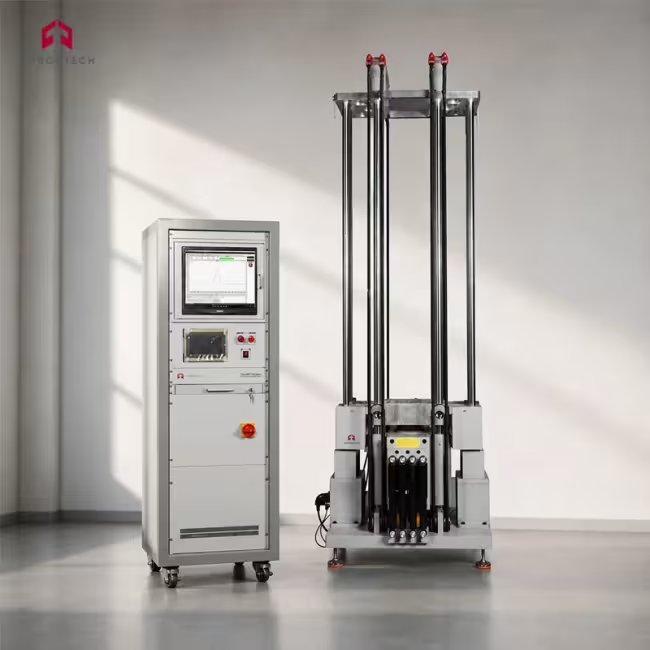
High Acceleration Shock Test System - ToronSTS™ HA Series
A high acceleration shock test system reproduces the short, severe impacts a product meets during handling, transport, and service. The ToronSTS™ HA Series drives a payload of up to 30 kg (66 lb) against a programmer that shapes a half-sine pulse, with peak acceleration reaching 10,000 G on the largest model. Pulse duration runs as short as 0.2 ms. Engineers read the result to judge whether a housing, a solder joint, or a sensor die survives the event.
Three configurations cover the range. The ToronSTS™ HA 10 handles small assemblies on a 200 x 250 mm table at up to 2,000 G, while the HA 30 doubles the table area for larger payloads at up to 1,500 G. The HA 30X reaches 10,000 G for component-level work where the pulse matters more than the specimen size. Each machine sits on air springs with hydraulic damping, so no foundation pit or anchor block is required.
Pneumatic boost supplements gravity and lets the table reach velocities a free drop alone cannot produce at the same machine height. A combined pneumatic and hydraulic braking circuit catches the table after impact and suppresses the secondary bounce that would otherwise contaminate the pulse. Operators set drop height and boost pressure at the touchscreen, then repeat the shot until the recorded pulse falls inside tolerance. Test records support a pass or fail call against an internal specification or a customer requirement.
High Acceleration Shock Test System - ToronSTS™ HA Series Application
- Aerospace and defense: Qualifies fuzes, guidance electronics, ordnance subassemblies, and airborne stores against the high-G transients produced by gun launch, store release, and hard landing.
- Consumer electronics: Screens smartphones, wearables, camera modules, and storage drives for solder joint cracking, BGA fracture, and connector unseating after drop and handling shock.
- Automotive electronics: Verifies airbag control units, crash sensors, and ADAS camera modules hold calibration after the acceleration transients seen at deployment and during rough-road impact.
- Semiconductor and MEMS: Establishes the shock survival limit of accelerometers, gyroscopes, oscillators, and bare packages where die attach and wire bond integrity govern the failure point.
- Energy storage: Confirms that cells, modules, and battery management boards keep electrical isolation and mechanical seal after impact loading.
- Medical devices: Tests portable defibrillators, infusion pumps, handheld diagnostics, and their enclosures for functional survival after a drop onto a hard floor.
- Packaging and product fragility: Determines the critical acceleration of a product so cushioning can be matched to the shock level the distribution chain actually delivers.
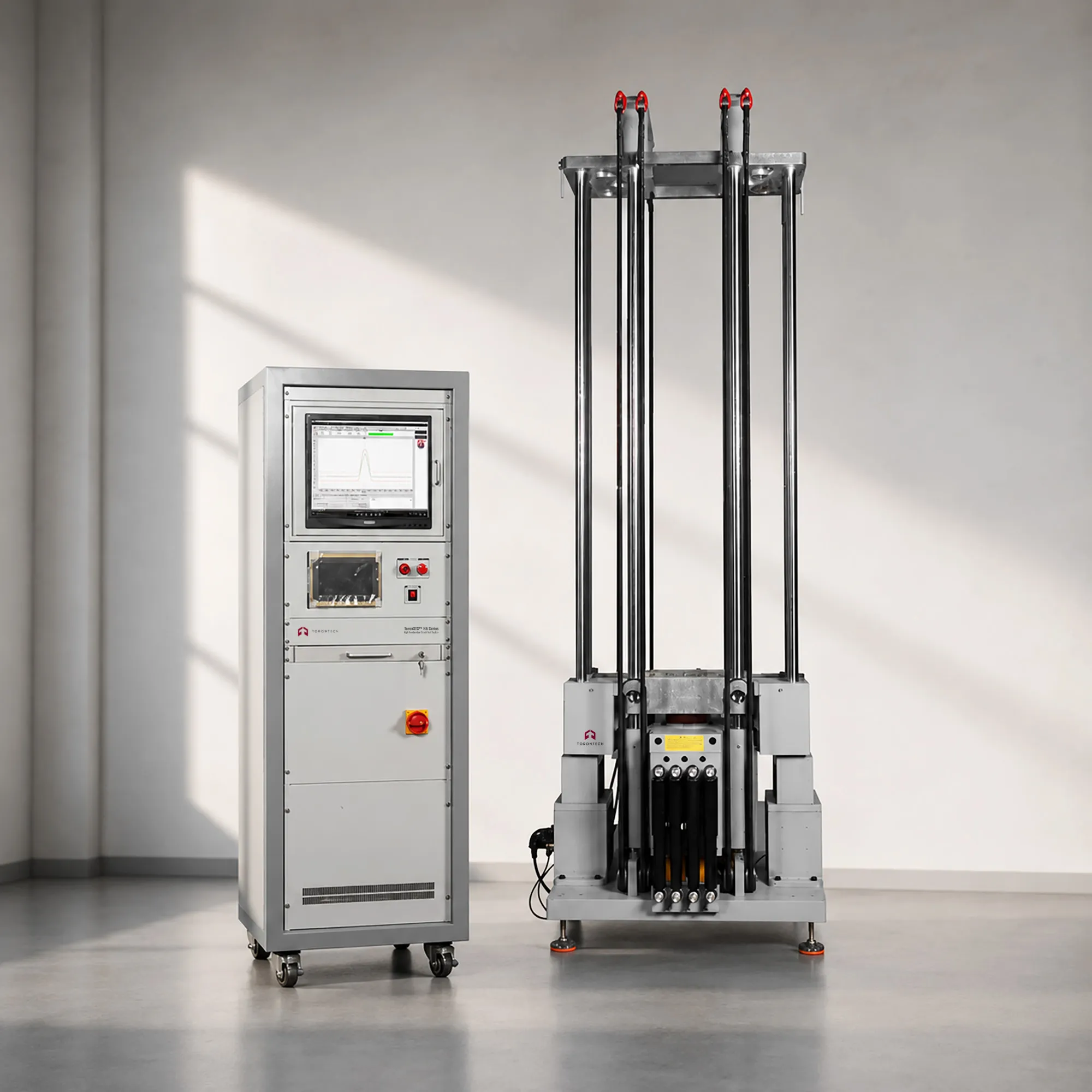
High Acceleration Shock Test System - ToronSTS™ HA Series Key Features
- Acceleration span of 20 to 10,000 G across the series, so one platform covers package-level fragility work and component-level high-G qualification.
- Pulse duration adjustable to 0.2 ms at the short end, reaching the durations required for hard-shock component screening rather than transport simulation only.
- Combined pneumatic and hydraulic boost and braking circuit that arrests the table after first contact and prevents multiple-impact contamination of the recorded pulse.
- Air spring isolation with hydraulic damping, allowing installation on a standard laboratory floor without a foundation pit, isolation mass, or structural anchoring.
- Touchscreen control of drop height and boost pressure, with stored settings that let a technician repeat a qualified pulse without re-tuning.
- Interlocked guarding and a full safety protection circuit covering table release, travel, and braking.
- Optional dual-mass shock amplifier for tests above the base acceleration capability of the machine.
- Optional waveform generator set for laboratories that need pulse shapes beyond the standard half-sine configuration.
- Three table and payload combinations, so specimen fixturing is matched to the machine rather than the machine oversized for the specimen.
Theory and Method
Shock testing on a drop-table machine converts a controlled velocity change into a measured acceleration pulse. The table carrying the specimen is raised to a set height and released; gravity plus pneumatic boost accelerates it down guide rails toward a programmer mounted on the seismic base. Contact with the programmer decelerates the table over a few tenths of a millisecond to a few tens of milliseconds, and the stiffness and travel of that programmer determine the pulse shape. Elastomeric and gas programmers produce the half-sine profile the HA Series is configured for. An accelerometer mounted on the table records the waveform, and peak acceleration, pulse duration, and velocity change are read off it.
Peak acceleration and duration are not set independently. Raising the drop height increases impact velocity, which raises peak G and shortens the pulse for a given programmer; swapping to a stiffer or softer programmer shifts the balance the other way. Reaching the top of the 10,000 G range calls for a dual-mass amplifier, where the primary table strikes a lighter secondary table and momentum transfer multiplies the acceleration the specimen sees. Braking engages immediately after the pulse so the table does not rebound into the programmer a second time, which would place an unrecorded shock on the specimen and invalidate the run. Operators typically shoot a trial pulse on a dummy mass, tune height and pressure, then run the specimen.
High Acceleration Shock Test System - ToronSTS™ HA Series Technical Specifications
| Specification | ToronSTS™ HA 10 | ToronSTS™ HA 30 | ToronSTS™ HA 30X |
|---|---|---|---|
| Table size | 200 x 250 mm (7.9 x 9.8 in) | 400 x 400 mm (15.7 x 15.7 in) | 300 x 300 mm (11.8 x 11.8 in) |
| Max. payload | 10 kg (22 lb) | 30 kg (66 lb) | 30 kg (66 lb) |
| Shock pulse | Half sine | ||
| Acceleration range | 20 to 2,000 G | 20 to 1,500 G | 20 to 10,000 G |
| Pulse duration | 0.2 to 18 ms | 0.5 to 30 ms | 0.2 to 18 ms |
| Max. drop height | 1,500 mm (59.1 in) | 1,200 mm (47.2 in) | 1,200 mm (47.2 in) |
| Machine dimensions (W x D x H) | 660 x 700 x 2,380 mm (26.0 x 27.6 x 93.7 in) | 720 x 680 x 1,890 mm (28.3 x 26.8 x 74.4 in) | 1,350 x 1,250 x 3,300 mm (53.1 x 49.2 x 129.9 in) |
| Optional devices | Dual-mass shock amplifier, waveform generator | ||