
HDD & SSD Data Destruction System - ToronEWR™ HDD/SSD
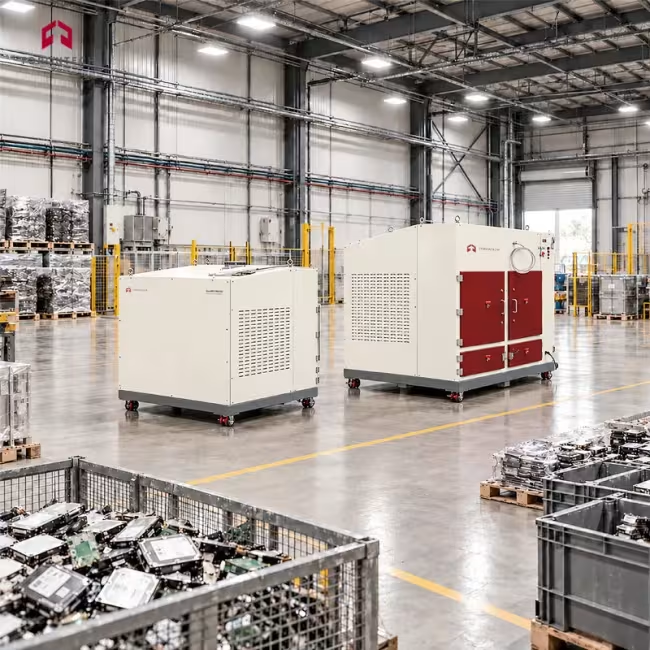
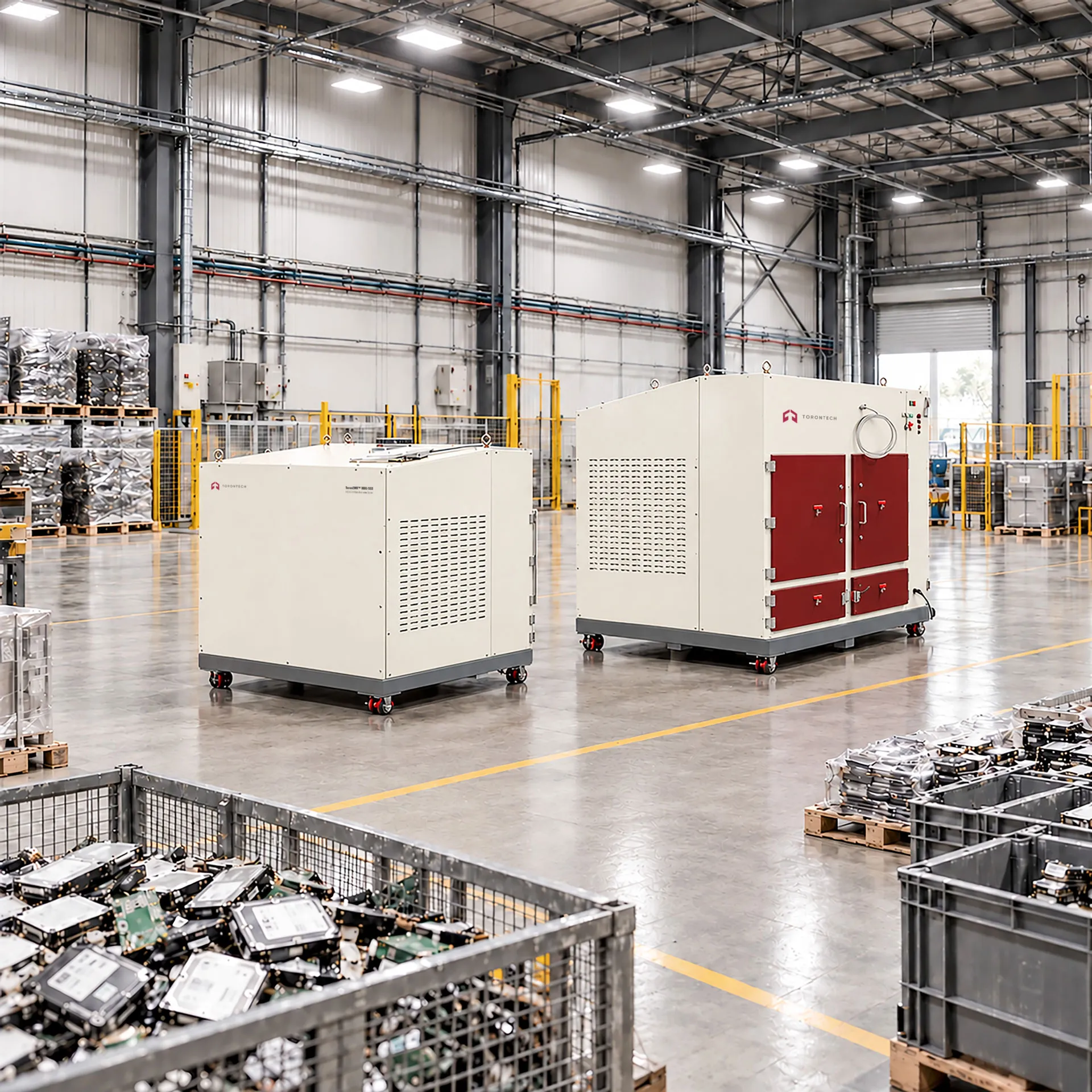
ToronEWR™ HDD/SSD hard drive and SSD shredder reduces storage media to fragments through opposed mechanical shearing, so the data they carry cannot be read back. Two counter-rotating shafts fitted with alloy steel blades cut hard drives into pieces measuring 20 to 40 mm in the base configuration. The same chamber accepts solid-state drives, magnetic tape, optical discs, USB drives, circuit boards, and loose chips. Enterprises, government departments, financial institutions, and IT asset disposal firms use it to retire media under their own custody.
Tightening privacy regulation drives most of the demand. GDPR and HIPAA both place the burden of proof on the organization holding the data, and physical destruction produces evidence that software erasure cannot match. Destroying media on your own premises also removes the chain-of-custody gap that sending drives to a third party creates. The unit is built as a mobile cabinet, so it can sit in a secure room rather than a plant floor.
Blade dimensions and configuration are specified to the throughput and output size a site needs. Sizing screens or a secondary shredding stage can follow the primary chamber where a smaller particle is required. Low rotational speed keeps vibration, noise, and energy draw down, which matters when the machine runs inside an office building rather than a workshop. Shredded material also stays recoverable as scrap, so metals in the drives return to the recycling stream.
HDD & SSD Data Destruction System - ToronEWR™ HDD/SSD Applications
The ToronEWR™ HDD/SSD system serves organizations that need destruction to happen under their own control rather than at a vendor site.
- Enterprise IT Departments: retires decommissioned server, laptop, and workstation drives without releasing them to an outside processor
- Government Agencies: destroys media on site where policy requires the process to stay within a controlled facility
- Financial Institutions: handles drives carrying account, transaction, and customer records under audit-ready conditions
- Healthcare Organizations: destroys media holding patient records where privacy rules govern disposal
- Data Center Decommissioning: processes drive volume generated when racks are refreshed or facilities close
- IT Asset Disposition Providers: offers clients on-site destruction as a service alongside remarketing and recycling
- Electronic Waste Recyclers: destroys data while liberating the aluminum, steel, and board content in drives for material recovery
- Legal and Professional Services: retires media holding privileged client material under documented conditions
- Research and Development Facilities: destroys drives carrying proprietary designs, test data, and unpublished work
- Telecommunications Operators: handles storage removed from network equipment and subscriber systems
- Managed Service Providers: processes drives collected across multiple client contracts from one location
- Defense and Aerospace Suppliers: retires media under contract security requirements, subject to the equipment approvals those contracts specify
HDD & SSD Data Destruction System - ToronEWR™ HDD/SSD Key Features
The ToronEWR™ HDD/SSD system pairs low-speed shearing with configurable output sizing, so one machine covers a range of media types and destruction targets.
- Opposed Shearing Action: counter-rotating shafts tear drives apart between interleaved cutters, which handles cast housings that impact-based machines struggle with
- 20 to 40 mm Base Output: the primary chamber reduces hard drives to fragments in this range without additional stages
- Configurable Output Size: sizing screens or a secondary shredding stage follow the primary chamber where a smaller particle is required
- Adjustable Blade Dimensions: cutter sizing is specified to the destruction target and throughput a site works to
- Multi-Media Capability: hard drives, solid-state drives, magnetic tape, optical discs, USB drives, circuit boards, and chips run in the same chamber
- High-Strength Alloy Steel Blades: cutters combine hardness with the toughness repeated drive-chassis duty demands
- Low-Speed High-Torque Drive: the motor delivers cutting force at low rotation, which suits dense assemblies and keeps the process controlled
- Reduced Vibration and Noise: slow shaft rotation makes the unit suitable for installation inside office and secure-room environments
- Low Energy Consumption: power draw stays modest relative to the destruction work performed
- Stable Operation: the low-speed design limits the shock loading that shortens service life on faster machines
- Emergency Stop Control: the operator panel carries an emergency stop within immediate reach of the feed position
- Mobile Cabinet Format: the unit is built on casters so it can be repositioned between secure areas
- On-Premises Custody: destroying media in house removes the chain-of-custody gap that off-site processing introduces
- Material Recovery Compatible: shredded output retains its value as scrap, so drive metals return to the recycling stream
- Throughput-Based Configuration: the machine is specified around the volume of media a site retires rather than sold as a fixed model
Theory and Method
Physical destruction exists because logical erasure carries residual doubt, and the doubt is largest exactly where the data density is highest. Hard drives store information as magnetic orientation across platter surfaces, while solid-state drives hold charge in cells inside NAND packages. Wear leveling and over-provisioning mean an SSD controller retires physical blocks that the host can no longer address, so an overwrite pass never reaches them. Reducing the device to fragments removes that uncertainty rather than arguing about it.
Particle size targets differ between media types for a physical reason worth understanding. Hard drive data spreads across a platter measuring dozens of square centimeters, so breaking and deforming that platter destroys readability even at relatively coarse fragment sizes. A NAND die, by contrast, measures only a few millimeters across, which means a fragment larger than the die can contain an intact and potentially readable chip. That asymmetry is why solid-state guidance sets far smaller targets than hard drive guidance does.
The dual-shaft mechanism works by shear rather than impact. Two shafts turn toward each other at low speed, and interleaved cutters catch the drive chassis between opposing hooks, tearing it apart the way scissors cut rather than the way a hammer breaks. High torque at low rotation carries the cutters through cast aluminum housings and steel covers without stalling. Low speed also limits heat, dust, and noise, and fragment size follows from cutter width together with any screen fitted below the chamber.
HDD & SSD Data Destruction System - ToronEWR™ HDD/SSD Technical Specifications
System Overview
| Parameter | Specification |
|---|---|
| Equipment Type | Dual-shaft shredder in mobile cabinet format |
| Base Output Particle Size | 20 to 40 mm |
| Reduced Particle Size | Available through sizing screens or secondary shredding |
| Rotor Configuration | Two counter-rotating shafts with interleaved cutters |
| Cutting Action | Opposed shearing between main shafts |
| Blade Material | High-strength alloy steel |
| Blade Sizing | Adjustable to destruction target and throughput |
| Drive Type | Low-speed, high-torque motor |
| Processable Media | Hard disk drives, solid-state drives, magnetic tape, optical discs, USB drives, circuit boards, chips |
| Vibration and Noise | Reduced relative to high-speed shredding equipment |
| Energy Profile | Low consumption for the duty performed |
| Operational Stability | Low-speed design limits shock loading |
| Mobility | Cabinet mounted on casters |
| Safety Provision | Emergency stop control at the operator panel |
| Configuration Basis | Specified to site throughput and required output size |
Machine Line-Up
The system is built from the modules below. Each stage is described with its function, working method, and available parameters.
1. Feed System
Media is introduced through a feed opening at the operator position, one item or one batch at a time depending on configuration. Controlled introduction keeps the shredder within its torque band and gives the operator a clear view of what enters the chamber, which matters when destruction has to be witnessed or logged.
| Parameter | Specification |
|---|---|
| Function | Introduces storage media into the cutting chamber |
| Feed Method | Operator-loaded at the machine feed opening |
| Accepted Media | Drives, tape cartridges, discs, USB devices, boards, and loose chips |
| Operational Benefit | Supports witnessed destruction and item-level logging |
2. Dual-Shaft Shredder
The dual-shaft shredder performs the destruction itself. Two shafts rotate toward each other at low speed, and interleaved alloy steel cutters catch each drive and shear it apart. High torque carries the cutters through aluminum castings, steel covers, platters, and circuit boards without stalling. Base output falls between 20 and 40 mm, and blade dimensions are specified during ordering to suit the destruction target.
| Parameter | Specification |
|---|---|
| Function | Primary destruction of storage media by mechanical shearing |
| Shaft Arrangement | Two counter-rotating main shafts |
| Cutter Configuration | Interleaved cutters, dimensions adjustable to requirement |
| Cutter Material | High-strength alloy steel |
| Operating Speed | Low speed |
| Torque Characteristic | High torque across the working range |
| Output Size | 20 to 40 mm |
| Accepted Material | HDD, SSD, tape, optical media, USB devices, PCBs, chips |
3. Sizing Screen
A screen fitted below the cutting chamber sets the largest fragment permitted to leave. Material that has not yet reached the aperture size stays in the chamber and is worked again, so the screen governs output consistency rather than just filtering it. Screen selection is the primary means of tightening particle size without adding a second machine.
| Parameter | Specification |
|---|---|
| Function | Controls maximum fragment size leaving the chamber |
| Position | Below the cutting chamber |
| Working Principle | Oversize material retained and re-cut until it passes |
| Configuration | Aperture selected to the required destruction target |
| Status | Fitted according to output specification |
4. Secondary Shredding Stage
Where the required particle is smaller than the primary chamber delivers, a secondary shredding stage follows. Running already-reduced fragments through a second cutting operation brings output down further, which is the route to the finer targets that solid-state media guidance sets.
| Parameter | Specification |
|---|---|
| Function | Further size reduction of primary shredder output |
| Status | Optional stage, specified to destruction target |
| Feed Source | Discharge from the primary dual-shaft chamber |
| Application | Required where the destruction policy calls for fine particles |
| Process Purpose | Reaches particle sizes beyond the base configuration |
5. Control and Safety System
The operator panel governs the machine and carries the safety interlocks. An emergency stop sits within reach of the feed position so the shafts can be halted immediately, and indicator controls show machine state during operation.
| Parameter | Specification |
|---|---|
| Function | Machine control, status indication, and operator safety |
| Interface | Operator control panel at the machine |
| Safety Device | Emergency stop within reach of the feed position |
| Controls | Start, stop, and machine status indication |
| Operation | Single-operator working from the feed position |