
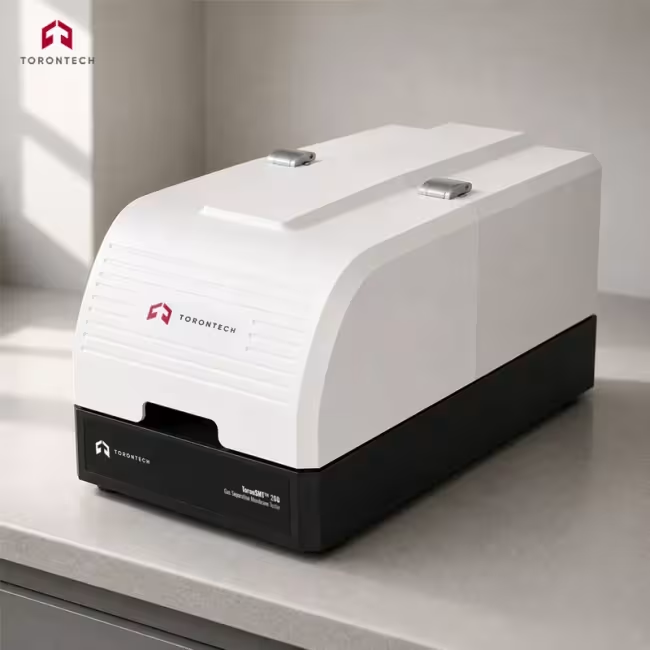
Gas Separation Membrane Tester
Gas Separation Membrane Tester - ToronSMT™ 200
Membrane Gas Permeation and Selectivity Tester
ToronSMT™ 200 is a gas separation membrane tester that measures the gas permeability, selectivity, and separation rate of separation membranes for single and mixed gases. The instrument applies the differential-pressure permeation principle and pairs it with an integrated gas chromatograph, so it quantifies both how fast a gas permeates and how well the membrane separates a mixture. Results report permeability in Barrers, the recognized unit for membrane performance.
The ToronSMT™ 200 covers a wide permeability range of 0.01 to 20,000 Barrers and works with common gases such as O₂, N₂, CO₂, H₂, CH₄, and He. A controlled pressure difference to 10 bar and high-accuracy vacuum sensors resolve low permeate pressures for accurate results. Optional water-bath temperature control holds the chamber isothermal across a 5°C to 95°C range for temperature-dependent studies.
One-button operation runs the full permeation sequence automatically, and real-time curves let operators follow each test. The ToronSMT™ 200 (Membrane Gas Permeation and Selectivity Tester) suits natural gas processing, biogas upgrading, hydrogen recovery, carbon capture, and membrane materials research, where accurate permeability and selectivity data guide membrane selection and development.
Gas Separation Membrane Tester - ToronSMT™ 200 Applications
The ToronSMT™ 200 characterizes gas separation membranes across the processes where permeability and selectivity determine separation performance.
- Natural Gas Processing: measures CO₂/CH₄ selectivity of membranes used to sweeten natural gas.
- Biogas Upgrading: characterizes membranes that separate CO₂ from methane to upgrade biogas to biomethane.
- Hydrogen Recovery and Purification: tests H₂-selective membranes for hydrogen separation and purification.
- Carbon Capture: evaluates CO₂-selective membranes for post-combustion and process carbon capture.
- Air Separation: measures O₂/N₂ selectivity of membranes for nitrogen generation and oxygen enrichment.
- Flat-Sheet Membrane R&D: supports development of new separation membrane materials tested as flat-sheet coupons.
- Olefin and Hydrocarbon Separation: studies membranes for light-hydrocarbon and olefin-paraffin separation.
- Membrane Materials Research: quantifies permeability and selectivity for polymer, mixed-matrix, and inorganic membranes.
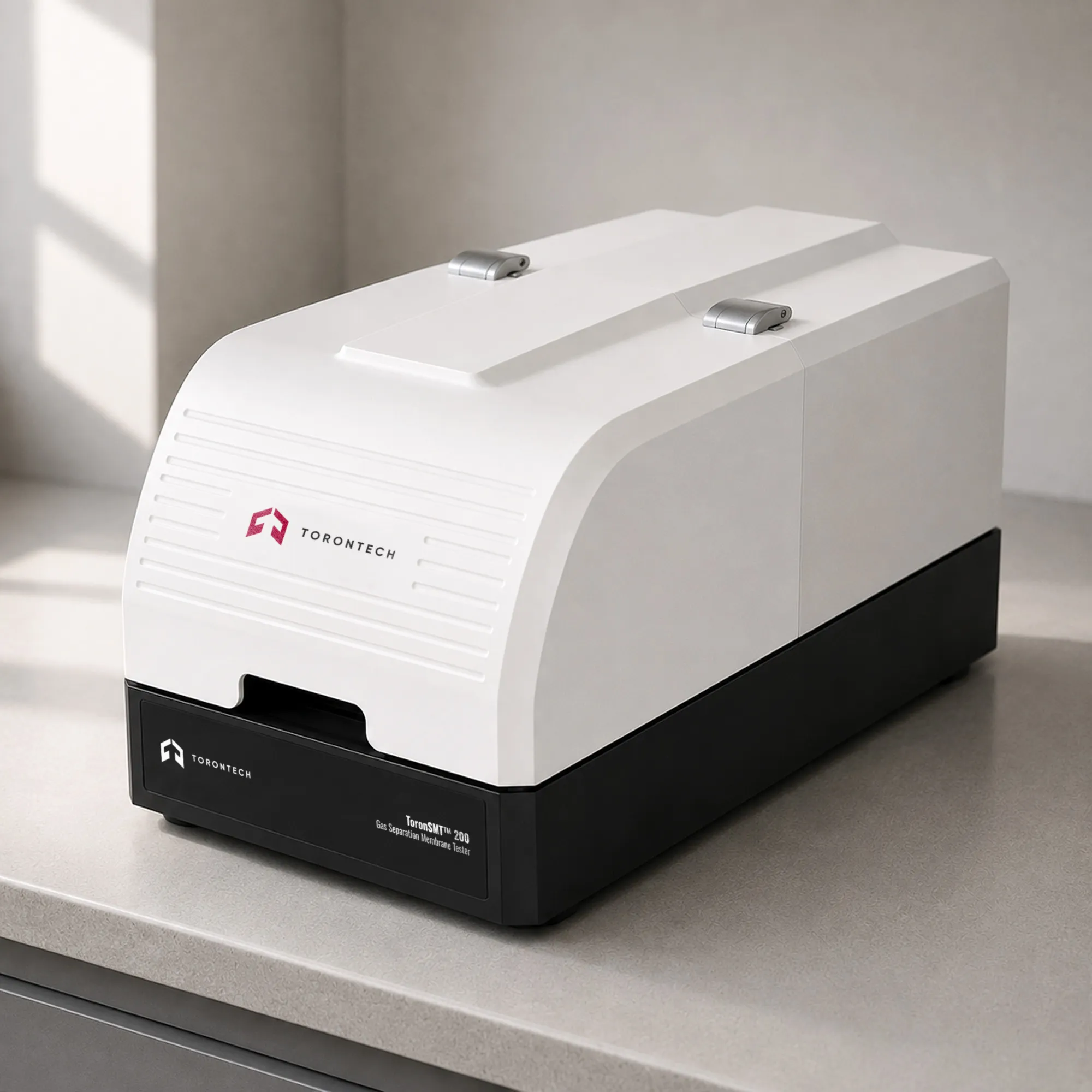
Gas Separation Membrane Tester - ToronSMT™ 200 Key Features
The ToronSMT™ 200 pairs differential-pressure permeation with an integrated gas chromatograph for full membrane characterization.
- Permeability, Selectivity, and Separation Rate: measures all three key parameters of a separation membrane in one system, for single or mixed gases.
- Single and Mixed-Gas Testing: characterizes membranes with pure gases and multi-component mixtures, closer to real process conditions.
- Integrated Gas Chromatograph: an onboard gas chromatograph resolves permeate composition so mixed-gas selectivity and separation rate can be quantified.
- Differential-Pressure Permeation Principle: applies a controlled pressure difference across the membrane and tracks permeate build-up for accurate permeability in Barrers.
- High-Accuracy Vacuum Sensing: precise vacuum sensors at 0.1 Pa resolve low permeate pressures for accurate permeability.
- Wide Permeability Range: covers 0.01 to 20,000 Barrers across tight selective layers and open membranes.
- One-Button Automated Testing: runs the full permeation sequence automatically, reducing operator effort and variability.
- Optional Water-Bath Temperature Control: holds the test chamber isothermal across a 5°C to 95°C range for temperature-dependent studies.
- Multiple Test and Loading Gases: works with common gases such as O₂, N₂, CO₂, H₂, CH₄, and He, within safe gas combinations.
- 24-Bit Delta-Sigma Data Acquisition: high-resolution conversion resolves the low permeate signals produced by selective membranes.
- Real-Time Data Curves: on-screen permeation curves let operators follow each test and judge steady state.
- Laboratory Data Management Integration: connects to lab data management software for centralized records and reporting.
Theory and Method
The instrument measures gas transport through a separation membrane by holding the membrane between a high-pressure feed side and a low-pressure permeate side. A controlled pressure difference drives gas through the membrane, and high-accuracy vacuum sensors track the pressure rise on the permeate side over time. The steady-state permeation rate, together with the membrane area, thickness, and pressure difference, gives the permeability in Barrers.
Permeability describes how much of a gas crosses the membrane, while selectivity is the ratio of permeabilities between two gases and sets how well the membrane separates a mixture. For a single gas, the pressure-rise measurement gives permeability directly. For a mixed feed, an integrated gas chromatograph analyzes the permeate composition, so the system reports the true mixed-gas selectivity and separation rate under realistic conditions.
Testing with real gas mixtures matters because a membrane's mixed-gas selectivity often differs from the ideal selectivity calculated from single-gas data. The ToronSMT™ 200 runs single-gas and mixed-gas tests on one platform, with optional water-bath temperature control for temperature-dependent studies. Automatic operation and 24-bit data acquisition keep the low permeate signals resolved and the measurement repeatable.
Gas Separation Membrane Tester - ToronSMT™ 200 Technical Specifications
| Parameter | Specification |
|---|---|
| Permeability Range | 0.01 to 20,000 Barrers |
| Test Flow | 0 to 100 ml/min (200, 300 ml/min optional) |
| Permeability Accuracy | 0.01 Barrers |
| Vacuum Accuracy | 0.1 Pa |
| Test Gases | O₂, N₂, CO, CO₂, H₂, CH₄, C₂H₄, C₂H₆, He, and others |
| Pressure Difference | 0 to 10 bar (standard) |
| System Pressure Resistance | 16 bar |
| Temperature Range | 5°C to 95°C, ±0.1°C (optional) |
| Test Area | Ø20 mm (3.14 cm²) |
| Sample Thickness | ≤ 2 mm |
| Sample Amount | 1 (single specimen) |
| Detector Sensitivity | ≥ 5,000 mv·ml/mg or 10,000 mv·ml/mg |
| Detector Drift | ≤ 0.10 mv; Noise ≤ 0.015 mv |
| Loading Gas Pressure | 2 bar |
| Loading Gas | N₂, H₂, He, Ar, and others |
| Main Unit Dimensions | 320 mm (W) × 625 mm (D) × 335 mm (H) |
| Gas Chromatograph Dimensions | 590 mm (L) × 480 mm (W) × 500 mm (H) (standard) |
| Voltage | AC 220 V, 50 Hz (110V is also available) |
Note: do not test oxygen together with flammable or explosive gases, and do not test corrosive gases.
Standard Delivery
| Item | Description |
|---|---|
| Main Unit | Membrane gas permeation test instrument |
| Control Software | Instrument operation and data-analysis software |
| Vacuum Pump | Evacuates the permeate side for permeation measurement |
| Tank Regulator | Regulates the feed gas supply pressure |
| PCIe Acquisition Card | Data acquisition interface for the control PC |
| Gas Chromatograph | Analyzes permeate composition for mixed-gas selectivity |
| Communication Cable | Connects the instrument to the control PC |
| Vacuum Grease | Seals the specimen at the chamber interface |
| Gas Pipeline | Tubing set for feed and permeate gas connections |
Optional Accessories
| Item | Description |
|---|---|
| Temperature Controller | Water-bath temperature control unit |
| Computer | Dedicated control PC |
| Laboratory Data Management System | Centralized data management and reporting software |