
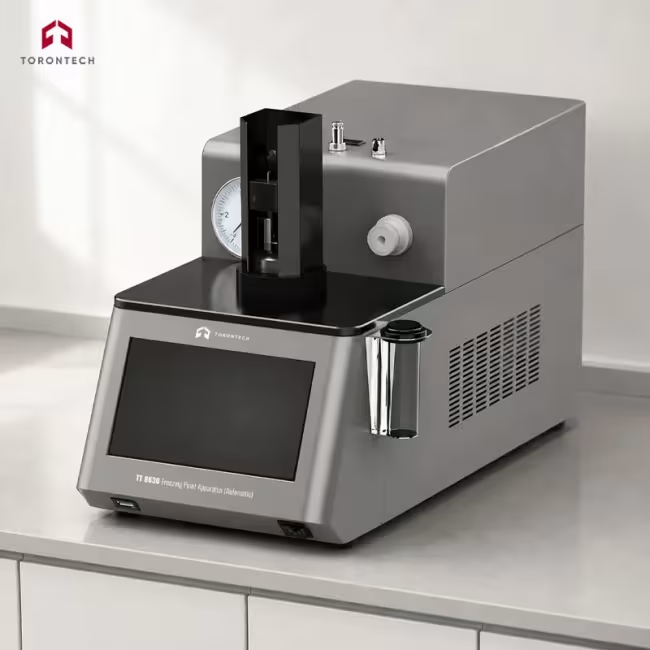
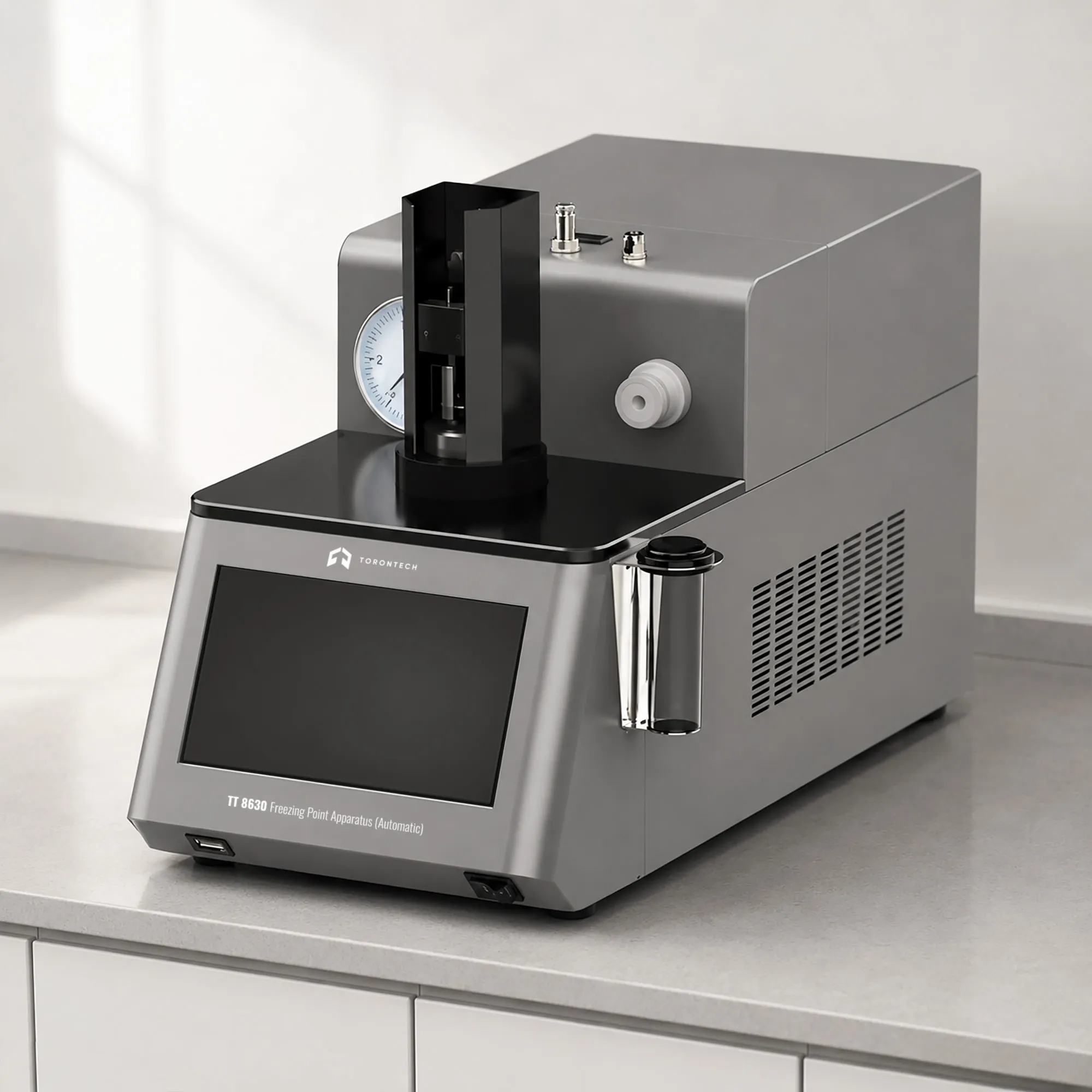
Freezing Point Apparatus (Automatic)
Freezing Point Apparatus (Automatic) - TT 8630
TT 8630 Freezing Point Apparatus (Automatic) delivers automated aviation fuel freezing point measurement in compliance with ASTM D8630, the Micro CFP Method, designed for fuel testing laboratories, petroleum refineries, and aviation fuel certification centers. A microfiber-optic measurement cell detects hydrocarbon crystal formation and dissolution through continuous luminous flux monitoring, eliminating manual visual observation. The test range covers −95°C to 45°C, sufficient for Jet A, Jet A-1, JP-5, JP-8, and aviation gasoline certification. Bath temperature control extends to −105°C for demanding test conditions.
The instrument automates the complete test cycle: the specimen cools at up to 5°C/min until crystal formation triggers detection, holds for five minutes, then heats at up to 5°C/min until crystals dissolve. Crystal appearance and disappearance are determined when the luminous flux crosses pre-set thresholds, producing an objective and reproducible result. Real-time temperature traces for both the bath and the fuel sample appear on the 10.4-inch color touchscreen throughout the test. Temperature control accuracy holds to ±0.5°C across the full working range.
Test records accumulate in onboard storage with capacity for tens of thousands of entries, each linked to its associated cooling curve, supporting traceability in accredited laboratory environments. Data export connects via USB flash drive, RJ45 network, or RS232 serial port, with direct LIMS integration. A built-in bath preheating function prepares the instrument before sample loading, and an automatic probe self-cleaning function reduces inter-test downtime. Together, these features suit the TT 8630 to high-throughput fuel labs operating under ISO/IEC 17025 or equivalent quality systems.
Freezing Point Apparatus (Automatic) - TT 8630 Applications
The TT 8630 Automatic Freezing Point Apparatus covers aviation fuel testing across the full production, distribution, and certification chain. Its ASTM D8630 compliance and extended temperature range support freeze-point verification wherever Jet A, Jet A-1, JP-5, JP-8, or aviation gasoline specifications must be met.
- Petroleum Refineries: quality control at point of production for aviation turbine fuels and aviation gasoline, confirming that each batch meets the freezing point limits defined in ASTM D1655 and DEF STAN 91-091 before shipment to distribution terminals.
- Aviation Fuel Depots and Distribution Terminals: receipt inspection and in-storage quality verification of Jet A-1 deliveries, confirming freeze point compliance before tank acceptance and onward distribution.
- Airport Fuel Quality Laboratories: on-site verification at airport fuel farms and into-plane fueling operations to meet regulatory and airline requirements for aircraft fueling safety at the point of uplift.
- Military Fuel Testing: compliance testing for JP-4, JP-5, JP-7, and JP-8 fuels under MIL-DTL-5624, MIL-DTL-83133, and related military turbine fuel specifications that require freeze point verification at each custody transfer point.
- Fuel Blending and Formulation: freeze point measurement during blending operations to optimize kerosene and naphtha cut ratios and confirm specification compliance before product release.
- Aviation Fuel Research and Development: characterization of Sustainable Aviation Fuel (SAF) candidates, novel fuel blends, and additive packages to quantify low-temperature performance across the instrument's full test range.
- Third-Party Testing and Certification Laboratories: independent freeze point verification for fuel shippers, airlines, and aviation authorities requiring ASTM D8630-compliant results for certification, quality audits, and import/export compliance.
Standards
The TT 8630 Automatic Freezing Point Apparatus is designed and built to align with internationally recognized test methods for aviation fuel freezing point determination. Laboratories should confirm which methods their applicable fuel specification accepts before reporting results under any alternative or supplementary method.
- ASTM D8630 - Standard Test Method for Freezing Point of Aviation Fuels (Micro CFP Method) [per manufacturer documentation;
- ISO 3013 - Petroleum Products — Determination of the Freezing Point of Aviation Fuels
Freezing Point Apparatus (Automatic) - TT 8630 Key Features
The TT 8630 Automatic Freezing Point Apparatus combines fiber-optic crystal detection, semiconductor refrigeration, and a full automation suite for aviation fuel laboratories with demanding throughput and traceability requirements. Each feature is designed to reduce operator effort and produce audit-ready results.
- 10.4-Inch Color Touchscreen with Multilingual Interface: provides full-touch operation and language switching to accommodate multilingual laboratory environments, with clear real-time display of test status and temperature readings throughout the cycle.
- Ultra-Low Bath Temperature Capability Down to −105°C: semiconductor refrigeration reaches −105°C bath temperature, providing thermal headroom beyond the −95°C test range to maintain tight control at the most demanding test conditions.
- Fully Automated Test Cycle: the instrument manages cooling, hold time, crystal detection, and controlled heating sequentially without operator input, reducing measurement variability and allowing technicians to focus on other tasks.
- Real-Time Dual Temperature Curves Archived with Each Result: live bath and sample temperature traces display on the touchscreen during every test and are saved alongside the result record, supporting traceability, trend analysis, and audit review.
- User-Configurable Test Intervals: timing parameters adjust to match laboratory protocols and throughput targets, providing operational flexibility while maintaining method compliance.
- Programmable Bath Preheating: built-in preheating with selectable enable/disable, time, and temperature settings warms the test bath before sample loading, shortening per-test cycle time in high-volume environments.
- Automatic Probe Self-Cleaning: the instrument automatically cleans the fiber-optic test probe between tests, limiting residual contamination from prior samples and reducing routine maintenance demands on laboratory staff.
- Bath Calibration and High-Capacity Data Storage: onboard bath temperature calibration tools and storage for tens of thousands of test records with associated cooling curves support long-term data management under ISO/IEC 17025 or equivalent quality management systems.
- USB, RJ45, and RS232 Connectivity: three standard interfaces support USB data export, RJ45 network integration, and RS232 serial communication, with direct LIMS connection for automated record transfer.
Theory and Method
Hydrocarbon crystals in aviation fuel form when the temperature drops below the fuel's characteristic freezing point. At cruise altitude, fuel tank temperatures can fall well below −40°C, and any crystals present can block filters and restrict engine fuel flow. Aviation fuel specifications including ASTM D1655 and DEF STAN 91-091 therefore set a maximum allowable freezing point for each fuel grade. Laboratory verification at refinery, terminal, and airport stages confirms that the fuel remains crystal-free at minimum operational temperatures.
The ASTM D8630 Micro CFP Method detects aviation fuel phase transitions through a microfiber-optic measurement cell. As the instrument cools the specimen, a light source transmits luminous flux through the cell; hydrocarbon crystals scatter that light as they form, driving detected flux below a pre-set threshold and marking crystal appearance. After a hold period at low temperature, the instrument begins controlled heating; as crystals dissolve, the luminous flux recovers above a second threshold. The instrument records that recovery temperature as the fuel's freezing point.
Semiconductor refrigeration in the TT 8630 uses the Peltier effect to cool the test bath without a conventional refrigerant circuit. Electrical current through a thermoelectric module transfers heat from the cold side to the hot side, reaching bath temperatures down to −105°C. This approach delivers precise temperature ramp rates of up to 5°C/min during both cooling and heating phases, with the control loop maintaining ±0.5°C accuracy. The absence of compressors and refrigerant fluids reduces mechanical complexity and simplifies laboratory installation.
Freezing Point Apparatus (Automatic) - TT 8630 Technical Specifications
| Parameter | Specification |
|---|---|
| Cooling Method | Semiconductor (Peltier) refrigeration |
| Test Range | -95°C to 45°C |
| Bath Temperature Control Range | -105°C to 45°C |
| Temperature Control Accuracy | ±0.5°C |
| Display | 10.4-inch color LCD, 800 × 600 resolution |
| Voltage | AC 220V, 50Hz (110V is also available) |
| Power Consumption | 1,000W |
| Dimensions (L × W × H) | 650 × 355 × 380 mm |
| Weight | 45 kg |