

Fire Spray Nozzle Drop Tester — ToronFT™ FS-FND
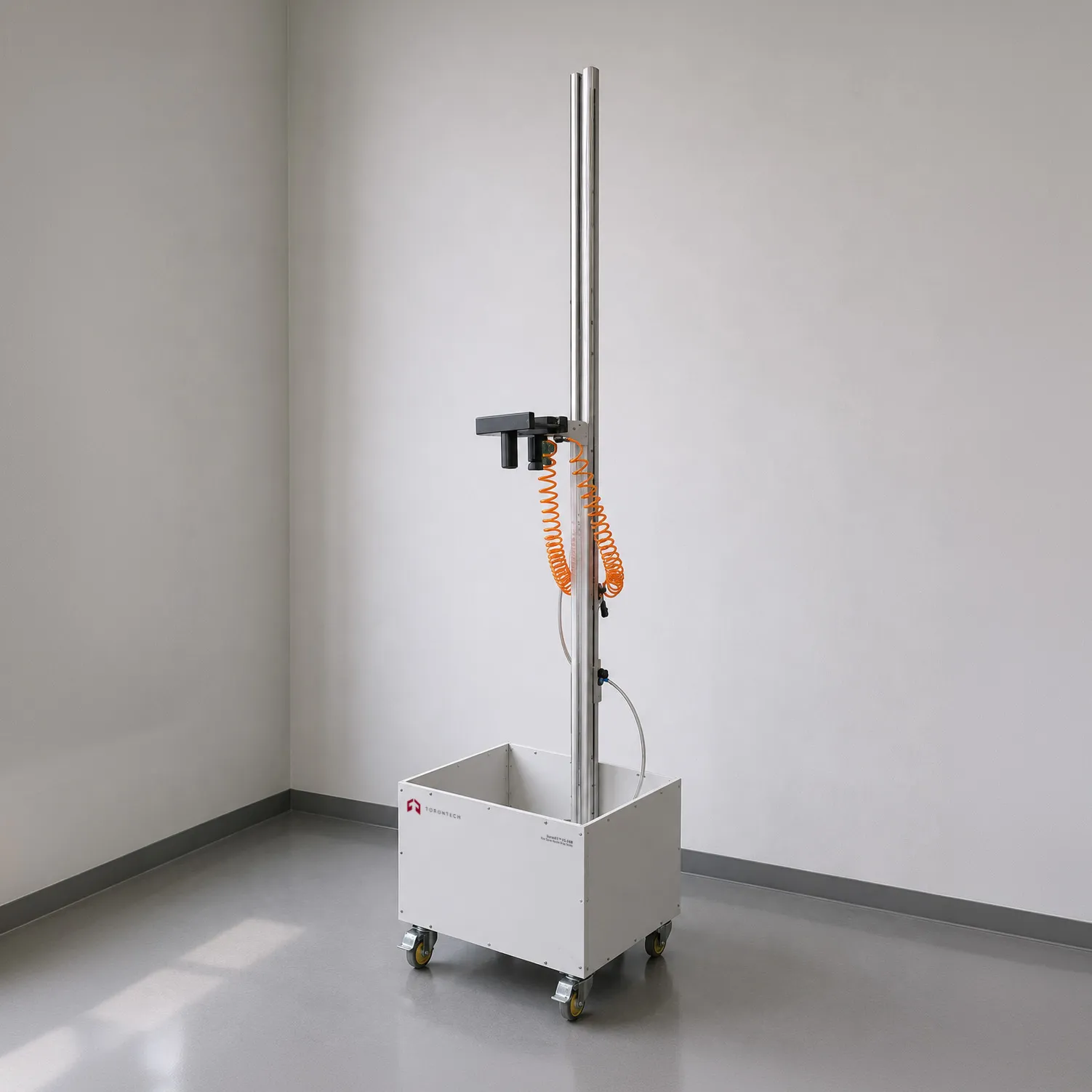
ToronFT™ FS-FND Fire Spray Nozzle Drop tester is a mechanical impact testing instrument designed for the drop resistance evaluation of spray fire nozzles. By dropping the nozzle from a standardized height of 1.5 m onto a reinforced cement board, the ToronFT™ FS-FND simulates the accidental drop impacts that fire nozzles experience during handling, installation, and field maintenance — verifying that the nozzle remains free from fragmentation and deformation and can continue to be used normally after impact.
The drop tester features a test height range of 1–2 m (adjustable), a precision air valve release mechanism for hands-free, controlled drops, and a standardized impact target of a 10 cm thick reinforced cement board. Each sample position is tested three times to provide statistically reliable drop resistance data for production qualification and certification programs.
Fire Spray Nozzle Drop Tester — ToronFT™ FS-FND Applications
- Fire nozzle manufacturers: drop resistance qualification for spray fire nozzle production and certification
- Third-party certification and testing laboratories: drop test compliance verification per international fire equipment standards
- Quality assurance departments: incoming inspection and batch sampling for drop resistance of fire nozzle assemblies
- R&D departments: evaluation of new nozzle body materials, geometries, and assembly processes for drop impact resistance
- Fire fighting equipment inspection: verification of nozzle structural integrity after accidental drops in the field
Fire Spray Nozzle Drop Tester — ToronFT™ FS-FND Key Features
- Standardized drop height: 1.5 m ± 0.05 m — replicating typical handling drop events for fire nozzle qualification
- Impact target: 10 cm thick reinforced cement board — standardized, non-yielding impact surface for consistent impact energy
- Three drops per sample position — providing statistically reliable drop resistance assessment
- Air valve release mechanism for precise, hands-free free-fall drop control — eliminating operator-induced lateral forces
- Test height range: 1–2 m (adjustable) — accommodating different test protocol requirements and nozzle sizes
- Nozzle mounted with switch facing downward for each drop — standardized orientation per test protocol
- Post-test evaluation: nozzle must be free from fragmentation and deformation and remain operational after drop events
- Self-contained, compact apparatus for efficient laboratory and field-service testing environments
Theory and Method
The standard drop test procedure begins by connecting the spray fire nozzle to the test stand air pipe and air source. The nozzle is hung on the test stand with the nozzle and switch facing downward. The lowest part of the spray fire nozzle is used as the base point, and the distance from base point to the impact surface is measured and set to 1.5 m ± 0.05 m. The air valve switch is then manually pulled down to raise the nozzle to 1.5 m above the platform, and the valve is released to allow the nozzle to fall freely onto the reinforced cement platform from a height of 0.05 m.
This drop sequence is repeated three times for each position of each sample, ensuring that all orientations of the nozzle are tested for drop resistance. After testing, each nozzle is inspected for fragmentation, deformation, or any condition that would prevent it from being used normally. The air-valve release mechanism ensures a clean, reproducible free-fall trajectory for each drop event.
Fire Spray Nozzle Drop Tester — ToronFT™ FS-FND Technical Specifications
| Parameter | Specification |
|---|---|
| Model | ToronFT™ FS-FND |
| Standard Drop Height | 1.5 m ± 0.05 m |
| Drop Height Adjustment Range | 1 – 2 m (adjustable) |
| Impact Surface | 10 cm thick reinforced cement board |
| Drops per Sample Position | 3 |
| Release Mechanism | Air valve (manual pull-down release) |
| Nozzle Mounting Orientation | Switch facing downward |
| Acceptance Criterion | No fragmentation, no deformation; remains operational |