
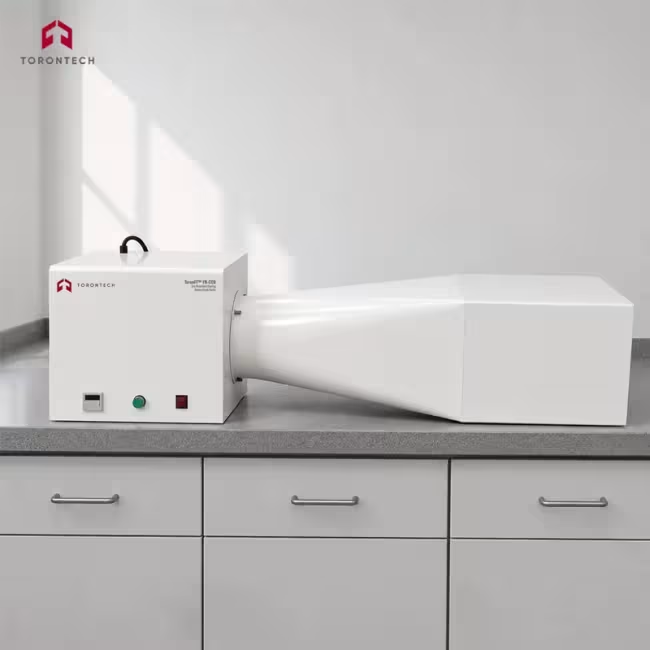
Fire Retardant Coating Drying Crack Tester
Fire Retardant Coating Drying Crack Tester – ToronFT™ FR-CCD
ToronFT™ FR-CCD Fire Retardant Coating Drying Crack Tester is a specialized laboratory instrument designed to assess the resistance of fire retardant coatings and building putties to cracking during the initial drying phase under controlled wind speed conditions. Drying crack resistance is a critical quality parameter for fire retardant coatings applied to building structures — premature cracking during curing can compromise the coating's protective and fire-resistant performance in service.
The ToronFT™ FR-CCD simulates the environmental conditions of wind-induced drying on freshly applied coating specimens, enabling manufacturers and quality laboratories to evaluate and optimize their fire retardant coating formulations for resistance to initial drying crack formation. This instrument supports testing under both indoor and outdoor building coating application scenarios.
Fire Retardant Coating Drying Crack Tester – ToronFT™ FR-CCD Applications
The ToronFT™ FR-CCD is applicable for drying crack resistance evaluation in the following coating and construction material sectors:
- Initial drying crack resistance testing of fire retardant coatings for interior and exterior building applications
- Quality assessment of building putties and fillers for crack resistance during curing
- Evaluation of intumescent coating formulations for susceptibility to wind-induced drying cracks
- Research and development of new fire retardant coating systems with enhanced drying stability
- Compliance testing for construction surface coatings and fire protection coatings under simulated environmental drying conditions
- Batch quality control testing of fire retardant coating production in manufacturing environments
Standards
The ToronFT™ FR-CCD is designed to comply with the following internationally applicable standards for coating crack resistance and weathering performance:
- ISO 1517: Paints and varnishes: Surface-drying test — Ballotini method
- ASTM D2354: Standard Test Method for Minimum Film Formation Temperature (MFFT) of Emulsion Vehicles
- ASTM D661: Standard Test Method for Evaluating Degree of Cracking of Exterior Paints
- ISO 4628-4: Paints and varnishes: Evaluation of degradation of coatings — Designation of quantity and size of defects — Part 4: Assessment of degree of cracking
Fire Retardant Coating Drying Crack Tester – ToronFT™ FR-CCD Key Features
- Controlled wind speed environment — axial flow fan maintains airflow at 3 ± 0.3 M/S, accurately simulating real-world wind conditions during coating initial drying and curing
- 600 mm square wind tunnel provides a long, uniform airflow path to ensure consistent wind velocity distribution across the full test area
- Generous test area of 400 mm (length) x 300 mm (width, square), accommodating multiple specimens simultaneously for batch drying crack resistance testing
- Hot bulb anemometer for precise airflow velocity measurement, ensuring test conditions remain within specified tolerances throughout the test
- Standard sample base dimensions of 300 mm x 150 mm x 6 mm, with two sample bases supplied as standard for back-to-back testing efficiency
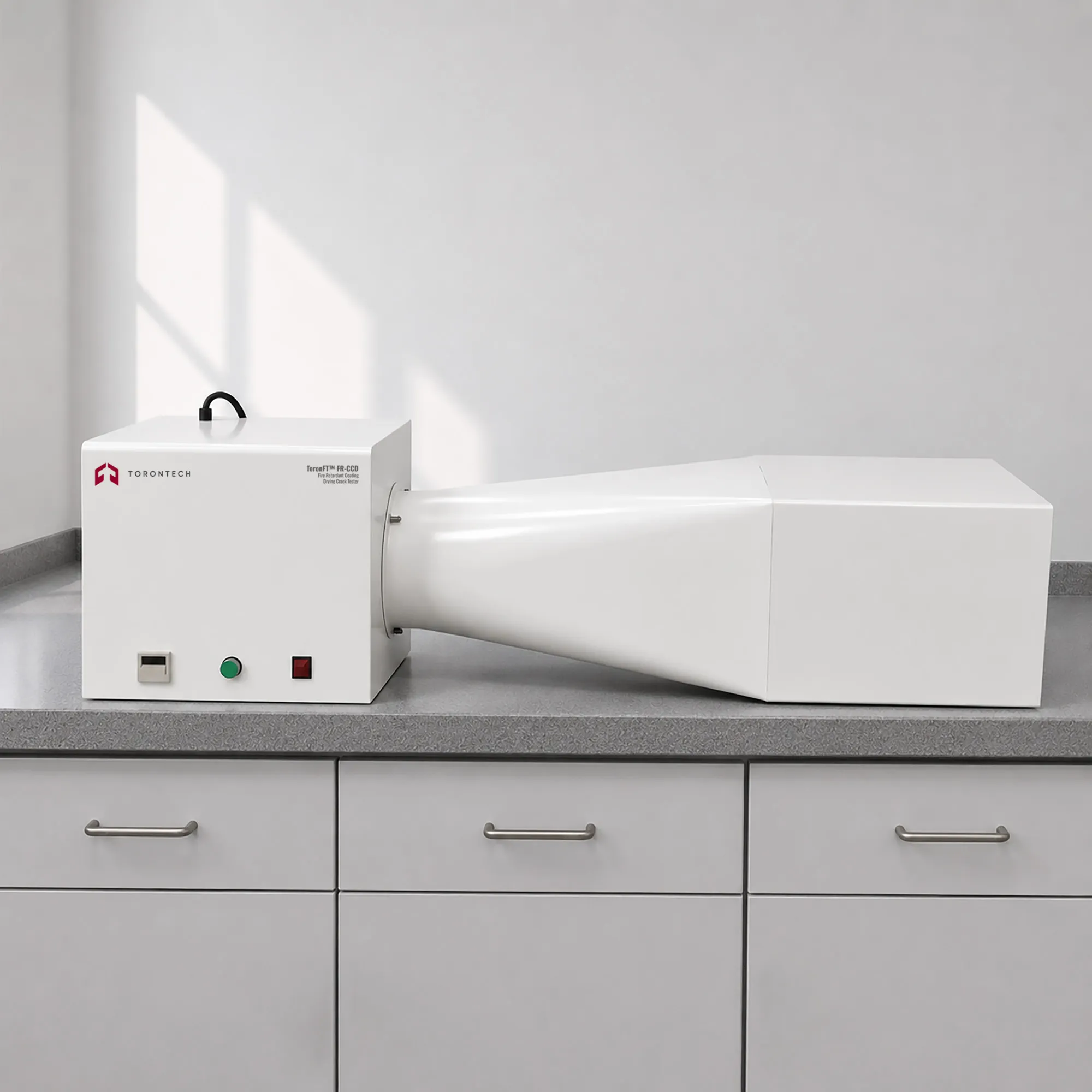
- Compact, three-component instrument assembly: axial fan unit, wind tunnel, and test stand — easy to set up and operate in laboratory environments
- Suitable for evaluating both indoor and outdoor fire retardant coating formulations and building putties under identical, reproducible wind-drying conditions
Theory and Method
The initial drying crack resistance test evaluates a coating's ability to withstand the stresses induced during early drying — when the coating film is transitioning from its wet, applied state to a hardened, cured state. Wind flow applied over the surface accelerates moisture evaporation, creating differential drying stresses that can lead to crack formation in coatings with inadequate cohesive strength or flexibility.
In the ToronFT™ FR-CCD, freshly applied fire retardant coating specimens are placed on the sample base within the test area of the wind tunnel. The axial flow fan generates a controlled, steady-state airflow directed uniformly over the specimen surfaces. The wind speed is regulated to 3 ± 0.3 M/S, replicating typical low-to-moderate wind conditions encountered during coating application and early curing on building surfaces. After the specified drying period, specimens are examined for the presence, size, and pattern of drying cracks in accordance with the applicable evaluation standard.
Fire Retardant Coating Drying Crack Tester – ToronFT™ FR-CCD Technical Specifications
| Parameter | Specification |
|---|---|
| Model | ToronFT™ FR-CCD |
| Product Name | Fire Retardant Coating Initial Drying Crack Resistance Tester — ToronFT™ FR-CID |
| Instrument Composition | Axial flow fan, wind tunnel, test stand |
| Fan Type | Axial flow fan |
| Wind Speed | 3 ± 0.3 M/S |
| Wind Tunnel Dimensions | 600 mm long, square cross-section |
| Test Area | 400 mm (length) × 300 mm (width, square) |
| Airflow Measurement | Hot bulb anemometer |
| Sample Base Material Dimensions | 300 mm × 150 mm × 6 mm |
| Sample Bases Supplied | 2 pieces |