

Fire Extinguisher Impact Tester — ToronFT™ FE-IT
ToronFT™ FE-IT is a standardized drop-weight impact tester designed for conducting mechanical impact tests on portable fire extinguishers of different capacities. This system evaluates the structural integrity of the extinguisher head — the valve assembly and handle area — under defined impact loads applied by a free-falling steel hammer from a controlled height, simulating the physical shock that a fire extinguisher may experience during a drop, fall, or handling impact event.
The apparatus supports two distinct impact test configurations as defined in applicable test standards: an upright impact test where the extinguisher stands vertically and the hammer falls axially onto the head, and a horizontal impact test where the extinguisher lies on its side with the head supported on a block and the hammer falls to impact the head from above. Both configurations use the same 75 mm diameter, 4 kg ± 0.1 kg steel hammer dropped from a defined height between 0.3 m and 1.0 m — adjustable via a limit switch-based height positioning system with a rising speed of 500 mm/min. These controlled parameters ensure repeatable, traceable impact test results across different extinguisher models and test sessions.
Fire Extinguisher Impact Tester — ToronFT™ FE-IT Applications
The ToronFT™ FE-IT serves fire extinguisher manufacturers, certification testing laboratories, and regulatory compliance facilities conducting mechanical impact qualification testing:
- Extinguisher Head Impact Testing — Upright Configuration: evaluating valve assembly and handle structural integrity under axial drop impact loads in the upright orientation
- Extinguisher Head Impact Testing — Horizontal Configuration: evaluating head structural integrity under lateral impact loads with the cylinder horizontal, simulating side-fall impact events
- Product Certification Testing: conducting the standardized impact tests required for portable fire extinguisher certification and listing submissions
- Design Validation: verifying that new valve designs, handle configurations, and head assemblies meet impact resistance requirements before production release
- Manufacturing QC: periodic impact testing of production samples to confirm consistent structural performance across manufactured batches
- Failure Mode Analysis: controlled impact testing to characterize failure modes and threshold loads for head assembly design improvement programs
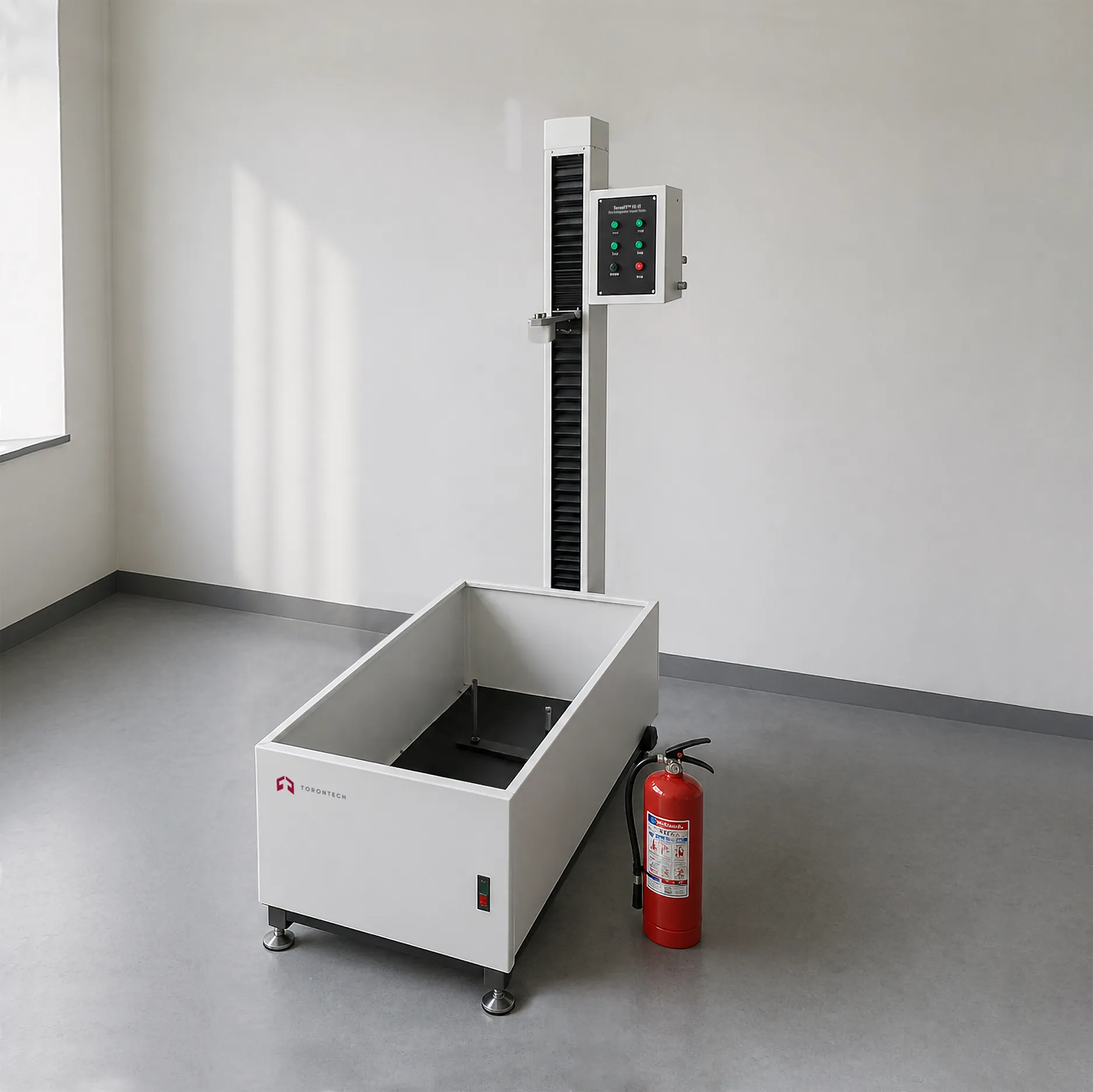
Fire Extinguisher Impact Tester — ToronFT™ FE-IT Key Features
Impact Test Configurations
- Two standardized test configurations: upright (axial hammer impact on head) and horizontal (transverse hammer impact on head supported on block)
- Both configurations use the same hammer and height adjustment system without structural reconfiguration
Steel Hammer Specifications
- Hammer diameter: 75 mm
- Hammer mass: 4 kg ± 0.1 kg
- Consistent mass tolerance for traceable impact energy calculation across test runs
Height Adjustment and Positioning
- Impact height range: 0.3–1.0 m above extinguisher head, continuously adjustable
- Motorized hammer raising system: 500 mm/min rising speed
- Limit switch-based height positioning for repeatable, documented drop height setting between test runs
Theory and Method
Upright Impact Test Configuration
In the upright impact test, the fire extinguisher is positioned vertically so that the central axis of the extinguisher cylinder is coaxial with the axis of the falling steel hammer. The hammer is raised to the defined test height and released in free fall, impacting the top of the extinguisher head along the cylinder axis. This configuration simulates a vertical drop event where the extinguisher falls head-first onto a hard surface, applying a concentrated axial impact load to the valve assembly, handle, and head connection — the area most vulnerable to functional damage in a real drop event.
Horizontal Impact Test Configuration
In the horizontal impact test, the extinguisher is placed on its side with the head area supported on a block so that the extinguisher head is positioned below the path of the falling hammer. The hammer is centered over the head of the device and released in free fall, impacting the head from directly above. This configuration simulates a side-fall or roll impact where the cylinder is horizontal and the head strikes a surface or is struck by a falling object, applying a transverse load to the valve and handle assembly.
Impact Height and Energy Control
The steel hammer — 75 mm diameter, 4 kg ± 0.1 kg — is raised to the defined test height using a motorized system with a rising speed of 500 mm/min. Impact height is adjustable between 0.3 m and 1.0 m above the top of the extinguisher head, with positioning controlled by a limit switch system that ensures repeatable height setting between test runs. The potential energy at release — determined by hammer mass and drop height — defines the impact energy applied to the extinguisher head. At the maximum 1.0 m drop height, the 4 kg hammer delivers approximately 39.2 J of impact energy, within the range specified in applicable test standards.
Fire Extinguisher Impact Tester — ToronFT™ FE-IT Technical Specifications
| Parameter | Specification |
|---|---|
| Test Configurations | Upright (axial) and horizontal (transverse) |
| Steel Hammer Diameter (mm) | 75 |
| Steel Hammer Mass (kg) | 4 ± 0.1 |
| Impact Height Range (m) | 0.3 – 1.0 (adjustable) |
| Height Positioning Method | Limit switch |
| Hammer Rising Speed (mm/min) | 500 |
| Applicable Extinguisher Capacities | Various (portable fire extinguishers) |
| Impact Energy at 1.0 m Drop (approx.) | 39.2 J |