
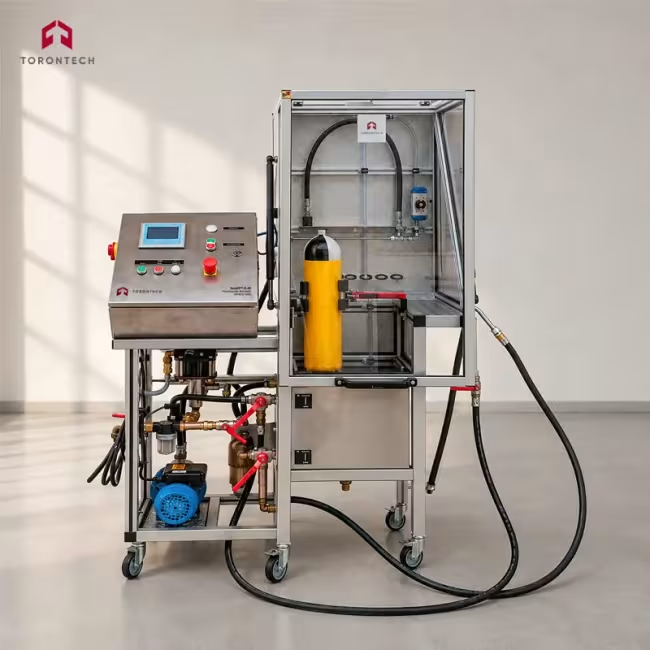
Fire Extinguisher Hydrostatic and Burst Tester
Fire Extinguisher Hydrostatic and Burst Tester - ToronFT™ FE-HS
ToronFT™ FE-HS is a fire extinguisher hydrostatic test machine that qualifies portable extinguisher cylinders for hydraulic strength, burst resistance, and volumetric expansion. An air-driven fluid pump raises water pressure inside the cylinder to any setpoint up to 14,000 psi, and the control system holds and records it. The cylinder sits inside a guarded test enclosure, so a shell can be taken to destruction without exposing the operator. Manufacturers, requalification shops, and approval laboratories use it as a single station for shell pressure work.
Testing covers water-based, dry powder, carbon dioxide, and clean agent extinguishers. Clamping, filling, pressurization, and draining run as one short cycle, and a single button starts the test once the setpoint is confirmed. Water returns to the 180-liter collection tank either by pump or by rotating the vessel, which keeps consumption low across a production shift. Measurement data writes to a file at the end of each run, and a data interface passes results to a laboratory system or a test certificate.
A pneumatic drive keeps electrical and hydraulic power out of the pressurized circuit, leaving the high-pressure side passive whenever the air supply is isolated. Air and water filtration protects both the pump and the cylinder under test against particulate carryover. Pressure range identification confirms the selected setpoint sits within what the fitted adapter can hold before the cycle begins. High-grade steel on the control panel and collection tank stands up to contact with test water and cleaning agents.
Fire Extinguisher Hydrostatic and Burst Tester - ToronFT™ FE-HS Applications
- Fire extinguisher manufacturing: Qualifies extinguisher shells against the design proof pressure during type testing and pulls production samples to burst so wall thickness and weld quality can be traced back to a coil lot or a forming setup.
- Cylinder requalification and service shops: Runs the periodic hydrostatic retest that in-service extinguishers require before recharge, recording hold pressure and expansion behavior for each cylinder passing through the shop.
- Third-party test and certification laboratories: Supports type approval programs where the shell must be pressurized past proof level to a recorded burst point, with the fracture examined for ductile failure and absence of fragmentation.
- Carbon dioxide and clean agent cylinder production: Handles the higher working pressures of gaseous agent cylinders, where proof and burst pressures sit well above those of stored-pressure water and powder units.
- Compressed gas cylinder and small pressure vessel manufacturing: Pressure tests metal vessels of comparable size and neck thread, including seamless and welded bodies checked for leakage and permanent deformation.
- Regulatory and market surveillance laboratories: Provides an auditable pressure record when extinguishers pulled from the field or from distribution are checked against the manufacturer's declared shell rating.
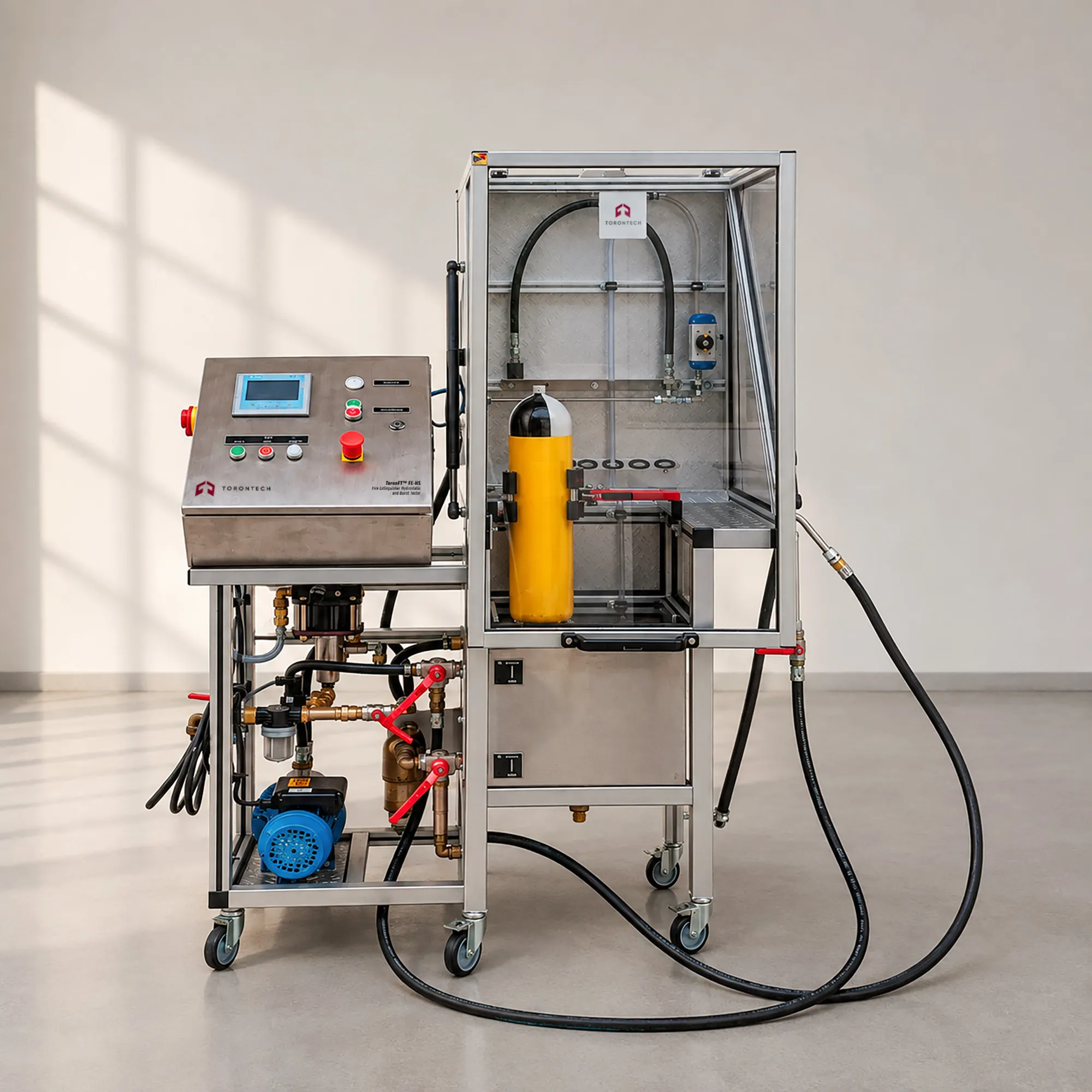
Fire Extinguisher Hydrostatic and Burst Tester - ToronFT™ FE-HS Key Features
- Air-driven intensifier pump reaches 14,000 psi with no hydraulic power pack and no electrical energy in the pressurized circuit, so the high-pressure side goes passive the moment air is isolated.
- Guarded test enclosure contains the cylinder during burst runs, allowing shells to be taken to destruction as a routine production or laboratory operation.
- Confirmation prompt above 60 bar requires the operator to acknowledge the target before the pump builds pressure, which catches setpoint entry errors before they reach the cylinder.
- Single-button cycle start sequences clamping, filling, pressurization, and emptying, and indicator lights report test status at a glance from across the bay.
- Water recovery to the 180-liter tank by return pump or by rotating the vessel cuts both fresh water draw and drain load between cycles.
- Ten tapered test adapters, five small and five large, with a quick-connect high-pressure hose cover the common extinguisher neck threads without changing hardware.
- Air and water filtration on both supply lines keeps particulate out of the intensifier and out of the cylinder under test.
- Pressure range identification checks the setpoint against the fitted adapter before the cycle starts, so a low-rated fitting is not taken to a high-pressure target.
- File export through the data interface moves pressure records straight into a laboratory system or a certificate, with no manual transcription step.
- IP54 enclosure rating and oil and acid resistant wetted parts suit a wet test bay where cylinders are washed and drained between runs.
Theory and Method
Hydrostatic testing uses water rather than gas because water is nearly incompressible and stores little energy at pressure. A cylinder that fails under water splits and leaks instead of releasing a blast. That difference makes destructive shell testing practical inside a laboratory. The cylinder is filled completely and purged of air. A tapered adapter threads into the neck and connects to the high-pressure hose through a quick-connect fitting.
Compressed air then drives the fluid pump. Air acting on a large-area drive piston is converted by a small-area plunger into water pressure at the ratio of the two areas. Shop air below 10 bar therefore produces test pressures reaching 14,000 psi. The pump stalls once the setpoint is reached and holds it against minor leakage. Indicator lights and the panel display report status through the cycle.
Three test types run on the same fixture. A proof or hydraulic strength test holds the cylinder at a defined multiple of its service pressure for a set dwell, and the shell passes with no leakage and no visible permanent deformation. A burst test continues past proof level until the shell fails. The pressure-versus-time trace gives the burst value, and the fracture is examined for ductility, break location, and fragmentation.
A volumetric expansion test compares total expansion measured while the cylinder is at pressure against the expansion remaining after release. The permanent portion, expressed as a percentage of total expansion, is the metric used to retire fatigued cylinders. Results export to file at the end of each cycle. The operator does not transcribe readings off a gauge, which removes a common source of certificate error.
Fire Extinguisher Hydrostatic and Burst Tester - ToronFT™ FE-HS Technical Specifications
| Specification | ToronFT™ FE-HS |
|---|---|
| Maximum test pressure | 14,000 psi (965 bar) |
| Test pump type | Compressed air driven fluid pump |
| Test pump maximum pressure | 14,000 psi (965 bar) |
| Compressed air supply required | Below 10 bar (145 psi), 300 L/min (10.6 scfm) |
| Air pressure regulator, adjustable | 0 to 4 bar (0 to 58 psi) |
| Safety valve setting | 4.3 bar (62 psi) |
| Operator confirmation threshold | 60 bar (870 psi) |
| Water pump | 230 V, 50 Hz, 0.54 kW, 2,800 rpm |
| Water pump flow rate | 45 L/min (11.9 gpm) |
| Collection tank capacity | 180 L (47.6 gal) |
| Test adapters supplied | 5 small tapered fittings, 5 large tapered fittings |
| High-pressure hose | Quick-connect, supplied with adapter set |
| Power cable | 5 m (16.4 ft), H07RN-F 3G 1.5 mm² |
| Control panel material | High-grade steel |
| Test stand material | Aluminum |
| Collection tank material | High-grade steel |
| Wetted material resistance | Oil and acid resistant |
| Ingress protection rating | IP54 |
| Data output | File export via data interface |