
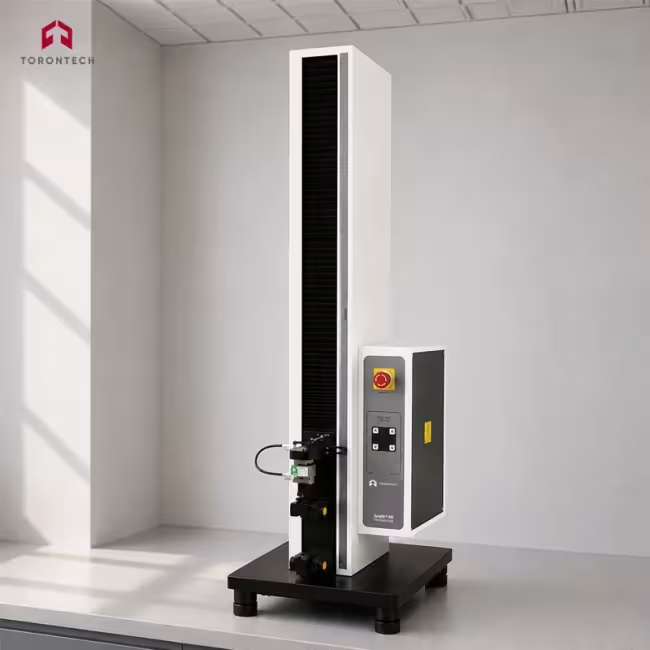
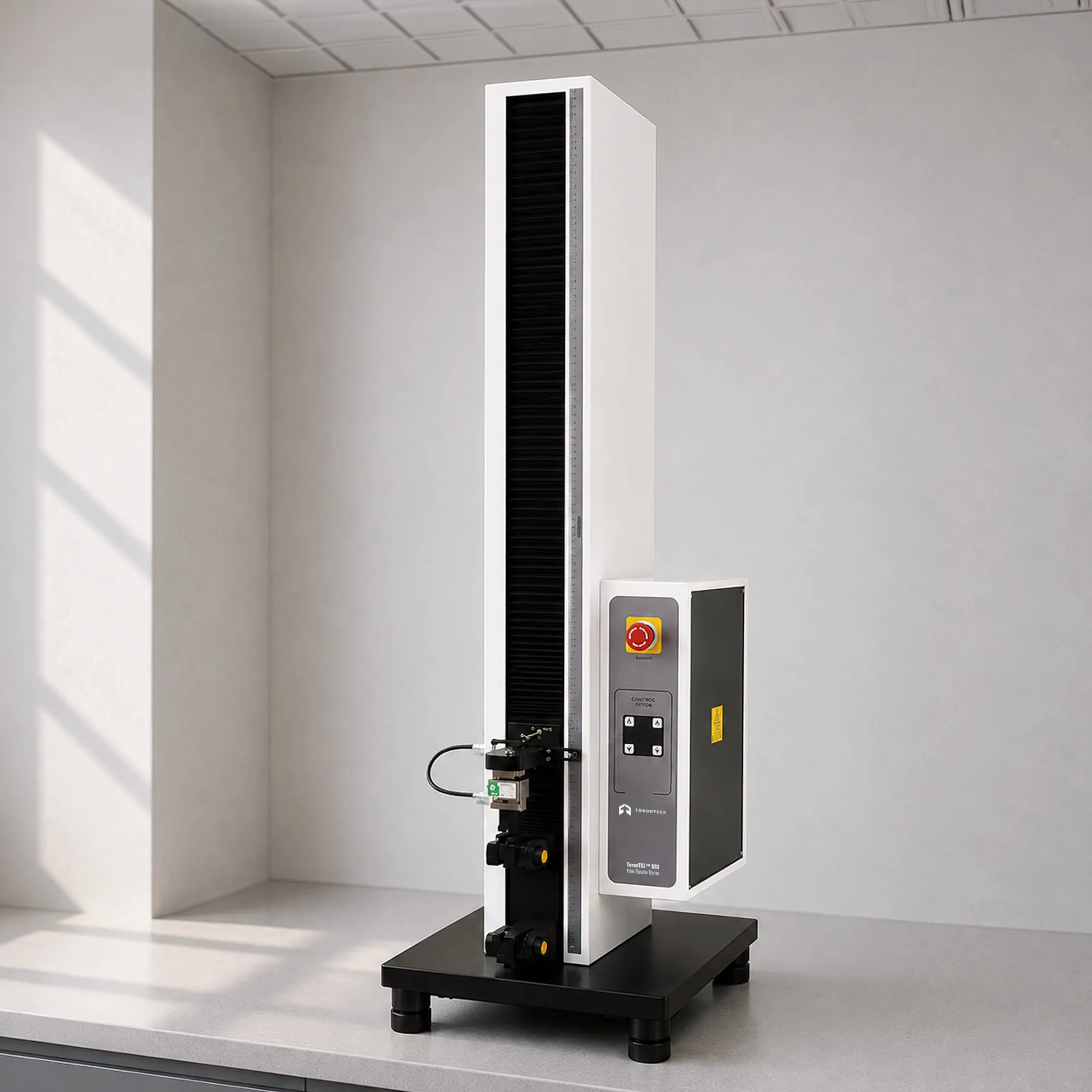
Film Tensile Tester
Film Tensile Tester - ToronTSL™ 882
Universal Tensile Tester for Films & Flexible Packaging
ToronTSL™ 882 is a film tensile tester that measures the tensile strength, elongation, and modulus of plastic films, sheets, laminates, foils, paper, nonwovens, and rubber. Beyond tension, it runs peel, seal-strength, and tear tests, so one instrument covers the mechanical and bond properties of flexible packaging. A servo drive, precision ball screw, and high-accuracy load cell give smooth motion and accurate force measurement.
Interchangeable load cells across a 50N to 1000N range and 960 mm of travel let the ToronTSL™ 882 handle weak films through stronger laminates and papers. Test, return, and jog speeds set freely in software over 0.1 to 1000 mm/min, with load accuracy to 0.03% of full scale. Bidirectional testing supports both tension and compression.
The bilingual workstation software runs ISO and ASTM methods and user-defined tests, overlays multiple curves, and calculates statistics automatically. Five-level user management and a traceable system log support data integrity. The ToronTSL™ 882 (Universal Tensile Tester for Films and Flexible Packaging) suits packaging, food, pharmaceutical, and materials labs for tensile, peel, and seal testing.
Film Tensile Tester - ToronTSL™ 882 Applications
The ToronTSL™ 882 measures tensile, peel, seal, and tear properties across films, packaging, and related materials.
- Plastic Films and Sheets: measures tensile strength and elongation of mono and multilayer films and sheets.
- Laminates and Flexible Packaging: tests ply-bond and peel strength of laminated and extrusion-coated packaging.
- Heat Seals and Pouches: measures seal strength of heat-sealed films and finished pouches.
- Pressure-Sensitive Tapes and Labels: runs peel-adhesion tests on tapes, labels, and release liners.
- Paper and Paperboard: measures tensile properties of paper, board, and release paper.
- Nonwovens and Medical Patches: tests tensile and peel behavior of nonwovens and medical patches.
- Rubber and Elastomers: measures tensile stress-strain properties of rubber and elastomer specimens.
- Foils and Metallized Films: tests tensile and bond strength of foils and metallized structures.
Standards
The ToronTSL™ 882 is designed to align with internationally recognized standards for tensile, peel, and seal-strength testing of films and flexible materials.
- ASTM D882 - Standard Test Method for Tensile Properties of Thin Plastic Sheeting
- ASTM D828 - Standard Test Method for Tensile Properties of Paper and Paperboard Using Constant-Rate-of-Elongation Apparatus
- ASTM E4 - Standard Practices for Force Verification of Testing Machines
- ASTM D1938 - Standard Test Method for Tear-Propagation Resistance (Trouser Tear) of Plastic Film and Thin Sheeting
- ASTM D3330 - Standard Test Method for Peel Adhesion of Pressure-Sensitive Tape
- ASTM F88 - Standard Test Method for Seal Strength of Flexible Barrier Materials
- ASTM F904 - Standard Test Method for Comparison of Bond Strength or Ply Adhesion of Similar Laminates Made from Flexible Materials
- ISO 37 - Rubber, Vulcanized or Thermoplastic: Determination of Tensile Stress-Strain Properties
- JIS P8113 - Paper and Board: Determination of Tensile Properties
Film Tensile Tester - ToronTSL™ 882 Key Features
The ToronTSL™ 882 pairs a servo-driven load frame with multi-mode software for tensile, peel, and seal testing.
- Multiple Test Modes: measures tensile strength, elongation, elastic modulus, peel strength, seal strength, and tear on one platform.
- Peel and Seal Strength: runs T-peel, 90° peel, 180° peel, and heat-seal strength tests for laminates and packaging seals.
- Bidirectional Testing: tests in both tension and compression directions with a high-accuracy load cell.
- Servo Drive and Ball Screw: a servo motor and precision ball screw give smooth, accurate crosshead motion and speed control.
- Selectable Load Cells: interchangeable load cells across a 50N to 1000N range suit weak films alongside stronger laminates and papers.
- Wide Speed Range: test, return, and jog speeds set freely in software over 0.1 to 1000 mm/min.
- High Load Accuracy: load measurement to 0.03% of full scale and 0.01 mm displacement accuracy support precise results.
- Long Travel: 960 mm of effective travel handles high-elongation films and long peel runs.
- Group Testing and Statistics: runs sample groups, overlays multiple curves, and calculates statistics automatically.
- Standard and Non-Standard Methods: runs ISO and ASTM methods as well as user-defined non-standard tests.
- Quiet Operation: the drive runs quietly, under 25 dB, for a better lab environment.
- Five-Level User Management: role-based access and a system log support data integrity and traceability.
- Overload Protection and Electronic Limits: protection and software-set travel limits guard the instrument and specimen.
- Test Workstation Software: bilingual workstation software handles method setup, acquisition, curves, and reporting.
- Laboratory Data Management Integration: optional lab data management software centralizes test records.
Theory and Method
A tensile test measures how a material responds to a pulling force. The instrument grips a specimen at both ends and moves one grip away at a controlled speed, while a load cell records the force and an encoder tracks the displacement. The result is a force-versus-elongation curve that describes the material's mechanical behavior.
The software derives tensile strength (the peak force divided by the cross-section), elongation at break (how far the specimen stretched), and elastic modulus (the slope of the initial linear region) from that curve. A servo drive and ball screw hold the test speed steady, which matters because film and packaging properties depend on the rate of loading.
The same load frame runs peel and seal tests by pulling a bonded or sealed joint apart at a set angle, such as T-peel, 90°, or 180°, and recording the force needed to separate it. Seal strength, ply-bond strength, and peel adhesion all come from this measurement. Interchangeable load cells and grips let one instrument cover weak films alongside stronger laminates, papers, and rubbers.
Film Tensile Tester - ToronTSL™ 882 Technical Specifications
| Parameter | Specification |
|---|---|
| Load Capacity | 500 N (standard); 50, 100, 250, 750, 1000 N (optional) |
| Load Accuracy | 0.03% of full scale (max) |
| Maximum Effective Travel | 960 mm |
| Displacement Accuracy | 0.01 mm |
| Test Speed | 0.1 to 1000 mm/min |
| Return Speed | 0.1 to 1000 mm/min |
| Jog Speed | 0.1 to 1000 mm/min |
| Sample Width | 38 mm (standard) |
| Sample Thickness | 2 mm (standard) |
| Voltage | AC 220 V, 50 Hz (110V is also available) |
| Power Consumption | 320 W (max) |
| Dimensions | 380 mm (L) × 450 mm (W) × 1309 mm (H) |
| Net Weight | 92 kg |
Standard Delivery
| Item | Description |
|---|---|
| Main Unit | Single-column tensile test frame with servo drive |
| Computer | Dedicated control PC |
| Load Cell | Force sensor for tensile and peel measurement |
| Control Software | Test workstation software for method setup, acquisition, and reporting |
| Grips | Standard tensile grips |
| PCIe Acquisition Card | Data acquisition interface for the control PC |
| Communication Cable | Connects the instrument to the control PC |
Optional Accessories
| Item | Description |
|---|---|
| Sampling Plates | Cutting plates for strip widths of 10, 15, 20, 25, and 25.4 mm |
| Test Plate | Fixture plate for specific test setups |
| Roller | Roller fixture for peel testing |
| Pneumatic Grips | Air-actuated grips for faster specimen loading |
| Calibration Assemblies | Reference assemblies for force and displacement calibration |
| Laboratory Data Management System | Centralized data management and reporting software |