
Elmendorf Tear Tester
Elmendorf Tear Tester - ToronETT™ 6383
Digital Tear Resistance Tester for Film, Paper and Nonwovens
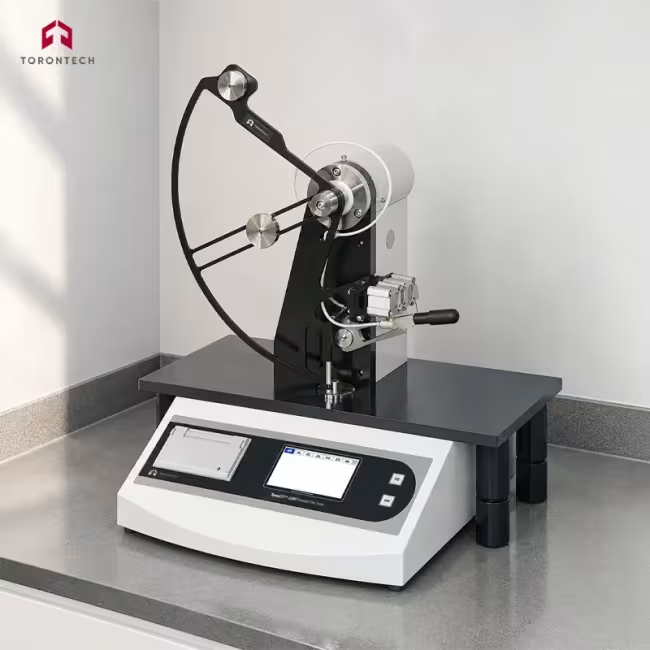
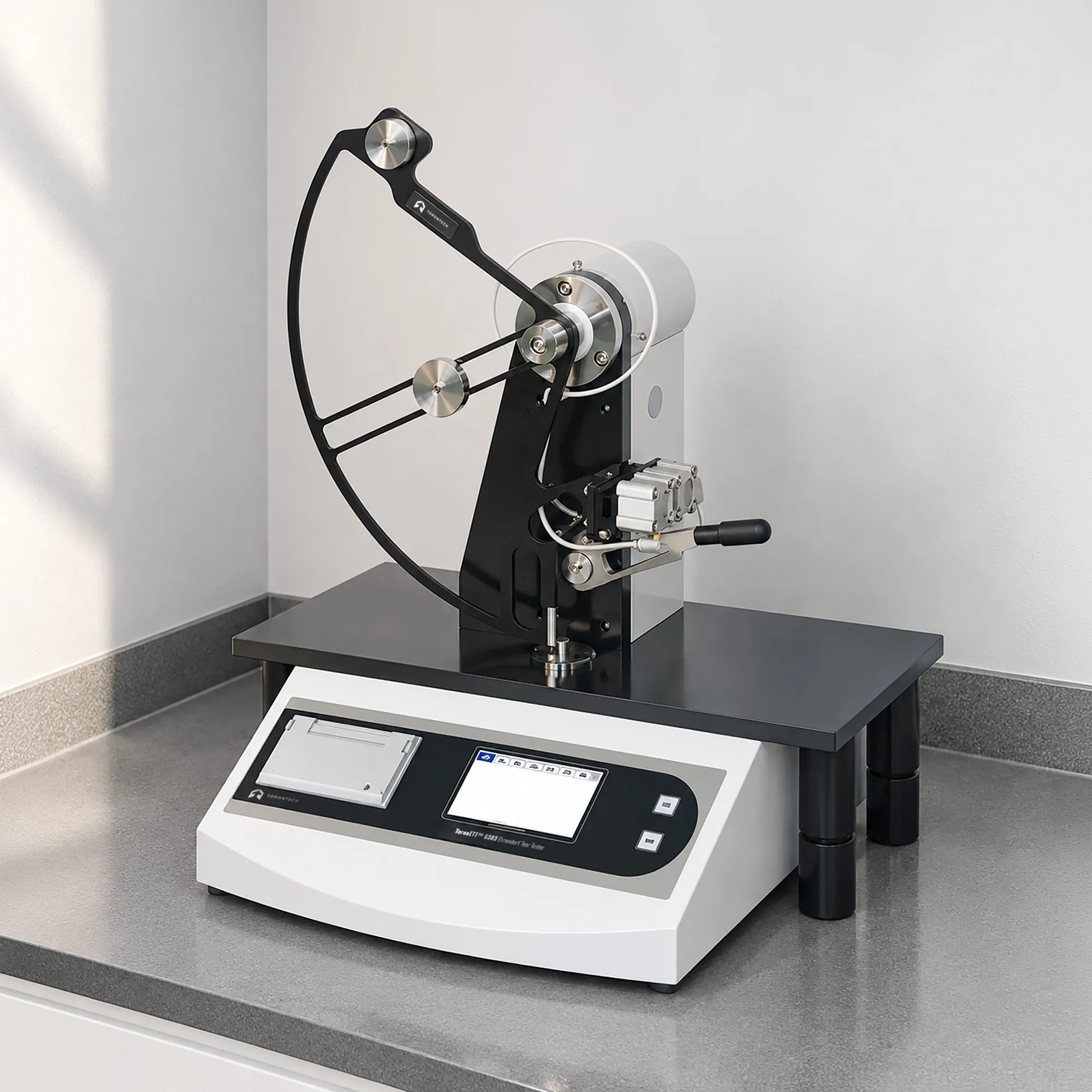
The ToronETT™ 6383 is an Elmendorf tear tester that measures the tearing resistance of plastic films, paper, board, textiles, and nonwovens by the falling-pendulum method. A weighted pendulum swings down and tears a pre-slit specimen, and the energy the pendulum loses gives the average tearing force. Interchangeable pendulum capacities suit light films through tough board and fabrics.
The ToronETT™ 6383 covers pendulum capacities of 200 gf through 6400 gf, so one instrument spans a wide range of materials. Pneumatic clamping holds the specimen squarely for consistent tears, and a touchscreen sets the test and shows results. Built-in statistics and historical data query handle results at the bench.
The ToronETT™ 6383 (Digital Tear Resistance Tester for Film, Paper, and Nonwovens) suits packaging, film, paper, and textile labs. Built around the Elmendorf method of ISO 6383-2 and ASTM D1922, it gives standards-based tear data. The embedded system supports remote maintenance and upgrades.
Elmendorf Tear Tester - ToronETT™ 6383 Applications
The ToronETT™ 6383 measures tear resistance across films, papers, and fabrics where resistance to tearing matters.
- Plastic Films and Sheets: measures the tear resistance of films and thin sheeting for packaging and converting.
- Paper and Paperboard: measures the internal tearing resistance of papers and board.
- Nonwovens and Textiles: measures the tearing strength of nonwovens, woven fabrics, and textiles.
- Flexible Packaging Laminates: checks the tear resistance of laminated and coated packaging films.
- Waterproofing Membranes: measures the tear resistance of waterproof films and membranes.
- Film and Material Development: quantifies tear resistance during product development.
- Quality Control: verifies tear performance against specification batch to batch.
- Notch and Defect Sensitivity: assesses how a material resists tearing once a nick has formed.
Standards
The ToronETT™ 6383 is designed to align with internationally recognized standards for tearing resistance by the Elmendorf falling-pendulum method.
- ISO 6383-2 - Plastics: Film and Sheeting: Determination of Tear Resistance: Part 2: Elmendorf Method
- ISO 1974 - Paper: Determination of Tearing Resistance: Elmendorf Method
- ASTM D1922 - Standard Test Method for Propagation Tear Resistance of Plastic Film and Thin Sheeting by Pendulum Method
- ASTM D1424 - Standard Test Method for Tearing Strength of Fabrics by Falling-Pendulum (Elmendorf-Type) Apparatus
- ASTM D689 - Standard Test Method for Internal Tearing Resistance of Paper
- TAPPI T414 - Internal Tearing Resistance of Paper (Elmendorf-Type Method)
Elmendorf Tear Tester - ToronETT™ 6383 Key Features
The ToronETT™ 6383 pairs a multi-capacity pendulum with pneumatic clamping and touchscreen control.
- Elmendorf Pendulum Method: measures average tearing force from the energy a swinging pendulum loses as it tears the specimen.
- Interchangeable Pendulum Capacities: 200 gf through 6400 gf covers light films to tough board and fabrics.
- Pneumatic Clamping: pneumatic clamping and release hold the specimen squarely for consistent tears.
- Touchscreen Operation: a color TFT touchscreen sets the test and shows results.
- Built-In Statistics: onboard statistics summarize results across a set of specimens.
- Historical Data Query: stored results can be recalled at the bench.
- Wide Material Range: tests films, sheets, paper, board, waterproof films, textiles, and nonwovens.
- Remote Maintenance: the embedded system supports remote maintenance and firmware upgrades.
- Optional Sample Cutter: an optional cutter prepares specimens to the required size.
- Optional Analysis Software: optional computer software adds data storage and reporting.
Theory and Method
The Elmendorf method measures the force needed to propagate a tear that has already been started in a specimen. A specimen is clamped on both sides of a slot, and a small starting cut is made. A weighted pendulum, raised to a fixed height, is released and swings down, tearing the specimen the rest of the way as it passes.
The pendulum loses energy as it tears the material, so it does not swing as high on the far side. That loss in height is proportional to the work done in tearing, and the instrument converts it into the average tearing force. A pointer or sensor reads the result directly in grams-force or millinewtons.
The pendulum capacity is matched to the material, since the specimen should absorb a suitable share of the pendulum's energy for an accurate reading. Interchangeable pendulum weights cover light films through tough paperboard and fabrics. Tearing resistance shows how well a film or sheet resists tear propagation once a nick or notch has formed.
Elmendorf Tear Tester - ToronETT™ 6383 Technical Specifications
| Parameter | Specification |
|---|---|
| Pendulum Capacities | 200, 400, 800, 1600, 3200, 6400 gf (optional capacities) |
| Gas Supply Pressure | 0.6 MPa |
| Interface | Ø4 mm fast plug |
| Dimensions | 478 mm (L) × 385 mm (W) × 570 mm (H) |
| Voltage | AC 220 V, 50 Hz (110V is also available) |
| Net Weight | 40 kg |
Standard Delivery
| Item | Description |
|---|---|
| Main Unit | Elmendorf falling-pendulum tear test instrument with touchscreen |
| Basic Pendulum (200 gf) | Standard pendulum |
| Extra Weight (400 gf) | Add-on weight to increase pendulum capacity |
| Calibration Weight (400 gf) | Reference weight for calibration |
Optional Accessories
| Item | Description |
|---|---|
| Basic Pendulums (200, 1600 gf) | Additional base pendulums |
| Extra Weights (400, 800, 3200, 6400 gf) | Add-on weights for higher capacities |
| Calibration Weights (200 to 6400 gf) | Reference weights for calibration across capacities |
| Sample Cutter | Prepares specimens to the required size |
| Control Software | Computer software for data storage and reporting |
| Communication Cable | Connects the instrument to a PC |