
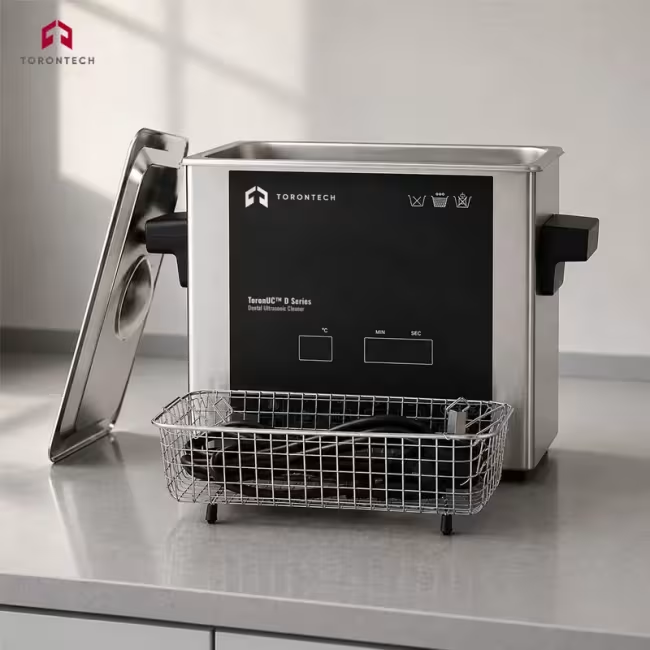
Dental Ultrasonic Cleaner – ToronUC™ D Series
Ultrasonic Retainer/Denture Cleaner
ToronUC™ D Series Dental Ultrasonic Cleaner is a professional-grade digital ultrasonic cleaning system purpose-built for dental offices, dental laboratories, medical device reprocessing, and precision cleaning applications demanding reliable instrument decontamination prior to sterilization. Available in seven tank capacities from 2 to 27 liters, the D Series scales seamlessly from single-operatory dental instrument cleaning through high-volume central sterilization department processing.
Each unit in the ToronUC™ D Series is equipped with a clear, user-friendly LED digital display panel showing real-time temperature and timer values, a power-off memory function that restores previous settings on restart, and a dedicated degas function that removes dissolved gases from the cleaning bath prior to each cycle — significantly improving cavitation uniformity and ultrasonic cleaning effectiveness on complex dental instruments with blind holes, threads, and hinged mechanisms.
The D Series operates at 40 kHz ultrasonic frequency with normal and soft power modes, enabling the operator to tailor cavitation intensity to the sensitivity of the items being cleaned. The heating system is adjustable from 0°C to 80°C, supporting enzymatic cleaning solutions used in pre-sterilization dental instrument processing. This makes the ToronUC™ D Series the leading dental ultrasonic cleaner choice for North American dental and medical instrument reprocessing environments.
40 kHz | 2–27 L | 500 W | 0–80°C | Degas |
Dental Ultrasonic Cleaner – ToronUC™ D Series Applications
The ToronUC™ D Series dental ultrasonic cleaner is optimized for the following professional and industrial cleaning applications:
- Dental Instrument Reprocessing: Serves as the primary dental ultrasonic cleaner for pre-sterilization decontamination of scalers, curettes, forceps, mirrors, probes, and other dental instruments. The degas function and 0–80°C heating support enzymatic solution protocols recommended by CDC and ADA instrument reprocessing guidelines.
- Medical Device Cleaning: Used for ultrasonic cleaning of reusable medical devices, surgical instruments, and endoscope accessories prior to high-level disinfection or sterilization. Effective on complex geometries, lumen channels, and articulated instruments that resist manual cleaning.
- Jewelry & Precious Metals: High-performance ultrasonic jewelry cleaner capability for professional jewelers, goldsmiths, and watch repair technicians cleaning intricate settings, chains, bangles, and movement components. Removes oils, polishing compounds, and residues without damage.
- Laboratory & Biochemistry: Cleans laboratory glassware, pipettes, analytical vessels, chemical reaction equipment, and biochemistry laboratory instruments, removing reagent residues and biological contamination with minimum manual effort.
- Tableware & Silverware: Restores the brilliance of fine silverware, cutlery, and tableware items in hospitality, catering, and institutional food service environments. Removes tarnish, food soils, and polishing residues safely and uniformly.
- Electronic Assemblies: Used as an industrial ultrasonic cleaner for flux removal, solder paste cleaning, and contamination removal from PCBs, wire harnesses, and precision electronic sub-assemblies using appropriate aqueous cleaning chemistry.
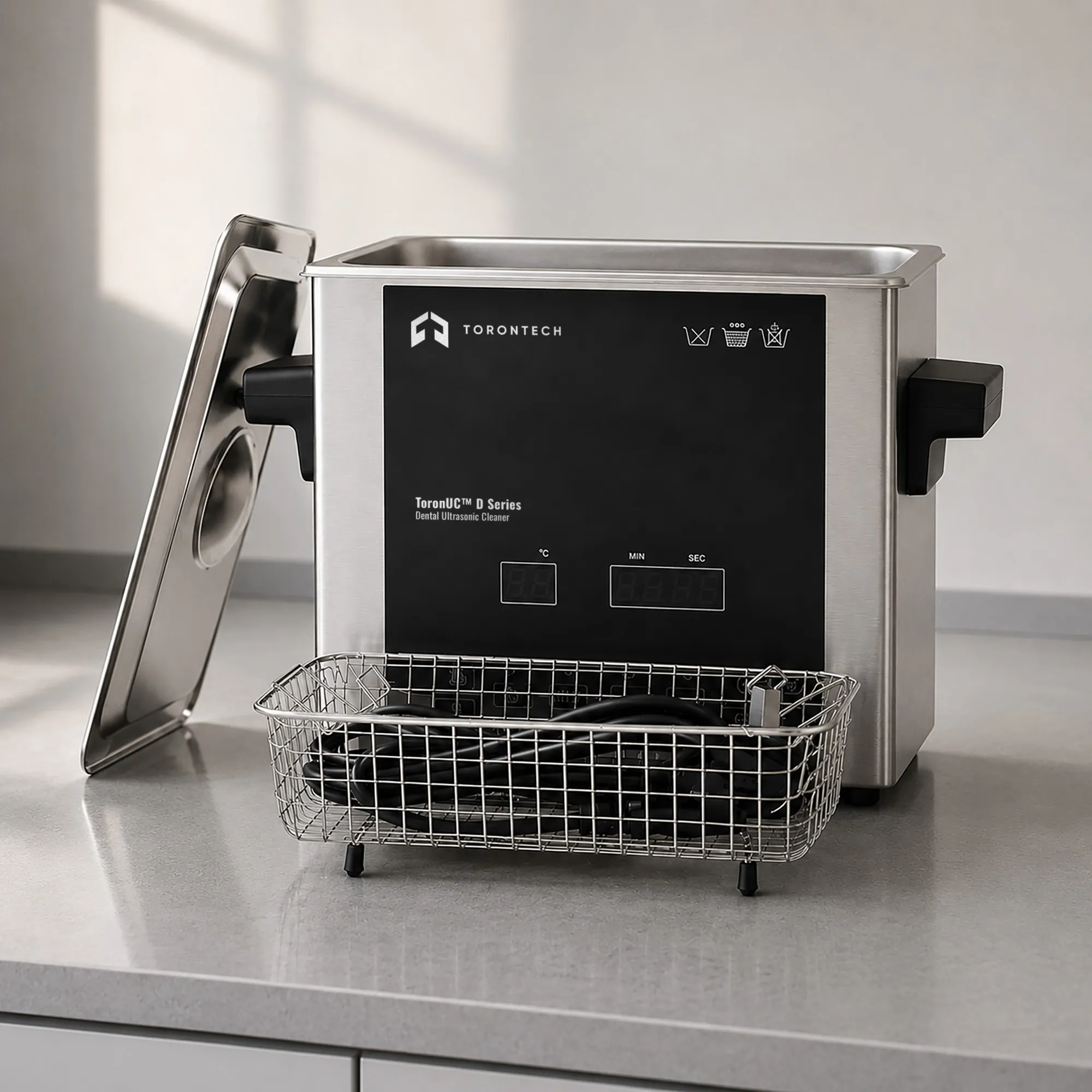
Dental Ultrasonic Cleaner – ToronUC™ D Series Key Features
- Normal & Soft Power Modes: Two ultrasonic power modes address the full range of cleaning requirements: Normal power for maximum cavitation intensity on heavily contaminated parts and instruments, and Soft power for gentle ultrasonic cleaning of delicate items or sensitive substrates, resolving cleaning blind spots.
- Degas Function: The dedicated degas mode purges dissolved gases from the cleaning solution before each cycle, maximizing cavitation bubble formation and ultrasonic cleaning efficiency. Essential for consistent performance when using freshly prepared cleaning chemistry.
- LED Digital Display: Clear LED display shows real-time temperature and timer values simultaneously, enabling continuous monitoring of cleaning conditions without interrupting the cycle.
- Power-Off Memory Function: The instrument automatically saves the last-used timer and temperature settings, restoring them on power-up. Eliminates repetitive reprogramming in high-throughput dental or laboratory environments.
- 0–80°C Temperature Range: The wide 0–80°C heating range supports the full spectrum of cleaning chemistries from cold-water ultrasonic cleaning through hot enzymatic and alkaline solutions, covering all dental and laboratory instrument reprocessing requirements.
- 1–99 Minute Timer: Fully adjustable digital timer from 1 to 99 minutes accommodates short decontamination cycles for lightly soiled instruments and extended ultrasonic cleaning programs for heavily contaminated batches.
- User-Friendly Panel Layout: The front panel is designed for intuitive single-operator use, with clearly labeled controls for heating, degas, timer, and ultrasonic power — minimizing training requirements in busy dental and medical reprocessing environments.
- Seven Capacity Options: Available from 2L to 27L, with models matched to every deployment from a single dental operatory through a central instrument reprocessing department or industrial parts cleaning station.
Theory & Ultrasonic Cleaning Method
Ultrasonic cleaning is based on the physical phenomenon of acoustic cavitation. When high-frequency sound waves typically 40 kHz are transmitted through a liquid cleaning solution, they generate millions of microscopic vacuum bubbles that form and violently implode at rates corresponding to the ultrasonic frequency. Each implosion releases an intense local jet of energy reaching temperatures of several thousand degrees Celsius and pressures exceeding 500 atmospheres — but only at a microscopic scale, ensuring the parts being cleaned are unaffected by thermal or mechanical shock.
This cavitation process is the core mechanism of all ultrasonic cleaning. The energy released by each collapsing bubble penetrates into surface pores, blind holes, threads, crevices, and complex geometries that brushes, sprays, and manual wiping methods simply cannot reach. Contaminants including oils, greases, flux residues, machining chips, polishing compounds, biological debris, fingerprints, and corrosion products are dislodged from the substrate surface and dispersed into the cleaning solution, leaving a thoroughly clean part surface in a fraction of the time required by conventional methods.
The heating function complements cavitation by reducing the viscosity of oily contaminants, improving the solubility of cleaning chemistry, and accelerating the overall cleaning reaction. The degas function (where available) purges dissolved gases from the cleaning solution during the initial warm-up phase, improving cavitation intensity and ensuring optimal ultrasonic cleaning performance from the first cycle.
The degas function is particularly important in dental instrument cleaning applications. Freshly prepared cleaning solutions contain significant dissolved gas that suppresses cavitation formation. Running the degas cycle before loading instruments purges these dissolved gases, ensuring immediate full-intensity ultrasonic cleaning from the first instrument load — a critical factor in clinical dental instrument reprocessing workflows.
Ultrasonic Cleaning Process Steps
1. Solution Preparation — Fill the tank with an appropriate water-based cleaning solution or solvent compatible with the parts being cleaned. Add recommended cleaning chemistry at the manufacturer-specified dilution ratio.
2. Pre-Heat (if required) — Activate the heating function and set the target temperature. Allow the bath to stabilize before loading parts to ensure consistent cavitation intensity.
3. Degas (if available) — Run the degas cycle to purge dissolved gases from the cleaning solution, maximizing cavitation efficiency and cleaning effectiveness from the first production run.
4. Load & Run — Submerge parts in the basket or cleaning cradle, ensuring all surfaces are exposed to the cleaning solution. Set the timer and activate the ultrasonic transducers.
5. Rinse & Dry — Remove parts and rinse with clean water to remove residual cleaning chemistry and loosened contaminants. Dry with compressed air or a clean cloth as appropriate.
Dental Ultrasonic Cleaner – ToronUC™ D Series Technical Specifications
| Model | Tank Size L×W×H (mm) | Unit Size L×W×H (mm) | Volume (L) | US Power (W) | Freq. (kHz) | Heating Power (W) | Timer (min) | Temp. (°C) |
|---|---|---|---|---|---|---|---|---|
| ToronUC™ 50D | 150×140×100 | 190×170×220 | 2 | 50 | 40 | 100 | 1–99 | 0–80 |
| ToronUC™ 100D | 240×140×100 | 270×170×240 | 3 | 100 | 40 | 100 | 1–99 | 0–80 |
| ToronUC™ 150D | 300×155×150 | 330×180×310 | 6 | 150 | 40 | 300 | 1–99 | 0–80 |
| ToronUC™ 200D | 300×240×150 | 330×270×310 | 9 | 200 | 40 | 300 | 1–99 | 0–80 |
| ToronUC™ 300D | 330×300×150 | 360×330×310 | 13 | 300 | 40 | 400 | 1–99 | 0–80 |
| ToronUC™ 400D | 500×300×150 | 550×330×310 | 20 | 400 | 40 | 500 | 1–99 | 0–80 |
| ToronUC™ 500D | 500×300×200 | 550×330×360 | 27 | 500 | 40 | 500 | 1–99 | 0–80 |