
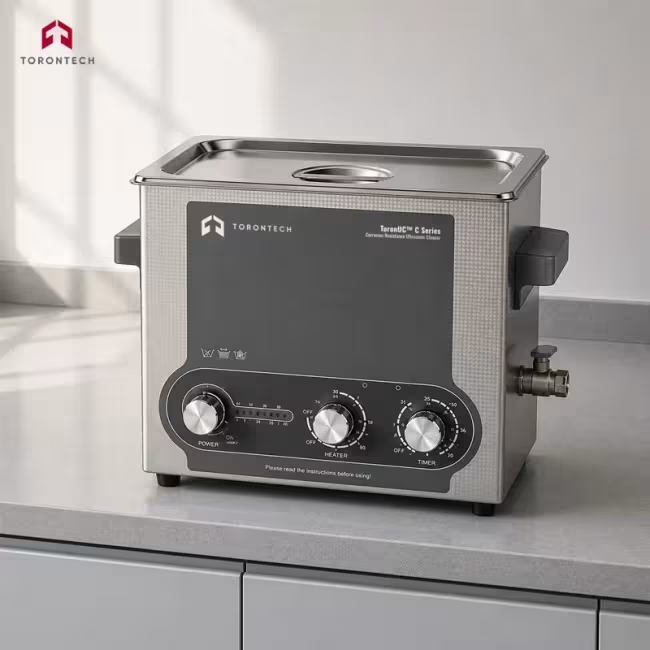
Corrosion Resistance Ultrasonic Cleaner
Corrosion Resistance Ultrasonic Cleaner – ToronUC™ C Series
ToronUC™ C Series Corrosion Resistance Ultrasonic Cleaner is a mechanically controlled, power-adjustable benchtop ultrasonic cleaning system purpose-built for industrial parts cleaning, metalworking, automotive maintenance, and chemical laboratory environments where corrosion resistance, robust construction, and variable power output are essential operating requirements.
The defining feature of the ToronUC™ C Series is its fully adjustable ultrasonic power output — continuously variable from 30% to 100% of rated power. This unique capability allows the operator to precisely match cavitation intensity to the fragility and contamination level of the parts being processed, making the C Series equally capable as a gentle ultrasonic glasses cleaner for delicate optics and a high-power industrial ultrasonic cleaner for automotive carburetor cleaning, degreasing of metal stampings, and removal of baked-on machining compounds from industrial components.
Constructed entirely from 304 stainless steel with a stamped tank body (no welding gaps) for maximum waterproofing, and equipped with ceramic heaters, an integrated cooling fan, and drainage valve on 6L and above models, the ToronUC™ C Series delivers the structural durability and chemical resistance required for sustained heavy-duty ultrasonic cleaning production in automotive, aerospace, and industrial manufacturing environments.
40 kHz | 2–27 L | 30–100% | 20–80°C | Drain+Fan |
Corrosion Resistance Ultrasonic Cleaner – ToronUC™ C Series Applications
The ToronUC™ C Series ultrasonic cleaner is specifically engineered for the following industrial and precision cleaning applications:
- Automotive Parts Cleaning: The industry-standard ultrasonic carburetor cleaner application — removes varnish deposits, fuel gum, carbon buildup, and corrosion from carburetors, fuel injectors, throttle bodies, and precision automotive fuel system components. Penetrates blind passages and spray holes that manual cleaning cannot reach.
- Industrial Parts Degreasing: Functions as a high-capacity industrial ultrasonic cleaner for removing cutting fluids, forming oils, grinding compounds, and corrosion inhibitors from machined metal parts, stampings, castings, and sub-assemblies prior to inspection, coating, or assembly.
- Optical & Glasses Cleaning: The variable power control makes the C Series an effective ultrasonic glasses cleaner for optical lenses, frames, and precision optical assemblies. Reduced power prevents damage to coatings and delicate substrates while maintaining effective cleaning action.
- Jewelry Polishing Residue Removal: Operates as an ultrasonic jewelry cleaner for professional jewelers and metalworkers, removing polishing compounds, grinding media residues, plating pre-treatment soils, and buffing wax from rings, pendants, and metal castings.
- Medical & Laboratory Equipment: Cleans laboratory instruments, dissection tools, reusable laboratory equipment, and analytical instrument components in medical research, pharmaceutical manufacturing, and university laboratory settings.
- Electronic & PCB Cleaning: Provides precise, adjustable ultrasonic cleaning for flux residue removal, solder paste cleaning, and contamination removal from PCBs and electronic assemblies with power adjustable to the sensitivity of the components.
Corrosion Resistance Ultrasonic Cleaner – ToronUC™ C Series Key Features
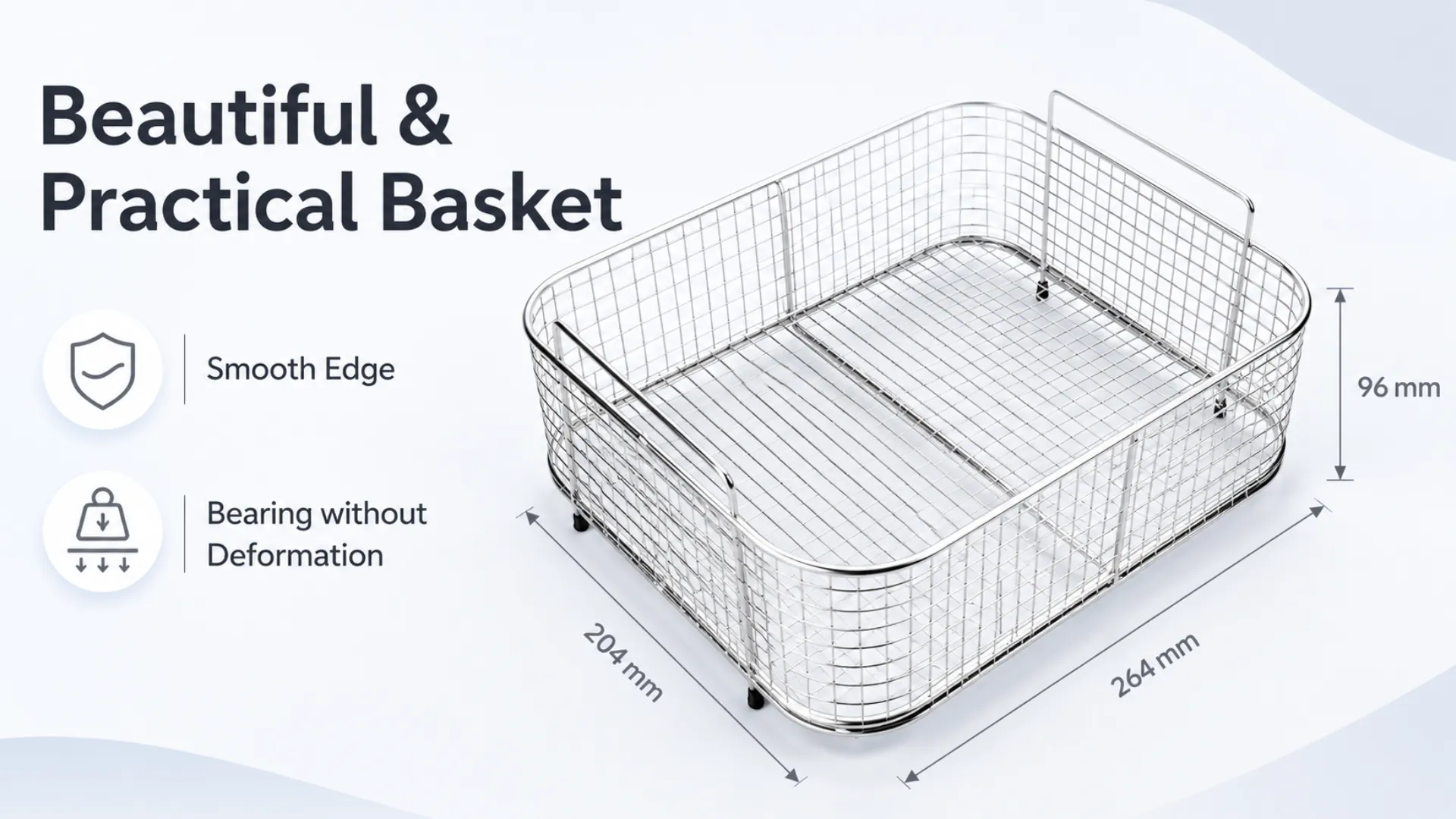
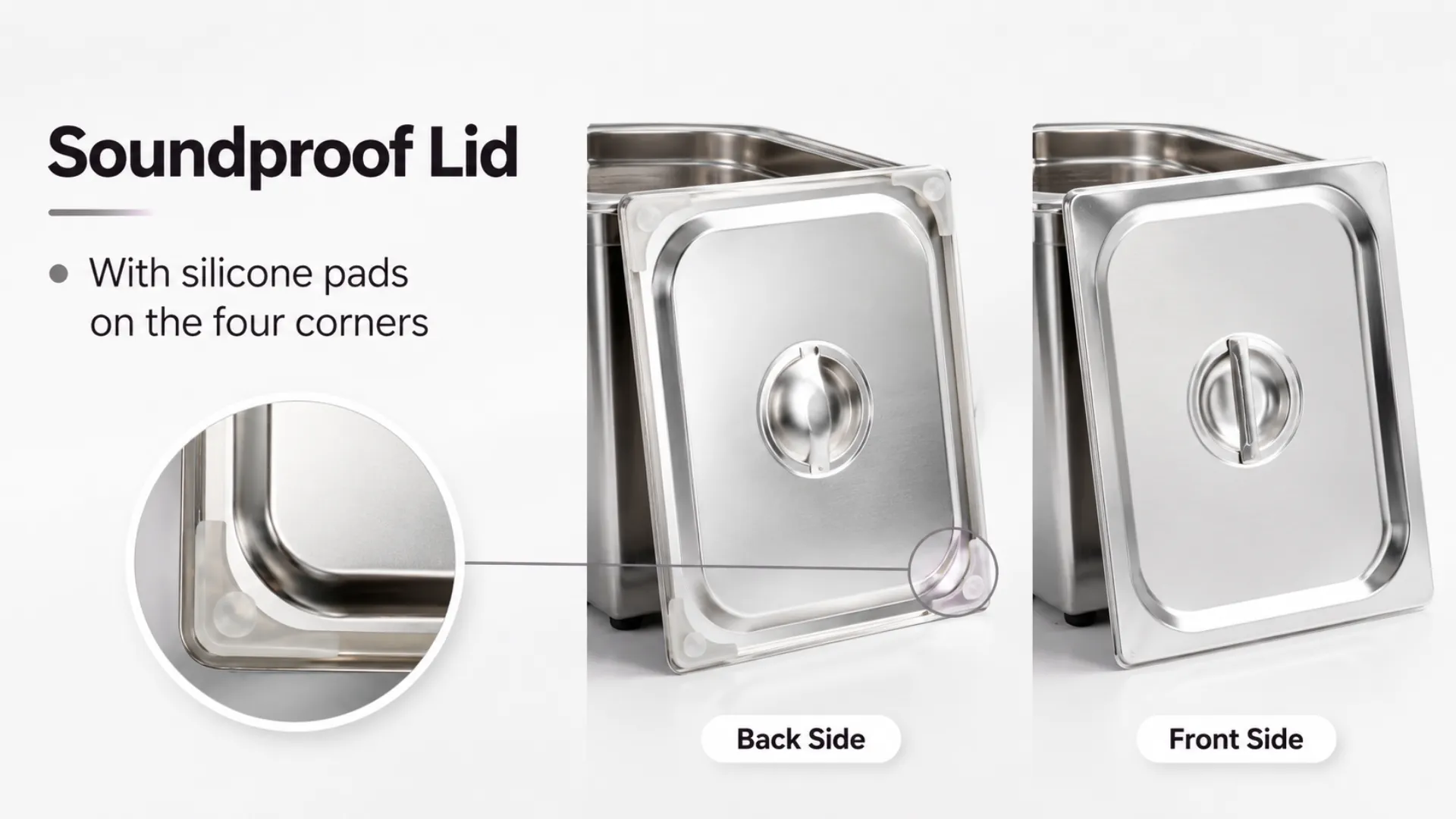
- 30–100% Power Adjustability: Continuous ultrasonic power adjustment from 30% to 100% of rated output enables precise cavitation control for any cleaning application — from gentle ultrasonic jewelry cleaner and ultrasonic glasses cleaner use to full-power industrial ultrasonic parts cleaner operation.
- Stamped Welding-Free Tank: The cleaning tank is manufactured by deep-draw stamping, eliminating welding seams and associated corrosion initiation points. The seamless construction provides maximum waterproofing and chemical resistance for long-term use with aggressive industrial cleaning chemistry.
- Ceramic Heater Elements: Ceramic heating elements provide superior heating efficiency, chemical resistance, and longevity compared to conventional metallic heaters — critical for sustained operation in corrosive cleaning solution environments.
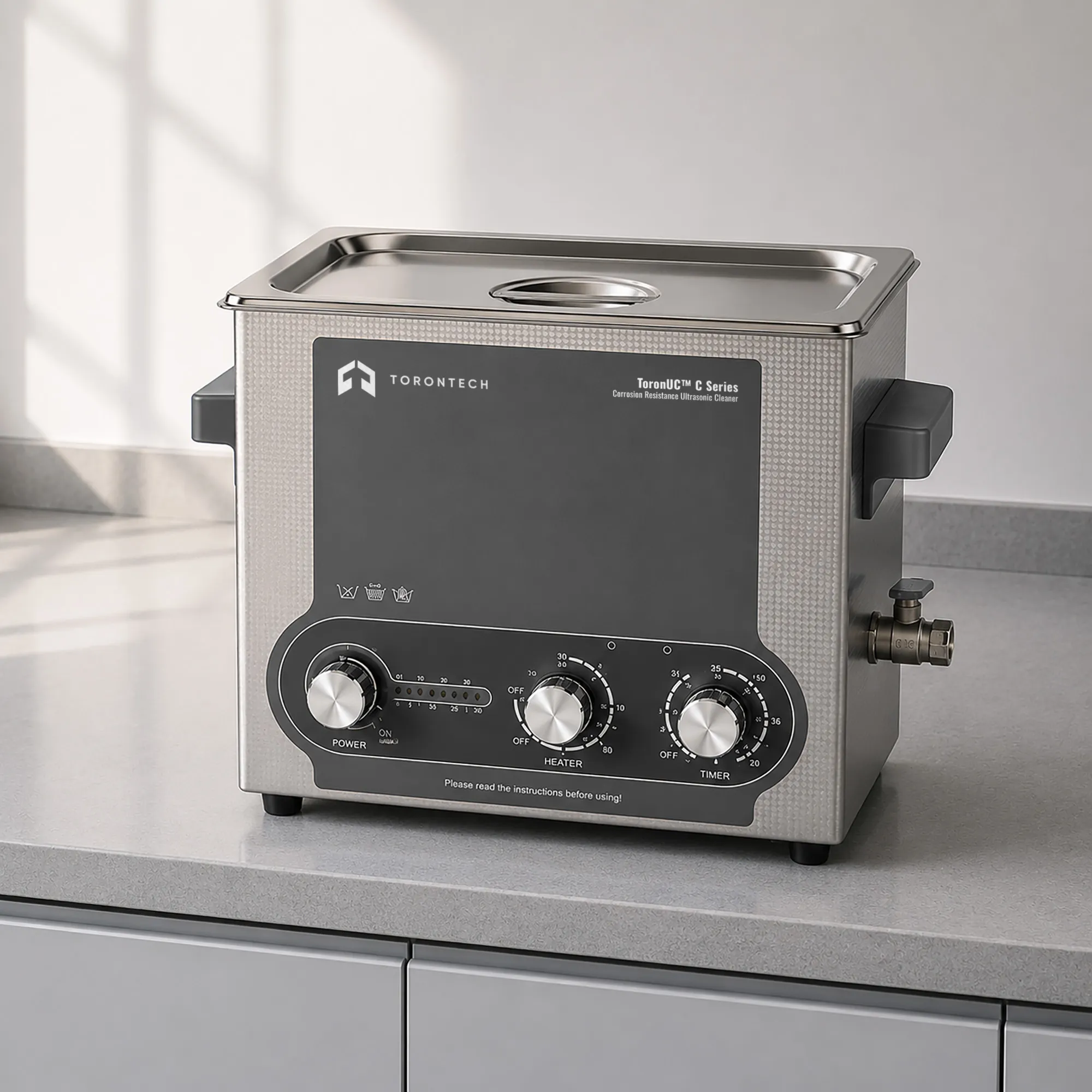
- Drainage Valve (6L+): Models from 6L and above include an integrated drain valve, enabling convenient in-place solution change without tilting the tank — essential for high-throughput industrial ultrasonic cleaning production workflows.
- Cooling Fan (6L+): An integrated cooling fan prevents electronic component overheating during extended production runs on larger models, ensuring stable performance and extended service life in continuous industrial operation.
- Special Cooling System: The dedicated internal cooling system maintains component operating temperatures within safe limits regardless of ambient temperature or duty cycle, enabling the C Series to operate reliably in warm industrial environments.
- Powerful Ultrasonic Transducers: High-output ultrasonic transducers deliver maximum cleaning intensity throughout the tank volume, ensuring uniform and repeatable ultrasonic cleaning performance across full batch loads.
- Mechanical Control Interface: Robust analog knob controls for timer and heater provide long-life mechanical reliability in industrial environments where digital touch panels may be susceptible to contamination, moisture, or physical damage.
Theory & Ultrasonic Cleaning Method
Ultrasonic cleaning is based on the physical phenomenon of acoustic cavitation. When high-frequency sound waves typically 40 kHz are transmitted through a liquid cleaning solution, they generate millions of microscopic vacuum bubbles that form and violently implode at rates corresponding to the ultrasonic frequency. Each implosion releases an intense local jet of energy reaching temperatures of several thousand degrees Celsius and pressures exceeding 500 atmospheres but only at a microscopic scale, ensuring the parts being cleaned are unaffected by thermal or mechanical shock.
This cavitation process is the core mechanism of all ultrasonic cleaning. The energy released by each collapsing bubble penetrates into surface pores, blind holes, threads, crevices, and complex geometries that brushes, sprays, and manual wiping methods simply cannot reach. Contaminants including oils, greases, flux residues, machining chips, polishing compounds, biological debris, fingerprints, and corrosion products are dislodged from the substrate surface and dispersed into the cleaning solution, leaving a thoroughly clean part surface in a fraction of the time required by conventional methods.
The heating function complements cavitation by reducing the viscosity of oily contaminants, improving the solubility of cleaning chemistry, and accelerating the overall cleaning reaction. The degas function (where available) purges dissolved gases from the cleaning solution during the initial warm-up phase, improving cavitation intensity and ensuring optimal ultrasonic cleaning performance from the first cycle.
The variable power control of the ToronUC™ C Series directly modulates cavitation bubble density and collapse energy. At 30% power, smaller, less energetic cavitation bubbles are generated — appropriate for delicate substrates like coated optical elements or precision jewelry. At 100% power, maximum cavitation intensity is achieved for heavy industrial ultrasonic parts cleaner applications such as ultrasonic carburetor cleaner service and degreasing of heavily contaminated mechanical assemblies.
Ultrasonic Cleaning Process Steps
1. Solution Preparation — Fill the tank with an appropriate water-based cleaning solution or solvent compatible with the parts being cleaned. Add recommended cleaning chemistry at the manufacturer-specified dilution ratio.
2. Pre-Heat (if required) — Activate the heating function and set the target temperature. Allow the bath to stabilize before loading parts to ensure consistent cavitation intensity.
3. Degas (if available) — Run the degas cycle to purge dissolved gases from the cleaning solution, maximizing cavitation efficiency and cleaning effectiveness from the first production run.
4. Load & Run — Submerge parts in the basket or cleaning cradle, ensuring all surfaces are exposed to the cleaning solution. Set the timer and activate the ultrasonic transducers.
5. Rinse & Dry — Remove parts and rinse with clean water to remove residual cleaning chemistry and loosened contaminants. Dry with compressed air or a clean cloth as appropriate.
Corrosion Resistance Ultrasonic Cleaner – ToronUC™ C Series Technical Specifications
| Model | Tank Size L×W×H (mm) | Unit Size L×W×H (mm) | Volume (L) | US Power (W) | Freq. (kHz) | Heating Power (W) | Timer (min) | Temp. (°C) |
|---|---|---|---|---|---|---|---|---|
| ToronUC™ 2C | 150×140×100 | 190×170×220 | 2 | 30–100 | 40 | 100 | 0–30 | 20–80 |
| ToronUC™ 3C | 240×140×100 | 270×170×240 | 3 | 30–100 | 40 | 100 | 0–30 | 20–80 |
| ToronUC™ 6C | 300×155×150 | 330×180×310 | 6 | 45–150 | 40 | 300 | 0–30 | 20–80 |
| ToronUC™ 9C | 300×240×150 | 330×270×310 | 9 | 60–200 | 40 | 300 | 0–30 | 20–80 |
| ToronUC™ 13C | 330×300×150 | 360×330×310 | 13 | 90–300 | 40 | 400 | 0–30 | 20–80 |
| ToronUC™ 20C | 500×300×150 | 550×330×310 | 20 | 120–400 | 40 | 500 | 0–30 | 20–80 |
| ToronUC™ 27C | 500×300×200 | 550×330×360 | 27 | 150–500 | 40 | 500 | 0–30 | 20–80 |