
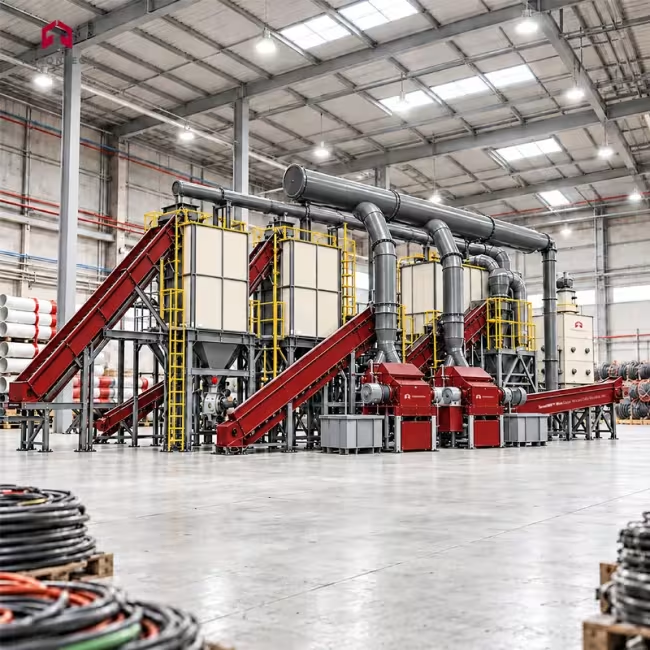
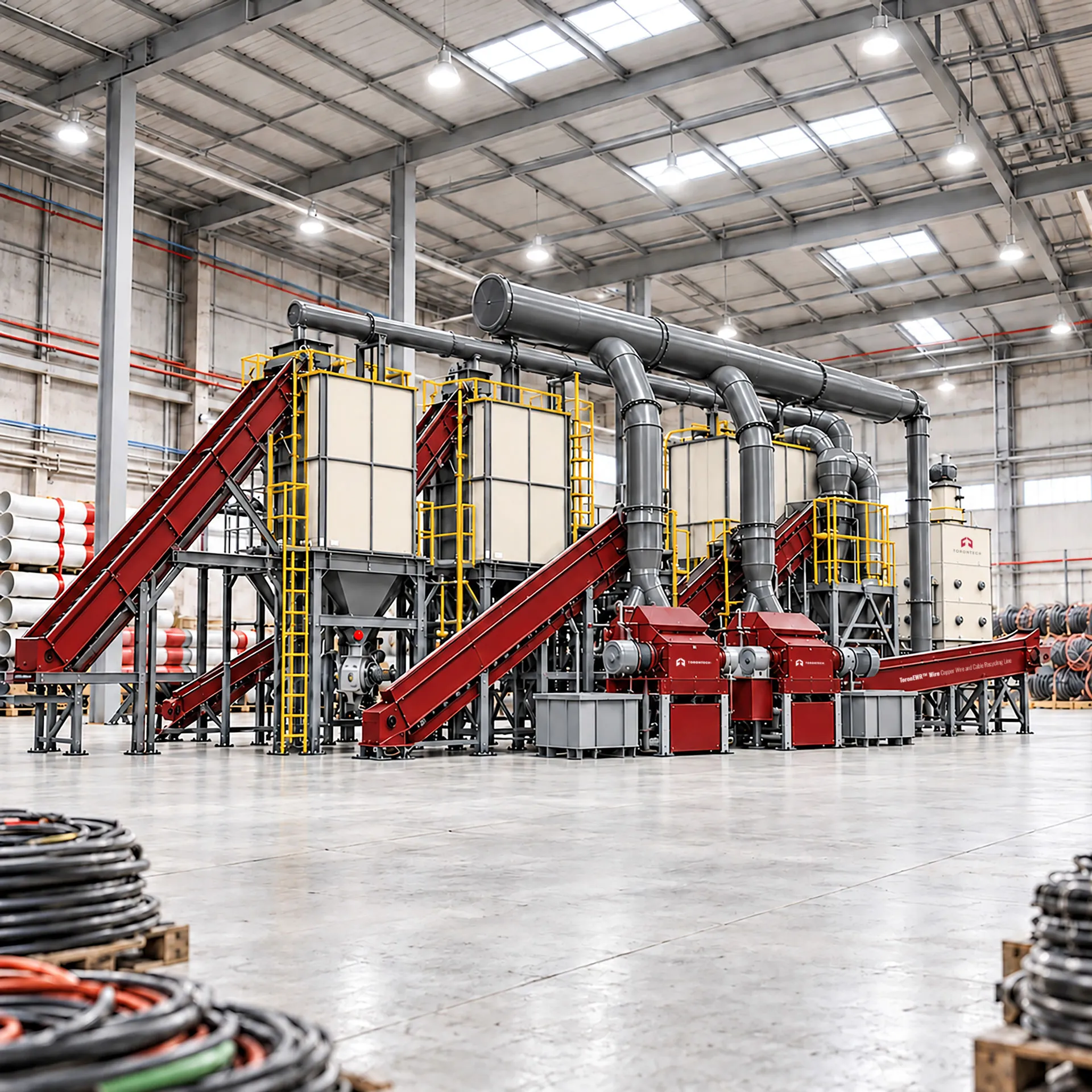
Copper Wire and Cable Recycling Line - ToronEWR™ Wire
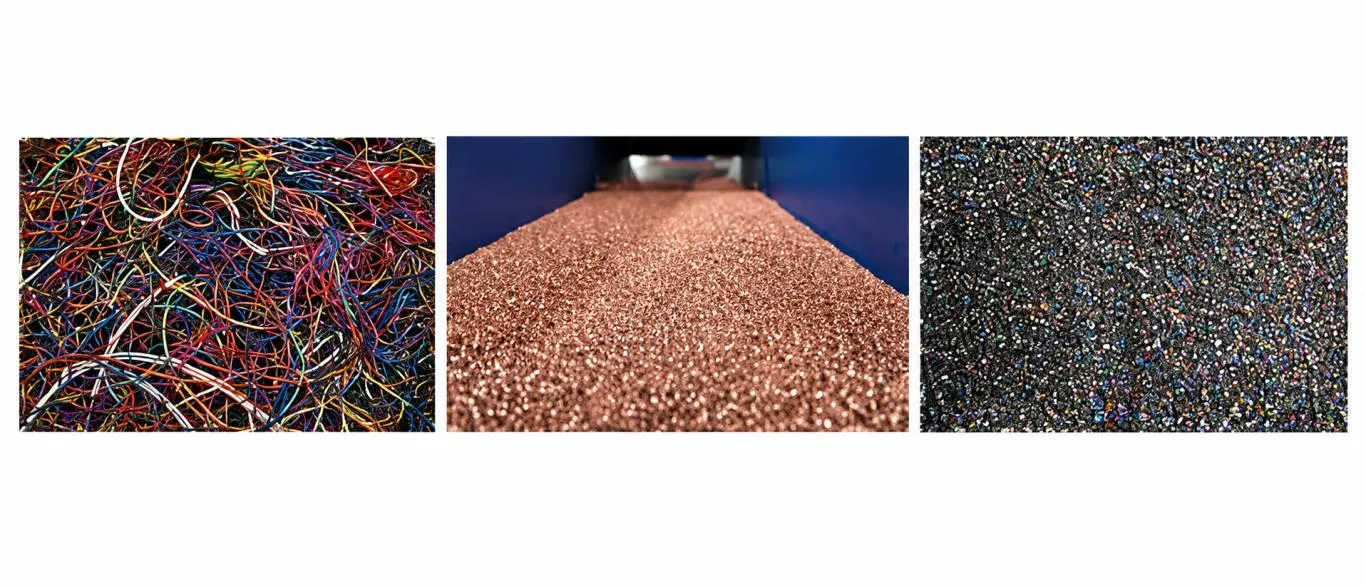
ToronEWR™ Wire copper wire and cable recycling line separates copper conductor from polymer insulation at 200 to 2,000 kg/h, producing clean copper granules and recovered plastic. Shredding, granulation, air classification, friction milling, and electrostatic separation run in sequence without water, solvent, or burning. Copper recovery reaches above 99 percent according to supplier data. Scrap processors, electrical contractors, and electronics recyclers use the line to convert mixed cable into two graded, saleable products.
Cable arrives in every imaginable form, from heavy utility feeder to hair-fine telecom pairs, and the line is built to take that variety. Household wiring, telecommunication cable, automotive harness, and fiber optic cable with metallic elements all run through the same equipment set. Feeding happens at a single point because the hopper holds enough material to carry the process, so one operator can charge the line and let it run.
Dry mechanical separation is what makes the process practical at this scale. No wash water means no effluent treatment, and no thermal stripping means no emissions from burning insulation. The supplier describes the operation as dust-free with no secondary pollution, and automation keeps operators away from direct contact with the material. Both output fractions leave the line ready for sale rather than needing a further cleaning step.
Copper Wire and Cable Recycling Line - ToronEWR™ Wire Applications
The ToronEWR™ Wire line serves anyone accumulating scrap cable in volume, whether as a primary business or as a byproduct of other operations.
- Copper Scrap Processing: converts mixed cable purchases into clean copper granules that command a better price than unstripped wire
- Metal Recycling Yards: adds cable capability so insulated wire becomes an accepted grade rather than a discounted one
- Electrical Contractors and Demolition: processes cable pulled from building strip-outs, rewiring projects, and site clearance
- Automotive Wire Harness Recycling: recovers copper from vehicle harnesses, where fine conductors and mixed insulation resist manual stripping
- Telecommunication Cable Recovery: handles multi-pair telecom cable containing large quantities of fine-gauge copper
- Utility and Power Cable Recovery: processes distribution and service cable retired during network upgrades
- Fiber Optic Cable Processing: recovers metallic armor, drain wires, and strength members from fiber cable assemblies
- Household Appliance Wiring: separates copper from the internal wiring harvested during appliance dismantling
- Electronics and WEEE Recycling: processes the cable fraction that accumulates alongside board and component streams
- Data Center Decommissioning: handles the volume of structured cabling removed during refresh and shutdown projects
- Cable Manufacturing Scrap: returns production offcuts, reel ends, and off-spec runs to the copper supply chain
- Waste Management Contractors: brings cable processing in house instead of selling unprocessed wire to a third party
Copper Wire and Cable Recycling Line - ToronEWR™ Wire Key Features
The ToronEWR™ Wire line combines size reduction with three independent separation principles, so material the first stage misses is caught by the next.
- Copper Recovery Above 99 Percent: supplier data reports better than 99 percent copper recovery across the combined separation stages
- Three Separation Principles: air classification, friction milling, and electrostatic sorting work in sequence rather than relying on density alone
- Dry Process Throughout: separation runs without wash water or chemical treatment, so there is no effluent stream to handle
- No Thermal Stripping: copper is freed mechanically rather than by burning insulation, avoiding the emissions that thermal methods produce
- Single-Point Feeding: hopper capacity is sized so the line runs on one charge, which cuts the labor needed to keep it fed
- Broad Cable Compatibility: household wiring, telecom cable, automotive harness, and fiber optic cable all run on the same equipment set
- Automatic Overload and Jam Protection: the shredder reverses automatically when sensors detect overloading or jamming, protecting the cutting chamber
- Siemens Microcomputer Control on the Shredder: automatic start, stop, and reverse functions run without operator intervention at the cutting stage
- Adjustable Output Granule Size: secondary granulation is set to the particle size your buyer specifies rather than to a fixed standard
- Low Energy Turbo Milling: the turbo mill draws less power than a conventional crusher while doing the surface-stripping work
- Reduced Operator Exposure: automation limits direct handling of scrap cable and the residues it carries
- Dust-Controlled Operation: the supplier describes the process as dust-free with no secondary pollution
- Fast Commissioning: the line is built for straightforward installation and test running, so it reaches production shortly after delivery
- Configurable to Requirement: equipment selection and sizing are matched to cable type, throughput target, and output grade
Theory and Method
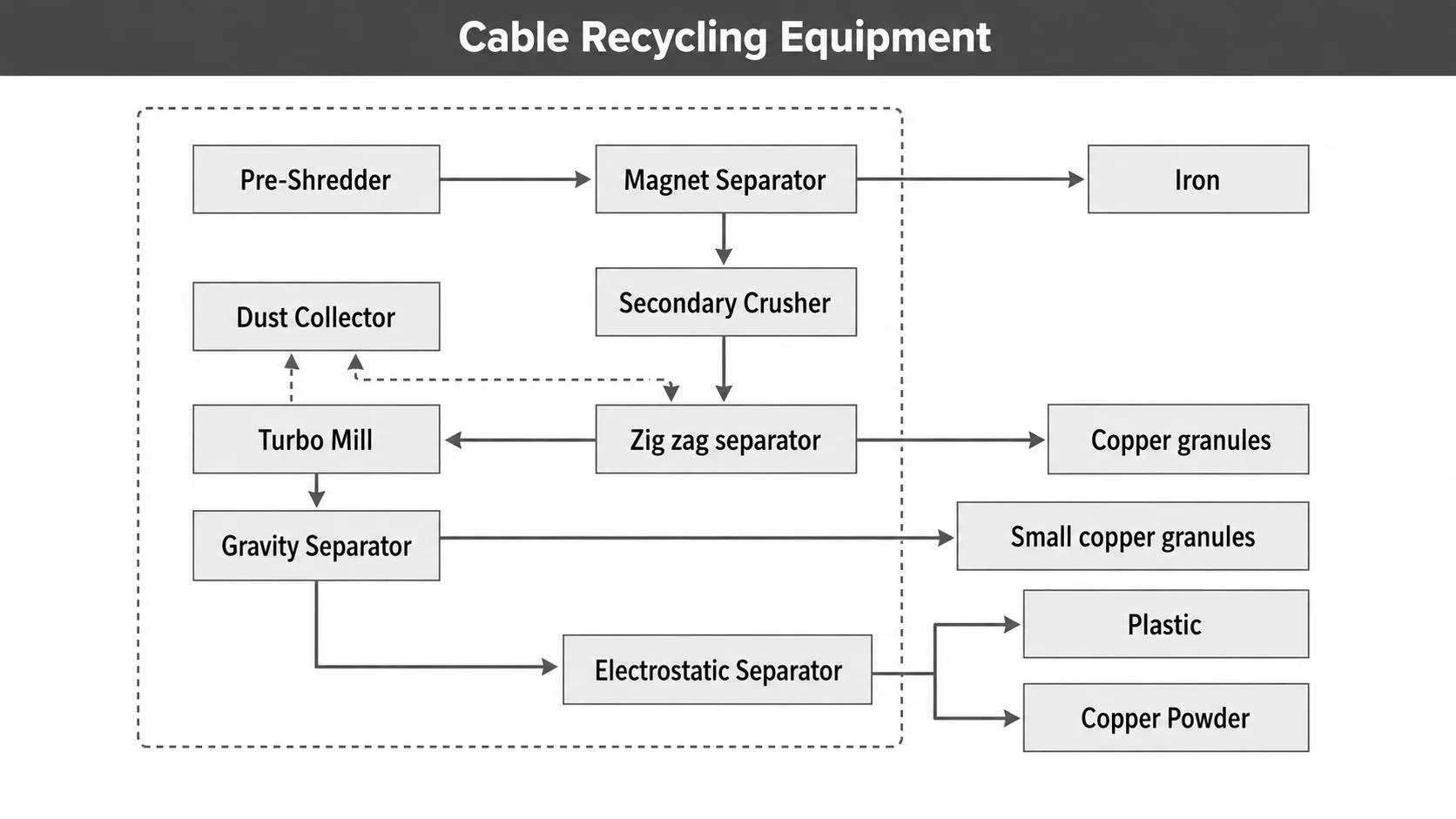
Cable recovery begins with liberation. Copper and its insulation behave very differently under mechanical stress: copper is ductile and deforms into rounded nodules, while PVC and polyethylene insulation are comparatively brittle under shear and fracture away as chips. Granulating cable to a controlled particle size exploits that contrast, breaking the conductor free of its sheath rather than trying to strip it. Every separation stage downstream works only as well as this liberation step allows.
Density then does most of the sorting. Copper sits near 8.96 grams per cubic centimeter against PVC around 1.4 and polyethylene near 0.92, a spread wide enough for air to resolve cleanly. The zig-zag separator sends material through a rising airstream that changes direction repeatedly. Each bend forces a decision: light plastic chips follow the airflow around the turn, while dense copper cannot change course fast enough and drops out. Repeating the turn several times sharpens the cut well beyond what a straight column achieves.
Fine wire leaves residue that air alone cannot resolve. Thin conductors hold insulation film clinging to the copper surface, so the turbo mill applies friction and rubbing that scrubs plastic off and rounds copper into discrete particles. Electrostatic separation then recovers the fines. High voltage charges every particle, but conductive copper drains that charge to the grounded rotor and flies off under centrifugal force, while non-conductive plastic retains its charge and stays pinned to the drum. That conductivity difference lifts recovery past 99 percent.
Copper Wire and Cable Recycling Line - ToronEWR™ Wire Technical Specifications
System Overview
| Parameter | Specification |
|---|---|
| System Type | Dry mechanical granulation and separation line for scrap wire and cable |
| Capacity Range | 200 to 2,000 kg/h |
| Processable Feedstock | Household electrical wiring, telecommunication cable, fiber optic cable, automotive harness, and general scrap cable |
| Output Materials | Copper granules, recovered plastic granules |
| Copper Recovery Rate | Above 99 percent (supplier stated) |
| Separation Methods | Crushing, air classification, vibrating screening and vibration separation, friction milling, electrostatic separation |
| Process Type | Dry, without water, solvent, or thermal stripping |
| Feeding Arrangement | Single-point charging, hopper sized to carry the process |
| Shredder Control | Siemens microcomputer control with automatic start, stop, and reverse |
| Protection | Automatic reverse on overload and jam detection |
| Environmental Profile | Described by the supplier as dust-free with no secondary pollution |
| Installation | Configured for straightforward installation, test running, and commissioning |
| Customization | Equipment set tailored to cable type and customer requirement |
Machine Line-Up
The line is assembled from the modules below. Each stage is described with its function, working method, and available parameters.
1. Feeding System
Scrap cable is charged into the infeed hopper, which is sized to hold enough material that the line runs on a single feed rather than needing continuous attention. Material passes from the hopper into the primary shredder at a controlled rate.
| Parameter | Specification |
|---|---|
| Function | Charges scrap cable into the primary shredder |
| Feeding Arrangement | Single-point charging with high-capacity hopper |
| Feed Material | Coiled, loose, or baled scrap wire and cable |
| Operational Benefit | Reduces the labor needed to keep the line supplied |
2. Single-Shaft Shredder
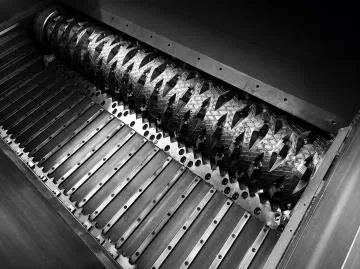 | The single-shaft shredder performs primary size reduction on incoming cable. Output from this stage can go directly to sale in some grades or continue to secondary granulation. Sensors detect overloading and jamming and reverse the rotor automatically, which protects the cutting chamber from damage when armored cable or foreign metal enters. |
| Parameter | Specification |
|---|---|
| Function | Primary size reduction of scrap wire and cable |
| Rotor Configuration | Single shaft |
| Control System | Siemens microcomputer control |
| Automatic Functions | Start, stop, and automatic reverse |
| Protection | Sensor-triggered reverse on overload and jamming |
| Output Handling | Direct use in some grades, or transfer to secondary granulation |
3. Granulator
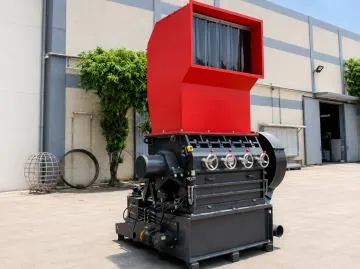 | The granulator carries out secondary size reduction, bringing material down to the particle size the separation stages need. Output size is set to what the customer and their buyer require rather than to a fixed value. The machine is built for straightforward operation with low energy consumption per ton. |
| Parameter | Specification |
|---|---|
| Function | Secondary size reduction to separation-ready particle size |
| Output Size | Set to customer requirement |
| Energy Profile | Low energy consumption for the duty |
| Operation | Straightforward operation and routine maintenance |
| Process Purpose | Liberates copper conductor from surrounding insulation |
4. Zig-Zag Air Separator
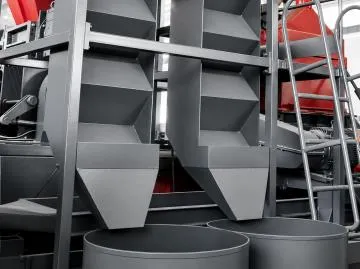 | The zig-zag separator uses airflow direction to divide light material from heavy. Material passes through a rising airstream that changes direction repeatedly, and each turn separates particles that can follow the flow from those that cannot. Copper drops out as the heavy fraction while plastic chips travel on with the air. |
| Parameter | Specification |
|---|---|
| Function | Density-based separation of copper from plastic |
| Separation Medium | Air |
| Working Principle | Repeated airflow direction change within a zig-zag column |
| Heavy Fraction | Coarse copper granules |
| Light Fraction | Plastic chips and insulation fragments |
| Process Position | After granulation, ahead of friction milling |
5. Turbo Mill
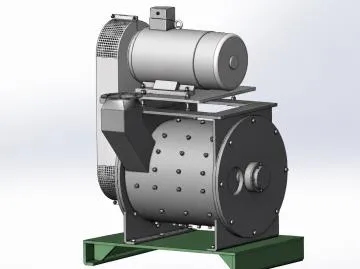 | Material remaining after air classification passes into the turbo mill. Friction and rubbing action scrubs plastic clinging to the copper surface, which matters most on fine-gauge wire where insulation adheres tightly. The mill refines the plastic fraction and rounds copper into discrete particles, improving the separation achievable downstream. Power draw is lower than a conventional crusher performing comparable work. |
| Parameter | Specification |
|---|---|
| Function | Surface stripping of residual plastic and particle refinement |
| Working Principle | Friction and rubbing between particles |
| Feed Source | Fraction remaining after zig-zag air separation |
| Effect on Copper | Converts remaining conductor into discrete particles |
| Effect on Plastic | Refines the plastic fraction for cleaner downstream sorting |
| Energy Profile | Lower power consumption than a conventional crusher |
6. Vibrating Screening and Separation
Vibrating screening and vibration separation work alongside the air and electrostatic stages to grade material by size and behavior. Screening keeps each downstream separator working within the particle range it handles best.
| Parameter | Specification |
|---|---|
| Function | Size grading and vibration-based separation of the material stream |
| Method | Vibrating screening combined with vibration separation |
| Process Purpose | Presents each separator with material in its optimal size range |
| Position | Set within the separation train during system design |
7. Electrostatic Separator
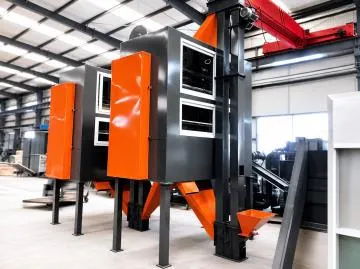 | The electrostatic separator resolves the fine fraction that density methods cannot. High-voltage charging distinguishes conductive from non-conductive material: copper releases its charge to the grounded rotor and separates under centrifugal force, while plastic retains charge and clings to the drum surface. This stage is what carries copper recovery past what air classification alone achieves. |
| Parameter | Specification |
|---|---|
| Function | Separation of conductive from non-conductive material |
| Working Principle | High-voltage electrostatic charging with conductivity-based release |
| Conductive Fraction | Copper granules |
| Non-Conductive Fraction | Plastic and insulation residue |
| Target Material | Fine particles unresolved by density separation |
| Related Applications | Circuit boards, blister packaging, aluminum-plastic laminate, cable |
8. Control and Automation
The line runs as an automated sequence rather than as separately operated machines. Automation holds output consistent between shifts and limits the direct handling that manual cable processing requires.
| Parameter | Specification |
|---|---|
| Function | Coordinated operation across the connected process line |
| Shredder Control | Siemens microcomputer control system |
| Operating Mode | Automated sequence from feeding through separation |
| Operator Involvement | Minimal manual handling of material |
| Process Benefit | Consistent output grade and reduced operator exposure |