

Compact Microwave Digestion System
Compact Microwave Digestion System – ToronMD™-1000
The Compact Microwave Digestion System ToronMD™-1000 prepares solid and semi-solid samples for trace element analysis in laboratories running moderate daily volumes. The unit holds eight independent high-pressure vessels and performs closed-vessel acid digestion inside a 35 L resonant cavity. Analysts working toward ICP-OES, ICP-MS, AAS, or AFS measurement use it to convert soils, foods, polymers, and alloys into clear, particle-free solutions. A benchtop footprint of 610 × 500 × 550 mm lets the system sit in labs where floor space is limited.
Closed-vessel digestion raises reaction temperature and pressure well beyond what an open hot plate reaches. Cycles that once took hours finish in minutes, and volatile elements such as mercury, arsenic, and selenium stay inside the vessel. Mid-infrared sensing reads the true temperature of every sample solution without touching it. Each vessel carries its own pressure-release path, so an over-pressure event vents in a controlled way. Operators build and run methods from a full touchscreen that shows temperature and system status in real time.
The ToronMD™-1000 suits laboratories that need dependable closed-vessel digestion without the throughput or the cost of a 40-position platform. Eight positions match the daily workload of municipal water labs, food QC departments, university research groups, and smaller commercial testing houses. A 316L stainless steel cavity carries a multi-layer Teflon coating that resists acid vapor across repeated runs. Installation calls for a fume hood or equivalent extraction, since vessels release acid fumes when opened after a cycle.
Compact Microwave Digestion System – ToronMD™-1000 Applications
Environmental Testing
Use the system to digest soils, sediments, sludge, airborne particulates, and solid waste before metals analysis. Microwave digestion helps break down complex matrices faster than hot-plate methods and supports more repeatable recoveries when running routine compliance work.
Water & Wastewater Labs
Prepare samples for trace-element testing when working with industrial wastewater, landfill leachate, and high-solids water samples. Controlled temperature feedback and vessel pressure control help maintain consistent digestion conditions across batches.
Food & Feed Safety
Digest food, feed, and agricultural products for elemental analysis, including heavy metals and nutritional elements. Microwave digestion reduces prep time and helps labs maintain consistent digestion quality when sample volumes increase.
Metals, Alloys & Materials QA
Digest metal powders, alloys, and manufactured materials when verifying composition, contamination, or process control. This is useful for QA/QC labs that need standardized, repeatable sample prep for downstream ICP or AAS workflows.
Petrochemical & Energy Samples
Support inorganic sample preparation for petroleum-derived materials and difficult industrial samples where digestion must be tightly controlled. Microwave digestion can shorten turnaround time for routine screening and R&D checks.
Plastics, Polymers & Consumer Materials
Digest plastics, polymers, and additives for elemental screening, contamination checks, or formulation control. This is often used in product quality investigations and supplier verification.
Cosmetics & Personal Care Products
Prepare cosmetic matrices for metals testing where sample composition can vary significantly. Reliable digestion helps reduce repeat re-runs and improves lab efficiency in routine product screening.
Geological & Mining Samples
Digest rocks, ores, soils, and mineral-rich matrices for geochemical or process-related testing. Consistent heating and pressure control help labs handle mineral-heavy samples more reliably in repeat workflows.
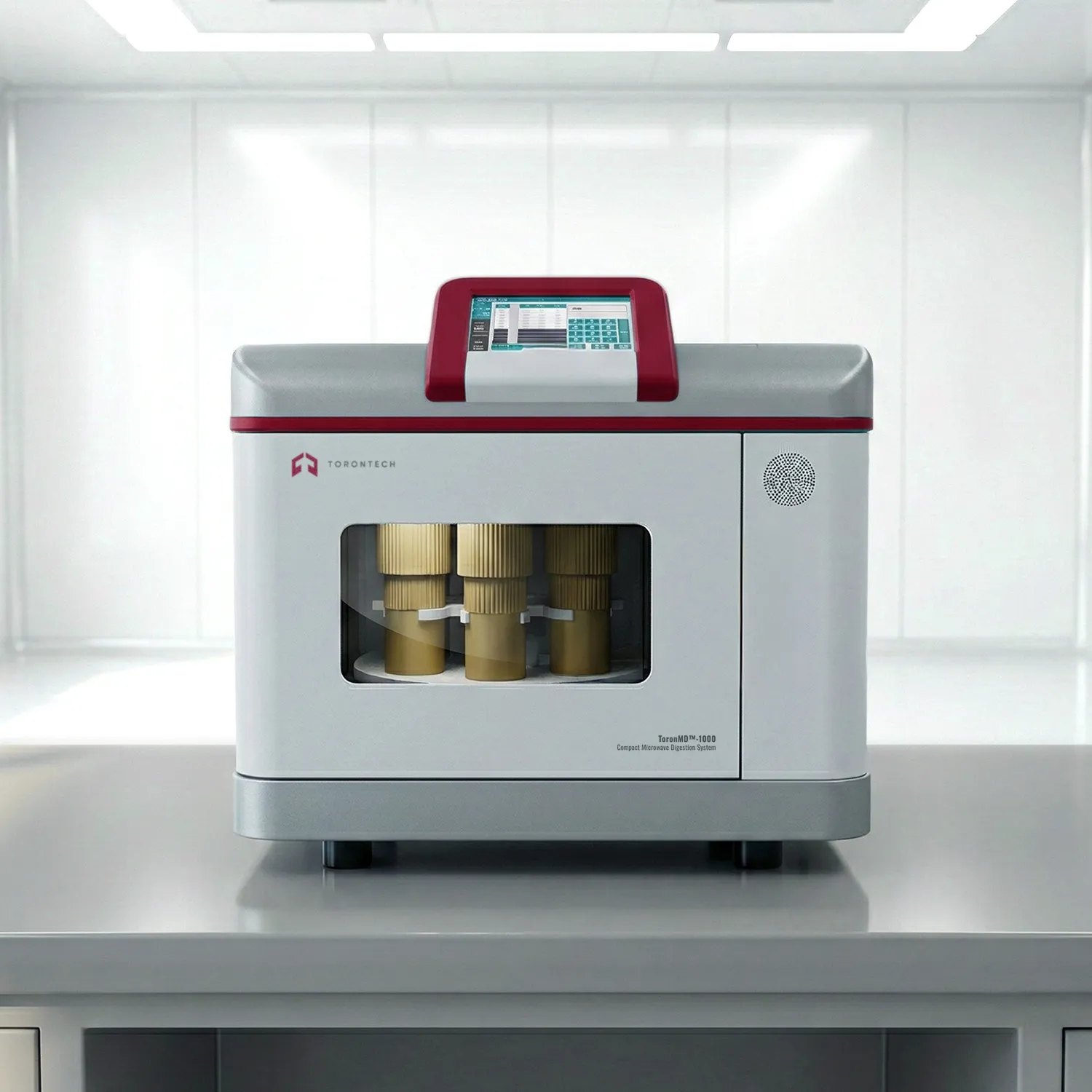
Compact Microwave Digestion System – ToronMD™-1000 Key Features
- Up to 10 active and passive safety protection functions for safer routine operation.
- Mid-infrared non-contact temperature sensor designed to penetrate TFM for real-time scanning and display of each sample’s actual temperature.
- Full-vessel pressure control mechanism that supports pressure releasing on each digestion vessel for safe, efficient digestion.
- Microwave focusing technology to improve heating uniformity, boost efficiency, and reduce microwave leakage risk.
- Full-vessel pressure control with pressure-limiting + pressure-release behavior to protect vessels while preserving analytes during normal operation.
- Non-contact, real-time temperature feedback across all vessels for tighter control and better method repeatability.
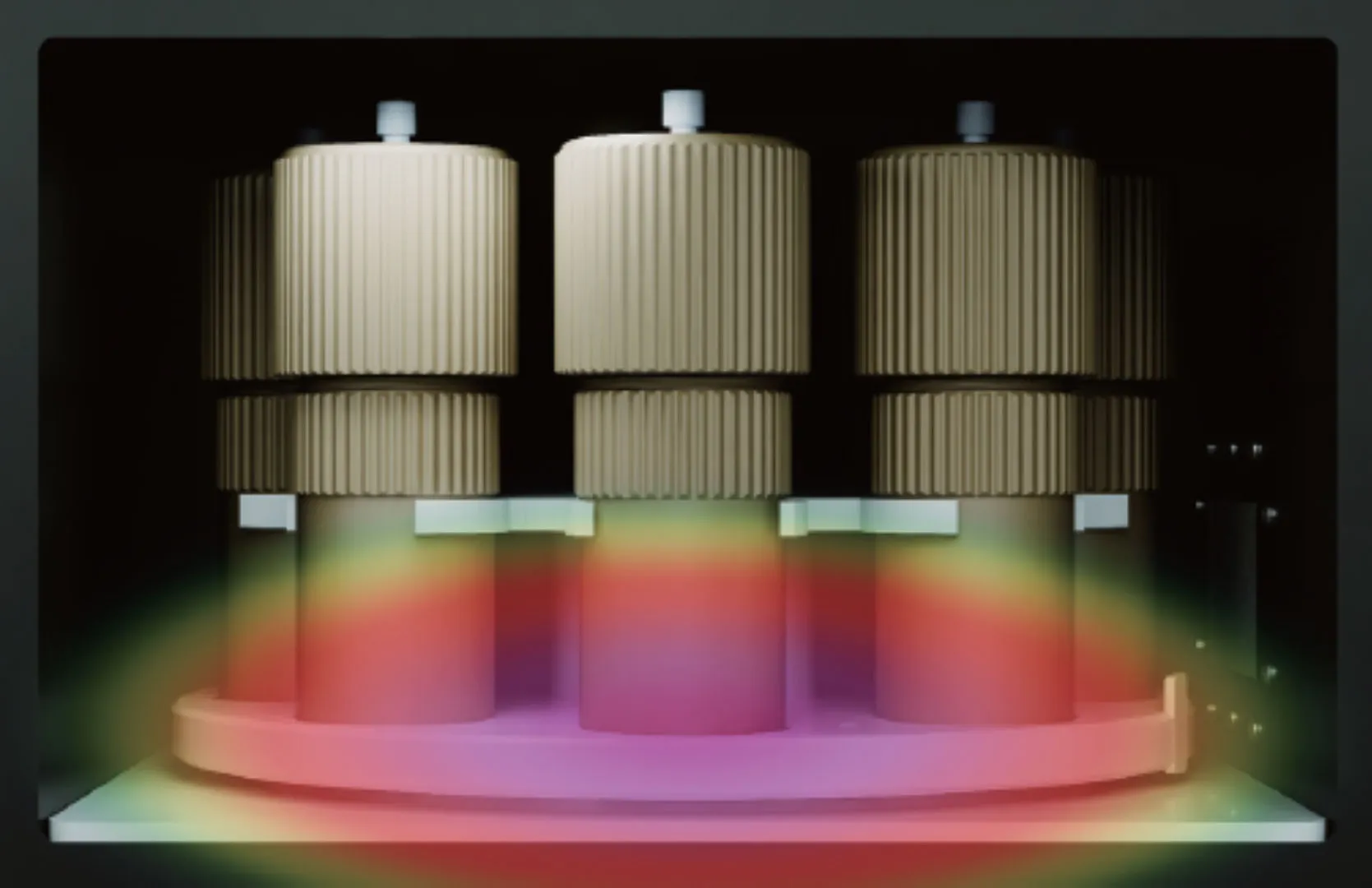
Microwave Focusing
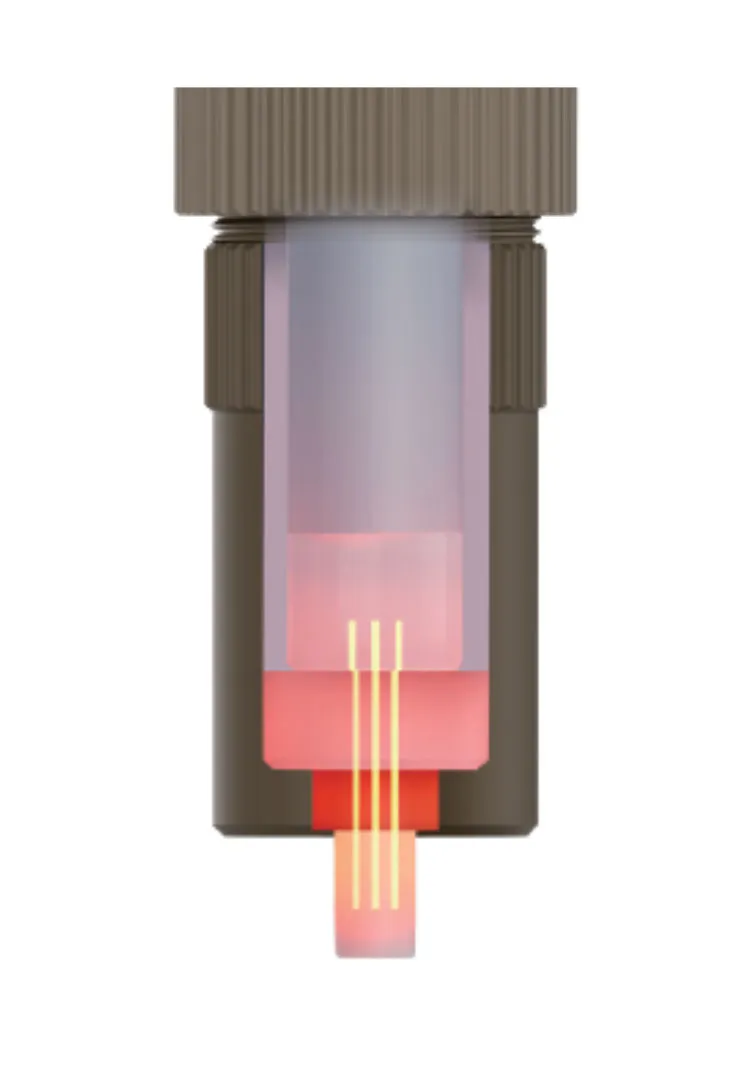
High-precision Real-time Temperature Feedback Technology
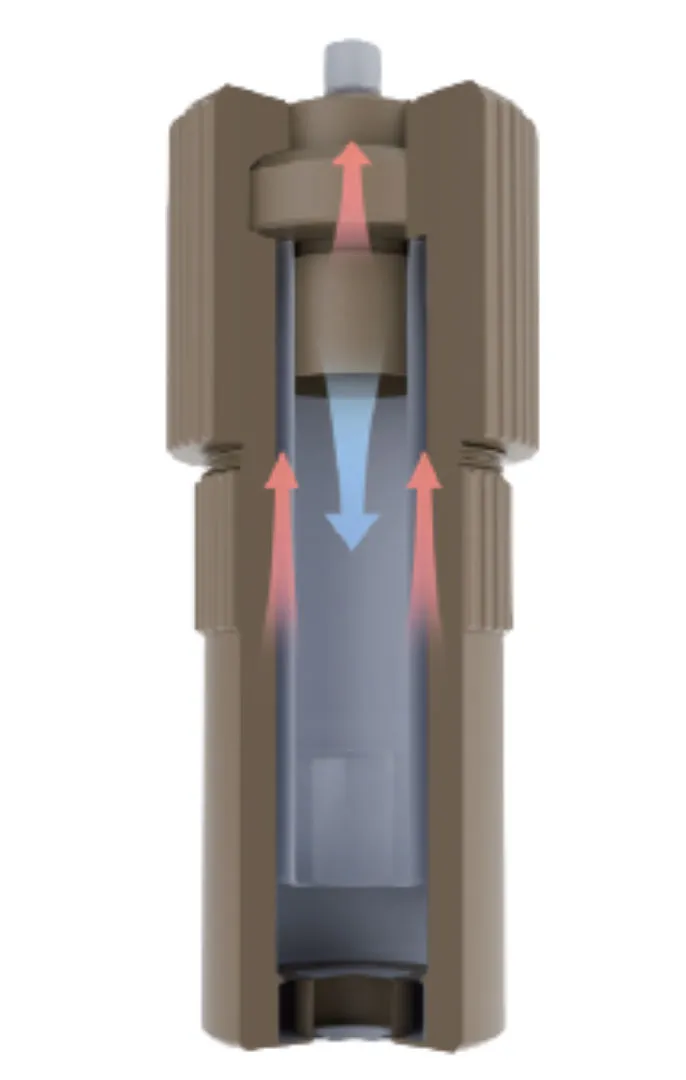
Full-vessels Pressure Control Mechanism
Theory and Method
Microwave digestion heats a sample by dielectric loss rather than by conduction from a hot surface. The 2450 MHz field reverses direction roughly 4.9 billion times per second, and polar molecules in the acid mixture rotate to follow it. Friction between those rotating molecules converts field energy directly into heat throughout the liquid volume. Ionic species add a second mechanism, ionic conduction, as dissolved ions migrate under the alternating field and collide with neighboring molecules. Heating therefore begins inside the sample instead of at the vessel wall.
The TFM inner vessel stays close to transparent at microwave frequencies, so most of the energy reaches the acid and the sample. Sealing the vessel lets the solution pass its atmospheric boiling point, and internal pressure climbs as the mixture heats and reaction gases form. Elevated temperature accelerates acid attack on the sample matrix, while elevated pressure holds volatile analytes in the liquid phase. Nitric acid decomposes organic material far more aggressively near 200°C under pressure than at its 120°C atmospheric boiling point.
Controlling this process depends on knowing the real solution temperature rather than the vessel surface temperature. Mid-infrared wavelengths pass through TFM, so the sensor scans each vessel and reports the temperature of the liquid inside without any probe entering the sample. That reading drives magnetron output and holds the programmed ramp and hold profile across the batch. The pressure-release design gives every vessel an independent vent path, which contains a single runaway reaction instead of letting it disturb the whole rotor.
Compact Microwave Digestion System – ToronMD™-1000 Technical Specifications
| Parameter | Specification |
|---|---|
| Batch Capacity | 8 positions |
| Digestion Rotor | Independent high-pressure digestion vessels |
| Digestion Vessel Volume | 100 mL |
| Inner Vessel Material | TFM |
| Outer Vessel Material | PEEK |
| Microwave Cavity | 316L stainless steel resonant cavity, multi-layer Teflon coated |
| Cavity Volume | 35 L |
| Microwave Frequency | 2450 MHz |
| Microwave Emission | Variable-frequency magnetron, high-energy microwave field |
| Microwave Output Power | 1000 W |
| Input Power | 1500 W |
| Temperature Measurement and Control | Mid-infrared non-contact sensing, all vessels |
| Pressure Release | Explosion-proof membrane, independent per vessel |
| Safety Door | High-strength explosion-proof door, side-opening with floating buffer design |
| Control System | Full touchscreen operation, extra-large real-time display of parameters and status |
| Power Supply | 220 to 240 VAC, 50/60 Hz |
| Ambient Temperature | 0°C to 40°C |
| Ambient Humidity | 15% to 80% RH |
| Dimensions (W × D × H) | 610 × 500 × 550 mm |
| Weight | 40 kg |
| Ventilation | Fume hood or equivalent extraction required |