
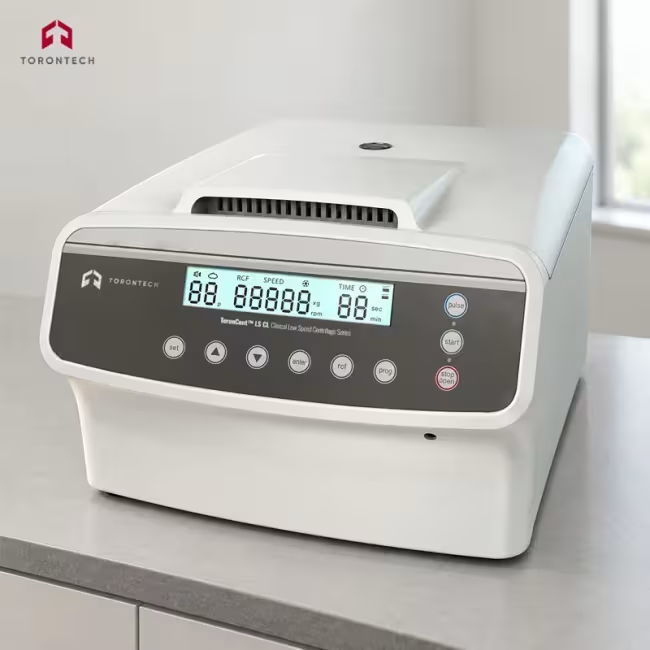
Clinical Low Speed Centrifuge Series - ToronCent™ LS CL
ToronCent™ LS CL clinical low speed centrifuge series covers three models on a shared platform, reaching 4,200 rpm on the smallest and 6,000 rpm and 5,120 x g on the largest. Hospital laboratories, physician offices, andrology units, and clinical research groups use them for serum separation, urine sediment work, and cell washing. Each model runs a fixed angle rotor plus a swing-out rotor taking 50 mL conical tubes or 15 mL and 5 mL brackets. Footprints suit a shared bench or satellite room.
Model choice comes down to rotor pairing. The LS CL-420 pairs two angle rotors at 4,000 rpm with a swing rotor reaching 2,760 x g, which suits routine blood tube and semen work. The LS CL-500 steps up to a 24 x 10 mL angle rotor at 5,000 rpm and 4,030 x g for higher tube counts. The LS CL-600 carries a 12 x 15 mL angle rotor at 6,000 rpm and 5,120 x g, the series ceiling. All three share the same swing-out rotor.
A microprocessor controller calculates RCF so operators enter either unit. The LS CL-420 stores 25 user-defined programs and runs a DC brushless motor. A damping structure isolates rotor vibration from the housing, which keeps the instrument steady on a light bench. The lid closes under soft pressure, locks out operation when open, and stays locked while the rotor turns.
Clinical Low Speed Centrifuge Series - ToronCent™ LS CL Applications
The ToronCent™ LS CL series handles the tube formats and g-force range that routine clinical separation calls for.
- Serum and Plasma Separation: batch processing of vacuum blood collection tubes for chemistry, serology, and immunoassay panels
- Urinalysis: sediment concentration in 10 mL and 15 mL tubes ahead of microscopic examination, with gentle handling that leaves the sediment button intact
- Andrology and Semen Analysis: sperm washing, density gradient preparation, and seminal plasma removal at the low g-force these protocols call for
- Physician Office and Point-of-Care Laboratories: a compact unit sized for satellite testing rooms rather than a central laboratory bench
- Cell Washing: repeated wash and resuspension cycles across 15 mL and 5 mL tube brackets
- Clinical Research: small-batch separations in 1.5 mL microtubes through 50 mL conical tubes on one instrument
- Microbiology: concentration of dilute cultures and specimen suspensions before plating or staining
- Cytology Sample Preparation: recovery of cells out of body fluids ahead of slide preparation
- Blood Banking Support: component checks and small-volume separations alongside the main processing line
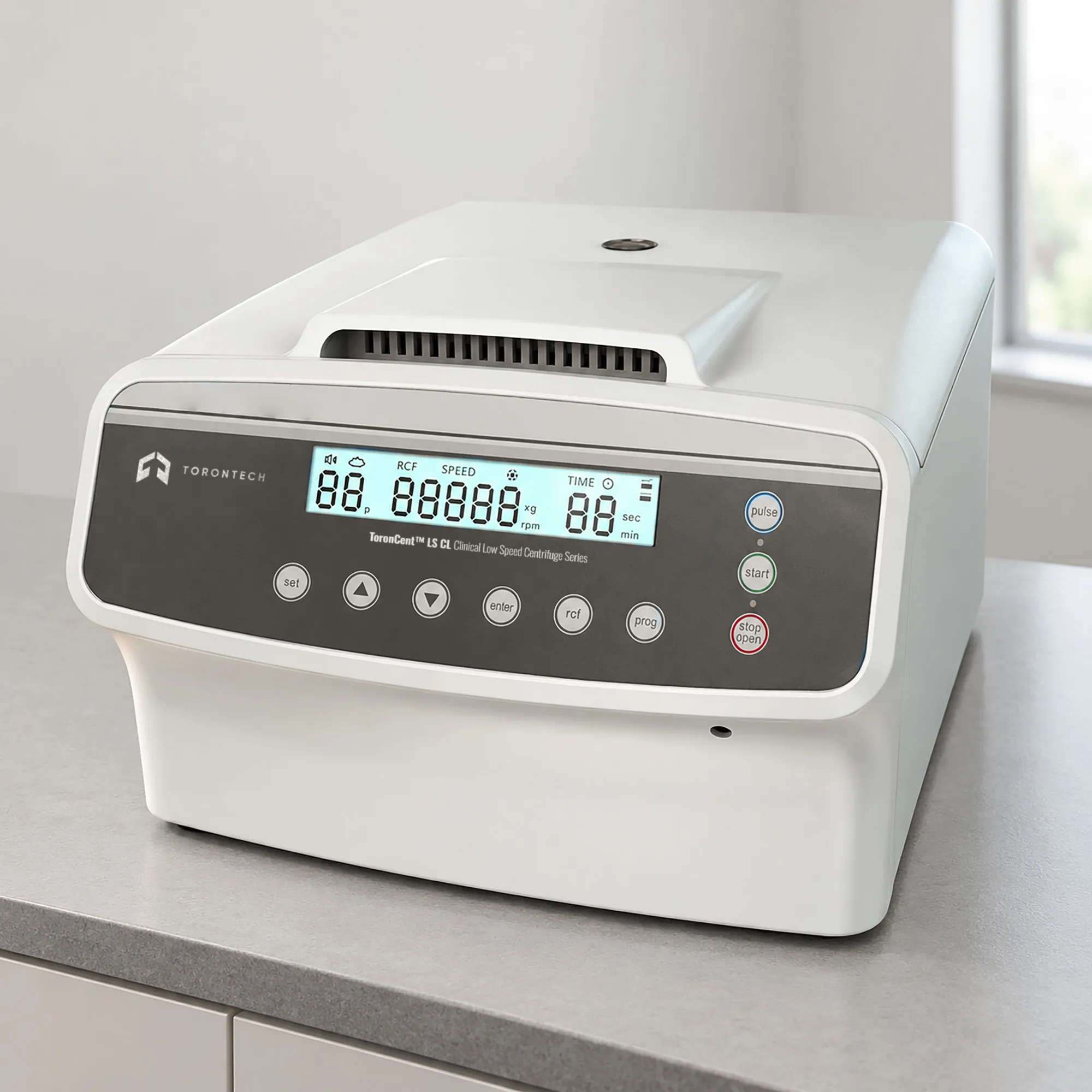
Clinical Low Speed Centrifuge Series - ToronCent™ LS CL Key Features
The control set, rotor pairings, and safety design target routine clinical batches rather than research-scale workloads.
- Three-Model Series: one platform covering 4,200 rpm through 6,000 rpm, so a laboratory can size the instrument to its tube counts and g-force needs
- Shared Swing-Out Rotor: the same 4 x 50 mL rotor and bracket set fits across the series, which simplifies accessory stocking for multi-unit sites
- Automatic RCF Calculation: converts between rpm and x g so protocols written in either unit run without hand conversion
- 25 Stored Programs: recalls routine methods on demand, removing repeat setup for high frequency panels
- DC Brushless Motor: runs without carbon brushes, leaving no carbon dust in the chamber and no brush replacement over the service life
- Microprocessor Control: holds set speed within ±30 rpm across the range
- Vibration Damping Structure: absorbs residual rotor imbalance so the instrument stays put on a light or shared bench
- Soft-Close Interlocked Lid: latches under light pressure, blocks operation when open, and stays locked while the rotor turns
- Touch Panel and LCD Display: shows speed, RCF, and time on one screen with direct key entry
- Wide Bracket Range: covers 0.5 mL microtubes up to 50 mL conical tubes, including 15 mL, 10 mL, 5 mL, and vacuum blood collection formats
- Compact 380 mm Footprint: the LS CL-420 weighs 19 kg and draws 250 W, which suits a satellite room or a crowded bench
- Noise at or Below 65 dB(A): keeps a shared clinical space workable through repeated runs
Theory and Method
Centrifugal separation exploits the fact that particles denser than their suspending medium migrate outward under rotation. Force on each particle scales with rotating radius and with the square of angular velocity, so a modest speed increase produces a large jump in relative centrifugal force. Sedimentation rate depends on particle size, how far its density sits above the medium, and the viscous drag that medium exerts. Whole blood separates cleanly because red cells, white cells, and plasma occupy distinct density bands.
Clinical separation sits deliberately at the low end of the speed range. Excessive g-force ruptures red cells and releases hemoglobin, which interferes with the chemistry and immunoassay panels the serum was drawn for. Sperm cells lose motility and membrane integrity under similar stress, so andrology protocols specify gentle conditions. Urine sediment holds casts and crystals that fragment when spun too hard, which destroys the diagnostic features the microscopist looks for. A ceiling of 6,000 rpm keeps every model in the series inside these working windows.
Rotor balance governs how the instrument behaves mechanically. An unevenly loaded rotor puts a rotating side load into the drive shaft, and that load transmits into the housing as vibration and noise. The damping structure absorbs the residual imbalance that careful tube pairing cannot remove, which keeps the instrument from walking across a bench. The interlocked lid closes the loop on the safety side, preventing a run with the chamber open and preventing access while the rotor carries energy.
Clinical Low Speed Centrifuge Series - ToronCent™ LS CL Technical Specifications
| Parameter | ToronCent™ LS CL-420 |
|---|---|
| Maximum Speed | 4,200 rpm |
| Maximum RCF | 2,760 x g |
| Maximum Capacity | 4 x 50 mL (swing rotor) |
| Speed Accuracy | ±30 rpm |
| Time Setting Range | 1 min to 99 min |
| Noise Level | ≤65 dB(A) |
| Voltage | AC 220 V ±22 V, 50/60 Hz (110V is also available) |
| Power Consumption | 250 W |
| Dimensions (W x D x H) | 380 x 500 x 300 mm |
| Packing Dimensions (W x D x H) | 465 x 660 x 350 mm |
| Net Weight | 19 kg |
Rotor Range
| Model | Rotor | Type | Maximum Capacity | Maximum Speed | Maximum RCF |
|---|---|---|---|---|---|
| LS CL-420 | Rotor 1a | Fixed angle | 18 x 10 mL | 4,000 rpm | 2,200 x g |
| LS CL-420 | Rotor 1b | Fixed angle | 12 x 10 mL | 4,000 rpm | 2,200 x g |
| LS CL-420 | Rotor 2a | Swing-out | 4 x 50 mL | 4,200 rpm | 2,760 x g |
| LS CL-420 | Rotor 2b | Swing-out | 12 x 15 mL | 4,200 rpm | 2,760 x g |
| LS CL-420 | Rotor 2c | Swing-out | 8 x 10 mL / 16 x 5 mL | 4,200 rpm | 2,760 x g |
Bracket and Adapter Options
| Model | Rotor | Bracket | Adapter Capacities |
|---|---|---|---|
| LS CL-420 | Rotor 1a | Not applicable | Direct tube loading, 18 x 10 mL; 7 mL adapter |
| LS CL-420 | Rotor 1b | Not applicable | Direct tube loading, 12 x 10 mL; 5 mL blood collection tube adapter |
| LS CL-420 | Rotor 2a | 4 x 50 mL | 15 mL conical; custom configurations on request |
| LS CL-420 | Rotor 2b | 12 x 15 mL | 1.5 mL; 5 mL; 10 mL |
| LS CL-420 | Rotor 2b | 12 x 2 x 5 mL | 0.5 mL; 1.5 mL |
| LS CL-420 | Rotor 2c | 8 x 10 mL | |
| LS CL-420 | Rotor 2c | 8 x 2 x 5 mL |
Custom bracket and adapter configurations are available across the series.