
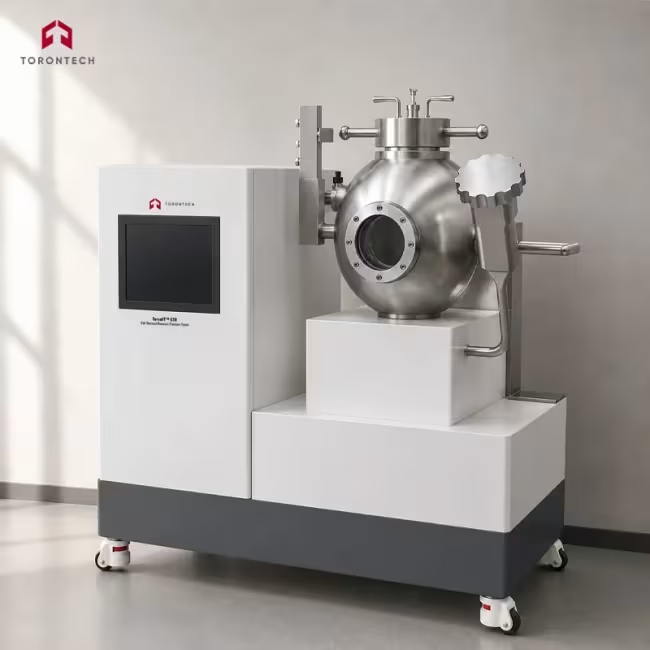
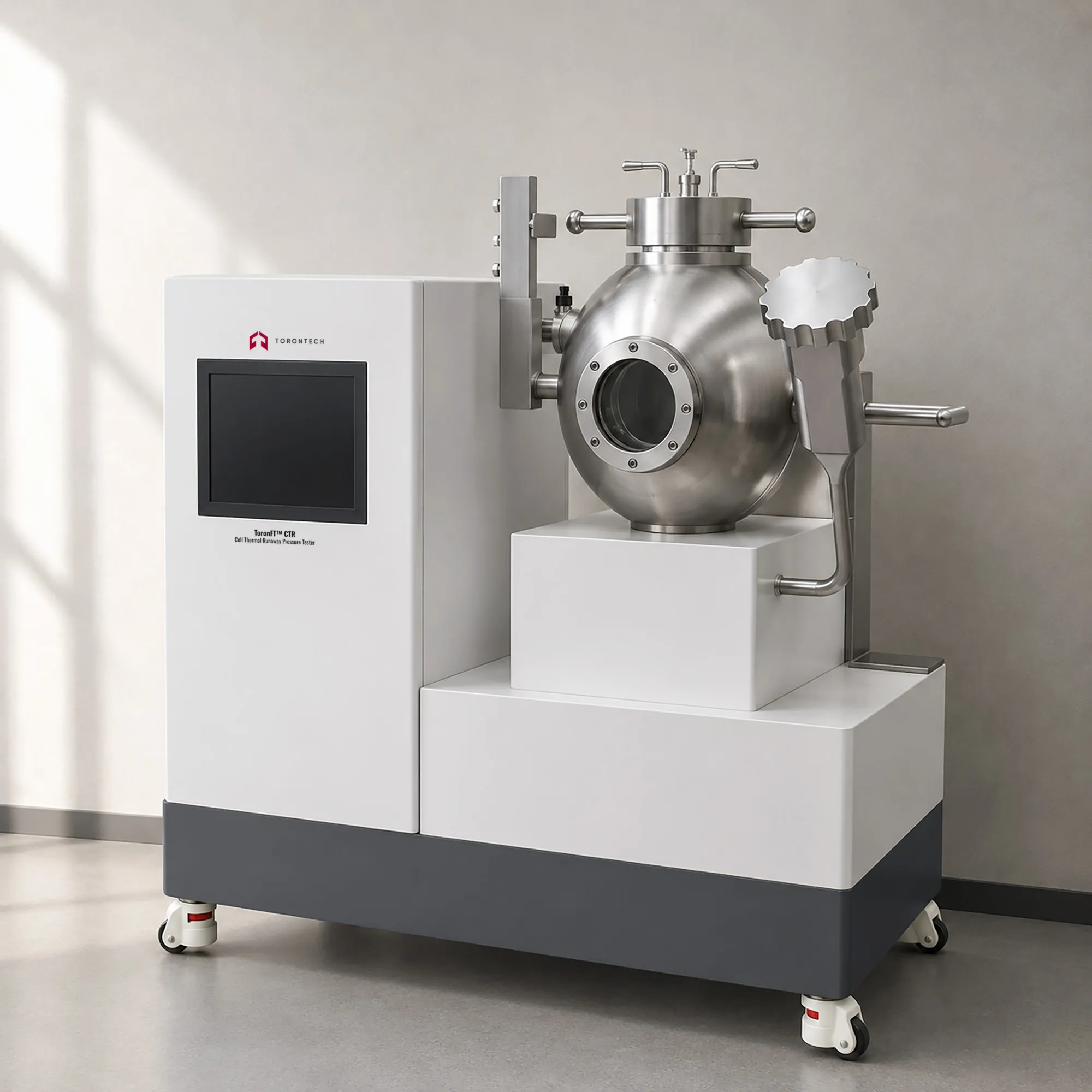
Cell Thermal Runaway Pressure Tester — ToronFT™ CTR
ToronFT™ CTR Cell Thermal Runaway Pressure Tester is a specialized battery safety testing instrument that uses electric heating inside a sealed pressure vessel to force a battery cell or assembly into thermal runaway — generating and collecting the gases discharged from the battery during the thermal runaway event. By capturing and quantifying the vent gases produced, the ToronFT™ CTR provides critical data on the composition, pressure rise rate, and total volume of flammable and toxic gases released during thermal runaway — information essential for battery safety design, hazard assessment, and fire code compliance programs.
The Cell Thermal Runaway Pressure Tester features a fully automatic control system (auto vacuum, auto gas filling, auto stirring), a PLC programmable control system with Labview host software, a movable metal specimen holder inside the chamber, and real-time monitoring of temperature, chamber pressure, and oxygen concentration — with test data reports automatically generated and output in Excel format for straightforward data management and analysis.
Cell Thermal Runaway Pressure Tester — ToronFT™ CTR Applications
- Lithium-ion battery manufacturers: vent gas composition, volume, and pressure characterization for cell and module safety qualification
- Electric vehicle and energy storage system developers: thermal runaway gas generation data for ventilation system design, fire suppression system selection, and explosion hazard assessment
- Third-party battery safety testing laboratories: thermal runaway gas pressure testing per UL 9540A and EN standards
- Fire protection engineers: gas generation and pressure rise rate data for battery storage facility hazard analysis and suppression system design
- R&D departments: evaluation of new cell chemistries and safety features (vents, separators, electrolytes) for reduced gas generation under thermal runaway
Standards
The ToronFT™ CTR supports cell thermal runaway pressure testing in compliance with internationally recognized battery safety and explosion prevention standards, including:
- EN 15967: Determination of maximum explosion pressure and maximum rate of pressure rise of gases and vapours (gas explosion pressure characterization)
- UL 9540A: Standard test method for evaluating thermal runaway fire propagation in battery energy storage systems (thermal runaway gas generation section)
- IEC 62619: Secondary cells and batteries — Safety requirements for secondary lithium cells and batteries for industrial applications
- ASTM E681: Standard test method for concentration limits of flammability of chemicals (vapor and gas)
- UN 38.3: Manual of tests and criteria — Lithium metal and lithium-ion batteries (thermal abuse test reference)
Cell Thermal Runaway Pressure Tester — ToronFT™ CTR Key Features
- Forces battery thermal runaway using electric heating inside a sealed pressure vessel — enabling controlled, instrumented gas generation and pressure rise measurement
- Customizable pressure vessel volume — adaptable to any battery cell or module size per user requirements
- Movable door with locking screws for chamber sealing — secure, repeatable specimen loading and chamber closure
- Movable metal specimen holder inside the chamber — flexible specimen positioning for different battery form factors
- Fully automatic control: auto vacuum, auto gas filling, auto stirring — eliminating manual pre-test preparation steps
- PLC programmable control system with Labview host software — strict interface, high automation, all complex procedures integrated
- Real-time monitoring: temperature, chamber pressure, and oxygen concentration — complete event characterization throughout thermal runaway
- Test data report: automatically generated; output in Excel format — easy viewing and editing for data management and submission
- Compliant with EN 15967 and UL 9540A — covering both European gas explosion pressure standards and US battery energy storage thermal runaway standards
Theory and Method
ToronFT™ CTR forces a battery cell into thermal runaway using electric heating within the sealed pressure vessel. After the vessel is loaded with the battery specimen via the movable specimen holder, the cell installation port is sealed using the movable door with locking screws. The system then automatically performs the pre-test sequence: auto vacuum (evacuating the vessel to a defined sub-atmospheric pressure), auto gas filling (introducing a defined atmosphere if required), and auto stirring (ensuring gas mixture uniformity inside the chamber).
As the heating program drives the battery into thermal runaway, the battery's internal pressure rises, vent gases are released, and the vessel pressure increases. The PLC control system with Labview host software continuously monitors and records chamber pressure, oxygen concentration, and temperature throughout the event. The pressure rise rate and maximum pressure are compared against the explosion pressure thresholds specified by EN 15967. Post-test, the test data report is automatically generated and output in Excel format, providing a complete, traceable record of the thermal runaway gas generation event. The vessel volume is customizable to match the battery size and test requirements specified by the user.
Cell Thermal Runaway Pressure Tester — ToronFT™ CTR Technical Specifications
| Parameter | Specification |
|---|---|
| Model | ToronFT™ CTR |
| Test Principle | Electric heating inside sealed vessel; forces battery thermal runaway; gas collection and pressure measurement |
| Pressure Vessel Volume | Customizable per user requirements |
| Cell Loading Port | Movable door with locking screws (chamber sealing) |
| Specimen Holder | Movable metal specimen holder (inside chamber) |
| Automated Control Functions | Auto vacuum, auto gas filling, auto stirring |
| Control System | PLC programmable + Labview host software |
| Real-Time Monitoring | Temperature, chamber pressure, oxygen concentration |
| Data Report Output | Automatically generated; Excel format |
| Standard Compliance | EN 15967; UL 9540A |