
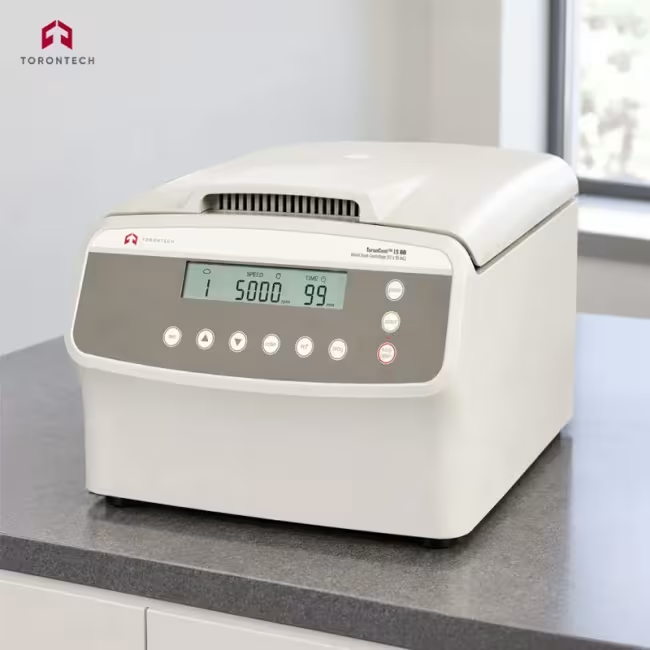
Blood Bank Centrifuge (12 x 15 mL) - ToronCent™ LS BB
ToronCent™ LS BB blood bank centrifuge runs a dedicated 12 x 15 mL rotor at 5,000 rpm and 3,555 x g, with a program set built around transfusion laboratory workflows. Blood banks, transfusion services, and hospital immunohematology departments use it where the same short protocol repeats many times a day. Acceleration reaches speed in 15 seconds or less, which keeps total cycle time down when a bench runs dozens of spins per shift. The chamber is stainless steel and the unit weighs 19 kg.
Repeatability drives the design. The controller stores up to 50 user-defined programs, so a laboratory can lock each protocol to a fixed speed and time rather than relying on operators to dial them in. An inching function delivers short manual bursts for separations that finish faster than a timed run. Fault self-diagnosis watches for overspeed, load imbalance, and door lock failures, and reports what it finds on the display.
An LCD display and microcomputer control drive setup, holding speed within ±30 rpm. A brushless DC motor runs the spindle with no carbon dust and no brush service over its life. The electronic door lock engages under light pressure and holds the lid shut while the rotor turns. Power draw is 250 W on a 380 mm wide footprint.
Blood Bank Centrifuge (12 x 15 mL) - ToronCent™ LS BB Applications
The ToronCent™ LS BB suits transfusion and immunohematology benches running repeat protocols on a fixed tube format.
- Blood Bank Sample Processing: preparation of donor and recipient samples ahead of typing, screening, and compatibility testing
- Red Cell Suspension Washing: repeated wash and resuspension cycles in 15 mL tubes for reagent and test cell preparation
- Transfusion Service Laboratories: a programmable bench unit where protocol lock-down matters more than g-force range
- Serum and Plasma Separation: clarified samples for antibody screening and serologic panels
- Hospital Immunohematology: routine spins on a bench that repeats the same cycle throughout a shift
- Component Quality Checks: small-volume separations alongside the main processing line
- Clinical Serology: sample clarification ahead of antibody and antigen testing
- Reference and Reagent Preparation: cell suspension work supporting in-house reagent panels
- Teaching and Training Laboratories: a stored-program instrument that produces consistent results across student operators
Standards
The source documentation for the ToronCent™ LS BB cites no test method or safety standard, so this page carries no compliance claim. The electronic door lock, the fault self-diagnosis system, and the stainless steel chamber operate as protective design rather than certified conformity to a published standard. Transfusion services that require documented centrifuge safety, electromagnetic compatibility, in vitro diagnostic classification, or regional market access approval should request the certificates ahead of ordering. Torontech supplies the documentation the manufacturer holds on request.
Blood Bank Centrifuge (12 x 15 mL) - ToronCent™ LS BB Key Features
The program memory, ramp performance, and chamber build target transfusion benches repeating short protocols throughout a shift.
- Dedicated Blood Bank Rotor: a 12 x 15 mL angle rotor rated to 5,000 rpm and 3,555 x g, matched to the machine rather than shared across a general purpose range
- 50 Stored Programs: locks each protocol to a fixed speed and time, which removes operator variation from a process where consistency drives the reading
- 15 Second Acceleration: reaches set speed in 15 seconds or less, cutting cycle time and narrowing run-to-run variability on short protocols
- Inching Function: delivers a controlled manual burst for separations that finish faster than the shortest timed setting
- Fault Self-Diagnosis: monitors overspeed, load imbalance, and door lock condition, and reports the specific fault on the display rather than stopping silently
- Electronic Door Lock: engages under light pressure and holds the lid shut while the rotor turns
- Stainless Steel Inner Chamber: withstands repeated cleaning and disinfection, which matters on a bench handling blood daily
- Brushless DC Motor: runs without carbon brushes, leaving no carbon dust in the chamber and no brush replacement over the service life
- Microcomputer Control with LCD Display: shows set and running values, holding speed within ±30 rpm
- 19 kg on a 380 mm Footprint: sits on a shared transfusion bench without dedicated space
- 250 W Power Draw: low enough for a standard bench circuit alongside other instruments
- Noise at or Below 65 dB(A): workable in a staffed laboratory through repeated cycles
Theory and Method
Blood separates under centrifugal force because its components occupy distinct density bands. Red cells are the densest and pack at the tube bottom, leukocytes and platelets form a thin buffy coat above them, and plasma or serum stays on top. The boundaries sharpen as the applied force and the spin duration increase, which is why transfusion protocols specify both a g-force and a time rather than one or the other. Reproducing a boundary in the same place every run is what makes serologic reading consistent.
Ramp time counts as part of the dose. A tube experiences force during acceleration and deceleration as well as at set speed, and on a short protocol those phases represent a large share of the total. A spin nominally lasting one minute can vary considerably between instruments if one takes 40 seconds to reach speed and another takes 15. Reaching set speed within 15 seconds narrows that variability and makes a short published protocol behave the way it was written.
Stored programs close the remaining gap. A laboratory that keys speed and time by hand introduces operator variation into a process where the reading depends on where a cell button sits and how firmly it adheres. Locking each protocol into memory removes that step. The inching function covers the other case, where a separation completes faster than any timed setting and the operator wants a controlled burst instead.
Blood Bank Centrifuge (12 x 15 mL) - ToronCent™ LS BB Technical Specifications
| Parameter | Specification |
|---|---|
| Maximum Speed | 5,000 rpm |
| Maximum RCF | 3,555 x g |
| Maximum Capacity | 12 x 15 mL |
| Speed Accuracy | ±30 rpm |
| Time Setting Range | 1 min to 99 min |
| Minimum Acceleration Time | ≤15 s |
| Program Memory | Up to 50 user-defined programs |
| Motor | Brushless DC |
| Control | Microcomputer, LCD display |
| Inner Chamber | Stainless steel |
| Door Lock | Electronic, automatic latching |
| Self-Diagnosis | Overspeed, imbalance, door lock |
| Noise Level | ≤65 dB(A) |
| Voltage | AC 220 V ±22 V, 50/60 Hz (110V is also available) |
| Power Consumption | 250 W |
| Dimensions (W x D x H) | 380 x 500 x 300 mm |
| Packing Dimensions (W x D x H) | 465 x 660 x 350 mm |
| Net Weight | 19 kg |
Rotor
| Rotor | Type | Maximum Capacity | Maximum Speed | Maximum RCF |
|---|---|---|---|---|
| Rotor 1 | Fixed angle | 12 x 15 mL | 5,000 rpm | 3,555 x g |