
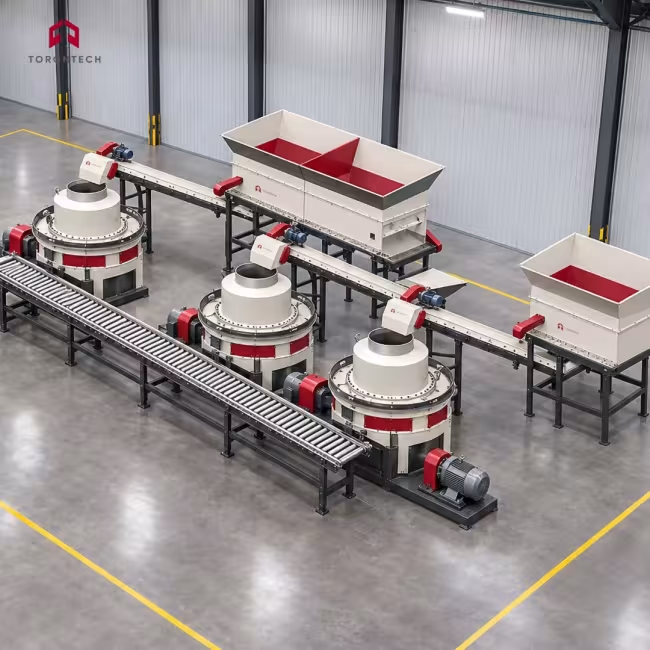
Biomass and RDF Briquette Machine
Biomass and RDF Briquette Machine - ToronPR™ RDF Series
Flat Ring Die Briquette Machine for Biomass, Straw and Refuse Derived Fuel
The biomass briquette machine compresses straw, crop residue, wood waste, and processed industrial solid waste into dense square fuel blocks. Biomass fuel producers, waste-to-energy suppliers, and recycling plants use it to turn bulky, low-density material into a solid fuel that stores, ships, and burns efficiently. The ToronPR™ RDF presses material through a horizontal flat ring die, forming 32 × 32 mm blocks of 50 to 100 mm length. Seven configurations deliver up to 10 t/h of biomass briquettes.
The flat ring die replaces the vertical ring die found on many briquette presses. As the die assembly rotates, centrifugal force spreads incoming material evenly across all molding holes. This even distribution prevents material from piling up in the center, which lowers energy use per ton. The design targets high-lignin and hard-to-form materials that challenge conventional presses.
The same machine produces refuse-derived fuel and solid recovered fuel blocks from processed industrial solid waste. Heating elements bring the die up to working temperature quickly, while a forced cooling system holds it there during long production runs. A multi-channel seal keeps dust out of the bearing lubrication area for longer service life. Torontech matches each model and die setup to the feedstock, moisture level, and output a plant needs.
Biomass and RDF Briquette Machine - ToronPR™ RDF Series Applications
This straw briquette machine serves operations that convert loose biomass or processed waste into a dense, transportable fuel.
- Agricultural Residue Processing: pressing corn stalks, wheat and rice straw, and other crop residue into fuel blocks
- Wood Waste Recycling: converting sawdust, wood chips, shavings, and bark into biomass briquettes
- Refuse-Derived Fuel Production: forming RDF blocks from shredded and sorted municipal and commercial waste
- Solid Recovered Fuel for Industry: producing SRF blocks for cement kilns, industrial boilers, and power plants
- Biomass Power and Heating: supplying uniform fuel blocks for biomass boilers and district heating systems
- Forage and Straw Densification: compressing forage and straw into dense blocks for storage and transport
- Waste-to-Energy Preprocessing: densifying light, bulky waste fractions before thermal treatment
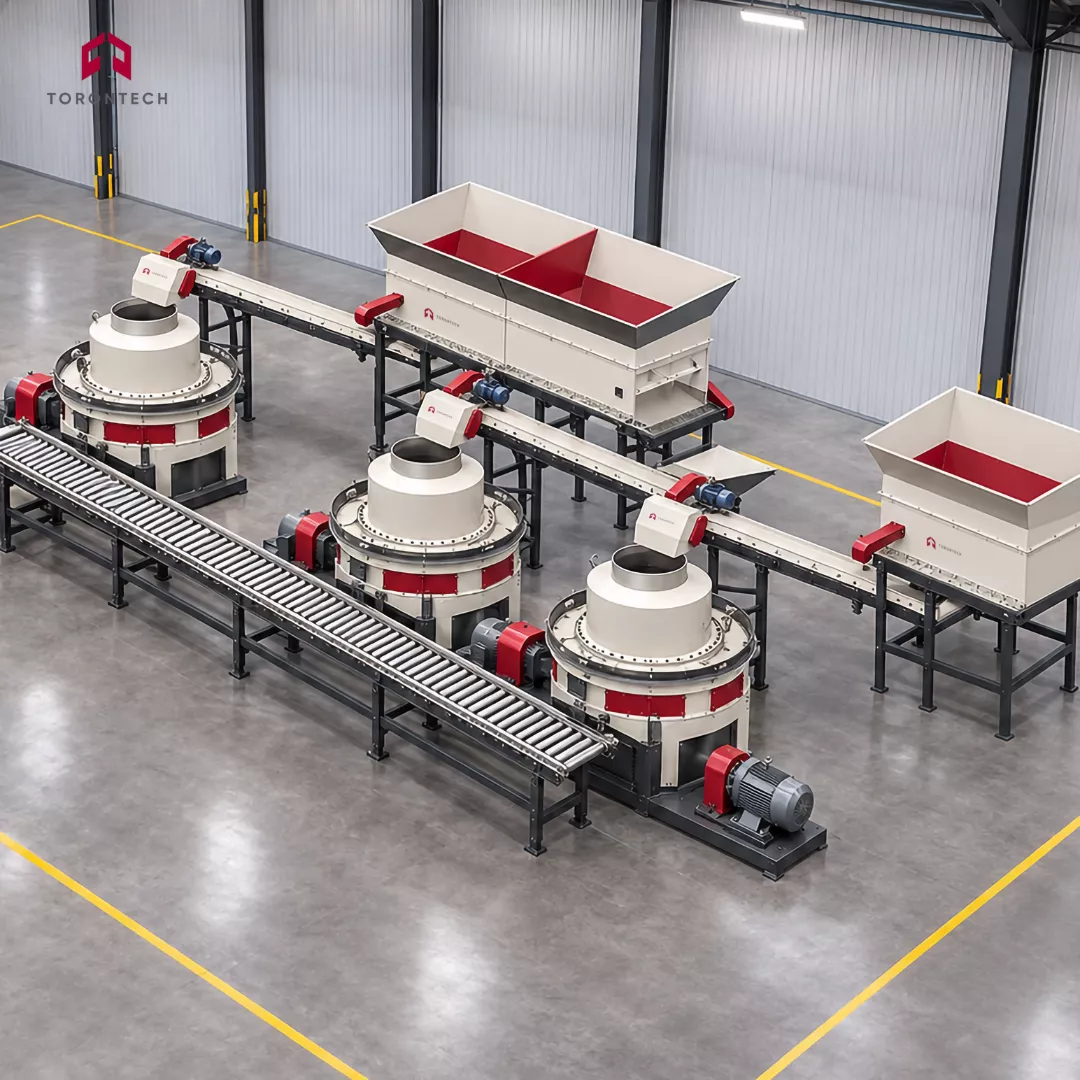
Biomass and RDF Briquette Machine - ToronPR™ RDF Series Key Features
The machine combines a flat ring die, even material distribution, and active temperature control for continuous fuel production.
- Flat Ring Die Design: a horizontal ring die replaces the vertical ring layout, supporting even pressing across all molding holes
- Centrifugal Material Distribution: die rotation spreads material evenly to every hole, preventing center buildup and lowering energy use per ton
- Built for High-Lignin Material: suited to hard-to-form biomass that challenges conventional briquette presses
- Die Heating at Start-Up: heating elements bring the die to forming temperature quickly for stable production
- Forced Die Cooling: a cooling system holds die temperature steady during long runs and supports continuous operation
- Multi-Channel Bearing Seal: sealing keeps dust out of the bearing lubrication area, extending bearing life
- Dual Feedstock Capability: produces biomass briquettes and RDF or SRF blocks from industrial solid waste
- Uniform Block Size: forms 32 × 32 mm square blocks of 50 to 100 mm length with 0.8 to 1.3 t/m³ density
- Seven Capacity Options: models deliver 1.0 to 10.0 t/h on biomass and 0.5 to 6.0 t/h on industrial solid waste
Theory and Method
Briquetting densifies loose material under high pressure. Rollers travel over the flat ring die and force material into its square molding holes. Inside each hole, extrusion pressure, friction against the die walls, and shear between the rollers combine to compact the particles tightly. Continuous pressing pushes the compacted material out the other side as a solid block.
Heat turns that compacted mass into a durable fuel. Pressure and friction raise the material temperature, which softens the lignin naturally present in plant matter. Softened lignin flows between particles and acts as a binder, then sets as the block cools. Plastic fractions in refuse-derived fuel soften in a similar way and help bind the block together without added adhesives.
Temperature control keeps this process stable. Heating elements bring a cold die up to forming temperature quickly at start-up, so the first blocks form properly. During long runs, friction can overheat the die, so a forced cooling system draws heat away and holds a steady working temperature. The rotating flat ring die feeds every hole evenly, which keeps pressure balanced across the die and output consistent.
Biomass and RDF Briquette Machine - ToronPR™ RDF Series Technical Specifications
Models 1500 to 4500 (Dual Motor)
| Parameter | ToronPR™ RDF 1500 | ToronPR™ RDF 2500 | ToronPR™ RDF 3500 | ToronPR™ RDF 4500 D |
|---|---|---|---|---|
| Output (Biomass, Straw) | 1.0-1.5 t/h | 1.5-2.5 t/h | 2.5-3.5 t/h | 3.5-5.0 t/h |
| Output (Industrial Solid Waste) | 0.5-1.0 t/h | 1.0-1.5 t/h | 2.0-2.5 t/h | 2.5-3.0 t/h |
| Power | 45 kW | 75 kW | 110 kW | 2 × 75 kW |
| Number of Die Holes | 36 | 48 | 72 | 90 |
| Briquette Size (L × W × H) | 32 × 32 × (50-100) mm | 32 × 32 × (50-100) mm | 32 × 32 × (50-100) mm | 32 × 32 × (50-100) mm |
| Briquette Density | 0.8-1.3 t/m³ | 0.8-1.3 t/m³ | 0.8-1.3 t/m³ | 0.8-1.3 t/m³ |
Models 4500 (Single Motor) to 8000
| Parameter | ToronPR™ RDF 4500 S | ToronPR™ RDF 6000 | ToronPR™ RDF 8000 |
|---|---|---|---|
| Output (Biomass, Straw) | 3.5-5.0 t/h | 4.0-6.0 t/h | 6.0-10.0 t/h |
| Output (Industrial Solid Waste) | 2.5-3.0 t/h | 3.0-4.0 t/h | 4.0-6.0 t/h |
| Power | 132 kW | 200 kW | 250 kW |
| Number of Die Holes | 90 | 120 | 150 |
| Briquette Size (L × W × H) | 32 × 32 × (50-100) mm | 32 × 32 × (50-100) mm | 32 × 32 × (50-100) mm |
| Briquette Density | 0.8-1.3 t/m³ | 0.8-1.3 t/m³ | 0.8-1.3 t/m³ |
Output is given in metric tons per hour. Parameters are for reference only and may change according to the final configuration.
Common Specifications
| Item | Description |
|---|---|
| Die Type | Horizontal flat ring die with rotating, centrifugal material distribution |
| Forming Principle | Roller extrusion pressure, friction, and shear through square die holes |
| Temperature Control | Heating elements for start-up and forced cooling for continuous operation |
| Bearing Protection | Multi-channel dust seal |
| Suitable Materials | Biomass, straw, and industrial solid waste for RDF and SRF production |