
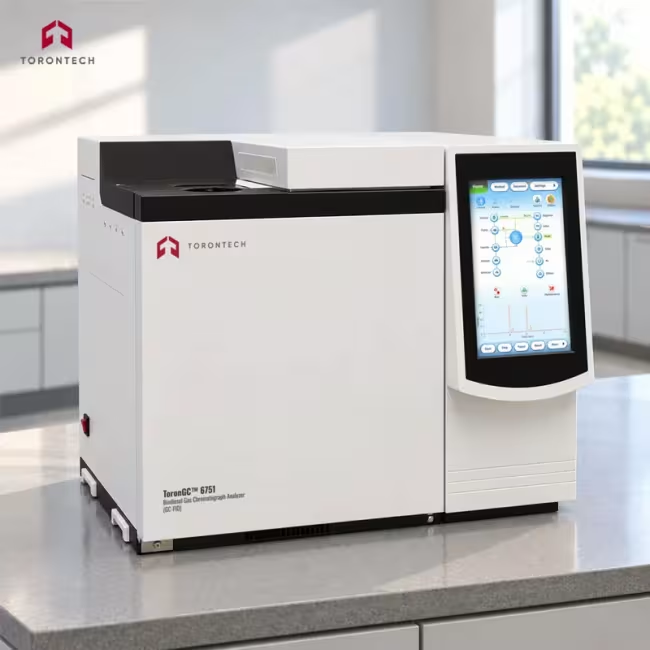
Biodiesel Gas Chromatograph Analyzer (GC-FID)
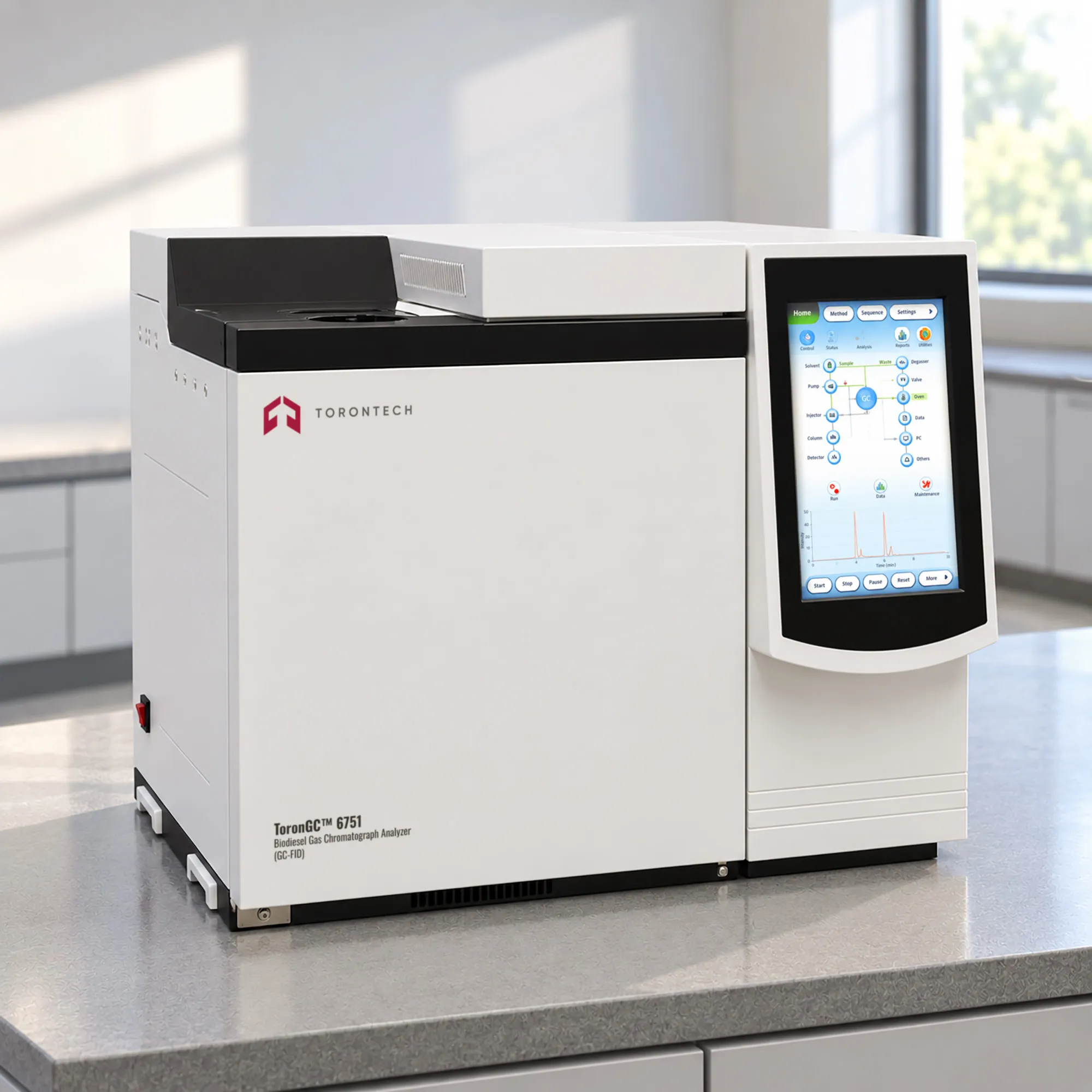
Biodiesel Gas Chromatograph Analyzer (GC-FID) – ToronGC™ 6751
Biodiesel Gas Chromatograph for ASTM D6584: Free and Total Glycerin, Monoglycerides, Diglycerides and Triglycerides in B100
The ASTM D6584 gas chromatograph measures free glycerin, total glycerin, monoglycerides, diglycerides, and triglycerides in fatty acid methyl ester (FAME) biodiesel derived from vegetable oils or animal fats. These analytes are regulated under ASTM D6751 and EN 14214, which define the maximum allowable glyceride concentrations a B100 batch must meet before qualifying as blending stock or neat fuel. The ToronGC™ 6751 gives production laboratories and third-party test facilities a compliant analytical system for that quality determination.
The analyzer pairs a flame ionization detector (FID) with a true cold on-column injection inlet. Unlike split/splitless inlets, the cold on-column system deposits sample directly onto the analytical column below the solvent boiling point. This prevents selective evaporation of heavier glycerides before separation begins, preserving complete analyte transfer across the full mass range without discriminative loss or thermal degradation of labile triglyceride fractions.
Separation occurs on a non-polar biodiesel analytical column (10 m x 0.32 mm ID, 0.1 μm film thickness) connected to a 1 m x 0.53 mm ID guard pre-column via a leak-free high-temperature purged metal tee connector. The column is rated for the wide temperature cycles this method demands and maintains reproducible retention times across its service life.
Biodiesel Gas Chromatograph Analyzer (GC-FID) – ToronGC™ 6751 Applications
- Biodiesel production QC: Verifies that finished B100 meets the free glycerin, total glycerin, and glyceride limits set in ASTM D6751 and EN 14214 before a batch is cleared for sale or blending.
- Third-party fuel testing laboratories: Equips independent certification labs with a GC-FID system configured for ASTM D6584 glycerin and glyceride determinations on producer-submitted samples.
- Transesterification process monitoring: Tracks monoglyceride, diglyceride, and triglyceride levels at critical stages of the reactor to confirm that conversion has reached the required yield before a batch advances.
- Renewable fuel regulatory compliance: Supports suppliers certifying B100 to the U.S. Renewable Fuel Standard (RFS2) or California LCFS programs that reference ASTM D6751 as the governing quality specification.
- Research and feedstock development: Quantifies glycerol and glyceride fractions in experimental FAME batches from novel feedstocks, supporting feedstock qualification and reaction parameter optimization.
- Fuel terminal and blending operations: Allows terminal laboratories to verify B100 feedstock quality on receipt before incorporating it into B5, B10, or B20 diesel pool.
Standards
- ASTM D6584 — Standard test method for determining total monoglycerides, total diglycerides, total triglycerides, and free and total glycerin in B100 fatty acid methyl ester biodiesel by gas chromatography; the method this analyzer is configured and validated to execute.
- ASTM D6751 — Standard specification for biodiesel B100 blend stock intended for middle distillate fuels; defines the maximum permissible concentrations of glycerin and glycerides that finished B100 must satisfy for commercial fuel use.
- EN 14214 — European specification for fatty acid methyl esters (FAME) intended for diesel engines and heating applications; sets glyceride concentration limits for markets requiring European certification, equivalent in scope to the limits established by ASTM D6751.
Biodiesel Gas Chromatograph Analyzer (GC-FID) – ToronGC™ 6751 Key Features
- True cold on-column injection inlet: deposits sample below the solvent boiling point directly onto the analytical column, delivering unbiased transfer of the full glyceride mass range and preventing degradation of labile triglyceride components at the inlet.
- 10.2-inch touch LCD with real-time monitoring: displays oven temperature, detector status, and carrier gas pressure simultaneously, so the operator can confirm run conditions without navigating separate menus during a sequence.
- Five-stage temperature programming: accommodates the wide oven ramp needed to elute the volatile glycerol fraction and the high-boiling triglyceride fraction within a single continuous run.
- Electronic pressure control (EPC) on both the FID and capillary inlet: holds flow and inlet pressure constant between injections without manual adjustment, supporting retention time reproducibility across a full sample batch.
- Over-temperature protection with configurable shutoff limit: powers down the oven automatically if any zone exceeds the user-defined threshold, protecting the biodiesel analytical column from irreversible thermal damage during a high-temperature ramp.
- Carrier gas pressure-loss protection: shuts off oven heating on a pressure drop at the inlet, preventing column oxidation in the event of a cylinder or regulator failure.
- Intelligent back-gate temperature control: dynamically adjusts the oven door angle to hold the programmed setpoint under ambient room temperature variation, maintaining setpoint accuracy to ±0.1°C throughout the run.
- Support for up to four detector configurations: allows the instrument to run FID and TCD simultaneously or to be reconfigured for other petroleum and fuel GC applications beyond biodiesel.
- 19-position autosampler: processes derivatized biodiesel samples unattended overnight, reducing per-sample hands-on time in high-throughput QC laboratories.
- Self-diagnosis with fault code display: identifies column, detector, and carrier gas faults by code on the screen, allowing the operator to locate and address failures without an external service manual.
Theory and Method
Glycerol and glycerides (mono-, di-, and tri-) are polar, high-boiling compounds that cannot be injected onto a GC column in their native form without adsorption or thermal loss at the inlet. Before analysis, each sample is treated with MSTFA (N-methyl-N-trimethylsilyltrifluoroacetamide) in pyridine, which converts the hydroxyl groups on glycerol and the glyceride backbones into trimethylsilyl (TMS) ether derivatives. The derivatization raises compound volatility and allows each analyte to migrate through the column without irreversible surface binding or decomposition.
Two internal standards are added to the sample before derivatization: 1,2,4-butanetriol (IS1) for the glycerol fraction and tricaprin (IS2) for the glyceride fractions. Four reference compounds (glycerol, mono-olein, di-olein, and tri-olein) establish the calibration curve. The derivatized sample is loaded via the 19-position autosampler into the cold on-column inlet and deposited directly onto the biodiesel analytical column for separation.
A five-stage oven temperature ramp sequentially elutes the glycerol fraction and the three glyceride classes through the FID, producing signals proportional to the carbon mass of each compound. Peak area ratios against the respective internal standards yield the absolute mass fraction (% m/m) of free glycerin, total glycerin, and each glyceride class, which are then compared against the limits in ASTM D6751 and EN 14214 to determine pass/fail status for the batch.
Biodiesel Gas Chromatograph Analyzer (GC-FID) – ToronGC™ 6751 Technical Specifications
| Parameter | Specification |
|---|---|
| Temperature control range | Room temperature +5°C to 400°C |
| Temperature increment | 0.1°C |
| Temperature control accuracy | ±0.1°C |
| Temperature programming stages | 5 stages |
| Hold time per stage | 0 to 999 min (0.1 min increment) |
| Max heating rate (at or below 200°C) | 40°C/min |
| Max heating rate (above 200°C) | 20°C/min |
| Detector | Flame Ionization Detector (FID) |
| Injection system | True cold on-column inlet |
| Analytical column | Non-polar, 10 m x 0.32 mm ID, 0.1 μm film thickness |
| Guard pre-column | 1 m x 0.53 mm ID |
| Maximum detector positions | 4 |
| Display | 10.2-inch touch LCD |
| Autosampler capacity | 19 positions |
| Pressure/flow control | Electronic Pressure Control (EPC) on FID and capillary inlet |
| Derivatization reagent | MSTFA in pyridine |
| Internal standards | 1,2,4-butanetriol (IS1) and tricaprin (IS2) |
Compound Limits Reference (EN 14214)
| Compound | Maximum % m/m |
|---|---|
| Free glycerin | 0.02 |
| Monoglycerides | 0.80 |
| Diglycerides | 0.20 |
| Triglycerides | 0.20 |
| Total glycerin | 0.25 |