
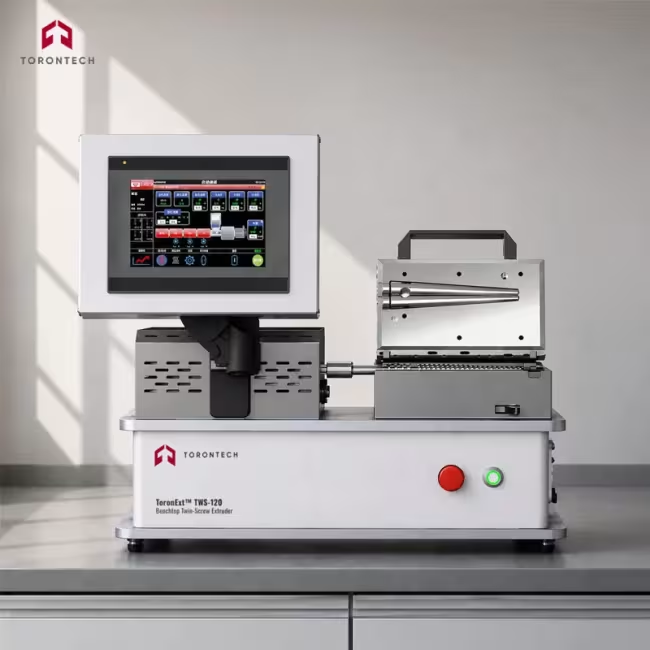
Benchtop Twin-Screw Extruder - ToronExt™ TWS-120
ToronExt™ TWS-120 Benchtop Twin-Screw Extruder runs polymer mixing trials on a 660 mm bench footprint, using a 40 g charge or as little as 10 ml. A pair of conical twin screws sits in a split barrel, and both screws lift out by hand for changeover. Screw speed spans 1 to 120 rpm against a 0 to 50 N·m torque range. Labs developing resins, additive packages, or filled systems can trial a formulation on what one synthesis batch yields.
Screws and barrel are machined from special alloy with wear and corrosion resistance, which suits repeated work with powder fillers, aggressive additives, and modified plastics. Sensors track torque, melt pressure, and material temperature throughout every run, and the Delta touch-screen controller plots the readings as live curves. Recorded process data stays with the formulation record, so a promising trial can be reproduced months later. Barrel temperature reaches 400°C under ±0.5°C control.
Research groups, corporate development labs, and university teaching programs share the same platform with the TWS-120. Compact dimensions and a 60 kg mass allow installation on a standard lab bench or inside a fume hood where solvent-bearing or odorous compounds need containment. Manual charging comes as standard, and an automatic feeder is available for longer continuous runs. Torontech supplies replacement screw sets, barrel seals, and application support for new formulation programs.
Benchtop Twin-Screw Extruder - ToronExt™ TWS-120 Applications
The ToronExt™ TWS-120 supports formulation work wherever material quantity, material cost, or bench space rules out a pilot-scale extruder.
- New Polymer Formulation Screening: compares resin, additive, and compatibilizer combinations on gram-scale charges before scale-up
- Filled and Reinforced Compounds: works calcium carbonate, talc, silica, and short-fiber loadings into thermoplastic matrices with a wear-resistant screw set
- Modified Plastics Development: produces toughened, flame-retarded, antistatic, and UV-stabilized trial compounds for property evaluation
- Corrosive Additive Trials: runs halogenated flame retardants, acidic stabilizers, and reactive coupling agents that attack standard tool steel
- Nanocomposite and Functional Filler Studies: disperses graphene, nanoclay, and conductive fillers at loadings that need controlled shear input
- Biopolymer and Compostable Resin Work: processes PLA, PBAT, PHA, and starch blends inside a narrow thermal window
- Pharmaceutical and Nutraceutical Melt Blending: mixes active compounds with polymer carriers for early dispersion and solubility screening
- Recycled Resin Assessment: evaluates additive packages on limited quantities of post-consumer or post-industrial feedstock
- Strand and Pellet Sample Production: delivers compounded output for downstream molding, filament, or property testing
- University Teaching Laboratories: demonstrates melting, mixing, and torque behavior to polymer engineering students at low material cost
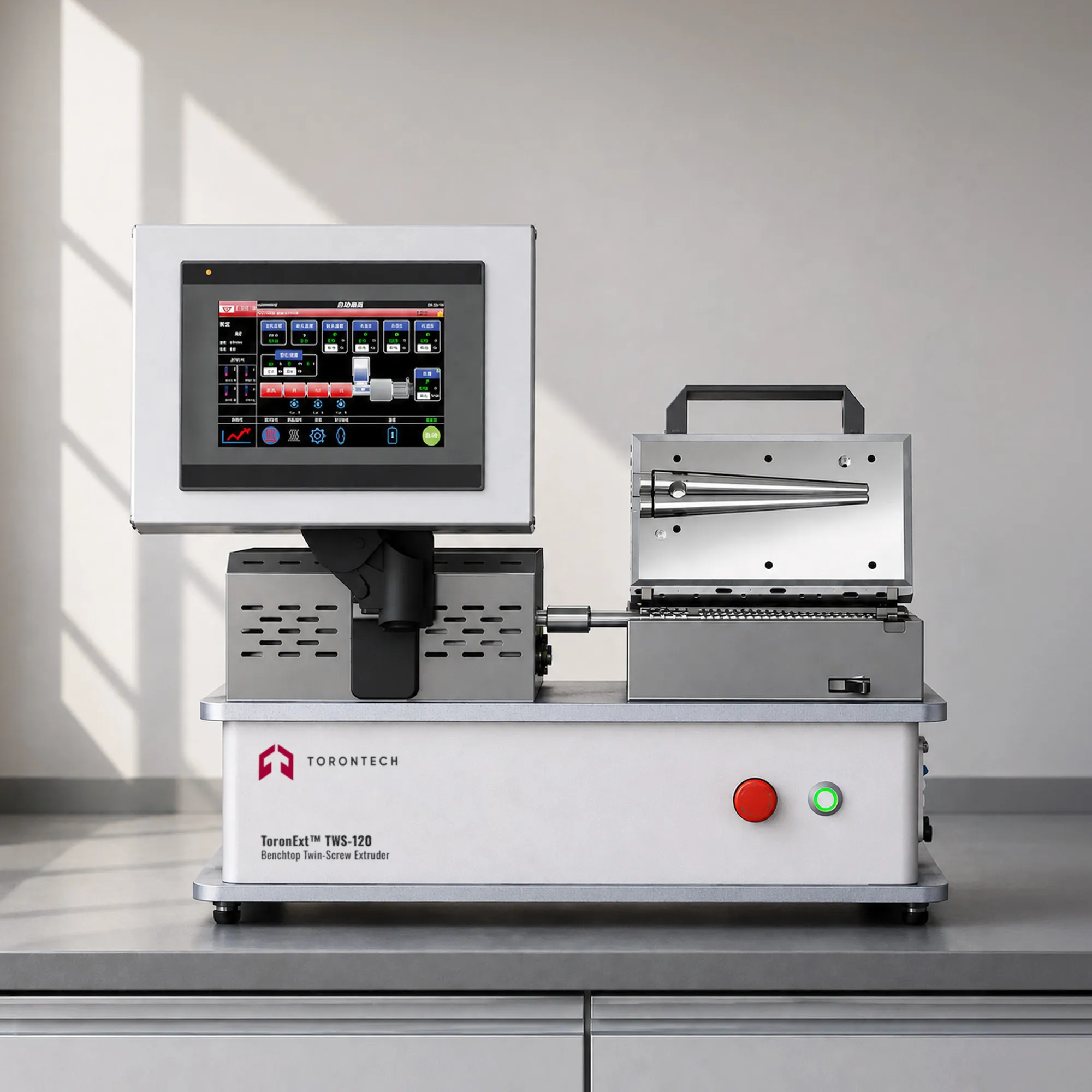
Benchtop Twin-Screw Extruder - ToronExt™ TWS-120 Key Features
Feature choices on the ToronExt™ TWS-120 focus on small charges, aggressive formulations, and traceable process records.
- Compact Benchtop Frame: 660 × 400 × 620 mm and 60 kg suit a shared bench or a fume hood without dedicated floor space
- 10 ml Minimum Processing Volume: opens formulation work to newly synthesized materials available only in small quantities
- 40 g Charge per Cycle: cuts material consumption per trial and keeps the cost of screening expensive resins in check
- Conical Twin-Screw Geometry: tapered flights accept bulky powders at the feed end and build pressure in a short barrel
- Special Alloy Screws and Barrel: wear and corrosion resistance supports long-term work with powder fillers and aggressive additives
- Quick-Release Conical Screws: screws come out by hand for cleaning or material changeover, cutting downtime between formulations
- Split Barrel Construction: separates for direct access to the flow path, melt observation, and complete cleanout
- Screw Speed 1 to 120 rpm: matches shear input to the formulation, from shear-sensitive biopolymers to stiff filled compounds
- Torque Measurement to 50 N·m: tracks melt resistance across the full run for a live view of melting and dispersion
- 400°C Barrel Capability: covers commodity resins through high-temperature engineering thermoplastics
- ±0.5°C Temperature Control: stabilizes melt viscosity so repeat trials return comparable results
- Multi-Sensor Monitoring: torque, pressure, and material temperature record together with real-time curve display for traceable research data
- Delta Touch-Screen Interface: one screen manages heating zones, screw speed, cycle timing, and process readouts
- Manual or Automatic Feeding: hand charging as standard, with an optional feeder for continuous small-volume extrusion
- Repeatable Screw Geometry: hardened surfaces hold original dimensions over years of service, protecting run-to-run consistency
- Research and Teaching Suitability: straightforward operation and low material cost fit both development labs and student instruction
Theory and Method
Conical twin screws solve a problem specific to small-scale extrusion. Screws tapering from a 25 mm root to a 10 mm tip give a large feed opening for bulky powders, then reduce channel volume steadily along the flight length. That reduction compresses the charge and builds discharge pressure within a barrel far shorter than a parallel machine of equivalent capability. Total internal volume stays near 10 ml, so very little material remains stranded in the flow path at the end of a run.
Intermeshing screw flights move material by positive displacement rather than by drag against the barrel wall. Each flight of one screw sweeps into the channel of the other, closing off a defined volume and pushing it toward the die. Fine powders and low-friction fillers that slip in a single-screw machine therefore convey predictably here. The same intermeshing action divides and recombines the melt stream on every rotation, distributing additives, while the tight clearance between screw and barrel imposes the shear that pulls agglomerates apart.
Torque and pressure readings turn the run into measurable data. Melt viscosity governs the resistance the screws meet, so the torque trace rises during solids compaction, drops through melting, and levels off as dispersion reaches steady state. Melt pressure at the discharge reflects both viscosity and any restriction at the die, which helps flag degradation or incomplete melting. Holding barrel temperature within ±0.5°C keeps shear-thinning behavior stable, so curves recorded from separate runs on the same recipe line up for direct comparison.
Benchtop Twin-Screw Extruder - ToronExt™ TWS-120 Technical Specifications
| Parameter | Specification |
|---|---|
| Screw Diameter | Ø10 mm (small end) / Ø25 mm (large end) |
| Screw Configuration | Conical twin screws, quick-release |
| Screw and Barrel Material | Special wear- and corrosion-resistant alloy |
| Screw Speed | 1 to 120 rpm |
| Torque Measurement | 0 to 50 N·m |
| Maximum Temperature | 400°C |
| Temperature Control Accuracy | ±0.5°C |
| Minimum Processing Volume | 10 ml |
| Material Volume per Cycle | 40 g |
| Feeding Mode | Manual standard, automatic optional |
| Barrel | Split type |
| Control System | Delta touch-screen HMI |
| Data Acquisition | Torque, pressure, barrel temperature |
| Voltage | 220 V, 50 Hz, 400 W (110V is also available) |
| Overall Dimensions | 660 × 400 × 620 mm |
| Net Weight | 60 kg |