
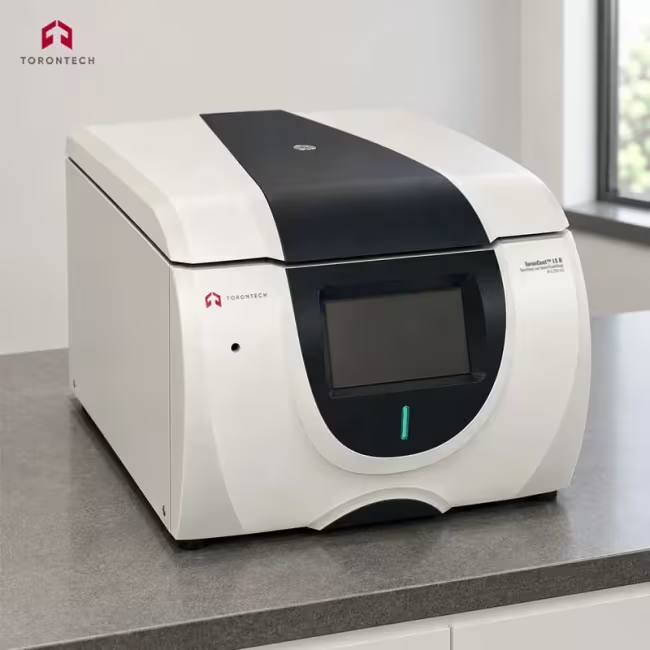
Benchtop Low Speed Centrifuge (4 x 250 mL) - ToronCent™ LS B
ToronCent™ LS B benchtop low speed centrifuge reaches 5,300 rpm and takes 4 x 250 mL, drawing 400 W at a net weight of 42 kg. Hospital laboratories, university research groups, and bioengineering facilities use it as a shared bench instrument covering microtubes, conical tubes, bottles, and plates. Five rotors span 15 mL and 5 mL angle work, 100 mL and 250 mL bracket loads, and oval or rectangular swing buckets. Automatic rotor identification caps the speed of every rotor to its own rating.
A 7-inch touchscreen accepts direct numeric entry for speed, time, RCF, and both ramp profiles, which removes the guesswork of knob setting. Programs store up to five centrifugation steps, each holding an independent speed and duration. Eleven acceleration and twelve deceleration profiles give the operator control over how gently the sample reaches and leaves speed. Run history and diagnostic records stay on the screen for review without a PC connection.
The 4 x 250 mL swing rotor uses an aerodynamic oval bucket that cuts chamber drag, noise, and power draw during long spins. A rectangular bucket serves the same rotor when square adapter formats suit the workload better. Adapters cover 1.5 mL microtubes up to 250 mL bottles, along with vacuum blood collection tubes and 96-well plates. The instrument occupies 436 mm of bench width.
Benchtop Low Speed Centrifuge (4 x 250 mL) - ToronCent™ LS B Applications
The ToronCent™ LS B suits laboratories that need one instrument to handle a broad mix of tube and plate formats.
- Hospital and Clinical Laboratories: serum and plasma separation across vacuum blood collection tubes, with up to 80 x 5 mL tubes loaded per run
- Plasma and Blood Component Work: swing-out buckets hold 250 mL containers and keep separated layers flat for clean decanting
- University Teaching and Research Laboratories: one shared instrument covering microtube, conical tube, bottle, and microplate work
- Bioengineering and Fermentation: recovery of cells and biomass out of broth in 100 mL and 250 mL volumes
- Cell Culture: pelleting suspension cultures and washing cells between media changes
- Molecular Biology: precipitate recovery in 1.5 mL microtubes, up to 104 positions in the oval bucket configuration
- Urinalysis and Cytology: sediment concentration in 10 mL and 15 mL tubes ahead of microscopy
- Immunoassay and Plate-Based Screening: spin-down of up to four 96-well plates using the microplate adapter
- Pharmaceutical and Chemical Quality Control: clarification of suspensions and emulsions before instrumental analysis
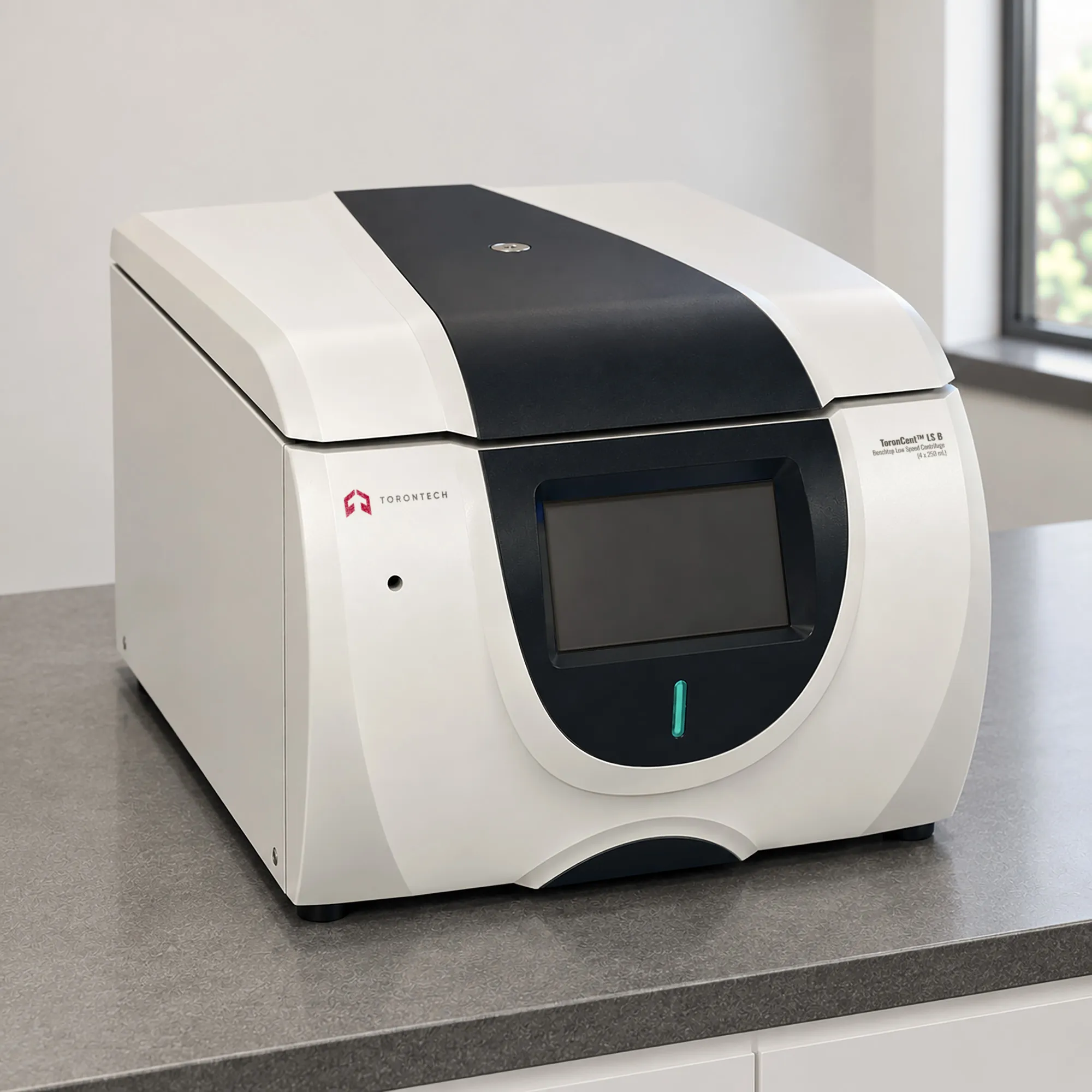
Benchtop Low Speed Centrifuge (4 x 250 mL) - ToronCent™ LS B Key Features
The touchscreen control set, rotor identification, and aerodynamic bucket design target laboratories running mixed workloads on a shared bench.
- 7-Inch Touchscreen: reads and responds through gloves, showing set values and live run values side by side
- Direct Numeric Entry: speed, time, RCF, and both ramp profiles are typed in rather than dialed, which is faster and less error-prone than knob setting
- Automatic Rotor Identification: recognizes the installed rotor and caps its speed, protecting the lower rated brackets and buckets
- Automatic Door Interlock: latches under light pressure and confirms closure before the run begins
- Eleven Acceleration and Twelve Deceleration Profiles: match ramp rates to sample fragility, with the tenth profile in each set open to custom timing on request
- Multi-Step Programs: store methods carrying up to five centrifugation steps, each with its own speed and duration
- On-Screen Run and Diagnostic Records: review past runs and fault history at the instrument without connecting a PC
- Aerodynamic Oval Bucket: cuts air resistance in the chamber, which lowers noise, power draw, and sample warming during long runs
- Five-Rotor Range: two angle rotors, a 4 x 100 mL bracket rotor, a 2 x 2 x 250 mL bracket rotor, and a 4 x 250 mL swing rotor offered with oval or rectangular buckets
- Wide Adapter Range: covers 1.5 mL microtubes up to 250 mL bottles, plus conical, round, vacuum blood collection, and 96-well plate formats
- Dual Time Ranges: cover 1 s to 99 min 59 s and 1 min to 99 h 59 min, handling both quick spins and overnight separations
- Three Timing Modes: start the clock at set speed, at spin-up, or in short spin mode, matching how the protocol defines run time
- Short Spin Function: delivers a manual pulse for collecting tube contents rather than separating them
- Self-Diagnostic Protection: monitors door interlock, over-speed, motor temperature, operator entry errors, and communication faults
- 400 W Draw at 42 kg: the lightest and lowest power unit in the low speed range, simple to site on a crowded bench
- Noise at or Below 65 dB(A): keeps a shared laboratory workable through extended runs
Theory and Method
Separation under centrifugal force depends on a density difference between the particles and the liquid holding them. Spinning the sample creates radial acceleration many times gravity, and suspended material migrates outward at a rate set by particle size, that density difference, and the viscosity resisting motion. Relative centrifugal force rises with the square of speed and in direct proportion to rotating radius, so a wider rotor delivers more force at the same rpm. Matching speed against radius gives the operator control over separation sharpness.
Air resistance inside the chamber grows steeply with speed, and the energy lost to it turns into heat that reaches the sample. The oval bucket profile presents a narrower frontal area than a square bucket, which cuts drag and lowers the power the motor draws to hold speed. Less turbulence also means less noise at the bench. The chamber runs cooler through long spins on an instrument that carries no refrigeration circuit, which matters for enzyme work and live cell suspensions.
Rotor identification governs safety at the drive level. Rated speeds run 5,300 rpm on the angle rotors down to 4,000 rpm on the 2 x 2 x 250 mL bracket rotor, and spinning a low rated rotor at the machine's ceiling risks failure. The controller reads the installed rotor and caps achievable speed, so an entry error cannot over-speed the hardware. Twelve deceleration profiles handle the other end, letting a settled pellet stay put instead of a hard brake stirring it back up.
Benchtop Low Speed Centrifuge (4 x 250 mL) - ToronCent™ LS B Technical Specifications
| Parameter | Specification |
|---|---|
| Maximum Speed | 5,300 rpm |
| Maximum RCF | 4,113 x g (see rotor table for per-rotor ratings) |
| Maximum Capacity | 4 x 250 mL |
| Speed Accuracy | ±20 rpm |
| Time Setting Range | 1 s to 99 min 59 s; 1 min to 99 h 59 min |
| Timing Modes | Start timing at set speed, start timing at spin-up, short spin timing |
| Program Steps | Up to 5 per program |
| Acceleration Profiles | 11 |
| Deceleration Profiles | 12 |
| Short Spin | Yes |
| Rotor Identification | Yes |
| Noise Level | ≤65 dB(A) |
| Voltage | AC 220 V ±22 V, 50/60 Hz (110V is also available) |
| Power Consumption | 400 W |
| Dimensions (W x D x H) | 436 x 560 x 380 mm |
| Packing Dimensions (W x D x H) | 547 x 727 x 432 mm |
| Net Weight | 42 kg |
Rotor Range
| Rotor | Type | Maximum Capacity | Maximum Speed | Maximum RCF |
|---|---|---|---|---|
| Rotor 1 | Fixed angle | 30 x 15 mL | 5,300 rpm | 4,113 x g |
| Rotor 2 | Fixed angle | 40 x 5 mL | 4,200 rpm | 2,860 x g |
| Rotor 3 | Bracket rotor | 4 x 100 mL | 5,300 rpm | 5,010 x g |
| Rotor 4 | Bracket rotor | 2 x 2 x 250 mL | 4,000 rpm | 2,684 x g |
| Rotor 5 | Swing-out, oval bucket | 4 x 250 mL | 4,200 rpm | 3,450 x g |
| Rotor 5 | Swing-out, rectangular bucket | 4 x 250 mL | 4,200 rpm | 3,412 x g |
Bucket and Adapter Options
| Rotor | Bucket or Bracket | Adapter Capacities |
|---|---|---|
| Rotor 1 | Not applicable | Direct tube loading, 30 x 15 mL |
| Rotor 2 | Not applicable | Direct tube loading, 40 x 5 mL; 10 mL, 5 mL, and 2 mL adapters available on request |
| Rotor 3 | Bracket, 4 x 100 mL | 4 x 50 mL (conical); custom configurations on request |
| Rotor 4 | Bracket | 2 x 2 x 250 mL; 2 x 8 x 50 mL (conical); 2 x 28 x 10 mL; 2 x 18 x 15 mL (conical); 2 x 40 x 5 mL; 2 x 2 x 96 microplate |
| Rotor 5 | Oval bucket | 4 x 1 x 250 mL; 4 x 2 x 100 mL; 4 x 4 x 50 mL (conical/round); 4 x 6 x 20 mL; 4 x 9 x 15 mL (conical/round); 4 x 14 x 10 mL; 4 x 14 x 5/7 mL; 4 x 10 x 5 mL; 4 x 26 x 1.5 mL |
| Rotor 5 | Rectangular bucket | 4 x 1 x 250 mL; 4 x 1 x 100 mL; 4 x 4 x 50 mL (conical); 4 x 9 x 15 mL (conical); 4 x 12 x 10 mL; 4 x 17 x 5/7 mL; 4 x 16 x 1.5 mL |
Custom bracket and adapter configurations are available across the rotor range.