
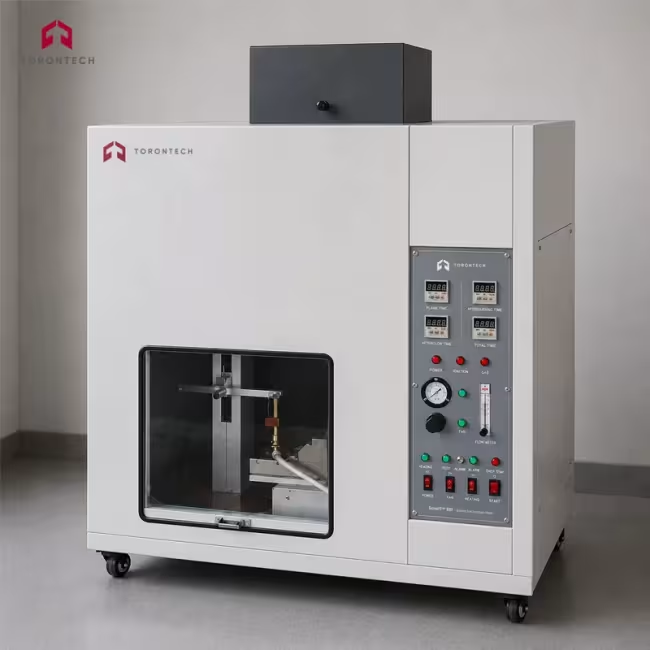
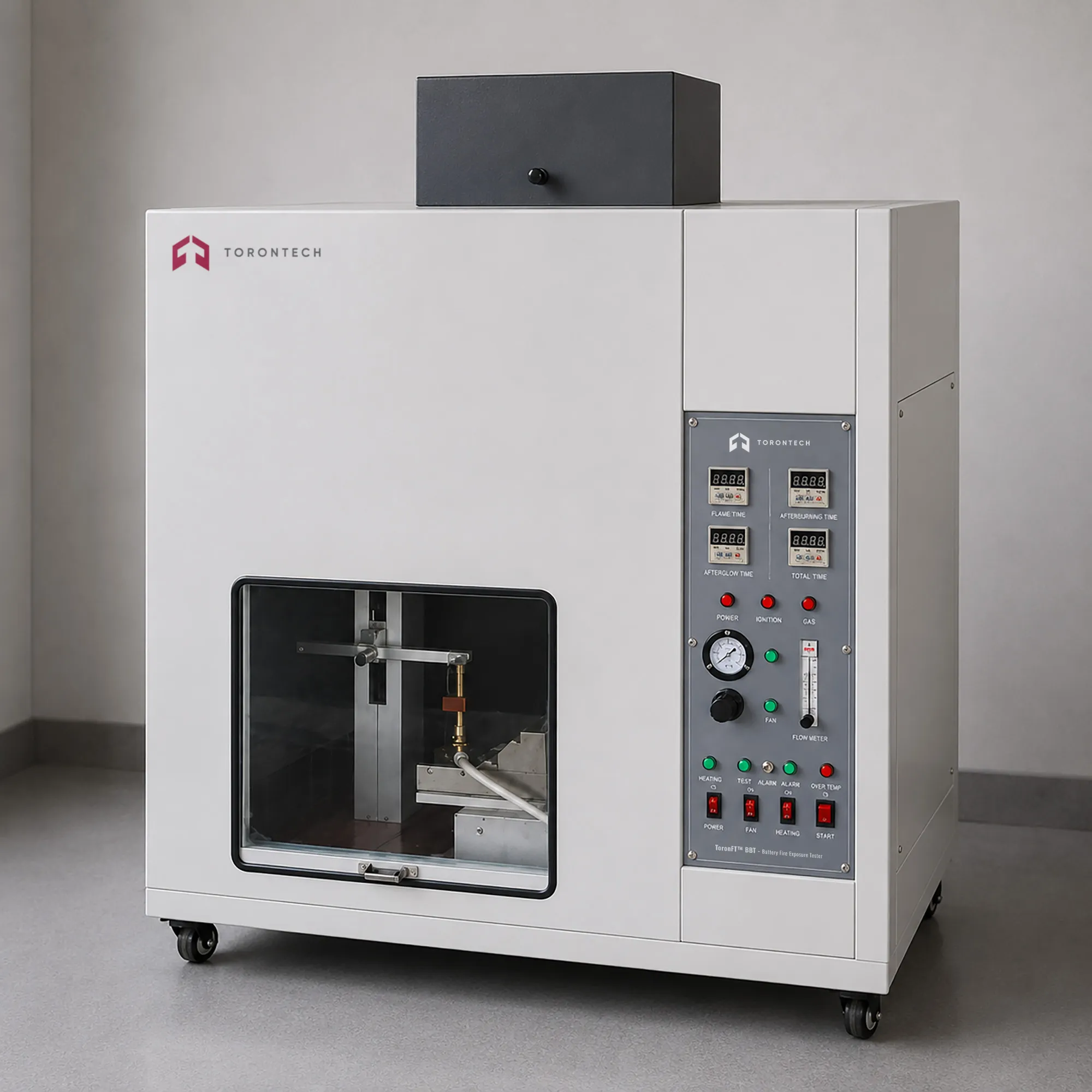
Battery Fire Exposure Tester
Battery Fire Exposure Tester – ToronFT™ BBT
ToronFT™ BBT Battery Fire Exposure Tester is a fully automated fire-exposure test instrument designed to evaluate the burn resistance and flammability of rechargeable lithium cells and battery packs. Compliant with UL 2054 and UL 1642, it subjects test specimens to controlled flame from a Bunsen burner while an octagonal wire-mesh enclosure contains any projectile particles ejected during combustion. Operators can program flame application time and monitor the test remotely, protecting personnel from hazardous events that may occur when a battery burns or ruptures.
The ToronFT™ BBT accommodates a wide range of cell and battery-pack formats, from small single-cell cylindrical lithium-ion batteries to multi-cell packs used in consumer electronics and portable power products. The instrument's adjustable flame height and automatic ignition system enable consistent, repeatable test conditions across each sample. A high-purity liquefied petroleum gas supply and Bunsen burner tube with a 9.5 mm internal bore diameter produce the bright-blue flame specified in UL 2054 Clause 22 and UL 1642 Clause 20. Test timing covers both flame-on and flame-off (afterburn) phases, each independently programmable from 0 to 99.99 seconds.
Designed for battery manufacturers, third-party test laboratories, and quality-control departments, the ToronFT™ BBT meets the physical hardware requirements of UL 2054, UL 1642, and IEC 60086-4, providing a single instrument for compliance testing across the most widely referenced North American and international battery safety standards. The fully automated control system removes operator variability from test execution, reducing the risk of inconsistent results and improving throughput in high-volume testing environments.
Battery Fire Exposure Tester – ToronFT™ BBT Applications
The ToronFT™ BBT is used across industries that design, manufacture, or qualify lithium-based battery products for commercial and consumer markets. Typical applications include:
- Lithium-Ion and Lithium-Metal Battery Manufacturing: fire-exposure and burn-resistance qualification of cylindrical, prismatic, and pouch cells prior to product certification under UL 1642 and UL 2054.
- Consumer Electronics Battery Packs: safety testing of battery packs for smartphones, laptops, tablets, portable power banks, and wearable devices to verify compliance with UL 2054 Household and Commercial Batteries requirements.
- Electric Vehicle (EV) and E-Mobility Components: fire-hazard evaluation of lithium-ion cells and small modules per UL 2580 and IEC 60086-4 as part of broader battery-abuse testing programs.
- Third-Party and Accredited Test Laboratories: standardized fire-exposure testing for battery manufacturers seeking UL, CE, or IEC certification, with reproducible test geometry matching the reference apparatus in published standards.
- Battery R&D and New Chemistry Development: rapid screening of prototype cell designs for thermal runaway behavior, burn propagation, and projectile risk during product development cycles.
- Power Tool and Industrial Battery Packs: flammability qualification of battery packs for cordless tools, medical devices, and industrial portable equipment prior to market release.
- Quality Control and Incoming Inspection: incoming-goods testing at electronics assemblers and OEM manufacturers to verify that purchased battery cells and packs meet published safety specifications before integration into end products.
Standards
The ToronFT™ BBT is designed to satisfy the fire-exposure and burning-resistance test apparatus requirements of the following international and North American battery safety standards:
- UL 2054 – Standard for Safety of Household and Commercial Batteries, Clause 22 / Fig. 22.1 – Battery Fire Exposure Test
- UL 1642 – Standard for Safety of Lithium Batteries, Clause 20 / Fig. 20.1 – Fire Exposure and Projectile Test
- IEC 62133-2 – Safety Requirements for Portable Sealed Secondary Lithium Cells and Batteries for Use in Portable Applications – Part 2: Lithium Systems
- IEC 60086-4 – Primary Batteries – Part 4: Safety of Lithium Batteries, Clauses 6.2.5 and 6.2.7 / Figure 1 – Fire Exposure Test Apparatus
- UN/DOT 38.3 – Recommendations on the Transport of Dangerous Goods – Manual of Tests and Criteria, Section 38.3 – Lithium Metal and Lithium-Ion Batteries
Battery Fire Exposure Tester – ToronFT™ BBT Key Features
The ToronFT™ BBT combines precision timing, automatic flame control, and a robust octagonal containment enclosure to deliver safe, reproducible battery burning tests with minimal operator intervention. Key features include:
- Fully Automatic Test Control: PLC-driven test sequence manages ignition, flame timing, and shutdown without manual intervention, eliminating operator variability and improving reproducibility across multiple test runs.
- Independent Flame-On and Afterburn Timers: separate programmable timers for flame application time and flame sustain time (each 0 to 99.99 seconds, resolution ±0.1 s) allow precise test-condition control matching UL 2054 and UL 1642 requirements.
- Adjustable Flame Height: Bunsen burner flame height adjusts from 10 to 75 mm (±2 mm), allowing the operator to set the bright-blue flame intensity specified in the applicable test standard without repeated re-calibration.
- Automatic Ignition System: built-in electronic auto-ignition starts the Bunsen burner reliably at the beginning of each test cycle, removing the need for manual lighting and reducing the risk of delayed ignition affecting test results.
- Standard-Compliant Octagonal Test Enclosure: the 305 mm wide by 355 mm deep by 610 mm tall octagonal wire-mesh cage matches the dimensional requirements of UL 2054 Fig. 22.1, containing projectile fragments and combustion gases throughout the test.
- Precision Wire-Mesh Sample Platform: the 20-openings-per-inch steel mesh screen (wire diameter 0.43 mm) positioned 38.1 mm above the burner tip reproduces the exact geometry required by UL 2054 Clause 22, IEC 60086-4, and UL 1642 Clause 20.
- Safe Test Rod Reference Geometry: a 6.35 mm diameter by 355.6 mm length test rod is included to verify instrument geometry and flame application alignment prior to production testing.
- Suitable for Cells and Battery Packs: the instrument accommodates both individual cylindrical or prismatic cells and multi-cell battery packs, supporting a single test platform for UL 1642 (cell-level) and UL 2054 (battery-pack-level) testing programs.
Theory and Method
Lithium-based batteries store high energy densities within flammable electrolyte solutions confined under pressure. When a cell is exposed to external heat, the electrolyte can vaporize, the separator can melt, and an internal short circuit can trigger thermal runaway, a self-sustaining exothermic reaction in which the cell generates far more heat than it can dissipate. The battery burning test quantifies the intensity and containment characteristics of this response by measuring how long a cell burns, whether it ejects fragments, and whether those fragments penetrate the surrounding mesh enclosure.
The ToronFT™ BBT replicates the standardized fire-exposure apparatus specified in UL 2054, UL 1642, and IEC 60086-4. A Bunsen burner with a 9.5 mm bore tube burns high-purity liquefied petroleum gas, producing a bright-blue, fully premixed flame calibrated to heat the supporting steel wire mesh to a bright red color (approximately 700 °C). The test specimen rests on a 20-mesh steel screen positioned 38.1 mm above the burner tip. Flame application continues until the battery explodes, burns out completely, or the programmed exposure time elapses. Throughout the test, the timer records both the active flame duration and the afterburn (continued combustion after the burner is extinguished), giving engineers precise combustion timing data for analysis.
An octagonal wire-mesh cage surrounds the specimen during testing. This cage intercepts any fragments, gas jets, or projectile particles expelled during a rupture event. Under UL 2054 and UL 1642, the battery passes the projectile test if none of the ejected material penetrates the mesh enclosure. The fully enclosed chamber of the ToronFT™ BBT also contains combustion gases and suppresses external fire spread. Because the entire test sequence runs under automatic PLC control with remote ignition capability, operators remain outside the test zone during flame exposure, eliminating personnel exposure to the thermal hazard and ensuring consistent flame application geometry on every cycle.
Battery Fire Exposure Tester – ToronFT™ BBT Technical Specifications
| Parameter | Specification |
|---|---|
| Model | ToronFT™ BBT (ZY6219) |
| Burner Type | Bunsen burner, bore inner diameter 9.5 mm (0.375 in), tube length approx. 100 mm |
| Flame Application Time | 0 – 99.99 s, accuracy ±0.1 s |
| Flame Sustain (Afterburn) Time | 0 – 99.99 s, accuracy ±0.1 s |
| Flame Height | 10 – 75 mm, adjustable, accuracy ±2 mm |
| Sample Platform Screen | Steel wire mesh, 20 openings per 25.4 mm, wire diameter 0.43 mm; mounted 38.1 mm above burner tip |
| Test Enclosure Shape | Octagonal |
| Test Enclosure Width | 305 mm (12 in) |
| Test Enclosure Depth | 355 mm (14 in) |
| Test Enclosure Height | 610 mm (24 in) |
| Ignition System | Automatic electronic ignition |
| Control Mode | Fully automatic, PLC |
| Fuel Gas | High-purity liquefied petroleum gas (LPG) |
| Reference Test Rod | Diameter 6.35 mm (¼ in) × Length 355.6 mm (14 in) |
| Applicable Standards | UL 2054 Clause 22 / Fig. 22.1; UL 1642 Clause 20 / Fig. 20.1; IEC 60086-4 Clauses 6.2.5 & 6.2.7 / Fig. 1; IEC 62133-2 |
Standard Package Contents
| Item | Description |
|---|---|
| Bunsen Burner with Support Stand | Complete burner assembly with adjustable gas valve and mounting bracket |
| Octagonal Wire-Mesh Test Enclosure | Metal cage enclosure, 305 mm × 355 mm × 610 mm, octagonal cross-section |
| Steel Wire-Mesh Sample Screen | 20-mesh steel screen, wire diameter 0.43 mm, positioned 38.1 mm above burner |
| Test Reference Rod | 6.35 mm diameter × 355.6 mm length, for instrument geometry verification |
| Test Cloth / Backing Material | Standard backing fabric for projectile-particle capture evaluation |
| LPG Gas Cylinder | 1 cylinder of high-purity liquefied petroleum gas (customer-supplied for ongoing use) |