
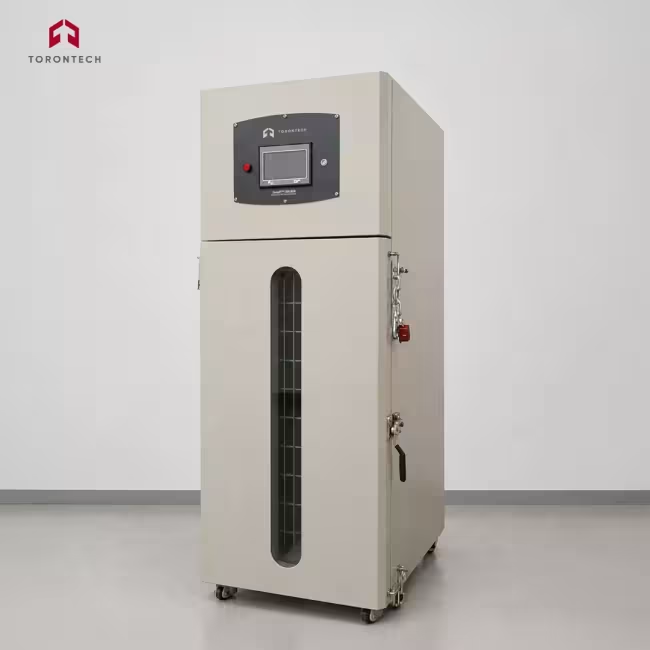
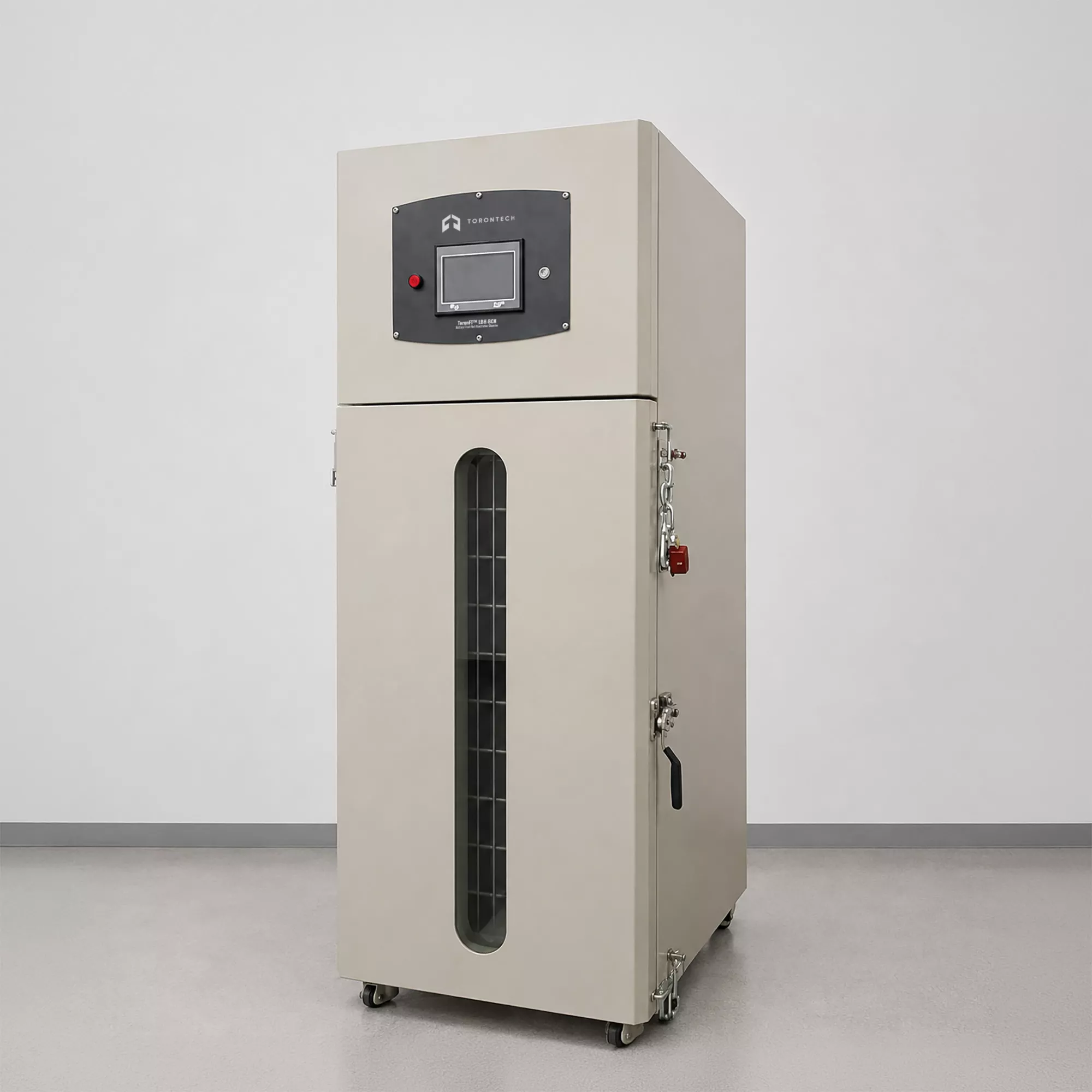
Battery Crush Nail Penetration Chamber – ToronFT™ LBH-BCN
ToronFT™ LBH-BCN Battery Crush Nail Penetration Chamber is a specialized mechanical abuse testing instrument designed for simulating situations where lithium batteries are subjected to crushing and puncture during use, transport, storage, or disposal of household waste. Battery crush and nail penetration tests are fundamental mechanical abuse tests for lithium battery safety certification — evaluating the battery's response to severe mechanical deformation and internal short circuit induced by external penetration.
By combining both crush and nail penetration test capabilities in a single all-in-one instrument platform, the ToronFT™ LBH-BCN provides a comprehensive, efficient lithium battery mechanical abuse testing solution that reduces equipment investment, laboratory footprint, and test setup time while delivering full compliance with the relevant international lithium battery crush and nail penetration test standards.
Battery Crush Nail Penetration Chamber – ToronFT™ LBH-BCN Applications
The ToronFT™ LBH-BCN is applicable for crush and nail penetration abuse testing of:
- Lithium-ion battery cells (cylindrical, prismatic, and pouch formats) for crush test and nail penetration safety qualification
- Lithium battery packs and modules requiring mechanical abuse testing for consumer product safety certification
- Lithium primary batteries for transport safety validation under crush and nail penetration test conditions
- Battery packs for portable electronics, power tools, and consumer devices requiring crush and nail penetration test compliance
- Electric vehicle battery cells and modules requiring mechanical abuse test qualification per automotive lithium battery safety standards
- Research and development testing of new lithium battery cell designs, materials, and safety features for crush resistance and nail penetration performance optimization
Standards
The ToronFT™ LBH-BCN is designed to comply with the following international standards for lithium battery crush and nail penetration testing:
- UN 38.3: United Nations Manual of Tests and Criteria: Test T.6 — Impact (crush test for lithium batteries in transport)
- IEC 62133: Safety requirements for portable sealed secondary lithium cells and batteries (crush and nail penetration tests)
- IEC 62619: Safety requirements for secondary lithium cells and batteries for use in industrial applications
- UL 1642: Standard for Lithium Batteries (crush and nail penetration test methods)
- UL 2054: underwrites laboratiries standard, for entire battery pack. It evaluates safety features to prevent fires or explosions during consumer use.
Battery Crush Nail Penetration Chamber – ToronFT™ LBH-BCN Key Features
- All-in-one lithium battery crush and nail penetration test platform — both crush and nail penetration abuse tests performed on a single instrument, reducing equipment cost, laboratory footprint, and test specimen changeover time
- Simulates real-world scenarios where lithium batteries experience crushing and puncture during product use, transport, household waste disposal, and industrial handling — providing realistic and standardized mechanical abuse test conditions
- Configurable crush force, plate geometry, and compression speed parameters for compliance with the specific crush test requirements of UN 38.3, IEC 62133, and UL 1642 lithium battery safety standards
- Configurable nail penetration parameters — nail diameter, penetration speed, and penetration depth — for compliance with IEC 62133 and IEC 62619 nail penetration test requirements
- Supports testing of cylindrical, prismatic, and pouch format lithium battery cells — as well as battery packs and modules — accommodating the full range of lithium battery product types requiring crush and nail penetration abuse testing
- Complies with UN 38.3, IEC 62133, IEC 62619, and UL 1642 providing internationally recognized lithium battery crush and nail penetration test results for product safety certification in North America and globally
Theory and Method
Crush testing evaluates the response of a lithium battery cell or pack when subjected to a compressive load applied by a flat plate or rod — simulating crushing damage from vehicle accidents, heavy object falls, or industrial handling incidents. The crush test induces external deformation of the battery casing and potential internal short circuits, and the battery's ability to avoid thermal runaway, fire, or explosion under these conditions is the pass/fail criterion.
Nail penetration testing evaluates the response of a lithium battery cell when a hardened steel nail (spike) is driven through the battery at a defined speed — creating a controlled internal short circuit by directly connecting positive and negative electrode layers through the nail. The nail penetration test is one of the most severe lithium battery abuse tests, as it creates a direct internal short that can trigger thermal runaway if the battery's internal safety mechanisms are insufficient. In the ToronFT™ LBH-BCN, both crush and nail penetration tests can be performed on the same instrument platform, with configurable force, speed, and penetration parameters to meet the specific requirements of UN 38.3, IEC 62133, UL 1642, and other applicable lithium battery safety standards.
Battery Crush Nail Penetration Chamber – ToronFT™ LBH-BCN Technical Specifications
| Parameter | Specification |
|---|---|
| Product Name | Battery Crush Nail Penetration Chamber — ToronFT™ LBH-BCN |
| Test Capabilities | Crush test AND nail penetration test (all-in-one platform) |
| Applicable Scenarios | Battery use, transport, storage, household waste disposal situations |
| Battery Formats Supported | Cylindrical, prismatic, pouch cells; battery packs and modules |
| Crush Test Parameters | Force, plate geometry, compression speed (configurable per standard) |
| Nail Penetration Parameters | Nail diameter, penetration speed, penetration depth (configurable per standard) |
| Compliance Standards | UN 38.3 T.6; IEC 62133; IEC 62619; UL 1642; UL 2054 |