
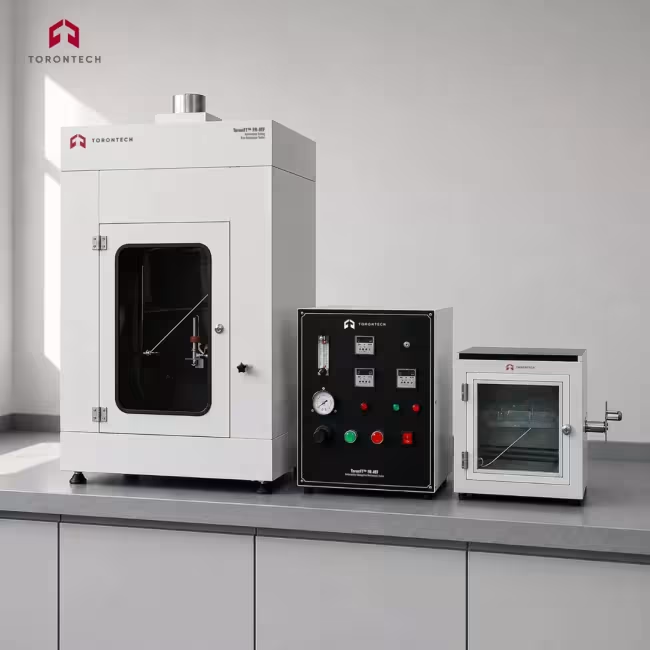
Automotive Tubing Fire Resistance Tester
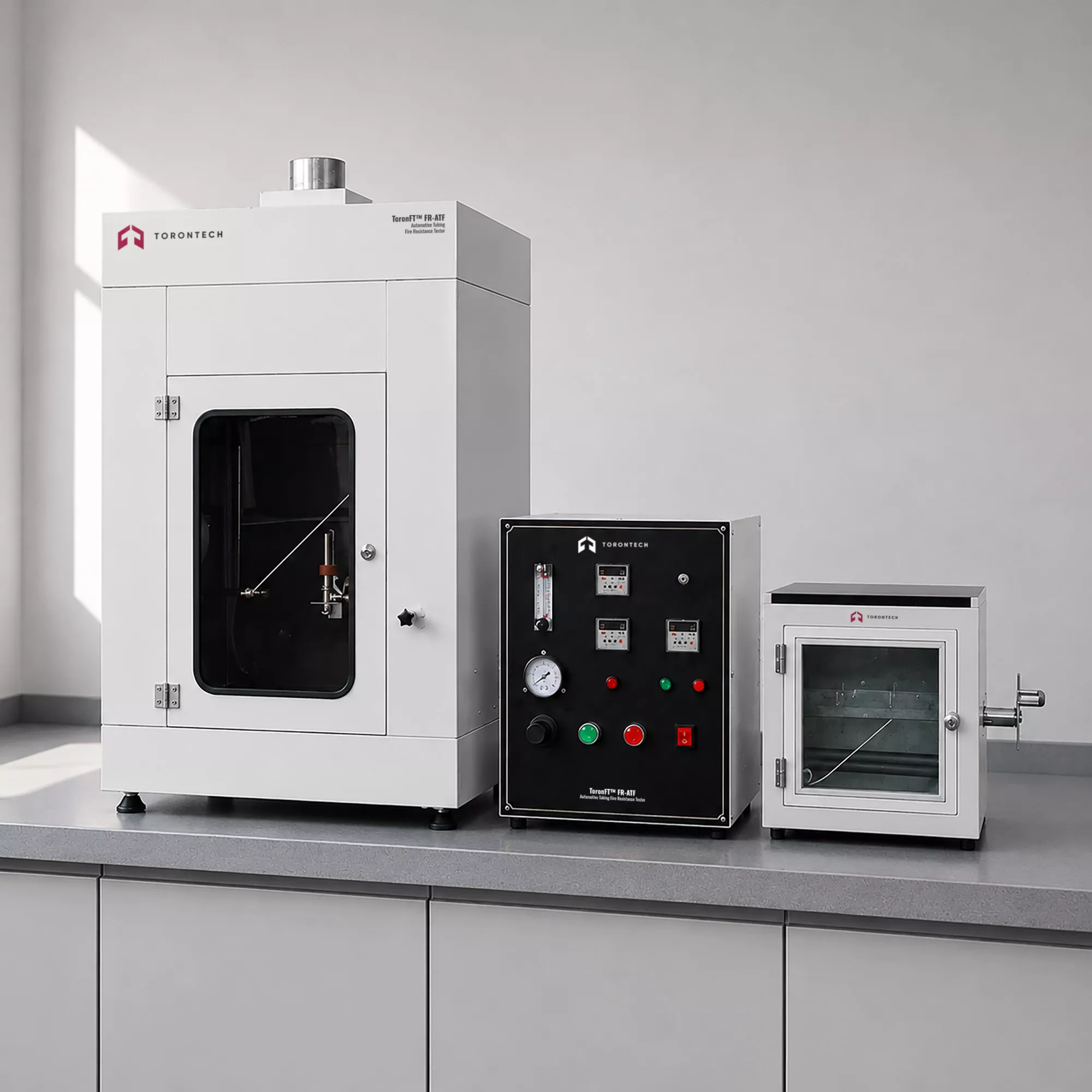
Automotive Tubing Fire Resistance Tester — ToronFT™ FR-ATF
ToronFT™ FR-APS Automotive Tubing Fire Resistance Tester is a precision fire resistance testing instrument designed to evaluate the surface fire resistance of automobile fuel pipes and the combustion durability of fuel pipe components under direct flame exposure. By applying a defined blowtorch flame to the surface of fuel pipe specimens under controlled conditions, the ToronFT™ FR-APS provides the standardized fire resistance data required for automotive fuel system component qualification — ensuring that fuel pipes and hose assemblies can withstand engine compartment fire exposure without catastrophic failure.
The automobile pipe surface fire resistance burning tester features a mirror-polished stainless steel combustion chamber, a No. 160 blowtorch with a flame height of approximately 200 mm, a precision fuel supply system, adjustable flame application time, and an integrated cooling plate — all designed to replicate the standardized test conditions required by England MG Rover 30MS401 and SAE J2027 automotive fuel system fire resistance standards.
Automotive Tubing Fire Resistance Tester — ToronFT™ FR-ATF Applications
- Automotive fuel pipe and hose manufacturers: surface fire resistance qualification for fuel supply lines, brake hoses, and hydraulic hose assemblies
- Automotive hose component manufacturers: combustion durability testing of serpentine tubes, pipeline connectors, and protective sleeve assemblies
- Third-party automotive testing laboratories: fuel pipe fire resistance testing per SAE J2027 requirements
- Automotive OEM quality assurance departments: incoming material and component fire resistance verification for fuel system components
- R&D departments — evaluation of new fuel pipe materials, jacketing compounds, and fire-resistant protective sleeve designs
Standards
The ToronFT™ FR-ATF supports automobile pipe surface fire resistance testing in compliance with internationally recognized automotive fire safety standards, including:
- SAE J2027: Shield specification for fuel systems (fire resistance requirements for fuel pipe and hose assemblies)
- MG Rover 30MS401: This is a legacy British automotive engineering standard (originally established by the MG Rover Group) that specifies the technical requirements and testing procedures for flexible hoses used in vehicle cooling systems, ensuring they can withstand high temperatures, pressure, and coolant degradation.
Automotive Tubing Fire Resistance Tester — ToronFT™ FR-ATF Key Features
- Designed for automobile fuel pipe surface fire resistance and combustion durability qualification
- Combustion chamber: mirror stainless steel plate, 1.2 mm thickness; dimensions 385 mm (L) × 204 mm (W) × 360 mm (H)
- Automatic process control for repeatable, standard-compliant test execution
- No. 160 blowtorch: outer diameter 35 mm; inner diameter 0.04 inch (~1 mm); length approximately 50 mm — standardized flame source
- Flame adjustment function: flame height approximately 200 mm — adjustable to meet standard-specified flame characteristics
- Adjustable flame application time — accommodating test durations specified by SAE J2027 and related standards
- Fuel supply plate: 203 mm (L) × 50 mm (W) × 22 mm (H) — standardized fuel storage geometry
- Coolant plate: 255 mm (L) × 100 mm (W) × 50 mm (H) — specimen cooling after flame exposure
- Fuel gas: liquefied gas (customer supplied); air compressor required (customer prepared)
- Compliant with SAE J2027 and England MG Rover 30MS401 automotive fuel pipe fire resistance standards
Theory and Method
The automobile pipe surface fire resistance test applies a standardized blowtorch flame to the surface of the fuel pipe or hose specimen under defined conditions — replicating the thermal attack that fuel system components may experience during an engine compartment fire event. The No. 160 blowtorch delivers a flame approximately 200 mm in height from the fuel supply controlled by the fuel storage system (fuel plate: 203 mm × 50 mm × 22 mm; coolant plate: 255 mm × 100 mm × 50 mm).
The combustion chamber (385 mm L × 204 mm W × 360 mm H) is constructed from mirror stainless steel plate (1.2 mm thickness) to maintain reflective, uniform heat distribution around the specimen. The adjustable flame application time is set by the operator according to the requirements of the applicable test standard. After the flame exposure period, the specimen is inspected for burning through, structural failure, or leakage — determining whether the fuel pipe passes the fire resistance criterion. The fuel storage system uses liquefied gas (customer supplied
Automotive Tubing Fire Resistance Tester — ToronFT™ FR-ATF Technical Specifications
| Parameter | Specification |
|---|---|
| Combustion Chamber Material | Mirror stainless steel plate, 1.2 mm thickness |
| Combustion Chamber Dimensions (L×W×H) | 385 mm × 204 mm × 360 mm |
| Blowtorch | No. 160; OD 35 mm; ID ~0.04 inch (~1 mm); length ~50 mm |
| Flame Height | ~200 mm (adjustable) |
| Flame Application Time | Adjustable |
| Fuel Plate Dimensions (L×W×H) | 203 mm × 50 mm × 22 mm |
| Coolant Plate Dimensions (L×W×H) | 255 mm × 100 mm × 50 mm |
| Fuel Gas | Liquefied gas (customer supplied) |
| Air Compressor | Self-prepared (customer) |
| Process Control | Automatic |
| Standard Compliance | SAE J2027; MG Rover 30MS401 |