
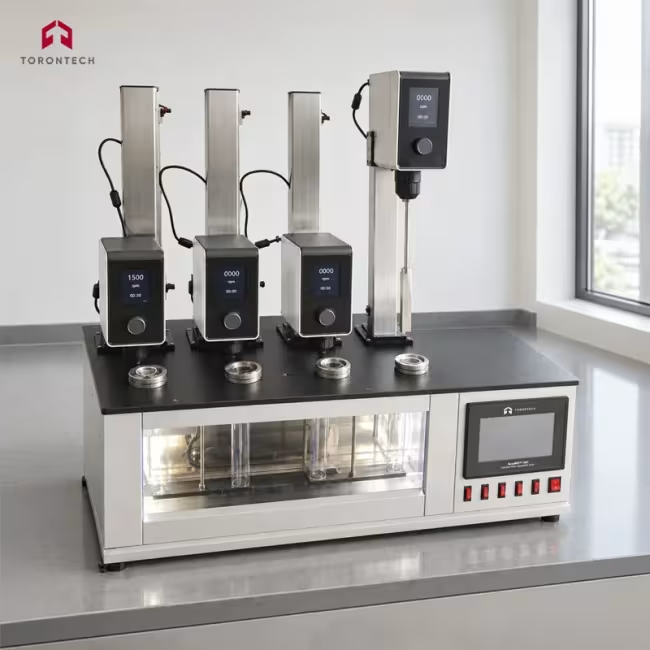
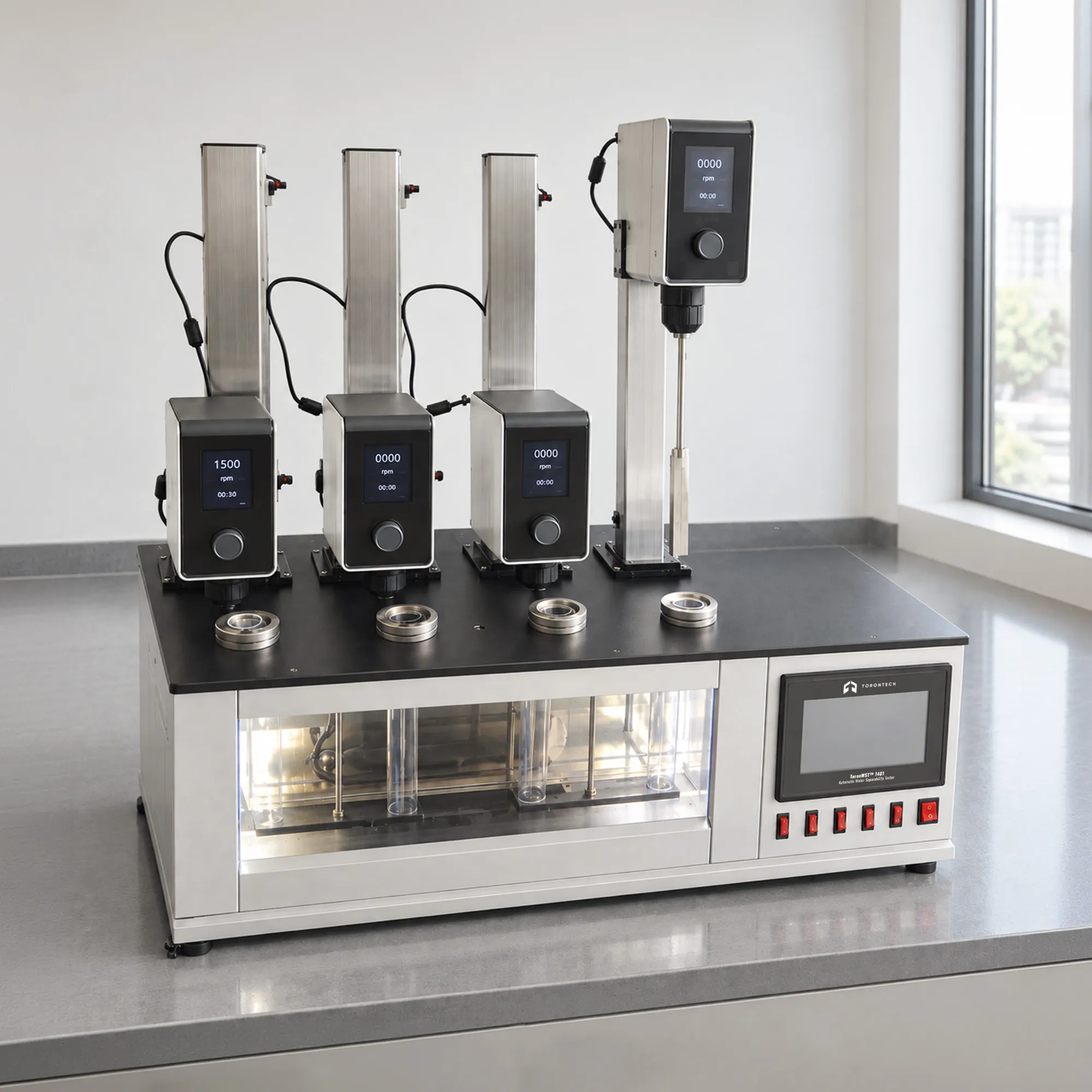
Automatic Water Separability Tester
Automatic Water Separability Tester - ToronWST™ 1401
Automatic Water Separability and Demulsibility Tester for Petroleum Oils and Synthetic Fluids
The ToronWST™ 1401 water separability tester determines how quickly petroleum oils and synthetic fluids release water after the two phases mix, following ASTM D1401. Lubricant blenders, power plant laboratories, and oil condition monitoring services use the instrument to qualify new oils and track fluids already in service. Four independent test positions run at the same time, so one unit carries the workload of four conventional testers. A PID-controlled stainless steel bath holds each specimen within ±0.1°C of setpoint anywhere from ambient to 100°C.
Each position carries its own stirring paddle, lifting mechanism, and digital speed controller. Stepper motors raise and lower the paddles automatically at the end of the five-minute stir, removing the manual step that most often disturbs a settling sample. Operators set temperature, stirring speed, and timer values from a 7-inch color touchscreen, then save those parameters for repeat use. High-torque motors with self-locking chucks drive through fluids as thick as 100,000 mPa·s, which takes the instrument well beyond light turbine oils.
Water separation results depend on stable temperature and repeatable agitation, and both drift when tests run across separate bath and stirrer assemblies. The ToronWST™ 1401 places all four positions in a single square stainless steel bath with an illuminated glass observation window, so every specimen sees the same thermal environment. Imported PT100 sensors report bath temperature directly, and linear-guide transmission keeps paddle travel quiet and free of vibration. Results stay comparable between positions, between operators, and between shifts.
Automatic Water Separability Tester - ToronWST™ 1401 Applications
Demulsibility testing appears in both product development and routine condition monitoring wherever oils meet water in service. The ToronWST™ 1401 supports laboratories across the lubricant supply chain.
- Lubricant Blending and Formulation: verifies that turbine, hydraulic, and circulating oil formulations separate from water within specification before release
- Steam and Gas Turbine Oil Monitoring: tracks demulsibility of in-service turbine oils exposed to steam leaks and condensate ingress
- Hydraulic Fluid Quality Control: confirms water shedding performance of hydraulic oils used in systems that breathe moist air through the reservoir
- Industrial Gear and Circulating Oils: evaluates fluids in steel mills, paper mills, and mining operations where water washdown and process moisture reach the sump
- Oil Analysis Laboratories: adds ASTM D1401 capability to routine test slates alongside viscosity, acid number, and water content
- Additive and Demulsifier Development: screens demulsifier chemistries and measures how detergents, rust inhibitors, and antiwear additives affect separation time
- Marine and Offshore Lubricants: tests oils against sodium chloride solution or substitute ocean water for shipboard and offshore service
- Petroleum Refining and Base Oil Production: checks base stocks and finished products against customer water separation limits
- Compressor and Bearing Oils: assesses fluids in systems where condensate collects and free water must drain rather than emulsify
Standards
The ToronWST™ 1401 meets the apparatus and procedural requirements of the recognized international test method for water separation characteristics of oils.
- ASTM D1401 - Standard Test Method for Water Separability of Petroleum Oils and Synthetic Fluids
Automatic Water Separability Tester - ToronWST™ 1401 Key Features
The ToronWST™ 1401 combines four-position throughput with the temperature and speed control that ASTM D1401 demands.
- Four Independent Test Positions: processes four specimens in parallel with separate paddles and lifting mechanisms, giving one instrument the output of four single-position testers
- PID Temperature Control to ±0.1°C: holds the bath at setpoint through the full test cycle so viscosity and interfacial tension stay constant across every position
- Automatic Paddle Lifting: stepper motors on four-path independent control raise each stirring assembly at the end of the stir, so the settling column is never disturbed by hand
- 7-Inch HD Color Touchscreen: displays live test status and gives operators direct access to setpoints without menu navigation
- PT100 Temperature Sensors: read bath temperature at the specimen for measurement traceable to the conditions the method specifies
- High-Torque Stirring System: high-power motors with self-locking chucks maintain set speed in fluids up to 100,000 mPa·s, covering gear and hydraulic oils as well as turbine grades
- Stepless Speed Adjustment from 100 to 2000 rpm: four independent LCD digital controllers let each position hold the 1500 rpm method speed or run alternate protocols
- Saved Parameter Sets: temperature setpoints and calibration offsets store to memory, so recurring test programs load without re-entry
- Linear-Guide Mechanical Transmission: delivers quiet, low-vibration paddle travel that protects the settling sample from mechanical disturbance
- Illuminated Stainless Steel Bath: a square bath with a lit glass observation window gives a clear view of the emulsion interface in a compact benchtop footprint
Theory and Method
Water separability, also called demulsibility, describes how readily an oil sheds water once the two liquids have been mixed. Stirring breaks water into fine droplets that interfacial tension holds apart from the oil phase. Polar species in the oil act as surfactants, gathering at the droplet surface and slowing recombination. Detergents, rust inhibitors, and acidic degradation products all behave this way, which is why a used oil often separates more slowly than the same product when new.
An oil with good demulsibility lets those droplets coalesce into larger drops that settle under gravity, leaving a clean interface. ASTM D1401 puts that behavior under fixed conditions so results compare across laboratories. The analyst combines 40 mL of oil with 40 mL of distilled water in a 100 mL graduated cylinder, brings the mixture to 54°C, and stirs at 1500 rpm for five minutes. Fluids more viscous than 90 mm²/s at 40°C run at 82°C instead.
Raising the paddle begins the settling period, and the analyst records the oil, water, and emulsion volumes at five-minute intervals. Results report as three volumes with elapsed time, for example 40-40-0 (20), meaning complete separation after 20 minutes. Testing stops when the emulsion layer reaches 3 mL or less, or at 30 minutes if a stable emulsion remains. Temperature stability drives repeatability here, since viscosity and interfacial tension both change with heat, and the ToronWST™ 1401 answers that with PID control and PT100 feedback.
Automatic Water Separability Tester - ToronWST™ 1401 Technical Specifications
| Parameter | Specification |
|---|---|
| Temperature Control Range | Ambient to 100°C, adjustable to any setpoint |
| Temperature Control Accuracy | ±0.1°C |
| Temperature Sensor | PT100 platinum resistance |
| Number of Test Positions | 4 |
| Number of Stirring Blades | 4 independent blades |
| Stirring Speed Range | 100 to 2000 rpm, stepless adjustment |
| Stirring Speed Accuracy | 1500 rpm ±5 rpm |
| Maximum Stirring Viscosity | 100,000 mPa·s |
| Stirring Timer Range | 0 to 999 minutes, user settable |
| Test Tube Capacity | 100 mL |
| Lifting Mechanism | Stepper motor, 4-path independent control |
| Display | 7-inch HD color touchscreen |
| Bath Construction | Square stainless steel with illuminated glass observation window |
| Mechanical Transmission | Linear-guide rail |
| Voltage | AC 220 V ±15%, 50 Hz or 60 Hz (110V is also available) |
| Maximum Power Consumption | 1500 W |
| Ambient Operating Temperature | 5°C to 40°C |
| Ambient Operating Humidity | Below 85% RH |