
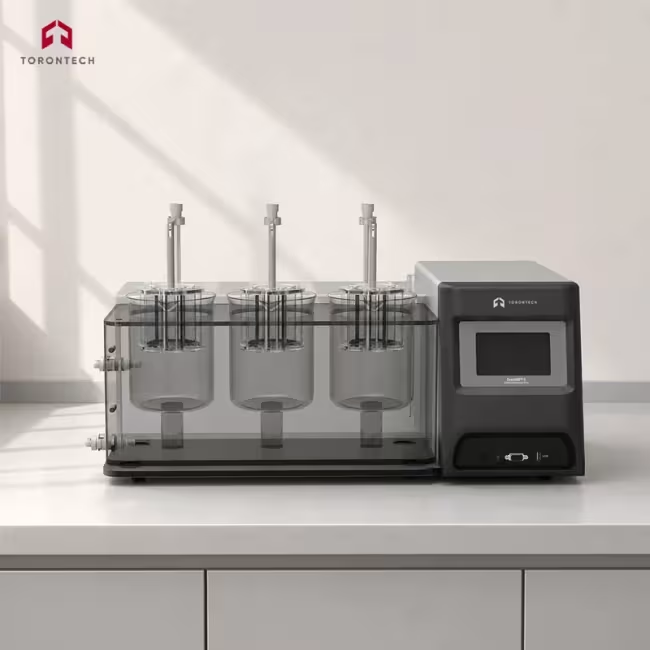
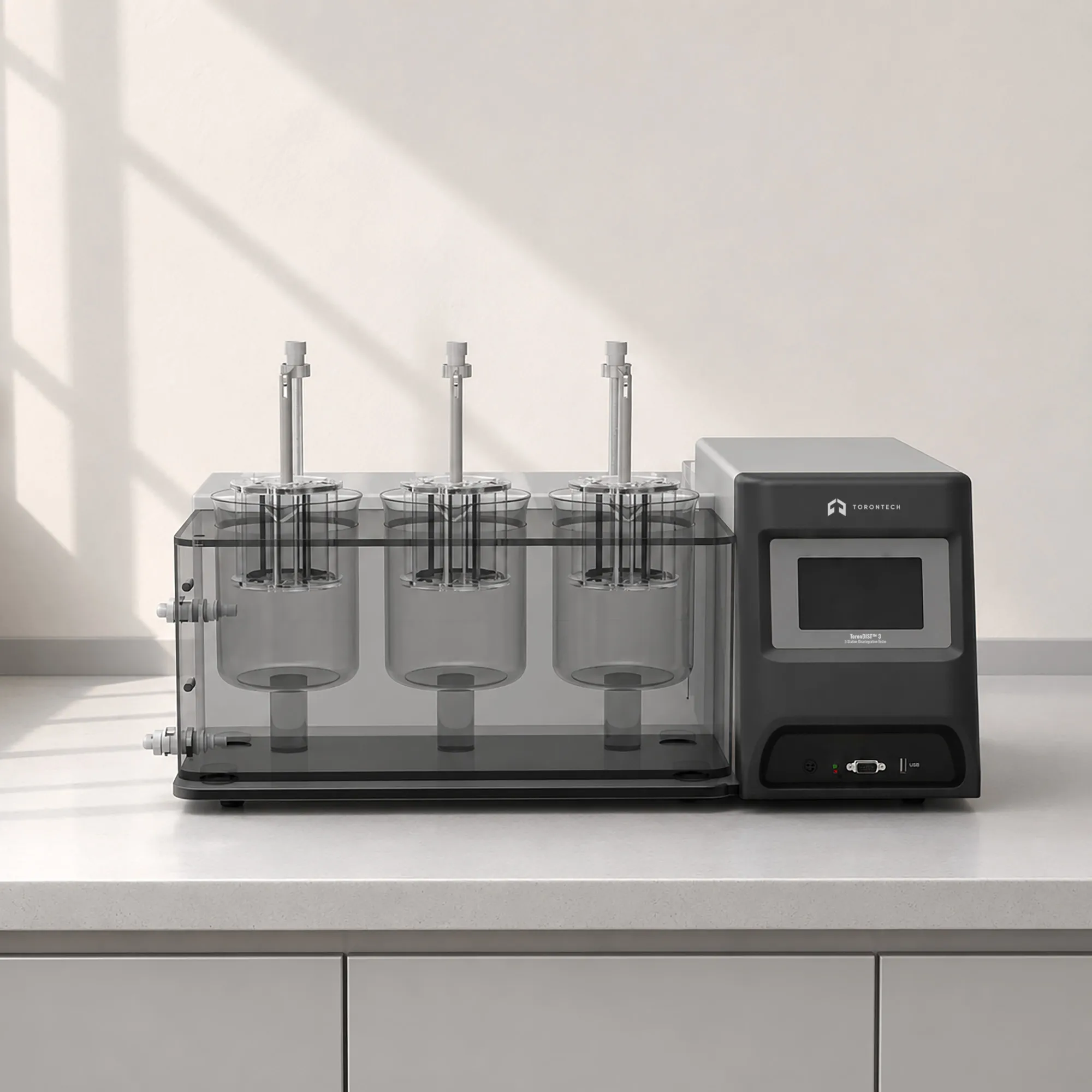
3-Station Disintegration Tester
3-Station Disintegration Tester - ToronDIST™ 3
ToronDIST™ 3 3-station disintegration tester runs three independent basket-rack assemblies in parallel, delivering 18-tube throughput per test cycle for pharmaceutical QC labs, formulation groups, and contract testing organizations. The instrument characterizes disintegration behavior of tablets, capsules, sugar-coated tablets, film-coated tablets, enteric-coated tablets, and pills under temperature-controlled aqueous conditions. Torontech built the platform around three-tier operator access, real-time bath temperature regulation, and automatic cycle logging to bring GMP-grade traceability to routine disintegration testing.
Each of the three baskets operates on its own reciprocating drive with speed adjustable from 5 to 35 strokes per minute, letting labs run different products or method conditions simultaneously across the three stations. Real-time bath temperature control with dual-layer thermal protection and onboard calibration holds uniformity to 0.1°C and accuracy to ±0.3°C, matching the tight thermal window required for reproducible disintegration end-point determination.
Torontech supplies the ToronDIST™ 3 with IQ/OQ qualification documentation for GMP validation and CE certification for the EU market. Interchangeable sieve apertures adapt the instrument between standard tablet testing and specialty methods for coated dosage forms or non-standard formulations.
3-Station Disintegration Tester - ToronDIST™ 3 Applications
The ToronDIST™ 3 supports disintegration testing across pharmaceutical QC, formulation development, and stability workflows requiring parallel triple-basket capacity.
- Batch Release Testing of Solid Oral Dosage Forms: routine disintegration QC of tablets, capsules, and pills with three parallel baskets shortening total analysis time per batch
- Coated Tablet Disintegration Analysis: sugar-coated, film-coated, and enteric-coated tablet testing where different media stages verify coating integrity and controlled release behavior
- Capsule Product Quality Control: hard and soft gelatin capsule disintegration testing at controlled temperature to confirm shell dissolution behavior meets product specifications
- Formulation Development: comparative disintegration profiling of prototype formulations to guide excipient selection and manufacturing process design
- Enteric Coating Verification: two-stage acid then buffer testing to confirm enteric coatings resist stomach pH and disintegrate correctly at intestinal pH
- Stability Program Testing: disintegration performance monitoring under ICH storage conditions to support shelf-life determination and expiry date extensions
- Contract Testing Laboratories: audit-trail-backed disintegration analysis for CRO and CDMO clients requiring full documentation packages
- Method Development and Validation: parameter screening across sieve aperture, stroke rate, and temperature conditions during method design for novel dosage forms
Standards
The ToronDIST™ 3 carries CE certification for the EU market under the Machinery Directive and Electromagnetic Compatibility Directive.
- EN ISO 12100:2010 - Safety of Machinery: General Principles for Design, Risk Assessment and Risk Reduction
- EN 60204-1:2018 - Safety of Machinery: Electrical Equipment of Machines
- EN 61010-1:2010+A1:2019 - Safety Requirements for Electrical Equipment for Measurement, Control, and Laboratory Use
- EN IEC 61326-1:2021 - Electrical Equipment for Measurement, Control, and Laboratory Use: EMC Requirements
CE certification covers the EU Machinery Directive 2006/42/EC and EMC Directive 2014/30/EU. IQ/OQ qualification documentation is available upon request.
3-Station Disintegration Tester - ToronDIST™ 3 Key Features
The ToronDIST™ 3 combines three independent basket stations with three-tier user access, precision temperature control, and interchangeable sieve options in one benchtop workstation.
- Three Independent Basket Stations: 18-tube parallel testing capacity across three baskets, letting labs run three products or three methods simultaneously without sequential batching
- Three-Tier User Access Control: administrator, method developer, and operator roles with individually logged actions meet GMP audit trail requirements and support 21 CFR Part 11-ready workflows
- Timestamped Audit Trails: every parameter change and operator action logs with user ID and timestamp for full documentation traceability under GMP inspection
- Real-Time Temperature Control with Calibration: continuous bath regulation with a dual-layer thermal barrier and onboard calibration function holds uniformity to 0.1°C and accuracy to ±0.3°C
- Adjustable Reciprocation Speed: 5 to 35 strokes per minute range covers standard pharmacopoeial disintegration methods and specialized low-speed or high-speed research protocols
- Interchangeable Sieve Apertures: standard 0.42 mm plus optional 0.71 mm and 1.0 mm meshes adapt the instrument between routine tablets, capsules, and non-standard dosage forms
- Scheduled Preheat Function: medium reaches setpoint before staff arrive, letting the lab begin testing immediately at shift start rather than waiting on bath warm-up
- Professional-Grade Circulation Pipeline: engineered flow path maintains uniform temperature across the bath and simplifies medium changeover between test sessions
- Stored Method Library: frequently used disintegration methods and cycle settings save to the controller for one-touch recall on repeat batches
- Direct USB Data Export: raw disintegration records transfer to lab PCs or LIMS without proprietary drivers or manual transcription
- IQ/OQ Qualification Package: factory-supplied installation and operational qualification documentation supports GMP validation on delivery
Theory and Method
Disintegration testing measures the time required for a solid oral dosage form to break apart into fragments small enough to pass through a defined mesh under standardized reciprocating-basket motion in a temperature-controlled medium. A basket-rack assembly holding six tubes with wire-mesh bottoms cycles up and down through the medium, and the end point is recorded when no visible fragment remains on the mesh. This time gates the dissolution and absorption steps that follow in vivo.
Reproducibility across baskets depends on tight control of medium temperature, basket geometry, stroke rate, and stroke distance. The ToronDIST™ 3 holds bath temperature uniformity to 0.1°C and accuracy to ±0.3°C through real-time regulation with a dual-layer thermal barrier and onboard calibration. Reciprocation speed is adjustable across 5 to 35 strokes per minute, covering the range required by common pharmacopoeial disintegration test methods. The 55 mm nominal stroke distance sits within the geometry envelope specified by pharmacopoeial apparatus requirements.
The three baskets operate independently, letting each station run its own method setup, medium composition, and timing schedule. Interchangeable sieve apertures of 0.42 mm standard, 0.71 mm, and 1.0 mm optional adapt the instrument between routine tablet testing, capsule testing, and specialized methods for enteric-coated or delayed-release products. A preheat function brings medium to setpoint before shift start, letting the lab begin testing immediately rather than waiting on warm-up.
3-Station Disintegration Tester - ToronDIST™ 3 Technical Specifications
| Parameter | Specification |
|---|---|
| Stations | 3 stations (6 tubes per station) |
| Basket Reciprocation Speed | 5 to 35 strokes/min |
| Basket Reciprocation Range | 55 ± 1.0 mm |
| Minimum Basket Distance | 25 ± 1.0 mm |
| Sieve Aperture | Standard 0.42 mm; Optional 0.71 mm and 1.0 mm |
| Temperature Adjustment Range | Ambient to 45.0°C |
| Temperature Uniformity | 0.1°C |
| Temperature Control Precision | ±0.3°C |
| Cycle Limit | < 100 cycles |
| Cycle Time Capacity | ≤ 999.9 h / 59 min 59 s |
| Voltage | AC 220 V ±10%, 50 Hz (110V is also available) |