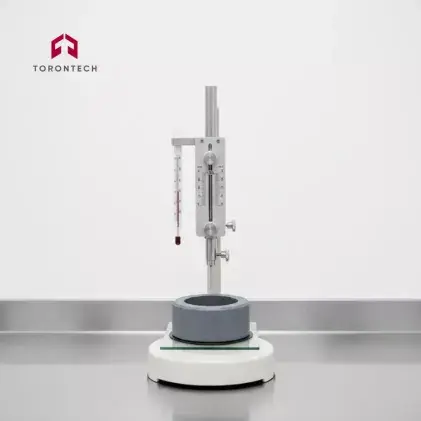
Time Every Pour Right With a Vicat Apparatus in Canada
A November placement in Ontario behaves nothing like the same mix in July. Drop the concrete temperature by 10 degrees C and the set time roughly doubles, pushing finishing crews into overtime and stalling formwork schedules.
Quality-control labs solve that problem with data, not guesswork. A Vicat apparatus in Canada measures normal consistency and setting times so producers know exactly how a cement will behave before it reaches the jobsite.
Why Setting Time Governs Canadian Winter Schedules
Canada's construction season now stretches deep into the cold months. CSA A23.1 requires crews to have protection and curing measures ready whenever air temperatures may fall below 5 degrees C within 24 hours of placement.
That planning starts in the lab. Producers who document how a cement paste stiffens can predict placing windows, finishing times, and safe stripping points instead of reacting to a jobsite surprise.
The challenge varies by region. Coastal British Columbia crews battle wet, marginal temperatures, while Prairie and northern operations face weeks below freezing and Quebec and the Maritimes deal with aggressive freeze-thaw cycling.
The Vicat apparatus supports four decisions that Canadian quality teams make every week:
- Normal consistency: establishes the water demand baseline before any setting test runs
- Initial set: defines the window for placing, consolidating, and screeding
- Final set: confirms when the paste has lost plasticity and holds its shape
- Comparative work: shows how accelerators, colder mix water, or a new cement lot shift the curve
Low-Carbon Cement Is Changing the Numbers
Canadian cement producers are decarbonizing quickly. The Cement Association of Canada's Concrete Zero action plan targets a 40 percent emissions reduction by 2030 and net-zero concrete by 2050.
Portland-limestone cement, designated GUL and recognized under CSA A3001, sits at the center of that shift. It cuts CO2 by up to 10 percent by interground limestone replacing clinker.
Lower clinker factors and higher volumes of supplementary cementing materials change hydration kinetics. Slag and fly ash blends often extend setting times, while limestone fines can accelerate early reactions.
Labs therefore re-baseline consistency and setting behavior whenever a supplier revises a blend. Precast plants and ready-mix producers running low-carbon mixes need current Vicat data, not values recorded three seasons ago.
The volumes involved make that discipline worthwhile. Federal projections put Canadian output near 55 million tonnes of cement and 400 million tonnes of concrete over a five-year span, most of it destined for domestic construction.
Standards and Test Methods Canadian Labs Follow
Canadian cement testing runs on a mix of ASTM and CSA documents. Torontech builds this instrument for the ASTM methods, while CSA publishes the parallel national requirements producers work to:
- ASTM C187: normal consistency of hydraulic cement paste, measured with the 10 mm plunger
- ASTM C191: time of setting by Vicat needle, with Method A covering the manual reference apparatus
- CSA A3004: the physical test methods for cementitious materials, which include normal consistency and time of set by Vicat needles
- CSA A3001: cementitious materials for use in concrete, the specification that governs GU and GUL cements
- CSA A23.1 and A23.2: concrete materials, construction methods, and the cold-weather provisions that make setting data operational
Laboratories pursuing ISO/IEC 17025 accreditation also need documented calibration and repeatable geometry. Fixed needle and plunger dimensions with a controlled sliding mass keep penetration results traceable between operators.
Specifying a Vicat Apparatus in Canada
Two configurations cover almost every Canadian application. Cement and mortar work calls for the standard unit, while gypsum and plaster testing needs the heavier modified assembly.
| Feature | Standard Model | Modified Model |
|---|---|---|
| Primary use | Cement and mortar (ASTM C187 / C191) | Gypsum and plaster |
| Moving mass | 300 g | 1115 g total assembly |
| Plunger type | 10 mm cylindrical | 8 mm conical |
| Net weight | 3.5 kg | 3.3 kg |
The standard configuration ships with a 1.0 mm initial-set needle, a 10 mm consistency plunger, a 60/70 by 40 mm mold, a glass plate, and a thermometer. Its 150 x 220 x 440 mm footprint suits crowded municipal and plant labs.
Before ordering a Vicat apparatus in Canada, work through a short checklist:
- Which binders you test: hydraulic cement, mortar paste, gypsum, or all three
- Which standards your clients audit against, since ASTM and CSA methods use different needle and mold specifications
- Whether daily test volume justifies a second frame so consistency and setting runs proceed in parallel
- Bench space and ambient control, because paste temperature influences every reading
Drywall and plaster manufacturers almost always need the modified assembly alongside a standard unit.
Equip Your Lab for Canada's Building Program
Verification demand keeps climbing. Ontario alone is executing a $236 billion capital plan, and the Gordie Howe International Bridge opened in July 2026 after years of heavy civil work across the Windsor corridor.
Torontech operates from its Canadian headquarters in Toronto and supports laboratories across every province. Our team helps cement plants, precast operations, universities, and testing houses match instrument configuration to the standards their clients audit against.
Tell us which cements and binders you test, and we will confirm the right build. Reach out to the Torontech team to request a quote on a Vicat apparatus configured for your program.