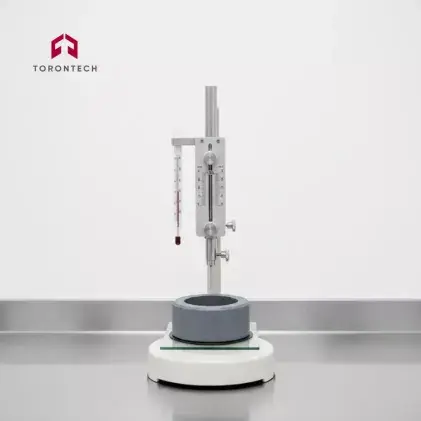
Vicat Apparatus Built for Brazil's Cement Quality Control
A cement batch that sets too fast can ruin a concrete pour. One that sets too slowly stalls formwork removal and delays the schedule. For Brazilian producers and testing labs, controlling setting time is not optional.
A Vicat apparatus in Brazil gives quality teams the consistency and setting-time data they need to meet ABNT NBR standards. Torontech supplies the Vicat apparatus configured for ASTM C187 and ASTM C191 compliance.
Why Cement Testing Drives Demand Across Brazil
Brazil consumed roughly 64.7 million tonnes of cement in 2024, its strongest year since the mid-2010s, according to SNIC, the national cement industry union. Every tonne bound for structural use needs verified setting behavior.
Demand comes from several active fronts at once. Each one puts cementitious materials under tight quality scrutiny before they reach a job site.
- Housing: The Minha Casa Minha Vida program drives mass residential construction, where a single small unit consumes several tonnes of cement.
- Infrastructure: The Novo PAC program funds roughly 23,000 projects, expanding highways, sanitation systems, and concrete pavement nationwide.
- Ready-mix and precast: Producers across São Paulo and the Northeast verify paste consistency before large pours and structural casts.
Major producers like Votorantim Cimentos, InterCement, and CSN run setting-time control on Portland cement before dispatch. Independent labs and university facilities perform the same checks for contractors and material suppliers.
Concrete pavement now features heavily in urban and highway works, which pushes still more cement through setting-time control each year. Accurate paste data protects both the schedule and the durability of finished structures.
Standards Governing the Vicat Apparatus in Brazil
Brazilian cement testing follows a clear framework set by ABNT, the country's national standards body. Two standards govern Vicat testing directly, and both rely on the same instrument.
- ABNT NBR 16606: determination of the normal consistency of Portland cement paste.
- ABNT NBR 16607: determination of initial and final setting times using the Vicat apparatus.
Cement type and quality follow ABNT NBR 16697, which sets the requirements for Portland cement sold in Brazil. Labs that serve export clients or multinational contractors often test to international methods as well.
The common methods Brazilian laboratories apply include the following:
- ABNT NBR 16606 and 16607: the domestic methods for consistency and setting time.
- ASTM C187 and ASTM C191: the U.S. methods for normal consistency and time of setting.
- EN 196-3: the European method for setting time and soundness.
A single instrument that supports all of these helps a lab serve both domestic and international clients without buying separate equipment.
Laboratories pursuing ISO/IEC 17025 accreditation through INMETRO, Brazil's accreditation authority, need equipment with documented calibration and traceable results. A Vicat apparatus in Brazil that ships with calibration records helps a lab build and maintain these accreditation programs over time.
How the Vicat Apparatus Measures Setting
The test is simple in principle but demands precision. A technician mixes cement paste to a standard consistency, then loads it beneath a weighted needle or plunger.
For normal consistency, a 10 mm plunger penetrates the paste to a target depth, which fixes the correct water-cement ratio. For setting time, a 1 mm needle records penetration at set intervals until the paste resists it. The moving assembly weighs 300 grams.
These readings tell engineers when fresh concrete will stiffen. That timing controls pour scheduling, formwork removal, and surface finishing on every site.
Brazil's warm climate raises the stakes. Higher ambient temperatures speed up hydration and shorten setting time, so readings taken under controlled conditions let crews plan pours before the paste hardens too early.
Choosing the Right Vicat Configuration
Selection depends on the material you test most often. Standard cement and mortar work calls for the standard model, while gypsum and plaster testing needs the modified version with a heavier moving assembly.
| Feature | Standard Model | Modified Model |
|---|---|---|
| Primary use | Cement and mortar (ASTM C187 / C191) | Gypsum and plaster |
| Moving mass | 300 g | 1115 g total assembly |
| Plunger type | 10 mm cylindrical | 8 mm conical |
| Net weight | 3.5 kg | 3.3 kg |
The standard configuration ships with an initial-set needle, a consistency plunger, a Vicat mould, a glass plate, and a thermometer. The modified unit adds conical plungers and a supplementary weight for plaster paste.
Buyers who run mixed workloads can specify both configurations. Explore the wider concrete and cement testing range from Torontech for related laboratory equipment.
Equip Your Lab for Brazil's Cement Standards
As Brazil's construction pipeline expands under Novo PAC and the housing sector stays active, labs face rising pressure to certify cement quickly and accurately. Reliable setting-time data keeps projects compliant and on schedule.
Torontech configures each Vicat apparatus for the standards your clients require, whether ABNT NBR, ASTM, or EN. The team supports laboratories across Latin America with calibration guidance and clear documentation.
To match a Vicat apparatus to your material types and testing volume, reach out to the Torontech team for a consultation tailored to your lab.