Ultracentrifuges Built for Saudi Arabia's Research Labs
Vaccine developers and genomics teams cannot afford compromised samples. When a team must isolate viral particles or subcellular fractions at extreme speed, any loss of purity or temperature control can invalidate weeks of work. Reliable high-g separation is the difference between usable data and a wasted run.
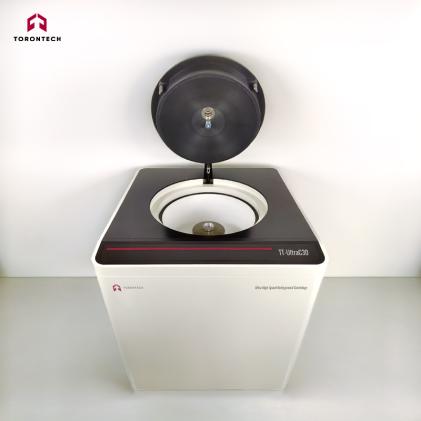
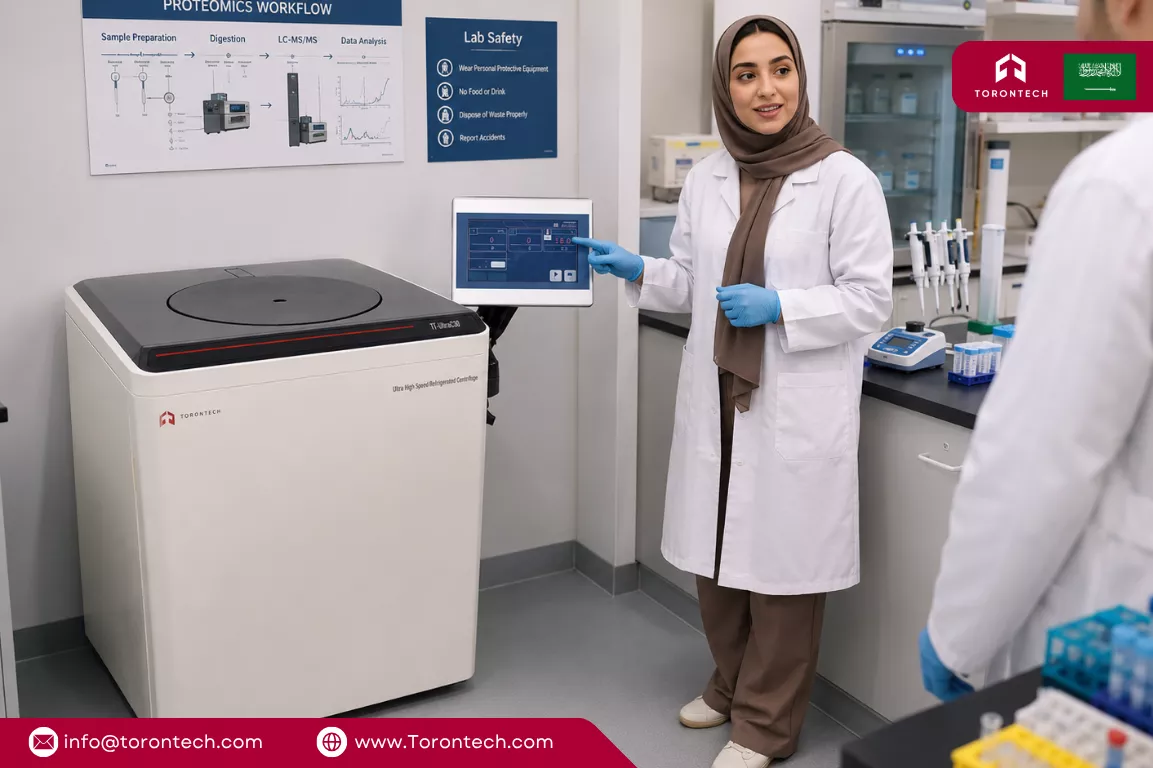
An ultracentrifuge in Saudi Arabia now sits at the center of this challenge as the Kingdom scales its biotechnology base. Torontech supplies the TT-UltraC30 ultracentrifuge, a floor-standing refrigerated system engineered for high-speed purification.
Vision 2030 and the Rise of Saudi Biotechnology
In January 2024, Crown Prince Mohammed bin Salman launched the National Biotechnology Strategy under Vision 2030. The plan targets regional biotech leadership by 2030 and global standing by 2040, backed by an expected $34.6 billion contribution to non-oil GDP.
The strategy rests on four pillars: vaccines, biomanufacturing, genomics, and plant optimization. Each pillar depends on laboratories that can isolate viruses, purify biologics, and separate nucleic acids with precision.
Biomanufacturing in particular targets local production of biologics and biosimilars, reducing reliance on imported therapies for oncology and immunology. These complex products require rigorous purification at every development stage.
Demand for separation equipment is already measurable. The Saudi laboratory centrifuge market reached USD 16.1 million in 2024, and a 2023 Ministry of Investment report flagged diagnostic laboratory expansion as a priority area.
That momentum extends to companies. The strategy's first cohort included vaccine developer SAGEbio and precision-diagnostics firm Novo Genomics, both reliant on high-purity sample preparation.
Applications Across the Kingdom's Research Base
Institutions such as King Faisal Specialist Hospital and Research Centre (KFSHRC), KAUST, and KACST run programs that rely on ultra-high-speed separation. The TT-UltraC30 handles the most demanding of these tasks at forces above 100,000 x g.
Key applications across Saudi laboratories include:
| Research Area | Ultracentrifuge Role |
|---|---|
| Vaccine development | Concentrating and purifying viral particles |
| Genomics | Isolating high-purity plasmids, DNA, and RNA |
| Proteomics | Separating ribosomes and subcellular organelles |
| Nanotechnology | Fractionating nanoparticles and liposomes |
These workflows feed the genomics pillar, including the national genomic database that KFSHRC's Center for Genomic Medicine helps build. They also support the vaccine and biologics programs central to the Kingdom's self-sufficiency goals.
At KFSHRC, the Human Cancer Genomic Research program studies cancers common in the Kingdom, work that depends on clean nucleic acid and protein fractions.
Each separation relies on sedimentation. As the rotor spins, it generates relative centrifugal force that drives denser particles outward first. Researchers rank how quickly a particle settles using the sedimentation coefficient, measured in Svedberg units.
Engineered for High-G, Heat-Sensitive Work
The TT-UltraC30 reaches 31,200 rpm and a maximum relative centrifugal force of 110,000 x g, with capacity up to six liters. An intelligent vacuum system and inverter compressor hold every rotor at 4 degrees C or below at full speed.
As a result, heat-sensitive samples stay protected throughout long runs. The design also cuts standby energy use by over 45 percent, while automatic rotor recognition and multiple safety interlocks guard against operator error.
At full speed, friction between the rotor and the surrounding air generates significant heat. Refrigeration and the reduced-pressure chamber control that heat, which preserves sample integrity during runs lasting several hours.
For labs comparing a refrigerated ultracentrifuge in Saudi Arabia, these specifications matter:
- Speed range from 300 to 31,200 rpm with ±5 rpm accuracy
- Temperature control from -20 to +40 degrees C
- Twelve interchangeable rotors, both fixed-angle and swinging-bucket
- R290 refrigerant and operating noise below 56 dB
Choosing an Ultracentrifuge in Saudi Arabia
Saudi laboratories increasingly pursue ISO/IEC 17025 accreditation through the Saudi Accreditation Center to prove measurement competence. Pharmaceutical and biologics facilities also work under SFDA good manufacturing practice oversight.
The right instrument supports these frameworks with traceable calibration, stable thermal performance, and documented run logs. Accreditation belongs to the facility and its validated methods, so the equipment should make that compliance easier to demonstrate.
Therefore, selection comes down to a few practical factors:
- Maximum RCF and speed required for your smallest target particles
- Rotor format: fixed-angle for pelleting, swinging-bucket for density gradients
- Sample volume, from microliter tubes to one-liter bottles
- Throughput, refrigeration range, and available floor space
The floor-standing format suits central research facilities that run high sample volumes, rather than space-limited satellite labs. A correctly matched system protects both data quality and audit readiness, two priorities for any lab pursuing accreditation in the Kingdom.
Equip Your Lab Through Torontech's GCC Team
Saudi Arabia's biotech transformation rewards laboratories that invest in dependable, high-performance separation. From vaccine research in Riyadh to genomics work across the Kingdom, the right system keeps projects on schedule.
Torontech's regional office supports buyers across the GCC with configuration guidance, rotor selection, and after-sales service. Whether you run a university lab, a hospital research center, or a biomanufacturing line, our team can match the TT-UltraC30 to your throughput and sample types.
To discuss your requirements, reach out to the Torontech team or contact Torontech ME FZE directly at +971 488 19252 or me@torontech.com. Our GCC headquarters in Dubai serves laboratories across Saudi Arabia and the wider region.