Sub-40 Micron Sample Prep: Ultra Centrifugal Mill in UAE
Your analyzer reads only what you feed it. When a plastic housing grinds unevenly or a fibrous plant sample overheats in the chamber, the result fails before the instrument starts. Bad grinding quietly wastes reagents, hours, and lab credibility.
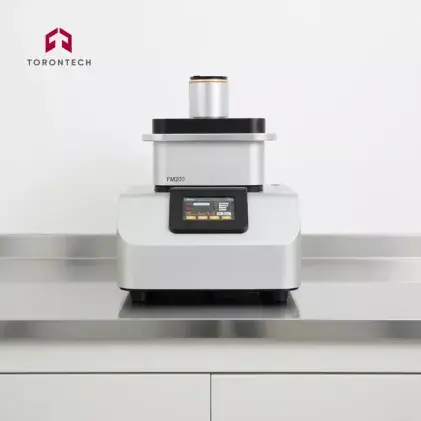
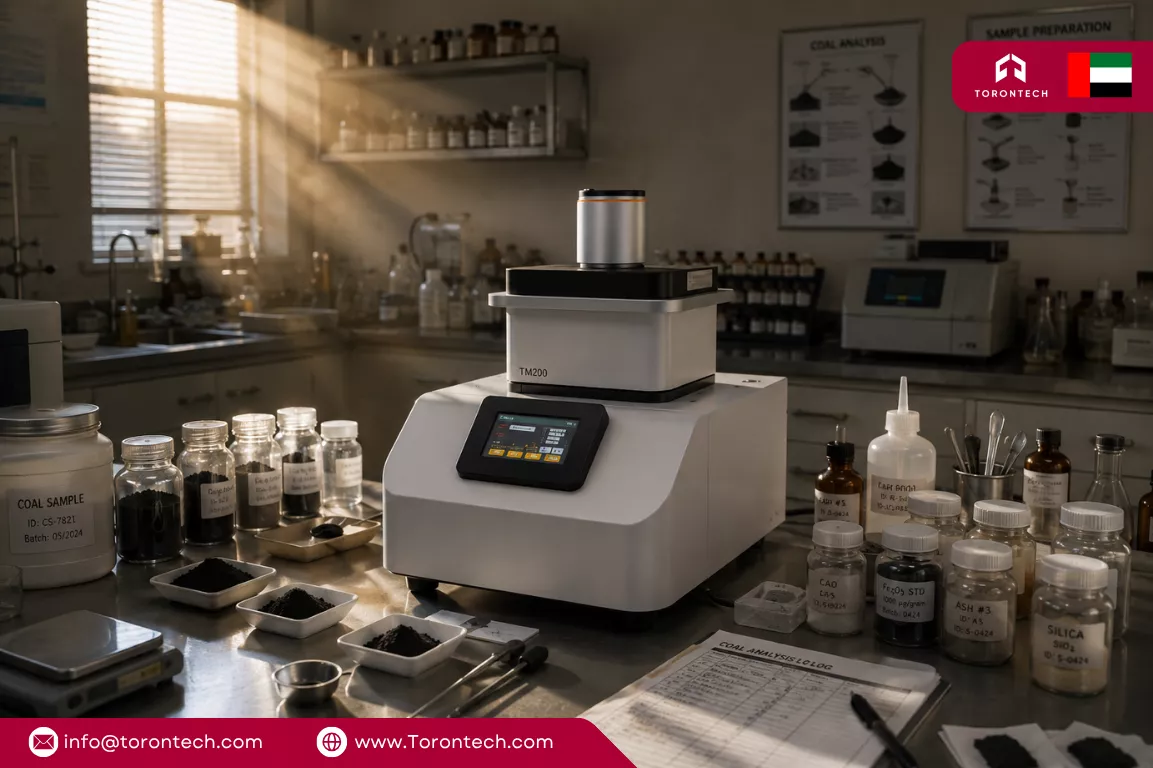
An Ultra Centrifugal Mill in UAE laboratories fixes the problem at the source. The Torontech Ultra Centrifugal Mill FM200 reduces feed material under 10 mm to below 40 microns in seconds, using a two-stage rotor and ring sieve system.
RoHS Screening Under the UAE's ECAS Route
Electrical and electronic products entering the Emirates market fall under Cabinet Decision No. 10 of 2017. MOIAT enforces the rule through the Emirates Conformity Assessment Scheme, and importers need a Certificate of Conformity before customs clearance.
That testing depends on homogeneous material. Laboratories separate cable jackets, connectors, and polymer housings, then grind each fraction to a uniform powder ahead of XRF screening or wet-chemistry confirmation.
The FM200 processes these polymers without smearing them. A dedicated air passage cools both rotor and sample during grinding, which matters when a lab checks for phthalates alongside lead, mercury, cadmium, and hexavalent chromium.
Accredited testing houses carry an extra burden. EIAC and ENAS assess laboratories against ISO/IEC 17025, and reproducibility depends on grinding that delivers the same particle distribution on every run, not simply a fine one.
Food Security Targets Drive Feed and Plant Analysis
The UAE imports most of its food and aims to produce half of it domestically by 2051 under the National Food Security Strategy. Consequently, agricultural and feed testing laboratories face rising sample volumes every year.
Nitrogen and protein determination in feed and grain begins with a representative ground sample. So does C.H.N. analysis of roots, stems, and leaves from research farms and the controlled-environment agriculture projects clustered around Food Tech Valley in Dubai.
Fibrous plant material defeats many blade grinders. Here, the shearing action between rotor and ring sieve cuts through it quickly, while short residence time in the chamber preserves moisture and volatile content.
Alternative Fuels and the Circular Economy Policy
The UAE Circular Economy Policy 2021 to 2031 pushes manufacturers toward material recovery. Meanwhile, Sharjah's waste-to-energy facility and Dubai's Warsan Waste Management Centre both require consistent characterization of incoming waste streams.
Cement producers burning refuse-derived fuel ask the same questions. What is the ash content? What is the calorific value? What harmful substances sit in the feedstock? Every answer starts from a milled, homogeneous sample.
Polymer volumes keep climbing as well. Operation 300bn targets AED 300 billion of industrial GDP by 2031, and the Borouge 4 expansion at Ruwais adds capacity that downstream converters must verify batch by batch.
Mixed waste, secondary fuel, and end-of-life plastics all grind on one instrument without a media change. Ring sieves from 0.08 mm to 2.00 mm let a single mill serve several test methods across a shift.
Specifying an Ultra Centrifugal Mill in UAE Laboratories
Procurement teams evaluating an Ultra Centrifugal Mill in UAE tenders usually start with three numbers: feed size, final fineness, and speed. The FM200 figures are below.
| Parameter | FM200 |
|---|---|
| Feed size | Under 10 mm |
| Final fineness | Under 40 μm |
| Speed range | 6,000 to 18,000 rpm |
| Ring sieve apertures | 0.08 to 2.00 mm |
| Collecting pan | 900 ml (300 ml sample) |
| Net weight | 38 kg |
Beyond the spec sheet, three practical details shape installations across the Emirates:
- Power supply: the mill runs on 220 V, 50/60 Hz, so it matches standard UAE mains without a step-down transformer
- Footprint: at 400 x 506 x 495 mm, it shares bench space in a compact Dubai or Sharjah laboratory rather than occupying a dedicated room
- Contamination control: the collecting pan lifts out for cleaning, which protects labs that run RoHS fractions one hour and animal feed the next
The grinding itself runs in two stages. Centrifugal force drives feed material against the rotor, which pre-crushes it on impact. Shearing and extrusion between rotor and ring sieve then finish the reduction.
Particles drop into the collecting pan as soon as they clear the sieve aperture. Because they leave the chamber quickly, heat-sensitive samples reach analytical fineness before thermal degradation sets in.
Safety and durability follow the same logic. A double-layer wear-proof seal ring keeps dust out of the motor, while electronic and mechanical interlocks guard the operator during rotor changes. Optional accessories, including an automatic feed device for homogeneous throughput, appear on the FM200 product page.
Talk to Torontech ME FZE in Dubai
Consumables decide uptime. A mill without the right ring sieve on the shelf halts an entire workflow. Lead times from Europe or Asia often stretch into weeks that an accredited turnaround cannot absorb.
Torontech ME FZE serves the UAE and the wider GCC from Meydan in Dubai. Our team matches rotor, sieve set, and feeding accessories to the samples you actually process, then keeps replacement parts moving through regional stock rather than air freight from overseas.
Call +971 488 19252 or email me@torontech.com to discuss your configuration. You can also reach out to the Torontech team online, or write to Meydan Grandstand, 6th floor, Meydan Road, Nad Al Sheba, Dubai-261440, UAE.