Ultra Centrifugal Mills for South Africa's Analytical Labs
A poorly ground sample wastes the most expensive analyzer in the building. An XRF or ICP reading is only as good as the powder fed into it. For South African mineral assayers and coal labs, inconsistent grinding turns precise instruments into guesswork.
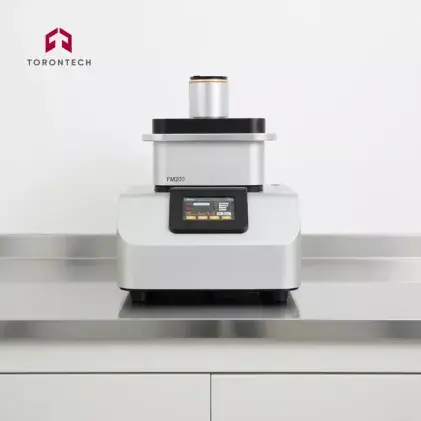
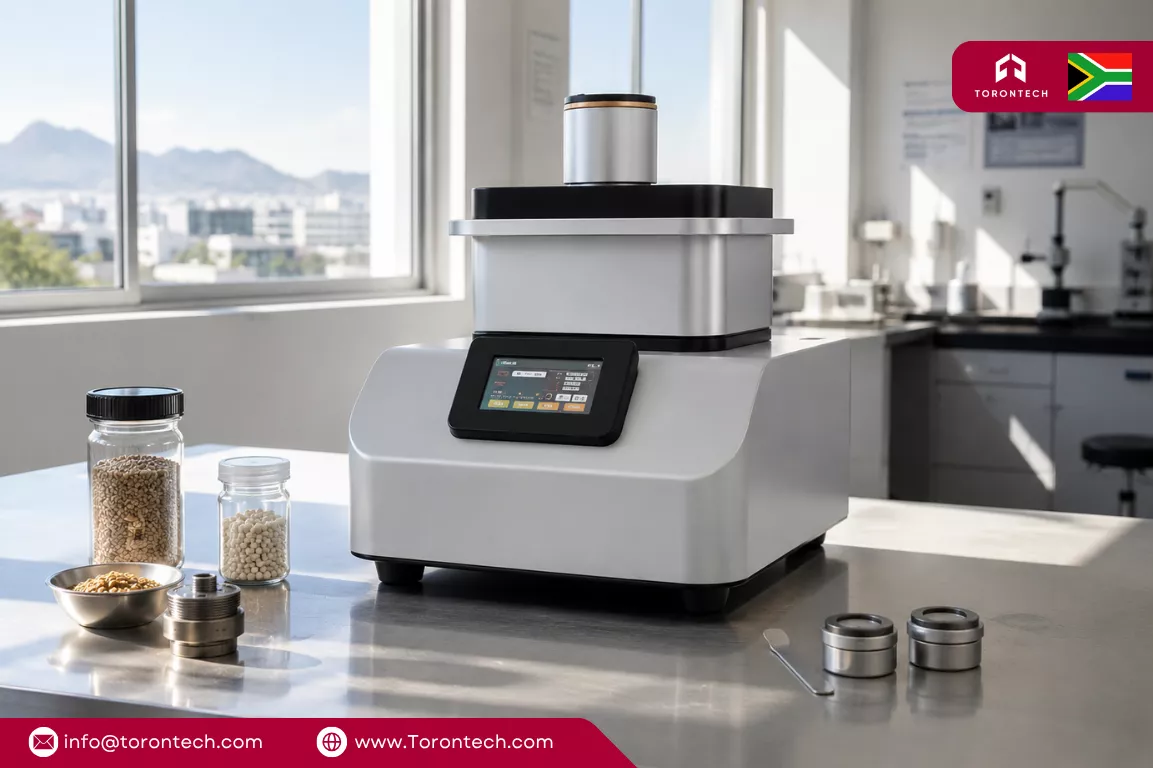
The Ultra Centrifugal Mill in South Africa solves that problem at its source. Torontech supplies the FM200 ultra centrifugal mill, a benchtop rotor mill that reduces feed material to under 40 microns for reliable, repeatable analysis.
How Two-Stage Grinding Protects Your Data
The FM200 grinds in two steps. A high-speed rotor first fractures the sample on impact. Shearing and friction between the rotor and a fixed ring sieve then reduce it further. Material passes through only when it is fine enough.
This matters because residence time stays short. Samples spend seconds in the chamber, not minutes, so heat does not build up. A dedicated air passage cools both the rotor and the material, protecting moisture content, volatiles, and organic structure before analysis.
Final fineness depends on the ring sieve you fit. Apertures run from 0.08 mm to 2.00 mm. Adjustable speed from 6,000 to 18,000 rpm lets technicians match the grind to soft, hard, brittle, or fibrous materials. A double-layer seal keeps dust out of the motor, and overload protection lets the unit restart and continue after a heavy load.
Industries Driving Demand for the Ultra Centrifugal Mill in South Africa
South Africa's analytical demand concentrates in a few high-volume sectors. Each one depends on representative, homogeneous sample preparation before the instrument ever runs.
Mining and minerals lead. Assay laboratories across the platinum belt, the Northern Cape manganese and iron ore fields, and gold operations pulverize ore and concentrate samples for XRF, ICP-OES, atomic absorption, and fire assay. Representative results depend on grinding every increment to the same fineness, which is exactly where a rotor mill earns its keep.
Coal is the second pillar. The Mpumalanga coal belt, the Richards Bay export route, and the Eskom supply chain run constant proximate analysis, calorific value, and ash determinations. Each one begins with grinding coal to a uniform fineness.
| Sector | Typical Samples | Downstream Analysis |
|---|---|---|
| Mining and minerals | Ore, concentrate, tailings | XRF, ICP-OES, fire assay |
| Coal and energy | Run-of-mine and export coal | Proximate, calorific value, ash |
| Agriculture and feed | Grain, plant tissue, animal feed | NIR, protein, moisture |
| Environment | Soil, dried plant matter | Heavy metals, C.H.N. |
Agriculture and environmental work fill the rest. Feed mills and research stations grind plant tissue and animal feed for nitrogen, protein, and moisture testing. Environmental labs prepare soil and dried plant matter for trace-metal screening. Fibrous and moist plant material often clogs lesser grinders, so a mill that handles it cleanly saves real bench time.
Supporting the Standards Your Customers Expect
South African testing operates inside a clear accreditation framework, and laboratories live or die by it. Most commercial assay and coal labs hold SANAS accreditation to ISO/IEC 17025, the standard that governs technical competence and result traceability.
Reproducible sample preparation underpins that accreditation. The FM200 is a sample-preparation tool, not a certified test method. Even so, consistent particle size and low cross-contamination directly support the repeatability that ISO/IEC 17025 audits demand.
Coal labs also follow international test methods, including ISO and ASTM proximate and calorific procedures, alongside SABS reference practices. The mill does not certify to these methods. It prepares the uniform powder that those methods require.
Key practices the FM200 supports include:
- Homogenizing ore and coal to analytical fineness for assay work
- Preserving moisture and volatiles through low-heat, short-residence grinding
- Reducing carryover between samples with easy-clean rotors and ring sieves
- Producing repeatable fineness for SANAS-accredited workflows
Choosing the Right Configuration
Specifying an ultra centrifugal mill in South Africa comes down to your materials, throughput, and target fineness. A handful of decisions shape the setup:
- Ring sieve range: finer apertures for sub-40-micron assay work, coarser ones for feed and grain
- Speed setting: higher speeds for hard, brittle ore, lower speeds for fibrous plant and elastic samples
- Grinding mode: dry grinding for most mineral and coal work, wet grinding where the application calls for it
- Accessories: an automatic feed device and large collection pans for high-volume assay benches
Matching these to your sample stream keeps preparation fast and your downstream results defensible.
Equip Your Lab for South African Conditions
From the Mpumalanga coalfields to Northern Cape assay benches, South African laboratories need sample preparation that keeps pace with heavy sample volumes without compromising data quality. The right rotor mill removes the weakest link in the analytical chain.
Torontech configures each FM200 rotor mill around your materials, target fineness, and throughput. Regional sales and support run through the Torontech ME FZE office, which serves the GCC and Africa.
To match sieve selection, speed range, and accessories to your application, reach out to the Torontech team. You can also contact Torontech ME FZE directly at +971 488 19252 or me@torontech.com to discuss specifications and lead times.